INSIDE ON EARTH
• The Earth, our
homeland is a dynamic planet.
• It is constantly undergoing changes
inside and outside.
ABOUT THE EARTH
Just like an onion, the Earth is made up of
several concentric layers with one inside
another.
INTERIOR OF THE EARTH
LITHOSPHERE
CRUST
MANTLE
CORE-MANTLE
OUTER CORE
INNER CORE
INTERIOR OF THE EARTH
CRUST
• The uppermost layer
over the earth’s surface
is called the crust.
• It is the thinnest of all
the layers.
• The crust forms only 0.5 per cent of
the volume of the earth, 16 per cent
consists of the mantle and 83 per
cent makes the core.
DID YOU KNOW?
• Crust is about 35 km.on the continental masses and only 5
km.on the ocean floors.
• The oceanic crust mainly consists of silica and magnesium;
it if there for called sima (si-silica and ma -magnesium).
• The main mineral constituents of the continental mass are
silica and alumina. It is thus called sial (si-silica and a
alumina).
CONTINENTAL CRUST AND
OCEANIC CRUST
• Just beneath the crust
is the mantle which
extends up to a depth
of 2900 km. below the
crust.
MANTLE
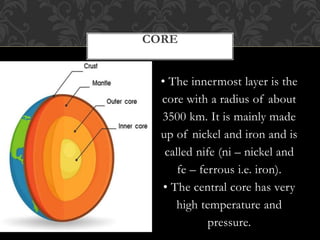
• The innermost layer is the
core with a radius of about
3500 km. It is mainly made
up of nickel and iron and is
called nife (ni – nickel and
fe – ferrous i.e. iron).
• The central core has very
high temperature and
pressure.
CORE
The deepest mine in the world, is in South Africa.
It is about 4 km. deep. In search for oil,
engineers have dug a hole about 6 km. deep.
To reach to the centre of the earth (which is not
possible!) you will have to dig a hole 6000 km.
deep on the ocean floor.
INTERESTING FACTS
• The earth’s crust is made
up of various types of
rocks. Any natural mass of
mineral matter that makes
up the earth’s crust is
called a rock. Rocks can be
of different colour, size and
texture.
ROCKS AND MINERALS
There are 3 major types of rocks-
IGNEOUS ROCKS
SEDIMENTARY ROCKS
METAMORPHIC ROCKS
TYPES OF ROCKS
• Igneous: Latin word Ignis meaning fire.
• Sedimentary: Latin word sedimentum
meaning settle down.
• Metamorphic: Greek word metamorphose
meaning change of form.
WORD ORIGIN
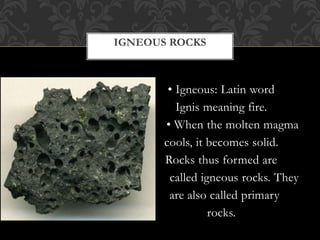
• Igneous: Latin word
Ignis meaning fire.
• When the molten magma
cools, it becomes solid.
Rocks thus formed are
called igneous rocks. They
are also called primary
rocks.
IGNEOUS ROCKS
• There are 2 types of igneous
rocks-
• 1. Intrusive rocks
• 2. Extrusive rocks.
TYPES OF IGNEOUS ROCKS
• Sometimes the molten magma
cools down deep inside the
earth’s crust. Solid rocks so
formed are called intrusive
igneous rocks. Since they cool
down slowly they form large
grains. Granite is an example of
such a rock. Grinding stones used
to prepare paste/powder of
spices and grains are made of
granite.
INTRUSIVE IGNEOUS ROCKS
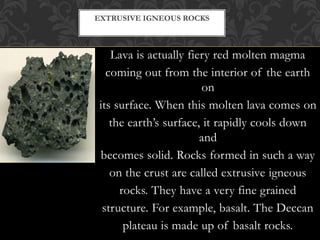
Lava is actually fiery red molten magma
coming out from the interior of the earth
on
its surface. When this molten lava comes on
the earth’s surface, it rapidly cools down
and
becomes solid. Rocks formed in such a way
on the crust are called extrusive igneous
rocks. They have a very fine grained
structure. For example, basalt. The Deccan
plateau is made up of basalt rocks.
EXTRUSIVE IGNEOUS ROCKS
Rocks roll down, crack, and hit each other
and are broken down into small fragments.
These smaller particles are called
sediments. These sediments are
transported and deposited by wind, water,
etc. These loose sediments are compressed
and hardened to form layers of rocks. These
types of rocks are called sedimentary rocks.
For example, sandstone is made from grains
of sand. These rocks may also contain
fossils of plants, animals and other
microorganisms that once lived on them.
SEDIMENTS AND SEDIMENTARY
ROCKS
• Igneous and sedimentary rocks can change into
metamorphic rocks under
great heat and pressure.
For example, clay changes
into slate and limestone
into marble.
Sedimentary rock turned
into a Metamorphic rock
METAMORPHIC ROCK
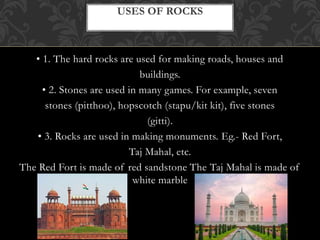
• 1. The hard rocks are used for making roads, houses and
buildings.
• 2. Stones are used in many games. For example, seven
stones (pitthoo), hopscotch (stapu/kit kit), five stones
(gitti).
• 3. Rocks are used in making monuments. Eg.- Red Fort,
Taj Mahal, etc.
The Red Fort is made of red sandstone The Taj Mahal is made of
white marble
USES OF ROCKS
• DEFINITION- This process of
transformation of the rock from one to
another in certain conditions in a
cyclic manner is known as the rock
cycle.
ROCK CYCLE
• When the molten magma cools; it
solidifies to become igneous rock.
• These igneous rocks are broken
down into small particles that are
transported and deposited to
form sedimentary rocks.
• When the igneous and
sedimentary rocks are subjected
to heat and pressure they
Change into metamorphic rocks.
PROCESS OF ROCK
CYCLE
• Rocks are made up of different minerals.
• Minerals are naturally occurring substances which
have certain physical properties and definite chemical
composition.
• Minerals are very important to humankind. Some are
used as fuels. For example, coal, natural gas and petroleum.
They are also used in industries – iron,aluminium, gold,
uranium, etc, in medicine, in fertilisers, etc.
DO YOU KNOW?

7 class chapter 1 INSIDE ON EARTH lecture.pptx

  • 1.
  • 2.
    • The Earth,our homeland is a dynamic planet. • It is constantly undergoing changes inside and outside. ABOUT THE EARTH
  • 3.
    Just like anonion, the Earth is made up of several concentric layers with one inside another. INTERIOR OF THE EARTH
  • 4.
  • 5.
    CRUST • The uppermostlayer over the earth’s surface is called the crust. • It is the thinnest of all the layers.
  • 6.
    • The crustforms only 0.5 per cent of the volume of the earth, 16 per cent consists of the mantle and 83 per cent makes the core. DID YOU KNOW?
  • 7.
    • Crust isabout 35 km.on the continental masses and only 5 km.on the ocean floors. • The oceanic crust mainly consists of silica and magnesium; it if there for called sima (si-silica and ma -magnesium). • The main mineral constituents of the continental mass are silica and alumina. It is thus called sial (si-silica and a alumina). CONTINENTAL CRUST AND OCEANIC CRUST
  • 9.
    • Just beneaththe crust is the mantle which extends up to a depth of 2900 km. below the crust. MANTLE
  • 10.
    • The innermostlayer is the core with a radius of about 3500 km. It is mainly made up of nickel and iron and is called nife (ni – nickel and fe – ferrous i.e. iron). • The central core has very high temperature and pressure. CORE
  • 11.
    The deepest minein the world, is in South Africa. It is about 4 km. deep. In search for oil, engineers have dug a hole about 6 km. deep. To reach to the centre of the earth (which is not possible!) you will have to dig a hole 6000 km. deep on the ocean floor. INTERESTING FACTS
  • 12.
    • The earth’scrust is made up of various types of rocks. Any natural mass of mineral matter that makes up the earth’s crust is called a rock. Rocks can be of different colour, size and texture. ROCKS AND MINERALS
  • 13.
    There are 3major types of rocks- IGNEOUS ROCKS SEDIMENTARY ROCKS METAMORPHIC ROCKS TYPES OF ROCKS
  • 14.
    • Igneous: Latinword Ignis meaning fire. • Sedimentary: Latin word sedimentum meaning settle down. • Metamorphic: Greek word metamorphose meaning change of form. WORD ORIGIN
  • 15.
    • Igneous: Latinword Ignis meaning fire. • When the molten magma cools, it becomes solid. Rocks thus formed are called igneous rocks. They are also called primary rocks. IGNEOUS ROCKS
  • 16.
    • There are2 types of igneous rocks- • 1. Intrusive rocks • 2. Extrusive rocks. TYPES OF IGNEOUS ROCKS
  • 17.
    • Sometimes themolten magma cools down deep inside the earth’s crust. Solid rocks so formed are called intrusive igneous rocks. Since they cool down slowly they form large grains. Granite is an example of such a rock. Grinding stones used to prepare paste/powder of spices and grains are made of granite. INTRUSIVE IGNEOUS ROCKS
  • 18.
    Lava is actuallyfiery red molten magma coming out from the interior of the earth on its surface. When this molten lava comes on the earth’s surface, it rapidly cools down and becomes solid. Rocks formed in such a way on the crust are called extrusive igneous rocks. They have a very fine grained structure. For example, basalt. The Deccan plateau is made up of basalt rocks. EXTRUSIVE IGNEOUS ROCKS
  • 19.
    Rocks roll down,crack, and hit each other and are broken down into small fragments. These smaller particles are called sediments. These sediments are transported and deposited by wind, water, etc. These loose sediments are compressed and hardened to form layers of rocks. These types of rocks are called sedimentary rocks. For example, sandstone is made from grains of sand. These rocks may also contain fossils of plants, animals and other microorganisms that once lived on them. SEDIMENTS AND SEDIMENTARY ROCKS
  • 20.
    • Igneous andsedimentary rocks can change into metamorphic rocks under great heat and pressure. For example, clay changes into slate and limestone into marble. Sedimentary rock turned into a Metamorphic rock METAMORPHIC ROCK
  • 21.
    • 1. Thehard rocks are used for making roads, houses and buildings. • 2. Stones are used in many games. For example, seven stones (pitthoo), hopscotch (stapu/kit kit), five stones (gitti). • 3. Rocks are used in making monuments. Eg.- Red Fort, Taj Mahal, etc. The Red Fort is made of red sandstone The Taj Mahal is made of white marble USES OF ROCKS
  • 22.
    • DEFINITION- Thisprocess of transformation of the rock from one to another in certain conditions in a cyclic manner is known as the rock cycle. ROCK CYCLE
  • 23.
    • When themolten magma cools; it solidifies to become igneous rock. • These igneous rocks are broken down into small particles that are transported and deposited to form sedimentary rocks. • When the igneous and sedimentary rocks are subjected to heat and pressure they Change into metamorphic rocks. PROCESS OF ROCK CYCLE
  • 26.
    • Rocks aremade up of different minerals. • Minerals are naturally occurring substances which have certain physical properties and definite chemical composition. • Minerals are very important to humankind. Some are used as fuels. For example, coal, natural gas and petroleum. They are also used in industries – iron,aluminium, gold, uranium, etc, in medicine, in fertilisers, etc. DO YOU KNOW?