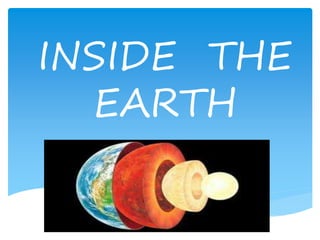

INSIDE THE
EARTH
Structure of the Earth
2
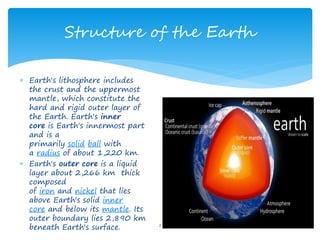
 Earth's lithosphere includes
the crust and the uppermost
mantle, which constitute the
hard and rigid outer layer of
the Earth. Earth's inner
core is Earth's innermost part
and is a
primarily solid ball with
a radius of about 1,220 km.
 Earth's outer core is a liquid
layer about 2,266 km thick
composed
of iron and nickel that lies
above Earth's solid inner
core and below its mantle. Its
outer boundary lies 2,890 km
beneath Earth's surface.
CRUST
3
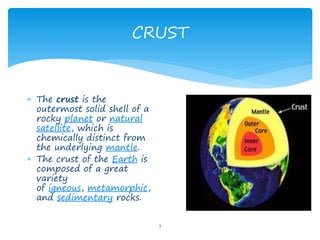
 The crust is the
outermost solid shell of a
rocky planet or natural
satellite, which is
chemically distinct from
the underlying mantle.
 The crust of the Earth is
composed of a great
variety
of igneous, metamorphic,
and sedimentary rocks.
CONTINENTAL CRUST
4
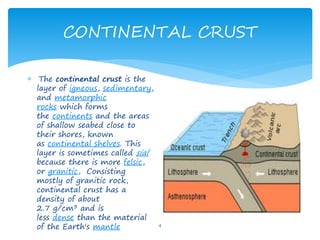
 The continental crust is the
layer of igneous, sedimentary,
and metamorphic
rocks which forms
the continents and the areas
of shallow seabed close to
their shores, known
as continental shelves. This
layer is sometimes called sial
because there is more felsic,
or granitic, Consisting
mostly of granitic rock,
continental crust has a
density of about
2.7 g/cm3 and is
less dense than the material
of the Earth's mantle
Oceanic crust
5
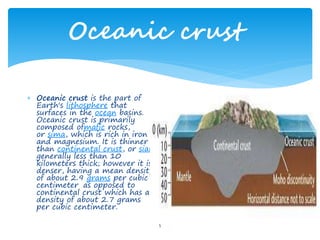
 Oceanic crust is the part of
Earth's lithosphere that
surfaces in the ocean basins.
Oceanic crust is primarily
composed ofmafic rocks,
or sima, which is rich in iron
and magnesium. It is thinner
than continental crust, or sial,
generally less than 10
kilometers thick; however it is
denser, having a mean density
of about 2.9 grams per cubic
centimeter as opposed to
continental crust which has a
density of about 2.7 grams
per cubic centimeter.
MANTLE
6
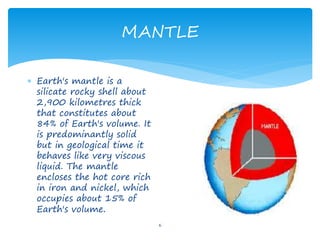
 Earth's mantle is a
silicate rocky shell about
2,900 kilometres thick
that constitutes about
84% of Earth's volume. It
is predominantly solid
but in geological time it
behaves like very viscous
liquid. The mantle
encloses the hot core rich
in iron and nickel, which
occupies about 15% of
Earth's volume.
LITHOSPHERE
7
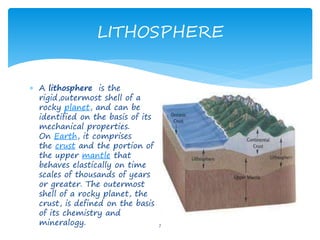
 A lithosphere is the
rigid,outermost shell of a
rocky planet, and can be
identified on the basis of its
mechanical properties.
On Earth, it comprises
the crust and the portion of
the upper mantle that
behaves elastically on time
scales of thousands of years
or greater. The outermost
shell of a rocky planet, the
crust, is defined on the basis
of its chemistry and
mineralogy.
Asthenosphere
8
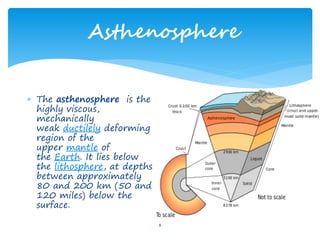
 The asthenosphere is the
highly viscous,
mechanically
weak ductilely deforming
region of the
upper mantle of
the Earth. It lies below
the lithosphere, at depths
between approximately
80 and 200 km (50 and
120 miles) below the
surface.
CORE
9
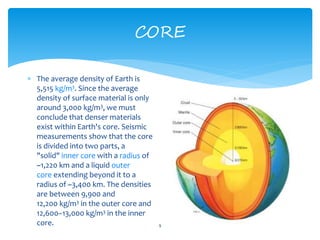
 The average density of Earth is
5,515 kg/m3. Since the average
density of surface material is only
around 3,000 kg/m3, we must
conclude that denser materials
exist within Earth's core. Seismic
measurements show that the core
is divided into two parts, a
"solid" inner core with a radius of
~1,220 km and a liquid outer
core extending beyond it to a
radius of ~3,400 km. The densities
are between 9,900 and
12,200 kg/m3 in the outer core and
12,600–13,000 kg/m3 in the inner
core.
INNER CORE
10
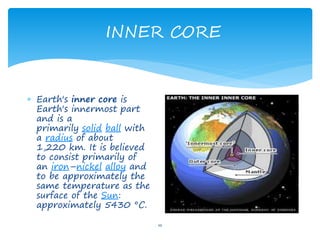
 Earth's inner core is
Earth's innermost part
and is a
primarily solid ball with
a radius of about
1,220 km. It is believed
to consist primarily of
an iron–nickel alloy and
to be approximately the
same temperature as the
surface of the Sun:
approximately 5430 °C.
OUTER CORE
11
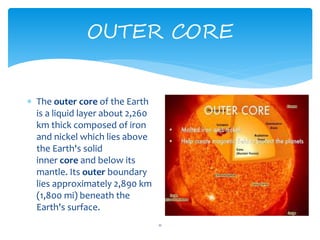
 The outer core of the Earth
is a liquid layer about 2,260
km thick composed of iron
and nickel which lies above
the Earth's solid
inner core and below its
mantle. Its outer boundary
lies approximately 2,890 km
(1,800 mi) beneath the
Earth's surface.
THANK YOU HAVE NICE
DAY
MADE BY SWAROOP RAJ
12

Inside the Earth

  • 1.
  • 2.
    Structure of theEarth 2  Earth's lithosphere includes the crust and the uppermost mantle, which constitute the hard and rigid outer layer of the Earth. Earth's inner core is Earth's innermost part and is a primarily solid ball with a radius of about 1,220 km.  Earth's outer core is a liquid layer about 2,266 km thick composed of iron and nickel that lies above Earth's solid inner core and below its mantle. Its outer boundary lies 2,890 km beneath Earth's surface.
  • 3.
    CRUST 3  The crustis the outermost solid shell of a rocky planet or natural satellite, which is chemically distinct from the underlying mantle.  The crust of the Earth is composed of a great variety of igneous, metamorphic, and sedimentary rocks.
  • 4.
    CONTINENTAL CRUST 4  Thecontinental crust is the layer of igneous, sedimentary, and metamorphic rocks which forms the continents and the areas of shallow seabed close to their shores, known as continental shelves. This layer is sometimes called sial because there is more felsic, or granitic, Consisting mostly of granitic rock, continental crust has a density of about 2.7 g/cm3 and is less dense than the material of the Earth's mantle
  • 5.
    Oceanic crust 5  Oceaniccrust is the part of Earth's lithosphere that surfaces in the ocean basins. Oceanic crust is primarily composed ofmafic rocks, or sima, which is rich in iron and magnesium. It is thinner than continental crust, or sial, generally less than 10 kilometers thick; however it is denser, having a mean density of about 2.9 grams per cubic centimeter as opposed to continental crust which has a density of about 2.7 grams per cubic centimeter.
  • 6.
    MANTLE 6  Earth's mantleis a silicate rocky shell about 2,900 kilometres thick that constitutes about 84% of Earth's volume. It is predominantly solid but in geological time it behaves like very viscous liquid. The mantle encloses the hot core rich in iron and nickel, which occupies about 15% of Earth's volume.
  • 7.
    LITHOSPHERE 7  A lithosphereis the rigid,outermost shell of a rocky planet, and can be identified on the basis of its mechanical properties. On Earth, it comprises the crust and the portion of the upper mantle that behaves elastically on time scales of thousands of years or greater. The outermost shell of a rocky planet, the crust, is defined on the basis of its chemistry and mineralogy.
  • 8.
    Asthenosphere 8  The asthenosphereis the highly viscous, mechanically weak ductilely deforming region of the upper mantle of the Earth. It lies below the lithosphere, at depths between approximately 80 and 200 km (50 and 120 miles) below the surface.
  • 9.
    CORE 9  The averagedensity of Earth is 5,515 kg/m3. Since the average density of surface material is only around 3,000 kg/m3, we must conclude that denser materials exist within Earth's core. Seismic measurements show that the core is divided into two parts, a "solid" inner core with a radius of ~1,220 km and a liquid outer core extending beyond it to a radius of ~3,400 km. The densities are between 9,900 and 12,200 kg/m3 in the outer core and 12,600–13,000 kg/m3 in the inner core.
  • 10.
    INNER CORE 10  Earth'sinner core is Earth's innermost part and is a primarily solid ball with a radius of about 1,220 km. It is believed to consist primarily of an iron–nickel alloy and to be approximately the same temperature as the surface of the Sun: approximately 5430 °C.
  • 11.
    OUTER CORE 11  Theouter core of the Earth is a liquid layer about 2,260 km thick composed of iron and nickel which lies above the Earth's solid inner core and below its mantle. Its outer boundary lies approximately 2,890 km (1,800 mi) beneath the Earth's surface.
  • 12.
    THANK YOU HAVENICE DAY MADE BY SWAROOP RAJ 12