TCP PRESENTO 2020
Inside and Out of School Learning
Presenting by,
V. Srinivas
B.Ed (Maths) 1st Year
GVC College,
Arcot
Ranipet Dist.,
TCP PRESENTO-2020
Inside and Out-of School
Learning
Introduction
This presentation illustrates the
conversation happened between
two students Dora and Ben
Tennyson along with their teacher
on their School learning and how a
small conversation started
originated into a debate and finally
ended with the verdict of their
favourite teacher Mr. Vasudeva who
makes the debate more interesting
Dora raised her first question : “Why
learning in the School is needed? “ sir..
Mr.Vasudeva answered : School is
important because it teaches us about the
world around us and prepares us with the
tools we will need for future success in the
job market. Outside of the classroom,
students also learn valuable lessons at
school, such as social skills, behavior, work
ethic, working for people they don't like,
and gaining a sense of personalTCP PRESENTO-2020
Ben asked , Is there any chance for us to learn outside a school
sir?
Mr. Vasudeva said off-course ‘YES’ my boy you can learn outside
school also. It is not now but even practised in the ancient period
during their ‘GuruKula’ Education. For the modern age it was
proposed by Ivan Illich, a Croatian-Austrian philosopher, in his
first book, Deschooling Society published in 1971, about the
groundbreaking critique of compulsory mass education.
In Deschooling Society Ivan Illich argued that a good education
system should have three purposes: to provide all that want to
learn with access to resources at any time in their lives; make it
possible for all who want to share knowledge etc. to find those
who want to learn it from them; and to create opportunities.
Source: TCP PRESENTO-2020
The two of them eagerly asked
their sir , “Please tell us some of
the ways to learn outside a school”
Sir replied,
In out-of school learning, usually
three approaches are followed,
They are:
• Field Training
• Field Research
• Internet web-based learning
But everything you learn outside the
TCP PRESENTO-2020
Dora asked sir. Is a curriculum linked with the
local area??
• Sir continued by saying , Yes, curriculum
includes all the learner’s experiences in or
outside school that are included in a programme
which has been devised to help him develop
intellectually, physically, emotionally, socially,
spiritually and morally.”
Curriculum is “the total
effort of the school to bring
about desired outcomes in
school and out of schoolTCP PRESENTO-2020
For fully understanding the concepts of
different subjects taught in the classroom,
learning outside the school is also
needed.
For example, in the classroom,
“Environmental Education” when
students learn the topic Solid
Waste Management, in the
classroom to know about various
techniques involved in it, they could
visit the nearby municipal garbageTCP PRESENTO-2020
Both of the students doubtfully questioned which is the
best way to learn sir whether it is Learning from inside or
outside the school??
Mr. Vasudeva maintained silence for a second and then
replied, you will be knowing the answer for this question
at the end of our conversation. Before claiming the
answer for this question one should know about
‘Observational Learning’.
Ben excitedly asked it’s sounds interesting sir. Please
tell me more about it sir.
Mr. Vasudeva began to tell , Observational learning
involves an individual keenly watching how others are
doing a particular task understanding the components of
the task and the way they are arranged, remembering
these details, trying himself to do the task repeatedly a
number of times, eliminating the errors in the
performance and getting the ability to perform the task
more or less similar to what he has seen.TCP PRESENTO-2020
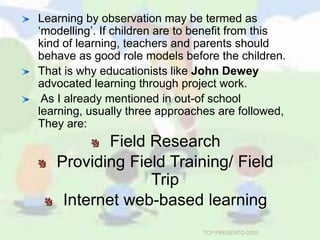
Learning by observation may be termed as
‘modelling’. If children are to benefit from this
kind of learning, teachers and parents should
behave as good role models before the children.
That is why educationists like John Dewey
advocated learning through project work.
As I already mentioned in out-of school
learning, usually three approaches are followed,
They are:
Field Research
Providing Field Training/ Field
Trip
Internet web-based learning
TCP PRESENTO-2020
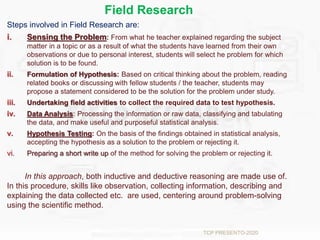
Field Research
Steps involved in Field Research are:
i. Sensing the Problem: From what he teacher explained regarding the subject
matter in a topic or as a result of what the students have learned from their own
observations or due to personal interest, students will select he problem for which
solution is to be found.
ii. Formulation of Hypothesis: Based on critical thinking about the problem, reading
related books or discussing with fellow students / the teacher, students may
propose a statement considered to be the solution for the problem under study.
iii. Undertaking field activities to collect the required data to test hypothesis.
iv. Data Analysis: Processing the information or raw data, classifying and tabulating
the data, and make useful and purposeful statistical analysis.
v. Hypothesis Testing: On the basis of the findings obtained in statistical analysis,
accepting the hypothesis as a solution to the problem or rejecting it.
vi. Preparing a short write up of the method for solving the problem or rejecting it.
In this approach, both inductive and deductive reasoning are made use of.
In this procedure, skills like observation, collecting information, describing and
explaining the data collected etc. are used, centering around problem-solving
using the scientific method.
TCP PRESENTO-2020
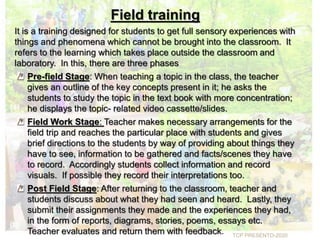
Field training
It is a training designed for students to get full sensory experiences with
things and phenomena which cannot be brought into the classroom. It
refers to the learning which takes place outside the classroom and
laboratory. In this, there are three phases
Pre-field Stage: When teaching a topic in the class, the teacher
gives an outline of the key concepts present in it; he asks the
students to study the topic in the text book with more concentration;
he displays the topic- related video cassette/slides.
Field Work Stage: Teacher makes necessary arrangements for the
field trip and reaches the particular place with students and gives
brief directions to the students by way of providing about things they
have to see, information to be gathered and facts/scenes they have
to record. Accordingly students collect information and record
visuals. If possible they record their interpretations too.
Post Field Stage: After returning to the classroom, teacher and
students discuss about what they had seen and heard. Lastly, they
submit their assignments they made and the experiences they had,
in the form of reports, diagrams, stories, poems, essays etc.
Teacher evaluates and return them with feedback. TCP PRESENTO-2020
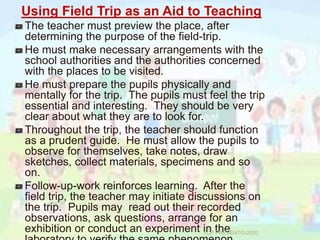
Using Field Trip as an Aid to Teaching
The teacher must preview the place, after
determining the purpose of the field-trip.
He must make necessary arrangements with the
school authorities and the authorities concerned
with the places to be visited.
He must prepare the pupils physically and
mentally for the trip. The pupils must feel the trip
essential and interesting. They should be very
clear about what they are to look for.
Throughout the trip, the teacher should function
as a prudent guide. He must allow the pupils to
observe for themselves, take notes, draw
sketches, collect materials, specimens and so
on.
Follow-up-work reinforces learning. After the
field trip, the teacher may initiate discussions on
the trip. Pupils may read out their recorded
observations, ask questions, arrange for an
exhibition or conduct an experiment in theTCP PRESENTO-2020
Advantages of Learning through Field Trip or visiting a
Museum
Students are energized by the excitement and anticipation of leaving the school
environment.
The transportation to and from the museum/site is often a pleasant open-social time.
Students have the opportunity to see new things and learn about them in a more
unstructured way.
Students have the opportunity to determine what they learn and how they learn it.
Said differently, student learning can be interest-driven, not teacher and curriculum
driven.
Students will experience a more holistic, integrated picture of the information that, in
the classroom, may have only been presented in a textual and abstract way.
Museums, and many other kinds of field trips are multi-media experiences; therefore,
learning is enriched and reinforced with superimposing sensory and intellectual
inputs.
Most museums are designed to stimulate curiosity and actively engage the visitor, so
you have a very professional partner working with you to help your students learn.
In some museums you can arrange for your class to meet with a museum educator,
often in a private classroom, to facilitate directed learning and/or provide a question-
answer session.
TCP PRESENTO-2020
Disadvantages of Field trips
Field trips can be expensive, and some
students may not have the funds to attend.
Teachers will likely have to deal with red
tape as they plan field trips including
permission slips, medical information, and
emergency procedures. Schools typically
require paperwork from teachers and their
students.
Students will be placed in a larger
environment than the classroom. New
surroundings could possibly lead to additional
discipline problems.
There may be students who, for one reasonTCP PRESENTO-2020
Learning Through Online portals or
e-Learning
As we know that technology is ruing every aspect of our
life at great pace on each passing day. We admit that it
making us lazy but at the same time it unlock the true
potential of human capabilities. With a computer, tablet
or even using a mobile having internet connection,
searching websites related to the topic for learning
purpose.
. Educational Website are new blackboard of
classrooms
Even one can use various kinds of educational apps to
study , clear doubts, do the homework or even can
learn a course and get certified.
There are lots of site those are let know the simplest
way to understated the topics & lots of MCQ available
online to check where we stand after reading the topic.
If we missed anything in class on any bad day we can
find out that same information on a website online .
Rich & poor both can utilize this.
TCP PRESENTO-2020
Advantages of e-Learning
A large variety of courses are available.
No need to travel, saving both time and money.
Multiple ways to communicate with your
professor
Cost efficient.
One can have better opportunities to
concentrate.
One can customize their learning environment.
One can enjoy a flexible schedule.
It will boost our career advancement
opportunities.
One can review course materials repeatedly .
One can learn at their own pace.
We can take online quizzes and exams and get
our score immediately.
In courses with dynamic discussion forums youTCP PRESENTO-2020
Disadvantages of Online Learning :
No face-to-face contact with fellow
students or course staff.
No student facilities such as laboratories
or libraries, although some MOOCs
incorporate practical activities to be done
at home, virtual laboratory experiments,
reading lists of freely-available papers or
temporary subscriptions to journals.
It can be hard to find answers to questions
or resolve difficulties, especially when
discussion forum participation is low.
You need effective self-motivation.
TCP PRESENTO-2020
Classroom Learning
Advantages:
You can ask questions directly to
the teacher face to face.
You can discuss issues with
fellow students.
There is ample opportunity for
social interaction and support.
You have access to on-campus
student facilities. TCP PRESENTO-2020
Classroom Learning Disadvantages:
Travel time and cost.
Attendance times can be
restrictive or inconvenient.
Shy students may have trouble
approaching the instructor with
questions.
You usually have to sit through
each lecture even if you already
know most of the material.
You may be required to buyTCP PRESENTO-2020
Judgement with a ‘Twist’
Since it’s the time for the answer to the question
asked by them , “Which is the best way to learn sir
whether it is Learning from inside or outside the
school??”
Mr. Vasudeva checked the clarity of his students by
asking some questions related to the learning
methodology and finally revealed the answer.
The judgement given by him increased the
excitement of his students.
“He told the students to make a
presentation determining the Pros and Cons
of the outside learning as well as the inside
learning and to get the answer for theirTCP PRESENTO-2020
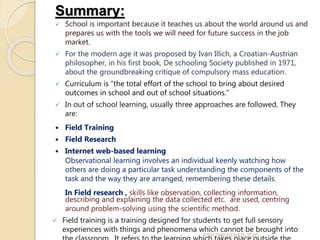
Summary:
 School is important because it teaches us about the world around us and
prepares us with the tools we will need for future success in the job
market.
 For the modern age it was proposed by Ivan Illich, a Croatian-Austrian
philosopher, in his first book, De schooling Society published in 1971,
about the groundbreaking critique of compulsory mass education.
 Curriculum is “the total effort of the school to bring about desired
outcomes in school and out of school situations.”
 In out of school learning, usually three approaches are followed, They
are:
 Field Training
 Field Research
 Internet web-based learning
 Observational learning involves an individual keenly watching how
others are doing a particular task understanding the components of the
task and the way they are arranged, remembering these details.
 In Field research , skills like observation, collecting information,
describing and explaining the data collected etc. are used, centring
around problem-solving using the scientific method.
 Field training is a training designed for students to get full sensory
experiences with things and phenomena which cannot be brought into
TCP PRESENTO-2020
Reference sources:
Google copywrite-free images
Brainly
Quora discussion topics
Learning and Teaching
Techniques by Kumarasamy
Contact
V Srinivas
8098430718
TCP PRESENTO-2020

INSIDE AND OUT SIDE SCHOOL LEARNING

  • 1.
    TCP PRESENTO 2020 Insideand Out of School Learning Presenting by, V. Srinivas B.Ed (Maths) 1st Year GVC College, Arcot Ranipet Dist., TCP PRESENTO-2020
  • 2.
    Inside and Out-ofSchool Learning Introduction This presentation illustrates the conversation happened between two students Dora and Ben Tennyson along with their teacher on their School learning and how a small conversation started originated into a debate and finally ended with the verdict of their favourite teacher Mr. Vasudeva who makes the debate more interesting
  • 3.
    Dora raised herfirst question : “Why learning in the School is needed? “ sir.. Mr.Vasudeva answered : School is important because it teaches us about the world around us and prepares us with the tools we will need for future success in the job market. Outside of the classroom, students also learn valuable lessons at school, such as social skills, behavior, work ethic, working for people they don't like, and gaining a sense of personalTCP PRESENTO-2020
  • 4.
    Ben asked ,Is there any chance for us to learn outside a school sir? Mr. Vasudeva said off-course ‘YES’ my boy you can learn outside school also. It is not now but even practised in the ancient period during their ‘GuruKula’ Education. For the modern age it was proposed by Ivan Illich, a Croatian-Austrian philosopher, in his first book, Deschooling Society published in 1971, about the groundbreaking critique of compulsory mass education. In Deschooling Society Ivan Illich argued that a good education system should have three purposes: to provide all that want to learn with access to resources at any time in their lives; make it possible for all who want to share knowledge etc. to find those who want to learn it from them; and to create opportunities. Source: TCP PRESENTO-2020
  • 5.
    The two ofthem eagerly asked their sir , “Please tell us some of the ways to learn outside a school” Sir replied, In out-of school learning, usually three approaches are followed, They are: • Field Training • Field Research • Internet web-based learning But everything you learn outside the TCP PRESENTO-2020
  • 6.
    Dora asked sir.Is a curriculum linked with the local area?? • Sir continued by saying , Yes, curriculum includes all the learner’s experiences in or outside school that are included in a programme which has been devised to help him develop intellectually, physically, emotionally, socially, spiritually and morally.” Curriculum is “the total effort of the school to bring about desired outcomes in school and out of schoolTCP PRESENTO-2020
  • 7.
    For fully understandingthe concepts of different subjects taught in the classroom, learning outside the school is also needed. For example, in the classroom, “Environmental Education” when students learn the topic Solid Waste Management, in the classroom to know about various techniques involved in it, they could visit the nearby municipal garbageTCP PRESENTO-2020
  • 8.
    Both of thestudents doubtfully questioned which is the best way to learn sir whether it is Learning from inside or outside the school?? Mr. Vasudeva maintained silence for a second and then replied, you will be knowing the answer for this question at the end of our conversation. Before claiming the answer for this question one should know about ‘Observational Learning’. Ben excitedly asked it’s sounds interesting sir. Please tell me more about it sir. Mr. Vasudeva began to tell , Observational learning involves an individual keenly watching how others are doing a particular task understanding the components of the task and the way they are arranged, remembering these details, trying himself to do the task repeatedly a number of times, eliminating the errors in the performance and getting the ability to perform the task more or less similar to what he has seen.TCP PRESENTO-2020
  • 9.
    Learning by observationmay be termed as ‘modelling’. If children are to benefit from this kind of learning, teachers and parents should behave as good role models before the children. That is why educationists like John Dewey advocated learning through project work. As I already mentioned in out-of school learning, usually three approaches are followed, They are: Field Research Providing Field Training/ Field Trip Internet web-based learning TCP PRESENTO-2020
  • 10.
    Field Research Steps involvedin Field Research are: i. Sensing the Problem: From what he teacher explained regarding the subject matter in a topic or as a result of what the students have learned from their own observations or due to personal interest, students will select he problem for which solution is to be found. ii. Formulation of Hypothesis: Based on critical thinking about the problem, reading related books or discussing with fellow students / the teacher, students may propose a statement considered to be the solution for the problem under study. iii. Undertaking field activities to collect the required data to test hypothesis. iv. Data Analysis: Processing the information or raw data, classifying and tabulating the data, and make useful and purposeful statistical analysis. v. Hypothesis Testing: On the basis of the findings obtained in statistical analysis, accepting the hypothesis as a solution to the problem or rejecting it. vi. Preparing a short write up of the method for solving the problem or rejecting it. In this approach, both inductive and deductive reasoning are made use of. In this procedure, skills like observation, collecting information, describing and explaining the data collected etc. are used, centering around problem-solving using the scientific method. TCP PRESENTO-2020
  • 11.
    Field training It isa training designed for students to get full sensory experiences with things and phenomena which cannot be brought into the classroom. It refers to the learning which takes place outside the classroom and laboratory. In this, there are three phases Pre-field Stage: When teaching a topic in the class, the teacher gives an outline of the key concepts present in it; he asks the students to study the topic in the text book with more concentration; he displays the topic- related video cassette/slides. Field Work Stage: Teacher makes necessary arrangements for the field trip and reaches the particular place with students and gives brief directions to the students by way of providing about things they have to see, information to be gathered and facts/scenes they have to record. Accordingly students collect information and record visuals. If possible they record their interpretations too. Post Field Stage: After returning to the classroom, teacher and students discuss about what they had seen and heard. Lastly, they submit their assignments they made and the experiences they had, in the form of reports, diagrams, stories, poems, essays etc. Teacher evaluates and return them with feedback. TCP PRESENTO-2020
  • 12.
    Using Field Tripas an Aid to Teaching The teacher must preview the place, after determining the purpose of the field-trip. He must make necessary arrangements with the school authorities and the authorities concerned with the places to be visited. He must prepare the pupils physically and mentally for the trip. The pupils must feel the trip essential and interesting. They should be very clear about what they are to look for. Throughout the trip, the teacher should function as a prudent guide. He must allow the pupils to observe for themselves, take notes, draw sketches, collect materials, specimens and so on. Follow-up-work reinforces learning. After the field trip, the teacher may initiate discussions on the trip. Pupils may read out their recorded observations, ask questions, arrange for an exhibition or conduct an experiment in theTCP PRESENTO-2020
  • 13.
    Advantages of Learningthrough Field Trip or visiting a Museum Students are energized by the excitement and anticipation of leaving the school environment. The transportation to and from the museum/site is often a pleasant open-social time. Students have the opportunity to see new things and learn about them in a more unstructured way. Students have the opportunity to determine what they learn and how they learn it. Said differently, student learning can be interest-driven, not teacher and curriculum driven. Students will experience a more holistic, integrated picture of the information that, in the classroom, may have only been presented in a textual and abstract way. Museums, and many other kinds of field trips are multi-media experiences; therefore, learning is enriched and reinforced with superimposing sensory and intellectual inputs. Most museums are designed to stimulate curiosity and actively engage the visitor, so you have a very professional partner working with you to help your students learn. In some museums you can arrange for your class to meet with a museum educator, often in a private classroom, to facilitate directed learning and/or provide a question- answer session. TCP PRESENTO-2020
  • 14.
    Disadvantages of Fieldtrips Field trips can be expensive, and some students may not have the funds to attend. Teachers will likely have to deal with red tape as they plan field trips including permission slips, medical information, and emergency procedures. Schools typically require paperwork from teachers and their students. Students will be placed in a larger environment than the classroom. New surroundings could possibly lead to additional discipline problems. There may be students who, for one reasonTCP PRESENTO-2020
  • 15.
    Learning Through Onlineportals or e-Learning As we know that technology is ruing every aspect of our life at great pace on each passing day. We admit that it making us lazy but at the same time it unlock the true potential of human capabilities. With a computer, tablet or even using a mobile having internet connection, searching websites related to the topic for learning purpose. . Educational Website are new blackboard of classrooms Even one can use various kinds of educational apps to study , clear doubts, do the homework or even can learn a course and get certified. There are lots of site those are let know the simplest way to understated the topics & lots of MCQ available online to check where we stand after reading the topic. If we missed anything in class on any bad day we can find out that same information on a website online . Rich & poor both can utilize this. TCP PRESENTO-2020
  • 16.
    Advantages of e-Learning Alarge variety of courses are available. No need to travel, saving both time and money. Multiple ways to communicate with your professor Cost efficient. One can have better opportunities to concentrate. One can customize their learning environment. One can enjoy a flexible schedule. It will boost our career advancement opportunities. One can review course materials repeatedly . One can learn at their own pace. We can take online quizzes and exams and get our score immediately. In courses with dynamic discussion forums youTCP PRESENTO-2020
  • 17.
    Disadvantages of OnlineLearning : No face-to-face contact with fellow students or course staff. No student facilities such as laboratories or libraries, although some MOOCs incorporate practical activities to be done at home, virtual laboratory experiments, reading lists of freely-available papers or temporary subscriptions to journals. It can be hard to find answers to questions or resolve difficulties, especially when discussion forum participation is low. You need effective self-motivation. TCP PRESENTO-2020
  • 18.
    Classroom Learning Advantages: You canask questions directly to the teacher face to face. You can discuss issues with fellow students. There is ample opportunity for social interaction and support. You have access to on-campus student facilities. TCP PRESENTO-2020
  • 19.
    Classroom Learning Disadvantages: Traveltime and cost. Attendance times can be restrictive or inconvenient. Shy students may have trouble approaching the instructor with questions. You usually have to sit through each lecture even if you already know most of the material. You may be required to buyTCP PRESENTO-2020
  • 20.
    Judgement with a‘Twist’ Since it’s the time for the answer to the question asked by them , “Which is the best way to learn sir whether it is Learning from inside or outside the school??” Mr. Vasudeva checked the clarity of his students by asking some questions related to the learning methodology and finally revealed the answer. The judgement given by him increased the excitement of his students. “He told the students to make a presentation determining the Pros and Cons of the outside learning as well as the inside learning and to get the answer for theirTCP PRESENTO-2020
  • 21.
    Summary:  School isimportant because it teaches us about the world around us and prepares us with the tools we will need for future success in the job market.  For the modern age it was proposed by Ivan Illich, a Croatian-Austrian philosopher, in his first book, De schooling Society published in 1971, about the groundbreaking critique of compulsory mass education.  Curriculum is “the total effort of the school to bring about desired outcomes in school and out of school situations.”  In out of school learning, usually three approaches are followed, They are:  Field Training  Field Research  Internet web-based learning  Observational learning involves an individual keenly watching how others are doing a particular task understanding the components of the task and the way they are arranged, remembering these details.  In Field research , skills like observation, collecting information, describing and explaining the data collected etc. are used, centring around problem-solving using the scientific method.  Field training is a training designed for students to get full sensory experiences with things and phenomena which cannot be brought into TCP PRESENTO-2020
  • 22.
    Reference sources: Google copywrite-freeimages Brainly Quora discussion topics Learning and Teaching Techniques by Kumarasamy Contact V Srinivas 8098430718 TCP PRESENTO-2020