INSECT MORPHOLOGY
By komal gul
Tagmosis
 Insect body is differentiated into three distinct regions called head, thorax and abdomen
 grouping of body segments into distinct regions is known as tagmosis
 the body regions are called as tagmata.
HEAD
 First anterior tagma formed by the fusion of six segments namely preantennary, antennary,
intercalary, mandibular, maxillary and labial segments.
 Head is attached or articulated to the thorax through neck or Cervix.
 Head capsule is sclerotized and the head capsule excluding appendages formed by the fusion of
several sclerites is known as Cranium
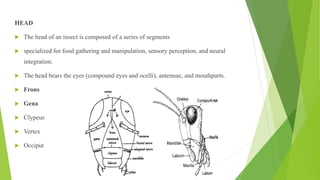
HEAD
 The head of an insect is composed of a series of segments
 specialized for food gathering and manipulation, sensory perception, and neural
integration.
 The head bears the eyes (compound eyes and ocelli), antennae, and mouthparts.
 Frons
 Gena
 Clypeus
 Vertex
 Occiput
 Functions of Head
 Food ingestion
 Sensory perception
 Coordination of bodily activities
 Protection of the coordinating centers
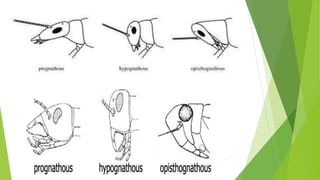
 TYPES OF INSECT HEADS
 Based on the inclination of long axis of the head and orientation of mouth parts there are three types of insect
heads.
 HYPOGNATHOUS (Hypo – below; gnathous – jaw)
 This type is also called orthopteroid type. The long axis of the head is vertical. It is at right angles to the long
axis of the body. Mouth parts are ventrally placed and project downwards.
 PROGNATHOUS (Pro- infront ; gnathous – jaw)
 This type is also called coleopteroid type. The long axis of the head is horizontal. It is in line with the long axis
of the body. Mouth parts are directed foreward. Eg: groung beetles.
 OPISTHOGNATHOUS (Opistho – behind ; gnathous – jaw)
 This type is also called hemipteroid type or opisthorhychous. Head is deflexed. Mouth parts are directed
backwards and held in between the fore legs. Eg: Stink bug.
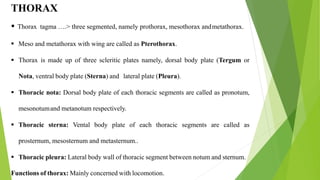
THORAX
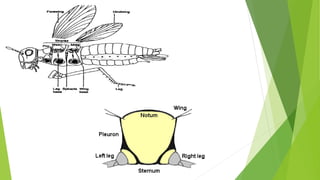
 Thorax tagma ….> three segmented, namely prothorax, mesothorax andmetathorax.
 Meso and metathorax with wing are called as Pterothorax.
 Thorax is made up of three scleritic plates namely, dorsal body plate (Tergum or
Nota, ventral body plate (Sterna) and lateral plate (Pleura).
 Thoracic nota: Dorsal body plate of each thoracic segments are called as pronotum,
mesonotumand metanotum respectively.
 Thoracic sterna: Vental body plate of each thoracic segments are called as
prosternum, mesosternum and metasternum..
 Thoracic pleura: Lateral body wall of thoracic segment between notum and sternum.
Functions of thorax: Mainly concerned with locomotion.
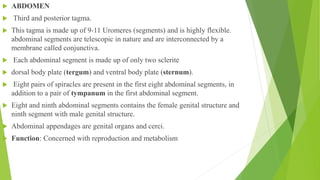
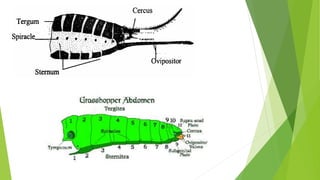
 ABDOMEN
 Third and posterior tagma.
 This tagma is made up of 9-11 Uromeres (segments) and is highly flexible.
abdominal segments are telescopic in nature and are interconnected by a
membrane called conjunctiva.
 Each abdominal segment is made up of only two sclerite
 dorsal body plate (tergum) and ventral body plate (sternum).
 Eight pairs of spiracles are present in the first eight abdominal segments, in
addition to a pair of tympanum in the first abdominal segment.
 Eight and ninth abdominal segments contains the female genital structure and
ninth segment with male genital structure.
 Abdominal appendages are genital organs and cerci.
 Function: Concerned with reproduction and metabolism
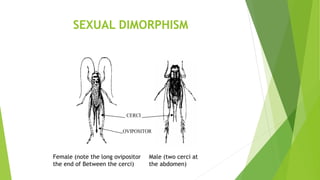
SEXUAL DIMORPHISM
CERCI
OVIPOSITOR
Female (note the long ovipositor Male (two cerci at
the end of Between the cerci) the abdomen)
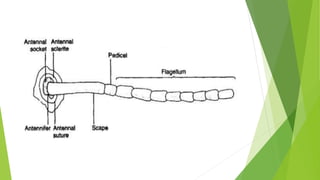
Antennae
 Antennae vary greatly among insects
 follow a basic plan: segments 1 and 2 are termed the scape and
pedicel, respectively.
 The remaining antennal segments (flagellomeres) are jointly
called the flagellum.
Antennae function
 sensory perception
 motion and orientation
 odor
 sound
 humidity
 a variety of chemical cues
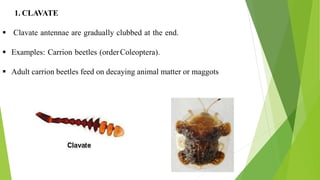
1. CLAVATE
Clavate antennae are gradually clubbed at the end. Examples: Carrion beetles (order
Coleoptera). Adult carrion beetles feed on decaying animal matter or maggots.
1. CLAVATE
 Clavate antennae are gradually clubbed at the end.
 Examples: Carrion beetles (orderColeoptera).
 Adult carrion beetles feed on decaying animal matter or maggots
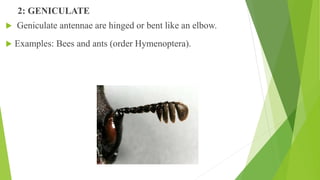
2: GENICULATE
 Geniculate antennae are hinged or bent like an elbow.
 Examples: Bees and ants (order Hymenoptera).
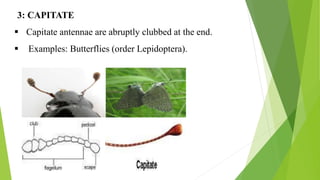
3: CAPITATE
 Capitate antennae are abruptly clubbed at the end.
 Examples: Butterflies (order Lepidoptera).
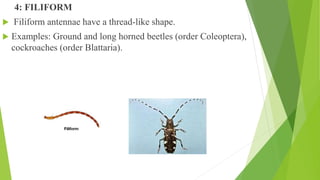
4: FILIFORM
 Filiform antennae have a thread-like shape.
 Examples: Ground and long horned beetles (order Coleoptera),
cockroaches (order Blattaria).
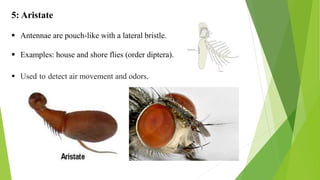
5: Aristate
 Antennae are pouch-like with a lateral bristle.
 Examples: house and shore flies (order diptera).
 Used to detect air movement and odors.
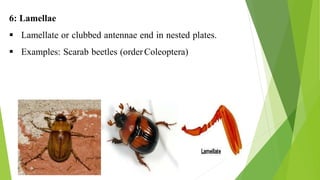
6: Lamellae
 Lamellate or clubbed antennae end in nested plates.
 Examples: Scarab beetles (orderColeoptera)
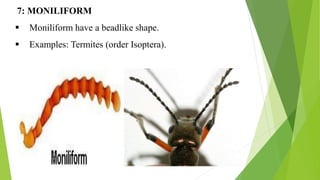
7: MONILIFORM
 Moniliform have a beadlike shape.
 Examples: Termites (order Isoptera).
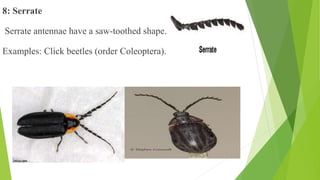
8: Serrate
Serrate antennae have a saw-toothed shape.
Examples: Click beetles (order Coleoptera).
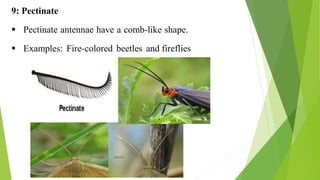
9: Pectinate
 Pectinate antennae have a comb-like shape.
 Examples: Fire-colored beetles and fireflies
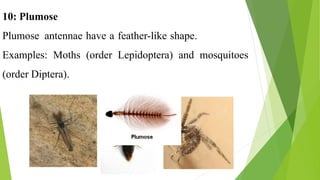
10: Plumose
Plumose antennae have a feather-like shape.
Examples: Moths (order Lepidoptera) and mosquitoes
(order Diptera).
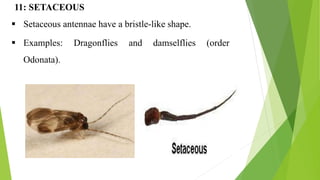
11: SETACEOUS
 Setaceous antennae have a bristle-like shape.
 Examples: Dragonflies and damselflies (order
Odonata).

entomology 4.pptx

  • 1.
  • 2.
    Tagmosis  Insect bodyis differentiated into three distinct regions called head, thorax and abdomen  grouping of body segments into distinct regions is known as tagmosis  the body regions are called as tagmata. HEAD  First anterior tagma formed by the fusion of six segments namely preantennary, antennary, intercalary, mandibular, maxillary and labial segments.  Head is attached or articulated to the thorax through neck or Cervix.  Head capsule is sclerotized and the head capsule excluding appendages formed by the fusion of several sclerites is known as Cranium
  • 3.
    HEAD  The headof an insect is composed of a series of segments  specialized for food gathering and manipulation, sensory perception, and neural integration.  The head bears the eyes (compound eyes and ocelli), antennae, and mouthparts.  Frons  Gena  Clypeus  Vertex  Occiput
  • 4.
     Functions ofHead  Food ingestion  Sensory perception  Coordination of bodily activities  Protection of the coordinating centers  TYPES OF INSECT HEADS  Based on the inclination of long axis of the head and orientation of mouth parts there are three types of insect heads.  HYPOGNATHOUS (Hypo – below; gnathous – jaw)  This type is also called orthopteroid type. The long axis of the head is vertical. It is at right angles to the long axis of the body. Mouth parts are ventrally placed and project downwards.  PROGNATHOUS (Pro- infront ; gnathous – jaw)  This type is also called coleopteroid type. The long axis of the head is horizontal. It is in line with the long axis of the body. Mouth parts are directed foreward. Eg: groung beetles.  OPISTHOGNATHOUS (Opistho – behind ; gnathous – jaw)  This type is also called hemipteroid type or opisthorhychous. Head is deflexed. Mouth parts are directed backwards and held in between the fore legs. Eg: Stink bug.
  • 6.
    THORAX  Thorax tagma….> three segmented, namely prothorax, mesothorax andmetathorax.  Meso and metathorax with wing are called as Pterothorax.  Thorax is made up of three scleritic plates namely, dorsal body plate (Tergum or Nota, ventral body plate (Sterna) and lateral plate (Pleura).  Thoracic nota: Dorsal body plate of each thoracic segments are called as pronotum, mesonotumand metanotum respectively.  Thoracic sterna: Vental body plate of each thoracic segments are called as prosternum, mesosternum and metasternum..  Thoracic pleura: Lateral body wall of thoracic segment between notum and sternum. Functions of thorax: Mainly concerned with locomotion.
  • 8.
     ABDOMEN  Thirdand posterior tagma.  This tagma is made up of 9-11 Uromeres (segments) and is highly flexible. abdominal segments are telescopic in nature and are interconnected by a membrane called conjunctiva.  Each abdominal segment is made up of only two sclerite  dorsal body plate (tergum) and ventral body plate (sternum).  Eight pairs of spiracles are present in the first eight abdominal segments, in addition to a pair of tympanum in the first abdominal segment.  Eight and ninth abdominal segments contains the female genital structure and ninth segment with male genital structure.  Abdominal appendages are genital organs and cerci.  Function: Concerned with reproduction and metabolism
  • 10.
    SEXUAL DIMORPHISM CERCI OVIPOSITOR Female (notethe long ovipositor Male (two cerci at the end of Between the cerci) the abdomen)
  • 11.
    Antennae  Antennae varygreatly among insects  follow a basic plan: segments 1 and 2 are termed the scape and pedicel, respectively.  The remaining antennal segments (flagellomeres) are jointly called the flagellum.
  • 12.
    Antennae function  sensoryperception  motion and orientation  odor  sound  humidity  a variety of chemical cues
  • 14.
    1. CLAVATE Clavate antennaeare gradually clubbed at the end. Examples: Carrion beetles (order Coleoptera). Adult carrion beetles feed on decaying animal matter or maggots. 1. CLAVATE  Clavate antennae are gradually clubbed at the end.  Examples: Carrion beetles (orderColeoptera).  Adult carrion beetles feed on decaying animal matter or maggots
  • 15.
    2: GENICULATE  Geniculateantennae are hinged or bent like an elbow.  Examples: Bees and ants (order Hymenoptera).
  • 16.
    3: CAPITATE  Capitateantennae are abruptly clubbed at the end.  Examples: Butterflies (order Lepidoptera).
  • 17.
    4: FILIFORM  Filiformantennae have a thread-like shape.  Examples: Ground and long horned beetles (order Coleoptera), cockroaches (order Blattaria).
  • 18.
    5: Aristate  Antennaeare pouch-like with a lateral bristle.  Examples: house and shore flies (order diptera).  Used to detect air movement and odors.
  • 19.
    6: Lamellae  Lamellateor clubbed antennae end in nested plates.  Examples: Scarab beetles (orderColeoptera)
  • 20.
    7: MONILIFORM  Moniliformhave a beadlike shape.  Examples: Termites (order Isoptera).
  • 21.
    8: Serrate Serrate antennaehave a saw-toothed shape. Examples: Click beetles (order Coleoptera).
  • 22.
    9: Pectinate  Pectinateantennae have a comb-like shape.  Examples: Fire-colored beetles and fireflies
  • 23.
    10: Plumose Plumose antennaehave a feather-like shape. Examples: Moths (order Lepidoptera) and mosquitoes (order Diptera).
  • 24.
    11: SETACEOUS  Setaceousantennae have a bristle-like shape.  Examples: Dragonflies and damselflies (order Odonata).