SRI PARAMAKALYANI COLLEGE
REACCREDITED WITH B GRADE WITH A CGPA OF 2.71 IN THE SECOND CYCLE OF NAAC
AFFILIATED TO MANOMANIUM SUNDARANAR UNIVERSITY, TIRUNELVELI.
ALWARKURICHI 627 412, TAMIL NADU, INDIA
POST GRADUATE & RESEARCH CENTRE
DEPARTMENT OF MICROBIOLOGY
(Government Aided)
ACADEMIC YEAR 2021-2022
I SEM CORE: MICROBIAL PHYSIOLOGY AND METABOLISM - (ZMBM13)
UNIT- 2
EMP,ED AND GLYOXYLATE CYCLE
K.JANAKI SUJITHA
REG NO:20211232516111
I M.SC MICROBIOLOGY
ASSIGNED ON: 05/12/2021
TAKEN ON:13/01/2022
SUBMITTED TO
GUIDE:
DR.S.VISWANATHAN
ASSISTANT PROFESSOR & HEAD
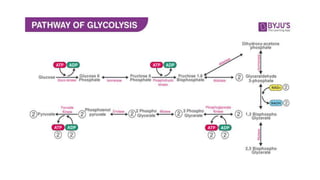
GLYCOLYSIS
SYNOPSIS:
GYLCOLYSIS (EMP) pathway:
1.Introduction
2.Cycle
3.Steps
4.Outcome
Introduction:
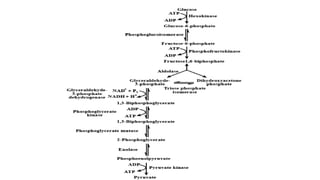
• Glycolysis is also known as Embden-Meyerhof pathway
• It takes place in cytoplasm of the cell
• Glycolysis is defined as the sequence of reactions converting glycose to pyruvate or
lactate with the production of ATP
• It occurs in the absence of oxygen (anaerobic) or in presence of oxygen (aerobic)
• Lactate is the end product under anaerobic condition
• In aerobic condition, pyruvate is formed, which is then oxidized to CO2 & H20.
• It is a sequence of 10 reaction involving 10 intermediate compounds
• It involves 2 phases
* Preparatory phase
* Payoff phase
• PHASE 1 – Preparatory
It consists of the first 5 steps.
In these case reaction, glucose is Enzymatically phosphorylated by ATP (first at

carbon 6 and later at carbon 1) to yield fructose 1,6 diphosphate which is then split
in half to yield 2 moles of the 3-carbon compound, glyceraldehyde 3-phosphate.
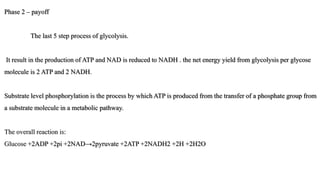
Phase 2 – payoff
The last 5 step process of glycolysis.
It result in the production of ATP and NAD is reduced to NADH . the net energy yield from glycolysis per glycose
molecule is 2 ATP and 2 NADH.
Substrate level phosphorylation is the process by which ATP is produced from the transfer of a phosphate group from
a substrate molecule in a metabolic pathway.
The overall reaction is:
Glucose ​+2ADP +2pi +2NAD→2pyruvate ​+2ATP +2NADH2 +2H +2H2O
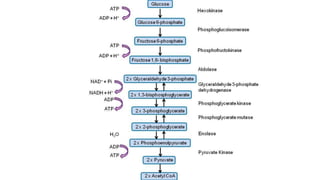
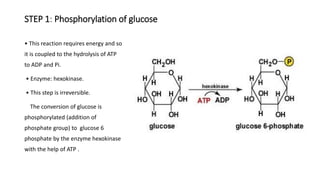
STEP 1: Phosphorylation of glucose
• This reaction requires energy and so
it is coupled to the hydrolysis of ATP
to ADP and Pi.
• Enzyme: hexokinase.
• This step is irreversible.
The conversion of glucose is
phosphorylated (addition of
phosphate group) to glucose 6
phosphate by the enzyme hexokinase
with the help of ATP .
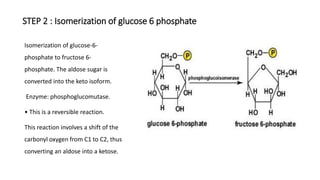
STEP 2 : Isomerization of glucose 6 phosphate
Isomerization of glucose-6-
phosphate to fructose 6-
phosphate. The aldose sugar is
converted into the keto isoform.
Enzyme: phosphoglucomutase.
• This is a reversible reaction.
This reaction involves a shift of the
carbonyl oxygen from C1 to C2, thus
converting an aldose into a ketose.
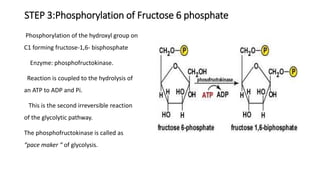
STEP 3:Phosphorylation of Fructose 6 phosphate
Phosphorylation of the hydroxyl group on
C1 forming fructose-1,6- bisphosphate
Enzyme: phosphofructokinase.
Reaction is coupled to the hydrolysis of
an ATP to ADP and Pi.
This is the second irreversible reaction
of the glycolytic pathway.
The phosphofructokinase is called as
“pace maker “ of glycolysis.
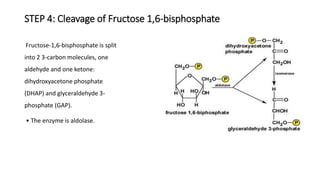
STEP 4: Cleavage of Fructose 1,6-bisphosphate
Fructose-1,6-bisphosphate is split
into 2 3-carbon molecules, one
aldehyde and one ketone:
dihydroxyacetone phosphate
(DHAP) and glyceraldehyde 3-
phosphate (GAP).
• The enzyme is aldolase.
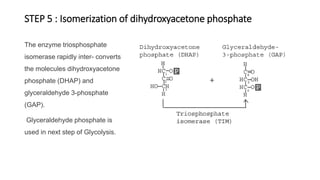
STEP 5 : Isomerization of dihydroxyacetone phosphate
The enzyme triosphosphate
isomerase rapidly inter- converts
the molecules dihydroxyacetone
phosphate (DHAP) and
glyceraldehyde 3-phosphate
(GAP).
Glyceraldehyde phosphate is
used in next step of Glycolysis.
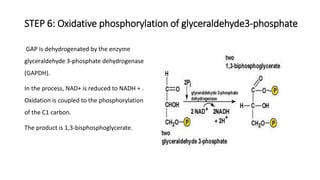
STEP 6: Oxidative phosphorylation of glyceraldehyde3-phosphate
GAP is dehydrogenated by the enzyme
glyceraldehyde 3-phosphate dehydrogenase
(GAPDH).
In the process, NAD+ is reduced to NADH + .
Oxidation is coupled to the phosphorylation
of the C1 carbon.
The product is 1,3-bisphosphoglycerate.
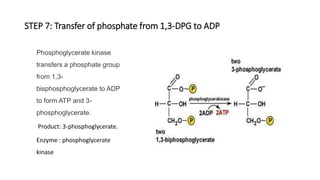
STEP 7: Transfer of phosphate from 1,3-DPG to ADP
Phosphoglycerate kinase
transfers a phosphate group
from 1,3-
bisphosphoglycerate to ADP
to form ATP and 3-
phosphoglycerate.
Product: 3-phosphoglycerate.
Enzyme : phosphoglycerate
kinase
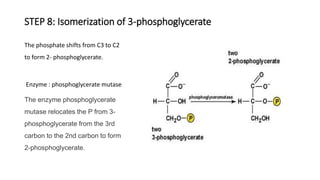
STEP 8: Isomerization of 3-phosphoglycerate
The phosphate shifts from C3 to C2
to form 2- phosphoglycerate.
Enzyme : phosphoglycerate mutase
The enzyme phosphoglycerate
mutase relocates the P from 3-
phosphoglycerate from the 3rd
carbon to the 2nd carbon to form
2-phosphoglycerate.
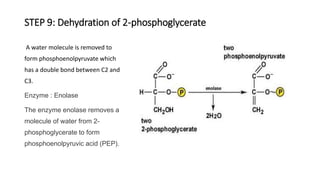
STEP 9: Dehydration of 2-phosphoglycerate
A water molecule is removed to
form phosphoenolpyruvate which
has a double bond between C2 and
C3.
Enzyme : Enolase
The enzyme enolase removes a
molecule of water from 2-
phosphoglycerate to form
phosphoenolpyruvic acid (PEP).
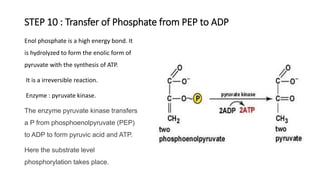
STEP 10 : Transfer of Phosphate from PEP to ADP
Enol phosphate is a high energy bond. It
is hydrolyzed to form the enolic form of
pyruvate with the synthesis of ATP.
It is a irreversible reaction.
Enzyme : pyruvate kinase.
The enzyme pyruvate kinase transfers
a P from phosphoenolpyruvate (PEP)
to ADP to form pyruvic acid and ATP.
Here the substrate level
phosphorylation takes place.
outcome of glycolysis:
The breakdown of a glucose molecule into two smaller pyruvate molecules.
Glycolysis starts with one molecule of glucose and ends with two pyruvate (pyruvic acid)
molecules, a total of four ATP molecules, and two molecules of NADH. Two ATP molecules were used in
the first half of the pathway to prepare the six-carbon ring for cleavage, so the cell has a net gain of two
ATP molecules and 2 NADH molecules for its use.
ED PATHWAY
SYNOPSIS:
ED pathway
1.Introduction
2.Cycle
3.Steps
4.significance
Entner-Doudoroff (ED) pathway
Introduction:
• This pathway occurs in both aerobic and anaerobic condition
• Occur in prokaryotes only
• It occurs in cytoplasm
• Pyruvate and glyceraldehyde-3-phosphate produced from glucose by ED pathway
> The Entner–Doudoroff pathway describes an alternate series of reactions
that catabolize glucose to pyruvate using a set of enzymes different from those used in
either glycolysis or the pentose phosphate pathway.
> Glycolysis (from glycose, an older term for glucose + -lysis degradation) is the
metabolic pathway that converts glucose C6H12O6, into pyruvate, CH3COCOO− + H+.
The free energy released in this process is used to form the high-energy compounds
ATP (adenosine triphosphate) and NADH (reduced nicotinamide adenine dinucleotide).
> Most bacteria use glycolysis and the pentose phosphate pathway. This
pathway was first reported in 1952 by Michael Doudoroff and Nathan Entner.
• There are a few bacteria that substitute classic glycolysis with the Entner-
Doudoroff pathway.
• They may lack enzymes essential for glycolysis, such as
phosphofructokinase-1. This pathway is generally found in Pseudomonas,
Rhizobium, Azotobacter, Agrobacterium, and a few other Gram-negative
genera.
• Very few Gram-positive bacteria have this pathway, with Enterococcus
faecalis being a rare exception. Most organisms that use the pathway are
aerobes due to the low ATP yield per glucose such as Pseudomonas and
Azotobacter, a genus of Gram-negative bacteria.
STEPS:
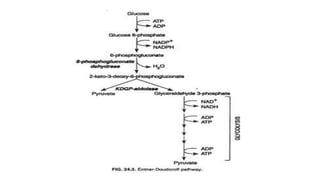
• At first glucose is phosphorylated to glucose -6-phosphate by the enzyme hexokinase.
• Glucose-6-phosphate is then oxidized to 6-phosphogluconolactone releasing a molecule of
NADPH. This reaction is catalysed by the enzyme glucose-6-phosphate dehydrogenase.
• Hydrolase enzyme converts 6-phopshogluconolactone to 6-phosphogluconate.
• 6-phosphogluconate undergoes dehydration reaction catalysed by 6-phosphogluconate
dehydratase to form 2-keto 3-deoxy 6-Phosphogluconate (KDPG).
• KDPG splits to form pyruvate and glceraldehyde-3-phosphate. It is catalysed by KDPG
aldolase enzyme
• Glyceraldehyde-3-phosphate is then metabolized by glycolysis to form pyruvate.
Significance of ED pathway :
• This pathway used two specific enzymes ie. 6-phosphogluconate
dehydratase and KDPG aldolase.
• This pathway generates 1 ATP, 1 NADH and 1 NADPH from one glucose
molecule.
Glyoxylate cycle
.
SYNOPSIS:
GLYOXYLATE CYCLE
1.Introduction
2.Cycle
3.Steps
4.significance
Introduction:
• The glyoxylate cycle, a variation of the tricarboxylic acid cycle, is an anabolic pathway
occurring in plants, bacteria, protists, and fungi.
• The glyoxylate cycle centers on the conversion of acetyl-CoA to succinate for the
synthesis of carbohydrates.
• The glyoxylate cycle was discovered in 1957 at the University of Oxford by Sir Hans
Kornberg and his mentor Hans Krebs.
• Plants as well as some algae and bacteria can use acetate as the carbon source for the
production of carbon compounds. Plants and bacteria employ a modification of the TCA
cycle called the glyoxylate cycle to produce four carbon dicarboxylic acid from two carbon
acetate units.
• Glyoxylate cycle is the process of synthesis of carbohydrate from
fats(obtain energy from fats).
• This cycle has two unique enzyme- isocitrate lyase and malate
synthase which bypass some of the reaction of TCA cycle.
• The primary function of the glyoxylate cycle is to allow growth when
glucose is not available and two-carbon compounds, such as ethanol and
acetate, are the only sources of carbon.
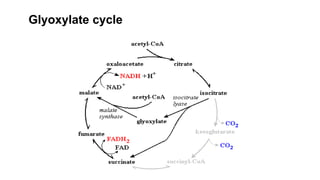
Glyoxylate cycle
Steps:
• Glyoxylate cycle is absent in higher organism.
• At first acetylcoA is produced from acetate or by oxidation of higher fatty acids.
• AcetylcoA then enter into TCA cycle and condensed with oxaloacetate to form citrate.
• Citrate then isomerized to isocitrate.
• Isocitrate lyase bypass the TCA cycle by splitting isocitrate into succinate and glyoxylate.
• Succinate metabolized by TCA whereas Glyoxylate condenses with another molecule of acetylcoA to form malate in the
presence of malate synthase.
• Malate is converted into oxaloacetate by the enzyme malate dehydrogenase.
Significance of Glyoxylate cycle:
• It is bypass reaction of TCA cycle
• It occurs in bacteria when they are cultured in acetate rich
carbon source.
• When Higher fatty acids are oxidized into acetyl coA
without forming pyruvate acids, then acetyl coA enters
into glyoxylate cycle.
• The glyoxylate cycle is an example of gluconeogenesis
REFERENCES:
>Willey, Joanne M., Linda Sherwood, Christopher J. Woolverton,
Lansing M. Prescott, and Joanne M. Willey. Prescott's Microbiology.
New York: McGraw-Hill, 2011.
> https://en.wikipedia.org
> https://www.csun.edu
SKILLS GAINED BY SEMINAR
• Confident level
• Communication
• Time management
• Referred lots of books
THANKS
• The Chairman
• The Secretary
• Management Committee
• The Principle, Sri Paramakalyani College
• The Head-Department of Microbiology
• The Staff Members-Department of Microbiology

EMP,ED,GLYOXYLATE PATHWAY

  • 1.
    SRI PARAMAKALYANI COLLEGE REACCREDITEDWITH B GRADE WITH A CGPA OF 2.71 IN THE SECOND CYCLE OF NAAC AFFILIATED TO MANOMANIUM SUNDARANAR UNIVERSITY, TIRUNELVELI. ALWARKURICHI 627 412, TAMIL NADU, INDIA POST GRADUATE & RESEARCH CENTRE DEPARTMENT OF MICROBIOLOGY (Government Aided) ACADEMIC YEAR 2021-2022 I SEM CORE: MICROBIAL PHYSIOLOGY AND METABOLISM - (ZMBM13) UNIT- 2 EMP,ED AND GLYOXYLATE CYCLE K.JANAKI SUJITHA REG NO:20211232516111 I M.SC MICROBIOLOGY ASSIGNED ON: 05/12/2021 TAKEN ON:13/01/2022 SUBMITTED TO GUIDE: DR.S.VISWANATHAN ASSISTANT PROFESSOR & HEAD
  • 2.
  • 3.
  • 4.
    Introduction: • Glycolysis isalso known as Embden-Meyerhof pathway • It takes place in cytoplasm of the cell • Glycolysis is defined as the sequence of reactions converting glycose to pyruvate or lactate with the production of ATP • It occurs in the absence of oxygen (anaerobic) or in presence of oxygen (aerobic) • Lactate is the end product under anaerobic condition • In aerobic condition, pyruvate is formed, which is then oxidized to CO2 & H20.
  • 5.
    • It isa sequence of 10 reaction involving 10 intermediate compounds • It involves 2 phases * Preparatory phase * Payoff phase • PHASE 1 – Preparatory It consists of the first 5 steps. In these case reaction, glucose is Enzymatically phosphorylated by ATP (first at carbon 6 and later at carbon 1) to yield fructose 1,6 diphosphate which is then split in half to yield 2 moles of the 3-carbon compound, glyceraldehyde 3-phosphate.
  • 6.
    Phase 2 –payoff The last 5 step process of glycolysis. It result in the production of ATP and NAD is reduced to NADH . the net energy yield from glycolysis per glycose molecule is 2 ATP and 2 NADH. Substrate level phosphorylation is the process by which ATP is produced from the transfer of a phosphate group from a substrate molecule in a metabolic pathway. The overall reaction is: Glucose ​+2ADP +2pi +2NAD→2pyruvate ​+2ATP +2NADH2 +2H +2H2O
  • 9.
    STEP 1: Phosphorylationof glucose • This reaction requires energy and so it is coupled to the hydrolysis of ATP to ADP and Pi. • Enzyme: hexokinase. • This step is irreversible. The conversion of glucose is phosphorylated (addition of phosphate group) to glucose 6 phosphate by the enzyme hexokinase with the help of ATP .
  • 10.
    STEP 2 :Isomerization of glucose 6 phosphate Isomerization of glucose-6- phosphate to fructose 6- phosphate. The aldose sugar is converted into the keto isoform. Enzyme: phosphoglucomutase. • This is a reversible reaction. This reaction involves a shift of the carbonyl oxygen from C1 to C2, thus converting an aldose into a ketose.
  • 11.
    STEP 3:Phosphorylation ofFructose 6 phosphate Phosphorylation of the hydroxyl group on C1 forming fructose-1,6- bisphosphate Enzyme: phosphofructokinase. Reaction is coupled to the hydrolysis of an ATP to ADP and Pi. This is the second irreversible reaction of the glycolytic pathway. The phosphofructokinase is called as “pace maker “ of glycolysis.
  • 12.
    STEP 4: Cleavageof Fructose 1,6-bisphosphate Fructose-1,6-bisphosphate is split into 2 3-carbon molecules, one aldehyde and one ketone: dihydroxyacetone phosphate (DHAP) and glyceraldehyde 3- phosphate (GAP). • The enzyme is aldolase.
  • 13.
    STEP 5 :Isomerization of dihydroxyacetone phosphate The enzyme triosphosphate isomerase rapidly inter- converts the molecules dihydroxyacetone phosphate (DHAP) and glyceraldehyde 3-phosphate (GAP). Glyceraldehyde phosphate is used in next step of Glycolysis.
  • 14.
    STEP 6: Oxidativephosphorylation of glyceraldehyde3-phosphate GAP is dehydrogenated by the enzyme glyceraldehyde 3-phosphate dehydrogenase (GAPDH). In the process, NAD+ is reduced to NADH + . Oxidation is coupled to the phosphorylation of the C1 carbon. The product is 1,3-bisphosphoglycerate.
  • 15.
    STEP 7: Transferof phosphate from 1,3-DPG to ADP Phosphoglycerate kinase transfers a phosphate group from 1,3- bisphosphoglycerate to ADP to form ATP and 3- phosphoglycerate. Product: 3-phosphoglycerate. Enzyme : phosphoglycerate kinase
  • 16.
    STEP 8: Isomerizationof 3-phosphoglycerate The phosphate shifts from C3 to C2 to form 2- phosphoglycerate. Enzyme : phosphoglycerate mutase The enzyme phosphoglycerate mutase relocates the P from 3- phosphoglycerate from the 3rd carbon to the 2nd carbon to form 2-phosphoglycerate.
  • 17.
    STEP 9: Dehydrationof 2-phosphoglycerate A water molecule is removed to form phosphoenolpyruvate which has a double bond between C2 and C3. Enzyme : Enolase The enzyme enolase removes a molecule of water from 2- phosphoglycerate to form phosphoenolpyruvic acid (PEP).
  • 18.
    STEP 10 :Transfer of Phosphate from PEP to ADP Enol phosphate is a high energy bond. It is hydrolyzed to form the enolic form of pyruvate with the synthesis of ATP. It is a irreversible reaction. Enzyme : pyruvate kinase. The enzyme pyruvate kinase transfers a P from phosphoenolpyruvate (PEP) to ADP to form pyruvic acid and ATP. Here the substrate level phosphorylation takes place.
  • 20.
    outcome of glycolysis: Thebreakdown of a glucose molecule into two smaller pyruvate molecules. Glycolysis starts with one molecule of glucose and ends with two pyruvate (pyruvic acid) molecules, a total of four ATP molecules, and two molecules of NADH. Two ATP molecules were used in the first half of the pathway to prepare the six-carbon ring for cleavage, so the cell has a net gain of two ATP molecules and 2 NADH molecules for its use.
  • 21.
  • 22.
  • 23.
    Entner-Doudoroff (ED) pathway Introduction: •This pathway occurs in both aerobic and anaerobic condition • Occur in prokaryotes only • It occurs in cytoplasm • Pyruvate and glyceraldehyde-3-phosphate produced from glucose by ED pathway
  • 24.
    > The Entner–Doudoroffpathway describes an alternate series of reactions that catabolize glucose to pyruvate using a set of enzymes different from those used in either glycolysis or the pentose phosphate pathway. > Glycolysis (from glycose, an older term for glucose + -lysis degradation) is the metabolic pathway that converts glucose C6H12O6, into pyruvate, CH3COCOO− + H+. The free energy released in this process is used to form the high-energy compounds ATP (adenosine triphosphate) and NADH (reduced nicotinamide adenine dinucleotide). > Most bacteria use glycolysis and the pentose phosphate pathway. This pathway was first reported in 1952 by Michael Doudoroff and Nathan Entner.
  • 25.
    • There area few bacteria that substitute classic glycolysis with the Entner- Doudoroff pathway. • They may lack enzymes essential for glycolysis, such as phosphofructokinase-1. This pathway is generally found in Pseudomonas, Rhizobium, Azotobacter, Agrobacterium, and a few other Gram-negative genera. • Very few Gram-positive bacteria have this pathway, with Enterococcus faecalis being a rare exception. Most organisms that use the pathway are aerobes due to the low ATP yield per glucose such as Pseudomonas and Azotobacter, a genus of Gram-negative bacteria.
  • 27.
  • 28.
    • At firstglucose is phosphorylated to glucose -6-phosphate by the enzyme hexokinase. • Glucose-6-phosphate is then oxidized to 6-phosphogluconolactone releasing a molecule of NADPH. This reaction is catalysed by the enzyme glucose-6-phosphate dehydrogenase. • Hydrolase enzyme converts 6-phopshogluconolactone to 6-phosphogluconate. • 6-phosphogluconate undergoes dehydration reaction catalysed by 6-phosphogluconate dehydratase to form 2-keto 3-deoxy 6-Phosphogluconate (KDPG). • KDPG splits to form pyruvate and glceraldehyde-3-phosphate. It is catalysed by KDPG aldolase enzyme • Glyceraldehyde-3-phosphate is then metabolized by glycolysis to form pyruvate.
  • 29.
    Significance of EDpathway : • This pathway used two specific enzymes ie. 6-phosphogluconate dehydratase and KDPG aldolase. • This pathway generates 1 ATP, 1 NADH and 1 NADPH from one glucose molecule.
  • 30.
  • 31.
  • 32.
    Introduction: • The glyoxylatecycle, a variation of the tricarboxylic acid cycle, is an anabolic pathway occurring in plants, bacteria, protists, and fungi. • The glyoxylate cycle centers on the conversion of acetyl-CoA to succinate for the synthesis of carbohydrates. • The glyoxylate cycle was discovered in 1957 at the University of Oxford by Sir Hans Kornberg and his mentor Hans Krebs. • Plants as well as some algae and bacteria can use acetate as the carbon source for the production of carbon compounds. Plants and bacteria employ a modification of the TCA cycle called the glyoxylate cycle to produce four carbon dicarboxylic acid from two carbon acetate units.
  • 33.
    • Glyoxylate cycleis the process of synthesis of carbohydrate from fats(obtain energy from fats). • This cycle has two unique enzyme- isocitrate lyase and malate synthase which bypass some of the reaction of TCA cycle. • The primary function of the glyoxylate cycle is to allow growth when glucose is not available and two-carbon compounds, such as ethanol and acetate, are the only sources of carbon.
  • 34.
  • 35.
    Steps: • Glyoxylate cycleis absent in higher organism. • At first acetylcoA is produced from acetate or by oxidation of higher fatty acids. • AcetylcoA then enter into TCA cycle and condensed with oxaloacetate to form citrate. • Citrate then isomerized to isocitrate. • Isocitrate lyase bypass the TCA cycle by splitting isocitrate into succinate and glyoxylate. • Succinate metabolized by TCA whereas Glyoxylate condenses with another molecule of acetylcoA to form malate in the presence of malate synthase. • Malate is converted into oxaloacetate by the enzyme malate dehydrogenase.
  • 36.
    Significance of Glyoxylatecycle: • It is bypass reaction of TCA cycle • It occurs in bacteria when they are cultured in acetate rich carbon source. • When Higher fatty acids are oxidized into acetyl coA without forming pyruvate acids, then acetyl coA enters into glyoxylate cycle. • The glyoxylate cycle is an example of gluconeogenesis
  • 37.
    REFERENCES: >Willey, Joanne M.,Linda Sherwood, Christopher J. Woolverton, Lansing M. Prescott, and Joanne M. Willey. Prescott's Microbiology. New York: McGraw-Hill, 2011. > https://en.wikipedia.org > https://www.csun.edu
  • 40.
    SKILLS GAINED BYSEMINAR • Confident level • Communication • Time management • Referred lots of books
  • 41.
    THANKS • The Chairman •The Secretary • Management Committee • The Principle, Sri Paramakalyani College • The Head-Department of Microbiology • The Staff Members-Department of Microbiology