Donna Turner BSc, RRT, CRE
2018 PAS Conference
Regina, Sask.
May 13,2018
Happy Mother’s Day!!
Disclosures
 Astra Zeneca
 Glaxo SmithKline
 Boehringer Ingelheim
 Novartis
 U of S College of Nursing
 U of S College of Medicine
 Palliative Care Association-Prince Albert Division
 SIAST LPN program
 Lung Association of Saskatchewan
 Saskatchewan College of Respiratory Therapists
Outline
 Understand factors involved in therapeutic
effectiveness of inhaled medications.
 Factors involved in determining the right
device for each patient.
 How to educate patients on the proper use
of devices.
All inhalers are NOT created equal
 When inhalers are used correctly, there is little
difference in clinical efficacy between different inhaler
types
 Patients are not created equal and this is the only limit
of these devices, one inhaler does not fit all.
New inhaler devices - the good, the bad and the ugly.
Lavorini F, et al. Respiration 2014;88:3–15
Factors affecting therapeutic
effectiveness of inhaled meds
 Particle size of delivered med
 Resistance within dry powder devices
 Inspiratory flow by patient
 Coordination of activation of device and inhalation
 Correct inhaler use
Particle size and its importance
http://www.slideshare.net/ashrafeladawy/asthma-inhaler-techniques
Inspiratory resistance in DPIs
 Low resistance devices
 Breezhaler
 Medium resistance devices
 Ellipta/Genuair/Diskus
 High resistance devices
 Turbuhaler/Handihaler
Dry powder inhalers and the right things to remember: a concept review
Dal Negro,R. Multidisciplinary Respiratory Medicine (2015) 10:13
Inspiratory flows
20
Inhalation device requirements for patients' inhalation maneuvers
PeterHaidl ,et al
Coordination of inhalation and activation
 MDI vs SMI vs DPI
 DPI are breath actuated, so timing of inhalation is not
an issue and some are pre loaded for easier use.
 MDI and SMI require coordination of timing of
inhalation with activation of delivery of med
 Some inhalers have numerous steps involved in the
delivery of inhaled med and this can lead to missteps in
the procedure
What is the right device?
Base this on:
 Ability of pt to coordinate device optimally
 Ability to reach peak inspiratory flow for device
 Physical Limitations
Arthritis
Tremor
Poor Eyesight
 Consider possible poor medication delivery during acute
“attacks”
 Advancing disease
 Allowing pts to handle different devices and have a choice
 Does the pt feel the med is working?
Checking device use and education
Evaluation of the use of inhaled medications by hospital inpatients with chronic obstructive pulmonary disease.
Batterink J, et al. Can J Hosp Pharm. 2012.
Education is the key to success
Common errors with devices
How to educate?
A few points to
consider…
Metered Dose Inhaler ®
• Ventolin
• Atrovent
• Airomir
• Flovent/Alvesco/Qvar
• Advair/Zenhale
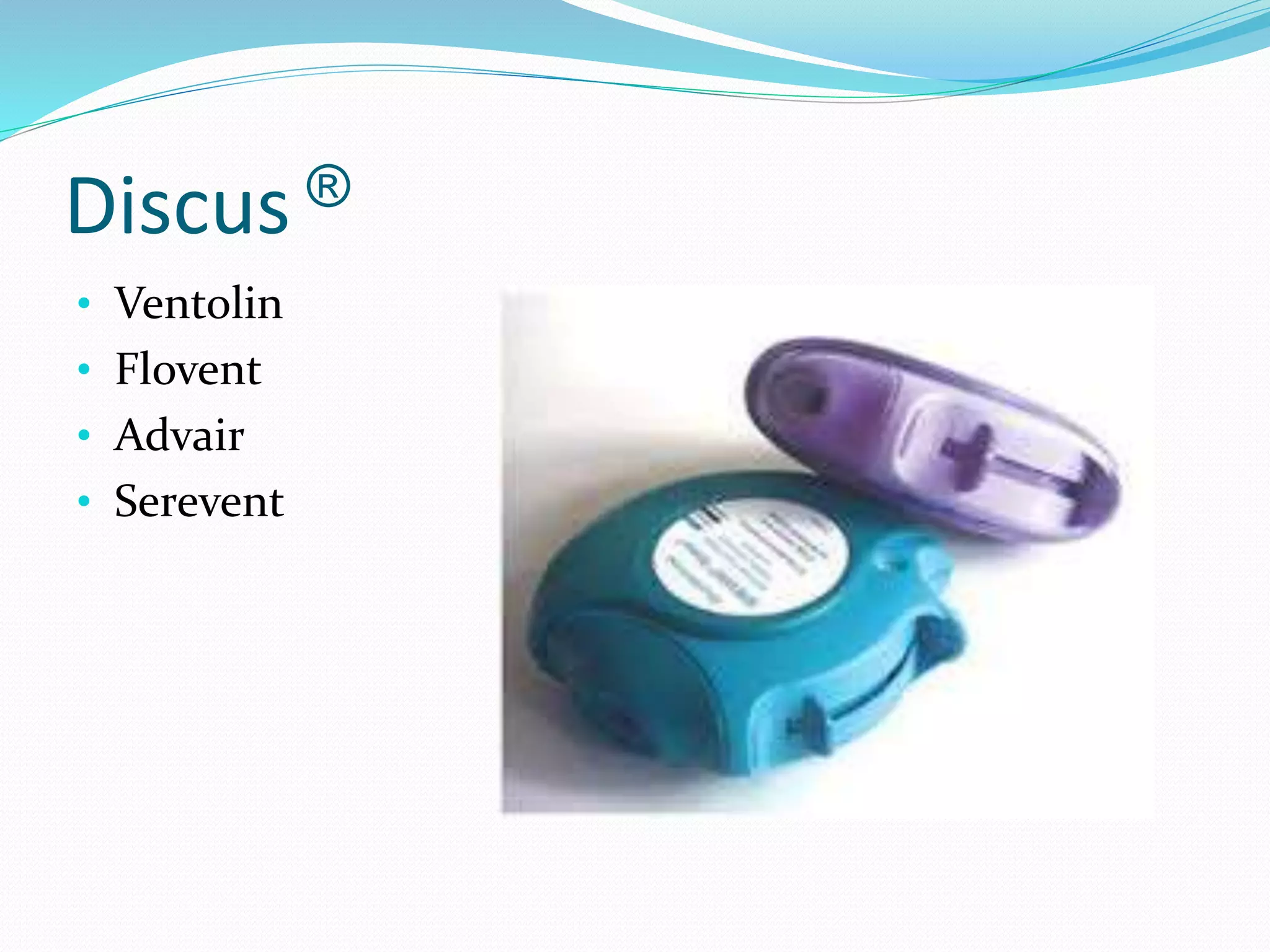
Discus ®
• Ventolin
• Flovent
• Advair
• Serevent
Turbuhaler ®
• Bricanyl
• Oxeze
• Pulmicort
• Symbicort
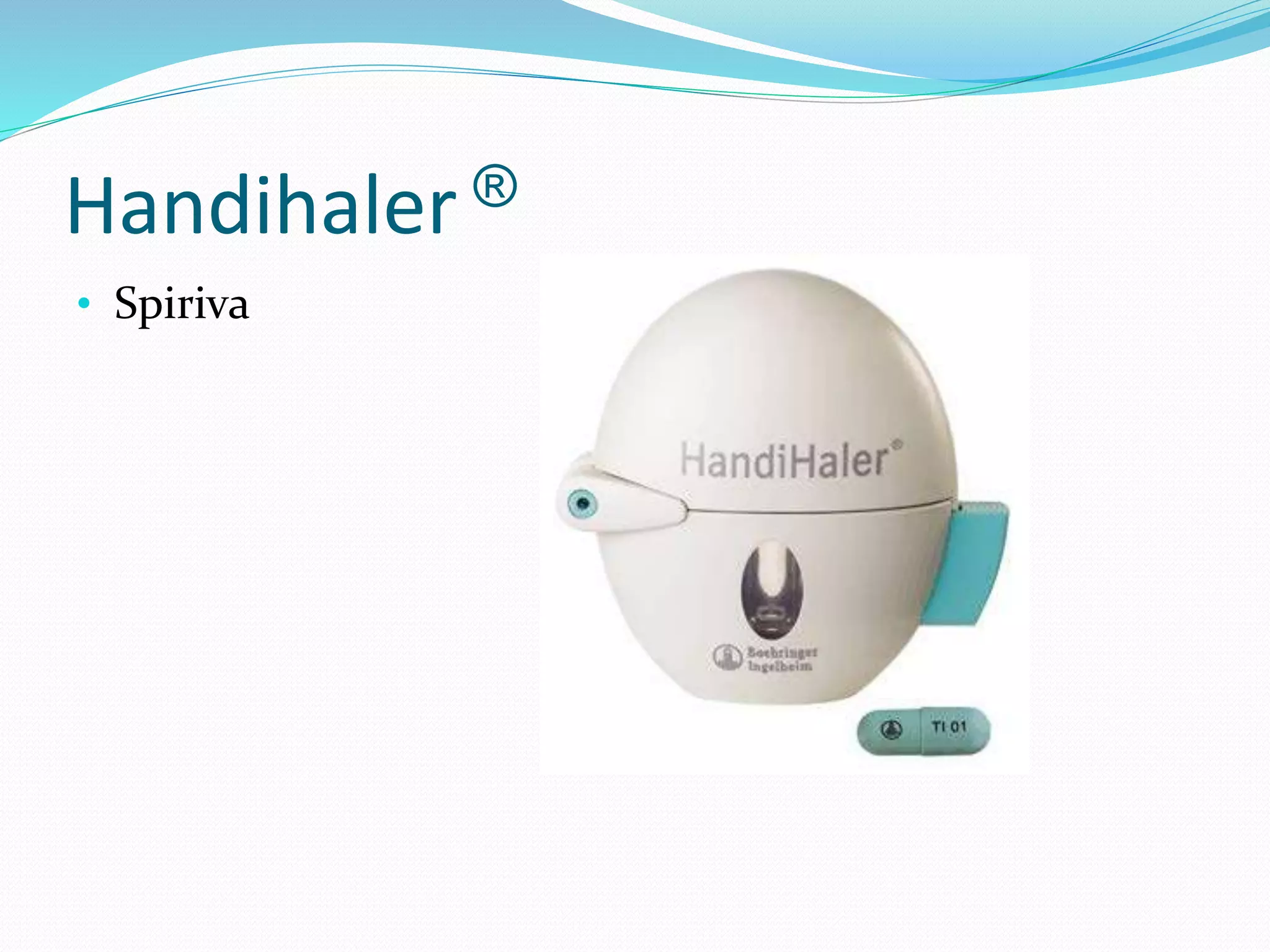
Handihaler ®
• Spiriva
Twisthaler ®
• Asmanex
Breezhaler ®
•Seebri
•Onbrez
•Ultibro
Ellipta®
•Incruse
•Anoro
•Breo
•Arnuity
Genuair ®
•Tudorza
•Duaklir
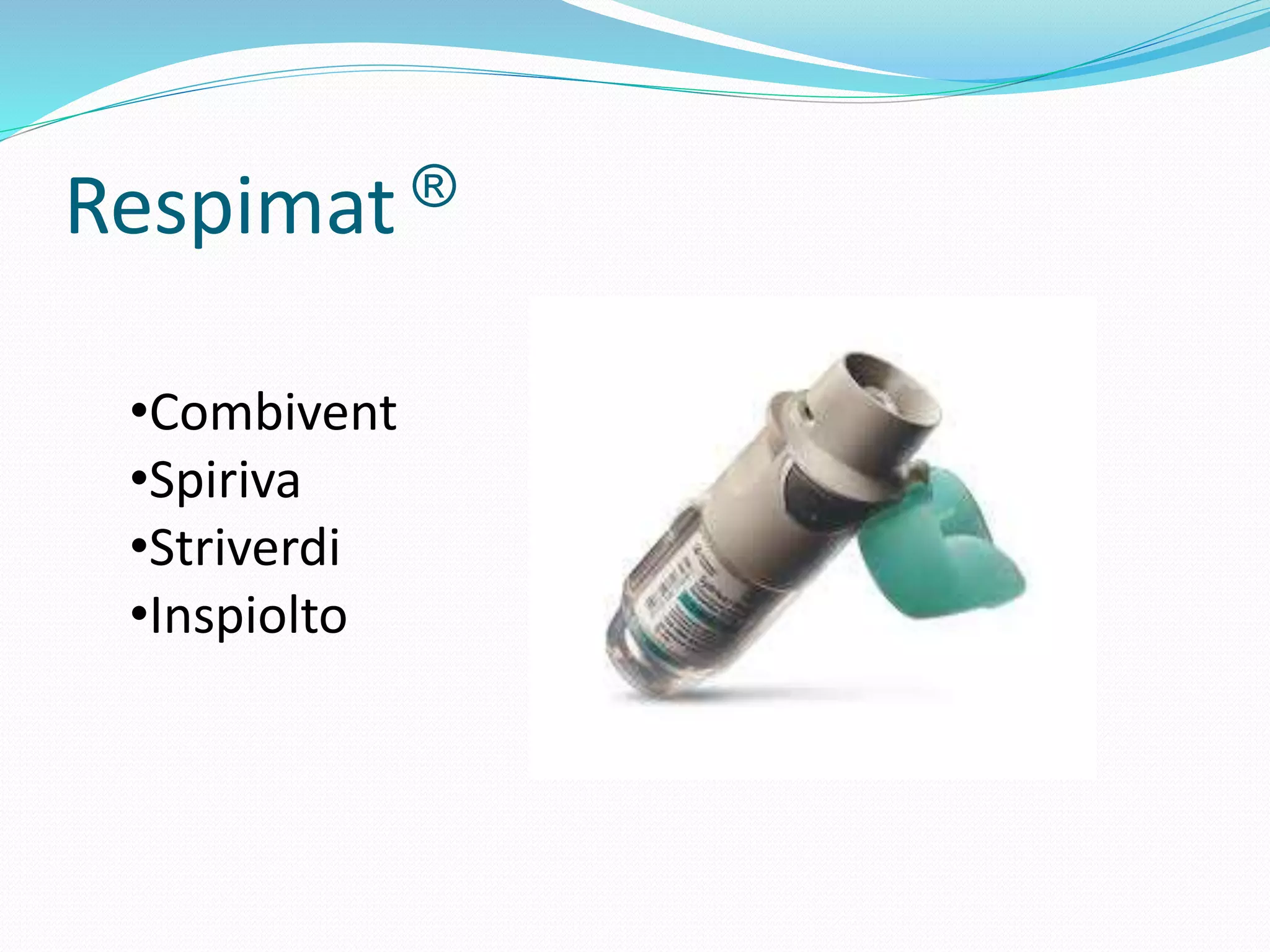
Respimat ®
•Combivent
•Spiriva
•Striverdi
•Inspiolto
We can’t do it alone….
Teamwork
divides the
task and
multiplies
the
success….
Medication and Delivery Devices
www.sk.lung.ca/resptrec-resources
CREs
https://mcarthurmedical.com
http://respiralogics.com
References
1.Evaluation of the use of inhaled medications by hospital inpatients with chronic
obstructive pulmonary disease.J, et al. Can J Hosp Pharm. 2012.
2.Rx Files –COPD New Drugs, New Devices and Considerations for Best Practice Sept/15
3. The Science of Respiratory Medication Delivery Information taken from a
2014Webinar presentation by Dr. Janice Leung, MD
4.New inhaler devices - the good, the bad and the ugly.Lavorini F, et al. Respiration
2014;88:3–15
5.Inhaler Technique and Training in People With Chronic Obstructive Pulmonary
Disease and Asthma:Choosing the Correct Inhaler
Toby G.D. Capstick, MRPharmS; Ian J. Clifton, MD Medscape CME Released: 01/27/2012
6.Dry powder inhalers and the right things to remember: a concept review
Dal Negro,R. Multidisciplinary Respiratory Medicine (2015) 10:13
7.Not all asthma inhalers are the same: factors to consider when prescribing an
inhaler Henry Chrystyna , David Pricea. Primary Care Respiratory Journal (2009)
8. http://www.specialconnections.ku.edu/?q=instruction/direct_instruction
9.Lung Association of Saskachewan-Inhaler videos and inhaler instruction sheets
10. Inhalation device requirements for patients' inhalation maneuvers PeterHaidl,et al
Thank-you!

Inhaled Medications Used in Respiratory Disease

  • 1.
    Donna Turner BSc,RRT, CRE 2018 PAS Conference Regina, Sask. May 13,2018
  • 2.
  • 3.
    Disclosures  Astra Zeneca Glaxo SmithKline  Boehringer Ingelheim  Novartis  U of S College of Nursing  U of S College of Medicine  Palliative Care Association-Prince Albert Division  SIAST LPN program  Lung Association of Saskatchewan  Saskatchewan College of Respiratory Therapists
  • 4.
    Outline  Understand factorsinvolved in therapeutic effectiveness of inhaled medications.  Factors involved in determining the right device for each patient.  How to educate patients on the proper use of devices.
  • 5.
    All inhalers areNOT created equal  When inhalers are used correctly, there is little difference in clinical efficacy between different inhaler types  Patients are not created equal and this is the only limit of these devices, one inhaler does not fit all. New inhaler devices - the good, the bad and the ugly. Lavorini F, et al. Respiration 2014;88:3–15
  • 6.
    Factors affecting therapeutic effectivenessof inhaled meds  Particle size of delivered med  Resistance within dry powder devices  Inspiratory flow by patient  Coordination of activation of device and inhalation  Correct inhaler use
  • 7.
    Particle size andits importance http://www.slideshare.net/ashrafeladawy/asthma-inhaler-techniques
  • 8.
    Inspiratory resistance inDPIs  Low resistance devices  Breezhaler  Medium resistance devices  Ellipta/Genuair/Diskus  High resistance devices  Turbuhaler/Handihaler Dry powder inhalers and the right things to remember: a concept review Dal Negro,R. Multidisciplinary Respiratory Medicine (2015) 10:13
  • 9.
    Inspiratory flows 20 Inhalation devicerequirements for patients' inhalation maneuvers PeterHaidl ,et al
  • 10.
    Coordination of inhalationand activation  MDI vs SMI vs DPI  DPI are breath actuated, so timing of inhalation is not an issue and some are pre loaded for easier use.  MDI and SMI require coordination of timing of inhalation with activation of delivery of med  Some inhalers have numerous steps involved in the delivery of inhaled med and this can lead to missteps in the procedure
  • 11.
    What is theright device? Base this on:  Ability of pt to coordinate device optimally  Ability to reach peak inspiratory flow for device  Physical Limitations Arthritis Tremor Poor Eyesight  Consider possible poor medication delivery during acute “attacks”  Advancing disease  Allowing pts to handle different devices and have a choice  Does the pt feel the med is working?
  • 12.
    Checking device useand education Evaluation of the use of inhaled medications by hospital inpatients with chronic obstructive pulmonary disease. Batterink J, et al. Can J Hosp Pharm. 2012.
  • 13.
    Education is thekey to success Common errors with devices
  • 14.
  • 15.
    A few pointsto consider…
  • 16.
    Metered Dose Inhaler® • Ventolin • Atrovent • Airomir • Flovent/Alvesco/Qvar • Advair/Zenhale
  • 17.
    Discus ® • Ventolin •Flovent • Advair • Serevent
  • 18.
    Turbuhaler ® • Bricanyl •Oxeze • Pulmicort • Symbicort
  • 19.
  • 20.
  • 21.
  • 22.
  • 23.
  • 24.
  • 25.
    We can’t doit alone…. Teamwork divides the task and multiplies the success….
  • 26.
    Medication and DeliveryDevices www.sk.lung.ca/resptrec-resources CREs
  • 27.
  • 28.
    References 1.Evaluation of theuse of inhaled medications by hospital inpatients with chronic obstructive pulmonary disease.J, et al. Can J Hosp Pharm. 2012. 2.Rx Files –COPD New Drugs, New Devices and Considerations for Best Practice Sept/15 3. The Science of Respiratory Medication Delivery Information taken from a 2014Webinar presentation by Dr. Janice Leung, MD 4.New inhaler devices - the good, the bad and the ugly.Lavorini F, et al. Respiration 2014;88:3–15 5.Inhaler Technique and Training in People With Chronic Obstructive Pulmonary Disease and Asthma:Choosing the Correct Inhaler Toby G.D. Capstick, MRPharmS; Ian J. Clifton, MD Medscape CME Released: 01/27/2012 6.Dry powder inhalers and the right things to remember: a concept review Dal Negro,R. Multidisciplinary Respiratory Medicine (2015) 10:13 7.Not all asthma inhalers are the same: factors to consider when prescribing an inhaler Henry Chrystyna , David Pricea. Primary Care Respiratory Journal (2009) 8. http://www.specialconnections.ku.edu/?q=instruction/direct_instruction 9.Lung Association of Saskachewan-Inhaler videos and inhaler instruction sheets 10. Inhalation device requirements for patients' inhalation maneuvers PeterHaidl,et al
  • 29.

Editor's Notes

  • #2 Hi, my name is Donna Turner… I want to Thank you for inviting me to speak today about Inhaled medications used in Respiratory disease. I want to start by acknowledging all the mom’s in the audience today and wish you all a very happy Mother’s day!
  • #3 I am a Respiratory Therapist and Certified Respiratory Educator and I have worked in Prince Albert for 32 years –some acute care, home care and now in a primary care clinic. I taught the RespTrec programs for the Lung Ass.of Saskatchewan for13 years but have been a volunteer with the Lung Association since I moved to Prince Albert, supporting the Pink Panters COPD program back in the early 1990s. So now I am working at the Cooperative Health Centre Community clinic in Prince Albert where there are 2 Respiratory Therapist CREs and we provide spirometry and education to asthma and COPD patients along with providing evaluations to help diagnose patients with chronic cough, shortness of breath and other respiratory issues. We see approximately 1500 patients per year so we get lots of practice teaching people about their inhaled medications and see a lot of the gaps in good drug delivery to the lungs. I am passionate about Respiratory care and Respiratory health and always looking for new ways to improve people’s breathing!
  • #7 All devices have their own particular engineering principles for proper medication delivery. BUT…there are basic principles of how drugs are delivered to lungs you need to be aware of.
  • #8 Particles of medication need to get past the upper oropharynx then moving down to the diseased portions of the lung near the terminal bronchioles and alveoli. Proper size is in the 1-5um size. Too big, they deposit too high in the oropharynx and larger airways, too small and they are exhaled out. Increased risk of s.e. if there is deposit at the back of the throat and upper airway. DPIs are breath actuated-need a deep and forcible inhalation at the start of the inhalation to deliver the proper size particles. The dry powder inhalers are designed in such a way that the drug/carrier mixture is partly deagglomerated into inhalable drug particles by the inspiratory airflow of the patient. The extent of device emptying and deagglomeration, depends strongly on the inspiratory airflow and absolute lung capacity, both of which differ from patient to patient and which determines the fine particle dose of drug emitted from the dry powder inhaler. MDIs produce consistent, appropriate particle size on activation carried in a propellant. Respimat SMI produce fine mist of the proper size particles on activation without a propellant.
  • #9 No significant resistance with the MDI or SMI devices We need to know there is a resistance within a device and how this relates to the inspiratory flow required by the patient to disperse the drug into the appropriate particle size to then be inhaled into the diseased area of the lung. For DPIs additional effort is necessary to overcome the device specific resistance to reach the required flow rate. Low resistance device requires high flow rate to disperse drug-the resistance within the device is not helping with this maneuver. Medium resistance device requires moderate force to produce the required inspiratory flow rate. The resistance of the device is involved in breaking up the particles within device and then pt completes inhalation of med. High resistance device requires a significantly higher force to produce the required inspiratory flow rate.The resistance of the device is involved in breaking up the particles within device and then pt completes inhalation of med. The extent of device emptying and deagglomeration, which determines the fine particle dose of drug emitted from the dry powder inhaler, depends strongly on the inspiratory airflow and absolute lung capacity, both of which differ from patient to patient.
  • #10 MDI flow rate-less than 90 lpm. Slow and steady with breath hold at the end of inhalation. Too fast, too turbulent, less drug delivery. Spacer improves delivery. SMI flow rate-not dependent on the pt’s insp flow . Slow deep breath with a 10 second breath hold being ideal. Every breath-actuated DPI has a minimum threshold in terms of flow efficiency. If the inspiratory flow rate is too low (or the flow acceleration below a threshold), deagglomeration is insufficient and a reduced dose is delivered The limits of the DPIs in advanced disease is that all these devices require a fast deep inspiration and some pts cannot generate sufficient insp flow with DPIs. Not all COPD patients but some with advanced COPD pts have inadequate PIF which may limit use of some or all DPIs. Plugging the nose may allow a greater inspiratory flow through mouth. One of our patients was not able to generate the high inspiratory flow required for the Breezhaler device. He actually cut the end off of each capsule for his Breezhaler and dumped the med into the chamber so he could get the med out of the device! Snorting Onbrez! New drug deliver method?
  • #11 Advantage of DPI over MDI and SMI is that they are breath actuated and for some pre loaded. This is very appealing to some patients. Remember, just because you have severe COPD does not mean you will not be able to use DPIs.
  • #12 Using the IN Check dial for checking inspiratory flow of pts using DPI and to emphasize the slower inspiration required with the MDIs. What do we do with patients to know what inhaler will work or what they have won’t work? What tools? What signs? IN check dial helps determine inspiratory strength of patients against various resistances similar to the resistances of inhalers. Basically, if a pt cannot inspire strong enough for one type of inhaler, then we need to move to alternate device
  • #13 Eg:Pt could not turn the Respimat device due to her arthritis. Recent study in Vancouver found 59% of patients admitted to hospital for COPD AE misused their inhalation devices. 93% of those using an MDI made at least one critical error contributing to inadequate amts of drug delivered to lungs.
  • #14 Correct use of the inhalation devices will maximize the beneficial effects of therapy, while minimizing potential adverse effects.  Identification of poor inhaler technique is an integral part of the management of patients with asthma or COPD Provision of appropriate training is going to remain essential for the management of patients with asthma and COPD for the foreseeable future. Regular review of watching patients taking their inhaled medication is also important.
  • #15 Ideally if we all use the same instructions to teach proper inhaler use then the message gets across to our patients. These are just a few of the education tools available from the Lung Association of Saskatchewan. Videos are also available on line to direct your patients to when time is an issue.
  • #16 While educating someone on a new inhaler, sometimes it’s good to know some of the things that could go wrong and we can emphasize these points to ensure mastery!
  • #17 MDI No appreciable resistance Requires coordination of actuation and inhalation Med is delivered with a propellant. Can add spacer to improve drug delivery Needs slow deep inspiration with breath hold at the end of inspiration-breath in should be 3-5 sec long. Make sure they know how to check that if it is empty-count doses used per day or listen for med in canister or weight of canister helps indicate doses left.
  • #18 Discus Medium resistance device. Pre-loaded with med. Can double dose this device-if opened but no med inhaled, when you open again, the last dose is still there, added to the second dose. Pt must keep this device level once loaded because dose will fall from device if tipped. Make sure they understand to open lid, then open device.
  • #19 Turbuhaler High resistance dry powder device. Preloaded with medication. Need to hear the click after you turn one way then back to indicate drug is loaded. Requires a very strong deep inspiration to deliver med. Cannot double dose, will not load one dose on top of another if first dose not inhaled. When you shake device the drying agent is what you hear not the med. Med counter can be hard to see until it gets to last 20 doses, then red wheel appears. Red trainer is not indicating pt has enough inspiratory strength
  • #20 Handihaler High resistance capsule-based device. Requires a strong deep inspiration to deliver med. Requires insertion of med pill-watch for pt taking pill orally or rectally! Pt with issues with eyesight may struggle to see where to put capsule. Medication sensitive to light and temperature, keep in foil packaging until ready to use. Pt with tremors will have difficulty loading this med. Capsule is opaque and cannot see when capsule is empty-patients sometimes take it apart to see if it is empty! Pt needs to take 2 inhalations to make sure they empty capsule adequately. Some patients cannot draw the medication deep enough for effect. Make sure pt releases button on sides after puncturing capsule. Pt needs to wash hands after use.
  • #21 TTwisthaler High resistance dry powder device. Preloaded with medication. When pt takes off the lid, the med is loaded and ready to take. Pt has to tighten the lid down tight to make sure next dose is loaded. Pt needs to watch the number of doses decrease when they open device Requires a very strong deep inspiration to deliver med. Med counter easy to see and device locks out when the device is empty.
  • #22 Breezhaler. Low resistance capsule-based device. Require insertion of med pill-watch for pt taking pill orally or rectally! Medication sensitive to light and temperature, keep in foil packaging until ready to use. Pt with tremors will have difficulty with this med. Pt with issues with eyesight may struggle to see where to put capsule. Capsule is clear so easy to see if empty after taking dose. Fast inspiratory flow is required to deliver meds deep within lungs with this device which may be difficult for some patients Make sure pt releases buttons on sides after puncturing capsule. Static on pill can make it difficult to puncture pill-can puncture pill when device is open then close device and inhale
  • #23 Ellipta Medium resistance device. Preloaded with med. Device requires a fast inspiratory flow. Make sure they hear the click when they open the device fully Pt must not cover air vents on top of inhaler as this helps maximize inspiratory flow and subsequent drug delivery. Big numbers on the front make it easy to see. Easy to open for patients with arthritis or little hands. Must not blow into device or med will come out the air vents. Cannot double dose as it dumps one dose before another is loaded. Must keep unit level when opened to prevent dumping out dose.
  • #24 Genuair Medium resistance device. Pre loaded with med. Has acoustic and auditory signals to help pts know they have taken the inhaler properly. Taste can be a deterrent to use. The Genuair® locks after the last dose. Twice per day dosing may lead to non-adherence to schedule.
  • #25 Respimat Device delivers fine particles in a soft mist with no appreciable resistance Needs coordination of inhalation and drug delivery from device. Cannot use with Spacer to help with coordination until further studies. Close lips tightly around the mouthpiece without closing the air vents (on the sides of the mouthpiece) The high amount of fine particles exit device slower and for a longer period of time(1.5s) compared to the MDI. Higher lung deposition, no propellant. 10 secs breath hold required to improve drug delivery. Requires assembly prior to using device for the first time Needs priming to start or if not used for 30 days. When the arrow reaches the end of the scale the inhaler locks automatically.
  • #26 Teamwork really is how we improve our chances of success…..find the resources in your area who can help!