DR. FIROZ A HAKKIM
MD RESPIRATORY MEDICINE
BRONCHODILATORS
SYMPATHOMIMETICS
NON- SELECTIVE
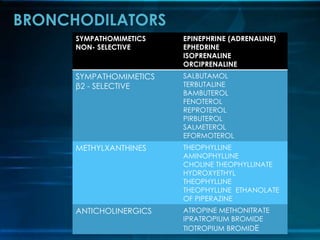
EPINEPHRINE (ADRENALINE)
EPHEDRINE
ISOPRENALINE
ORCIPRENALINE
SYMPATHOMIMETICS
β2 - SELECTIVE
SALBUTAMOL
TERBUTALINE
BAMBUTEROL
FENOTEROL
REPROTEROL
PIRBUTEROL
SALMETEROL
EFORMOTEROL
METHYLXANTHINES THEOPHYLLINE
AMINOPHYLLINE
CHOLINE THEOPHYLLINATE
HYDROXYETHYL
THEOPHYLLINE
THEOPHYLLINE ETHANOLATE
OF PIPERAZINE
ANTICHOLINERGICS ATROPINE METHONITRATE
IPRATROPIUM BROMIDE
TIOTROPIUM BROMIDE
BRONCHODILATORS
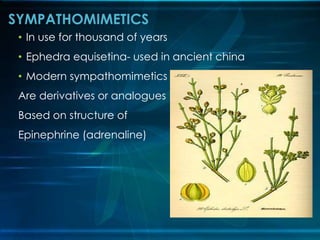
• In use for thousand of years
• Ephedra equisetina- used in ancient china
• Modern sympathomimetics
Are derivatives or analogues
Based on structure of
Epinephrine (adrenaline)
SYMPATHOMIMETICS
They are both alpha and beta adrenergic agonist that
acts as a neurotransmitter in the sympathetic nervous
system,
Alpha receptor being predominantly stimulatory
(vasoconstriction) and beta receptor predominantly
inhibitory ( relaxation of smooth muscle in the
respiratory tract, vasculature and uterus)
SYMPATHOMIMETICS
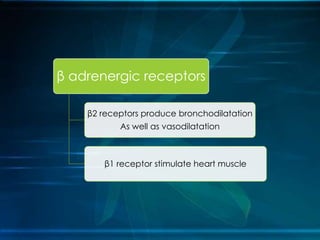
β adrenergic receptors
β2 receptors produce bronchodilatation
As well as vasodilatation
β1 receptor stimulate heart muscle
• Are non selective or poorly selective and are more
likely to produce unwanted effects ( tachycardia,
cardiac stimulation)
• Adrenaline – alpha + beta 1 + beta 2 agonist
• Ephedrine – alpha + beta 1 + beta 2 action
• Isoprenaline – beta 1 + beta 2 agonist
Non selective
sympathomimetics
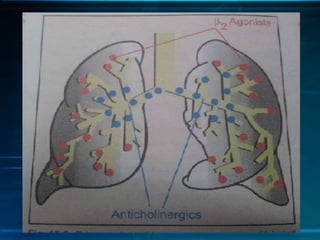
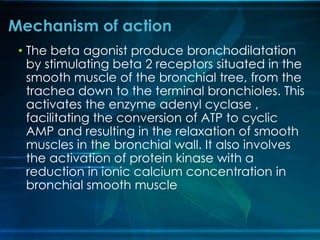
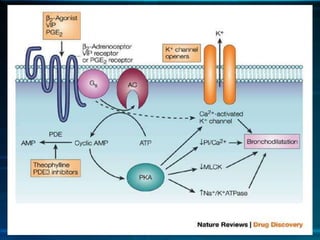
• The beta agonist produce bronchodilatation
by stimulating beta 2 receptors situated in the
smooth muscle of the bronchial tree, from the
trachea down to the terminal bronchioles. This
activates the enzyme adenyl cyclase ,
facilitating the conversion of ATP to cyclic
AMP and resulting in the relaxation of smooth
muscles in the bronchial wall. It also involves
the activation of protein kinase with a
reduction in ionic calcium concentration in
bronchial smooth muscle
Mechanism of action
• Other beneficial non bronchodilator
effects include enhanced mucociliary
transport, diminished release of
histamine and other chemical
mediators of asthma from mast cells,
inhibition of cholinergic
neurotransmission and a possible
increased ventilatory response to
hypercapnia and hypoxia
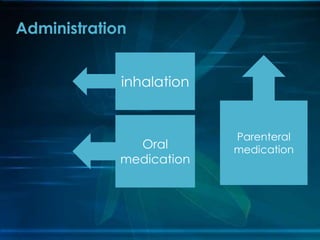
Administration
inhalation
Oral
medication
Parenteral
medication
• Preferred route is inhalation from MDI
• 10 % of fraction leaving device reaches lungs,
remaining impacting in oropharynx and being
swallowed
• Systemic side effects are generally insignificant in
comparison to oral administration
• Rapid onset of action compared with same drug
taken orally
• Onset of 3-6 min, 80% bronchodilatation in 5 min.
Reaching peak in 30- 60 min, effect wearing off
over 3-6 hr.
Inhalation
• If unable to manage inhaled therapy
• Slow onset of action , produce
bronchodilatation after about 30 min and
reaching a peak at 1-2 hr
Oral medication
• In severe exacerbations
• Onset of action is rapid, occuring within a
few minutes and peak effect reached
sooner than inhalation , duration of action
being 4 hrs
Parenteral medication
• When swallowed may undergo conjugation in gut
wall as well as in liver
• Relatively small quantities of these drugs are
excreted unchanged by the kidneys and dosage
modification is unnecessary in renal insufficiency
• Slightly penetrate the blood brain barrier and also
cross placenta so that oral medication is perhaps
better avoided in pregnancy.
Metabolism and excretion
• Principal dose limiting adverse effect of beta agonist is
Skeletal muscle tremors, particularly affecting hands.
• Muscle cramps, tachycardia ( reduced peripheral
vascular resistance, vasodilatation occuring as a result
of stimulation of receptors in vascular smooth muscle)
• Metabolic effects like hypokalemia, brought about by
stimulation of pancreatic beta 2 receptors , resulting in
increased insulin release and an intracellular potassium
shift
• Non specific effects – dryness of mouth, nausea ,
vomiting
Adverse effects
• Paradoxical bronchoconstriction occuring after
patients have taken beta 2 agonist by pressurized MDI
or nebulization, are unusual and may be by drug or the
constituent of propellant or physical charecteristics like
temperature , ph , osmolality.
• May worsen ventilation – perfusion mismatch in short
term.may arise if pulmonary vessels that were
previously reflexly constricted in response to local
hypoxia are dilated by beta 2 receptor stimulation so
that blood is shunted into areas of lung still relatively
poorly ventilated. This can be overcome by
administration of oxygen as a routine.
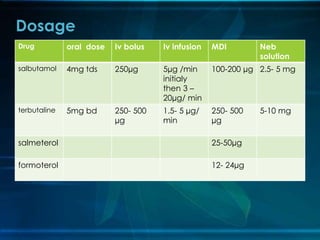
Drug oral dose Iv bolus Iv infusion MDI Neb
solution
salbutamol 4mg tds 250µg 5µg /min
initialy
then 3 –
20µg/ min
100-200 µg 2.5- 5 mg
terbutaline 5mg bd 250- 500
µg
1.5- 5 µg/
min
250- 500
µg
5-10 mg
salmeterol 25-50µg
formoterol 12- 24µg
Dosage
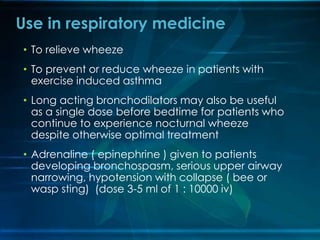
• To relieve wheeze
• To prevent or reduce wheeze in patients with
exercise induced asthma
• Long acting bronchodilators may also be useful
as a single dose before bedtime for patients who
continue to experience nocturnal wheeze
despite otherwise optimal treatment
• Adrenaline ( epinephrine ) given to patients
developing bronchospasm, serious upper airway
narrowing, hypotension with collapse ( bee or
wasp sting) (dose 3-5 ml of 1 : 10000 iv)
Use in respiratory medicine
Bronchodilators  sympathomimetics

Bronchodilators sympathomimetics

  • 1.
    DR. FIROZ AHAKKIM MD RESPIRATORY MEDICINE BRONCHODILATORS
  • 2.
    SYMPATHOMIMETICS NON- SELECTIVE EPINEPHRINE (ADRENALINE) EPHEDRINE ISOPRENALINE ORCIPRENALINE SYMPATHOMIMETICS β2- SELECTIVE SALBUTAMOL TERBUTALINE BAMBUTEROL FENOTEROL REPROTEROL PIRBUTEROL SALMETEROL EFORMOTEROL METHYLXANTHINES THEOPHYLLINE AMINOPHYLLINE CHOLINE THEOPHYLLINATE HYDROXYETHYL THEOPHYLLINE THEOPHYLLINE ETHANOLATE OF PIPERAZINE ANTICHOLINERGICS ATROPINE METHONITRATE IPRATROPIUM BROMIDE TIOTROPIUM BROMIDE BRONCHODILATORS
  • 3.
    • In usefor thousand of years • Ephedra equisetina- used in ancient china • Modern sympathomimetics Are derivatives or analogues Based on structure of Epinephrine (adrenaline) SYMPATHOMIMETICS
  • 4.
    They are bothalpha and beta adrenergic agonist that acts as a neurotransmitter in the sympathetic nervous system, Alpha receptor being predominantly stimulatory (vasoconstriction) and beta receptor predominantly inhibitory ( relaxation of smooth muscle in the respiratory tract, vasculature and uterus) SYMPATHOMIMETICS
  • 5.
    β adrenergic receptors β2receptors produce bronchodilatation As well as vasodilatation β1 receptor stimulate heart muscle
  • 7.
    • Are nonselective or poorly selective and are more likely to produce unwanted effects ( tachycardia, cardiac stimulation) • Adrenaline – alpha + beta 1 + beta 2 agonist • Ephedrine – alpha + beta 1 + beta 2 action • Isoprenaline – beta 1 + beta 2 agonist Non selective sympathomimetics
  • 8.
    • The betaagonist produce bronchodilatation by stimulating beta 2 receptors situated in the smooth muscle of the bronchial tree, from the trachea down to the terminal bronchioles. This activates the enzyme adenyl cyclase , facilitating the conversion of ATP to cyclic AMP and resulting in the relaxation of smooth muscles in the bronchial wall. It also involves the activation of protein kinase with a reduction in ionic calcium concentration in bronchial smooth muscle Mechanism of action
  • 10.
    • Other beneficialnon bronchodilator effects include enhanced mucociliary transport, diminished release of histamine and other chemical mediators of asthma from mast cells, inhibition of cholinergic neurotransmission and a possible increased ventilatory response to hypercapnia and hypoxia
  • 11.
  • 12.
    • Preferred routeis inhalation from MDI • 10 % of fraction leaving device reaches lungs, remaining impacting in oropharynx and being swallowed • Systemic side effects are generally insignificant in comparison to oral administration • Rapid onset of action compared with same drug taken orally • Onset of 3-6 min, 80% bronchodilatation in 5 min. Reaching peak in 30- 60 min, effect wearing off over 3-6 hr. Inhalation
  • 13.
    • If unableto manage inhaled therapy • Slow onset of action , produce bronchodilatation after about 30 min and reaching a peak at 1-2 hr Oral medication
  • 14.
    • In severeexacerbations • Onset of action is rapid, occuring within a few minutes and peak effect reached sooner than inhalation , duration of action being 4 hrs Parenteral medication
  • 15.
    • When swallowedmay undergo conjugation in gut wall as well as in liver • Relatively small quantities of these drugs are excreted unchanged by the kidneys and dosage modification is unnecessary in renal insufficiency • Slightly penetrate the blood brain barrier and also cross placenta so that oral medication is perhaps better avoided in pregnancy. Metabolism and excretion
  • 16.
    • Principal doselimiting adverse effect of beta agonist is Skeletal muscle tremors, particularly affecting hands. • Muscle cramps, tachycardia ( reduced peripheral vascular resistance, vasodilatation occuring as a result of stimulation of receptors in vascular smooth muscle) • Metabolic effects like hypokalemia, brought about by stimulation of pancreatic beta 2 receptors , resulting in increased insulin release and an intracellular potassium shift • Non specific effects – dryness of mouth, nausea , vomiting Adverse effects
  • 17.
    • Paradoxical bronchoconstrictionoccuring after patients have taken beta 2 agonist by pressurized MDI or nebulization, are unusual and may be by drug or the constituent of propellant or physical charecteristics like temperature , ph , osmolality. • May worsen ventilation – perfusion mismatch in short term.may arise if pulmonary vessels that were previously reflexly constricted in response to local hypoxia are dilated by beta 2 receptor stimulation so that blood is shunted into areas of lung still relatively poorly ventilated. This can be overcome by administration of oxygen as a routine.
  • 18.
    Drug oral doseIv bolus Iv infusion MDI Neb solution salbutamol 4mg tds 250µg 5µg /min initialy then 3 – 20µg/ min 100-200 µg 2.5- 5 mg terbutaline 5mg bd 250- 500 µg 1.5- 5 µg/ min 250- 500 µg 5-10 mg salmeterol 25-50µg formoterol 12- 24µg Dosage
  • 19.
    • To relievewheeze • To prevent or reduce wheeze in patients with exercise induced asthma • Long acting bronchodilators may also be useful as a single dose before bedtime for patients who continue to experience nocturnal wheeze despite otherwise optimal treatment • Adrenaline ( epinephrine ) given to patients developing bronchospasm, serious upper airway narrowing, hypotension with collapse ( bee or wasp sting) (dose 3-5 ml of 1 : 10000 iv) Use in respiratory medicine