HUMIDIFIERS
MODERATOR- DR. MOHIT JAGGA
PRESENTER- DR. AMIT
• Humidity: Amount of water vapor in a gas.
• Absolute humidity: Mass of water vapor
present in a volume of gas. (milligram of water
per liter of gas)
• Humidity at saturation: Maximum amount of
water vapor that volume of gas can hold.
Varies with temperature. Warmer the temp-
more the water vapor held by the gas.
At body temp 37˚C- 44mg H2O/ L
• Relative humidity (percent saturation)
: Amount of water vapor at particular
temperature expressed as percentage of
amount that would be held if the gas were
saturated.​
• Water vapor pressure: Pressure exerted by
water vapor in a gas mixture.​
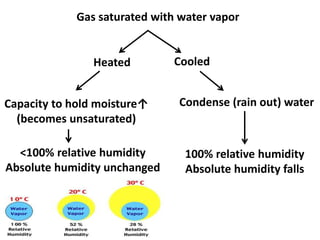
Gas saturated with water vapor
Heated Cooled
Capacity to hold moisture↑
(becomes unsaturated)
Condense (rain out) water
<100% relative humidity
Absolute humidity unchanged
100% relative humidity
Absolute humidity falls
ANAESTHETIC CONSIDERATIONS
• Upper respiratory tract (esply nose) functions as
principal heat and moisture exchanger.
Temp in upper trachea- 30˚C- 33˚C
Relative humidity- 98% Water content- 33mg/L
• Tracheal tubes and supraglottic airway devices
bypass the airway when tracheobronchial
mucosa takes up this role but its capacity is
limited.
•Water is intentionally removed from medical
gases to prevent clogging of regulators and
valves, thus gases delivered
from anaesthesia machine are dry and at room
temperature.
•When such gas is inspired it gets warmed to
body temp and absorbs water by evaporation
from surface of resp tract mucosa till it becomes
saturated causing drying of the resp mucosa.
EFFECTS OF DRY GAS INHALATION
• Damage to resp. tract- Secretions thicken
- Ciliary function↓
- Surfactant activity impaired
- Atelectasis and airway
obstruction
- loci for infection
- Susceptible to injury
• Body heat loss
• Absorbent desiccation
• Tracheal tube obstruction- due to thickened secretions
• Excessive humidity causes ciliary degeneration and
paralysis, pulmonary edema, decreased hematocrit and
serum sodium.
SOURCES OF HUMIDITY AND HEART
• CO2 absorbent- reaction of absorbent with CO2 liberates
water and heat (exothermic reaction)
• Exhaled gases- by rebreathing
• Rinsing inside of breathing tubes and reservoir bag with
water
• Low fresh gas flow with circle breathing system conserves
moisture
• Coaxial breathing circuits
NOTE- Bains circuit though coaxial does not meet optimal
humidification requirement due to high fresh gas flows
HUMIDIFIERS are devices that add molecules of water to gas.
Classified as :-
• Active humidifiers (presence of external sources of heat
and water)
• Passive humidifiers (utilization of patient’s own
temperature and hydration to achieve humidification in
successive breaths)
HUMIDIFIERS
ACTIVE HUMIDIFIERS
• Act by allowing air passage inside a heated water
reservoir.
• Add water to gas by passing the gas over a water
chamber, through a saturated wick, bubbling it through
water, or mixing it with vaporized water.
• Do not filter respiratory gases
• Two types –
1. Heated
2. Unheated
HEATED HUMIDIFIERS
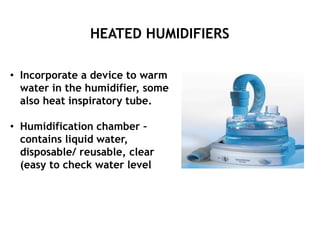
• Incorporate a device to warm
water in the humidifier, some
also heat inspiratory tube.
• Humidification chamber –
contains liquid water,
disposable/ reusable, clear
(easy to check water level
COMPONENTS
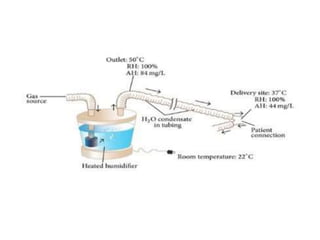
• HUMIDIFICATION CHAMBER- contains water.
• HEAT SOURCE- heated rods immersed in water or plate at
bottom of chamber.
• INSPIRATORY TUBE- conveys humidified gas to pt. Has a
water trap to collect condensed water. Heated wire inside
the tube to prevent moisture rainout and for more precise
control of temperature.
• TEMPERATURE MONITOR- to measure gas
temperature at patient end of breathing system
• THERMOSTAT
• CONTROLS FOR TEMPERATURE SELECTION
• ALARMS
THERMOSTAT -
• SERVO CONTROLLED UNIT- automatically regulates
power to heating element in response to
temperature sensed by probe near patient
connection.
• NON SERVO CONTROLLED UNIT- provides power to
heating element according to the setting of a
control irrespective of delivered temperature.
Controls –
most allow temperature selection at end of
delivery tube or at humidification chamber
outlet
Alarms –
to indicate
• temperature deviation by a fixed amount.
• displacement of temperature probe.
• disconnection of heater wire.
• low water level in humidification chamber.
• faulty airway temperature probe.
• lack of gas flow in the circuit
ADVANTAGES
Provide saturated gas at body
temperature or above even
with high flow rates
Some can be used for
spontaneously breathing and
tracheostomized patients
DISADVANTAGES
Bulky, complex
High maintenance costs
Electrical hazards
Increased work
Little protection against heat
loss during anesthesia
Different designs and different techniques for humidification.
STANDARD REQUIREMENTS
• Must be capable of producing output of at least
10 mg H2O/L and 33 mg H2O/L with supraglottic
airway devices.
• Average temperature at delivery tube outlet not to
fluctuate by >2˚C from set temperature. (Alarm activated if
not so)
• Volume of liquid exiting humidifier shall not exceed
1ml/min or 20ml/hr (neonates) and 5ml/min or 20ml/hr
(others).
• Gas temperature at outlet shall not exceed 41˚C.
Interrupt heating and activate alarm if > 41˚C.
• Accessible surface temperature of delivery tube not
>44˚C with in 25cm of patient connection port.
• No water spillage into breathing system if humidifier
tilted 20˚ from normal position.
• All calibrated controls and indicators accurate to within
5% of their full scale values (except temp ±2˚C).
• Direction of flow must be marked on humidifiers with
flow direction sensitive components.
HOW TO USE
• IN CIRCLE SYSTEM- Heated humidifier to be placed in
inspiratory limb downstream of unidirectional valve and
filter should be upstream of humidifier.
• IN MAPELSON SYSTEM- placed in the fresh gas supply
tube. The temperature probe should be between fresh gas
supply tube and T-piece or between T-piece and patient.
HAZARDS
• Infection
• Breathing system problems- sticking valves, leaks, noise,
clogged filters and HMEs, fires, overheating etc.
• Water aspiration
• Overhydration
• Thermal injury
• Increased work of breathing
• Monitoring intreference with flow and pressure sensors
• Altered anaesthetic agents
• Equipement damage or malfunction
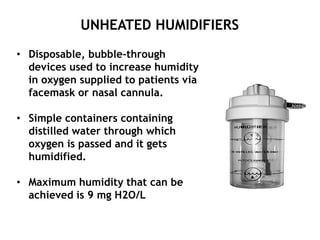
UNHEATED HUMIDIFIERS
• Disposable, bubble-through
devices used to increase humidity
in oxygen supplied to patients via
facemask or nasal cannula.
• Simple containers containing
distilled water through which
oxygen is passed and it gets
humidified.
• Maximum humidity that can be
achieved is 9 mg H2O/L
PASSIVE HUMIDIFIERS
• Simplest designs are Heat & Moisture Exchangers
(HMEs).
• Artificial noses - mimic the action of nasal cavity
in gas humidification.
• Also called as condenser humidifier, Swedish
nose, nose humidifier, regenerative humidifier,
vapor condenser
HEAT AND MOISTURE EXCHANGERS
(HME)
• Conserves some exhaled water and heat and returns
them to patient in the inspired gas.
• Placed between ET tube and breathing circuit
• Also filter bacteria/ virus (heat and moisture
exchanging filter).
• Pediatric and neonatal low dead space HMEs are also
available.
OTHER END
PATIENT END
INDICATIONS
• ↑ Inspired heat and
humidity during both short
and long term ventilation.
• Especially useful when
transporting intubated
patients on transport
ventilators.
• Supply supplemental
oxygen to intubated pt or pt
with supraglottic airway.
CONTRAINDICATIONS
• Patients with thick, copious or bloody secretions
• Pts with a leak that prevents exhaled gas from traversing
the passive humidifier (bronchopleuralcutaneous fistula
or leaking or absent tracheal tube cuff)
• Pts managed with low tidal volume like ARDS
• Hypothermic pts <32˚C
• Pts with high minute ventilation volumes (>10L/min)
• Hygroscopic HME- Wool, foam or paper like material
coated with moisture retaining chemical
• Hydrophobic HME- Pleated hydrophobic membrane with
small pores
• Composite hydrophobic and hygroscopic- A hygroscopic
salt (calcium or lithium chloride) is added inside the
hydrophobic HME.
• Composite hygroscopic HMES- Hygroscopic HME with a
layer of thin, non woven fiber subjected to electric field
which increases its polarity and improves filtration
efficiency
OTHER TYPES
USE
• Small HMEs used in large pts will be inefficient.
• Connecting more than 1 HME in series will improve
performance.
• Increase in dead space should not be excessive.
• Should be accessible and visible- to detect contamination or
disconnection.
• Greatest inspired humidity when placed next to tracheal tube.
• Sampling line should be on machine side to decrease amount
of moisture exposed to it.
• Can be used with any breathing system, in tracheostomised
pts.
Can be combined with unheated humidifier.
Can be used with nebulizer (to be placed bt pt and HME).
• Should be replaced if contaminated with secretions.
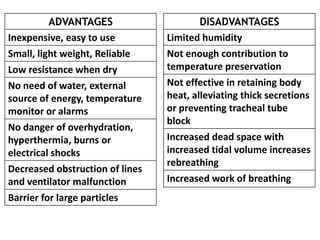
ADVANTAGES
Inexpensive, easy to use
Small, light weight, Reliable
Low resistance when dry
No need of water, external
source of energy, temperature
monitor or alarms
No danger of overhydration,
hyperthermia, burns or
electrical shocks
Decreased obstruction of lines
and ventilator malfunction
Barrier for large particles
DISADVANTAGES
Limited humidity
Not enough contribution to
temperature preservation
Not effective in retaining body
heat, alleviating thick secretions
or preventing tracheal tube
block
Increased dead space with
increased tidal volume increases
rebreathing
Increased work of breathing
HAZARDS
• Excessive resistance
• Airway obstruction
• Inefficient filtration
• Foreign particle aspiration
• Rebreathing
• Leaks and disconnections
• Hypothermia
• Dry CO2 absorbent
HEAT AND MOISTURE EXCHANGING FILTER
(HMEF)
• Operate based on electrostatic or mechanical
filtration.
• classified into :
1. Pleated
2. Electrostatic filters
• In certain devices, an active heated water source can
be added to HMEs converting them from passive to
active, increasing their humidification capacity.
• If the external source of water runs out, these devices
will still work as passive HMEs
• Several models exist :
1. Booster
2. Performer
3. Humid heat
4. Hygrovent gold
ACTIVE HMES
THANK YOU

Humidifiers.pptx

  • 1.
    HUMIDIFIERS MODERATOR- DR. MOHITJAGGA PRESENTER- DR. AMIT
  • 2.
    • Humidity: Amountof water vapor in a gas. • Absolute humidity: Mass of water vapor present in a volume of gas. (milligram of water per liter of gas) • Humidity at saturation: Maximum amount of water vapor that volume of gas can hold. Varies with temperature. Warmer the temp- more the water vapor held by the gas. At body temp 37˚C- 44mg H2O/ L
  • 3.
    • Relative humidity(percent saturation) : Amount of water vapor at particular temperature expressed as percentage of amount that would be held if the gas were saturated.​ • Water vapor pressure: Pressure exerted by water vapor in a gas mixture.​
  • 4.
    Gas saturated withwater vapor Heated Cooled Capacity to hold moisture↑ (becomes unsaturated) Condense (rain out) water <100% relative humidity Absolute humidity unchanged 100% relative humidity Absolute humidity falls
  • 5.
    ANAESTHETIC CONSIDERATIONS • Upperrespiratory tract (esply nose) functions as principal heat and moisture exchanger. Temp in upper trachea- 30˚C- 33˚C Relative humidity- 98% Water content- 33mg/L • Tracheal tubes and supraglottic airway devices bypass the airway when tracheobronchial mucosa takes up this role but its capacity is limited.
  • 6.
    •Water is intentionallyremoved from medical gases to prevent clogging of regulators and valves, thus gases delivered from anaesthesia machine are dry and at room temperature. •When such gas is inspired it gets warmed to body temp and absorbs water by evaporation from surface of resp tract mucosa till it becomes saturated causing drying of the resp mucosa.
  • 7.
    EFFECTS OF DRYGAS INHALATION • Damage to resp. tract- Secretions thicken - Ciliary function↓ - Surfactant activity impaired - Atelectasis and airway obstruction - loci for infection - Susceptible to injury • Body heat loss • Absorbent desiccation • Tracheal tube obstruction- due to thickened secretions • Excessive humidity causes ciliary degeneration and paralysis, pulmonary edema, decreased hematocrit and serum sodium.
  • 8.
    SOURCES OF HUMIDITYAND HEART • CO2 absorbent- reaction of absorbent with CO2 liberates water and heat (exothermic reaction) • Exhaled gases- by rebreathing • Rinsing inside of breathing tubes and reservoir bag with water • Low fresh gas flow with circle breathing system conserves moisture • Coaxial breathing circuits NOTE- Bains circuit though coaxial does not meet optimal humidification requirement due to high fresh gas flows
  • 9.
    HUMIDIFIERS are devicesthat add molecules of water to gas. Classified as :- • Active humidifiers (presence of external sources of heat and water) • Passive humidifiers (utilization of patient’s own temperature and hydration to achieve humidification in successive breaths) HUMIDIFIERS
  • 10.
    ACTIVE HUMIDIFIERS • Actby allowing air passage inside a heated water reservoir. • Add water to gas by passing the gas over a water chamber, through a saturated wick, bubbling it through water, or mixing it with vaporized water. • Do not filter respiratory gases • Two types – 1. Heated 2. Unheated
  • 11.
    HEATED HUMIDIFIERS • Incorporatea device to warm water in the humidifier, some also heat inspiratory tube. • Humidification chamber – contains liquid water, disposable/ reusable, clear (easy to check water level
  • 13.
    COMPONENTS • HUMIDIFICATION CHAMBER-contains water. • HEAT SOURCE- heated rods immersed in water or plate at bottom of chamber. • INSPIRATORY TUBE- conveys humidified gas to pt. Has a water trap to collect condensed water. Heated wire inside the tube to prevent moisture rainout and for more precise control of temperature. • TEMPERATURE MONITOR- to measure gas temperature at patient end of breathing system • THERMOSTAT • CONTROLS FOR TEMPERATURE SELECTION • ALARMS
  • 14.
    THERMOSTAT - • SERVOCONTROLLED UNIT- automatically regulates power to heating element in response to temperature sensed by probe near patient connection. • NON SERVO CONTROLLED UNIT- provides power to heating element according to the setting of a control irrespective of delivered temperature.
  • 15.
    Controls – most allowtemperature selection at end of delivery tube or at humidification chamber outlet Alarms – to indicate • temperature deviation by a fixed amount. • displacement of temperature probe. • disconnection of heater wire. • low water level in humidification chamber. • faulty airway temperature probe. • lack of gas flow in the circuit
  • 17.
    ADVANTAGES Provide saturated gasat body temperature or above even with high flow rates Some can be used for spontaneously breathing and tracheostomized patients DISADVANTAGES Bulky, complex High maintenance costs Electrical hazards Increased work Little protection against heat loss during anesthesia
  • 18.
    Different designs anddifferent techniques for humidification.
  • 19.
    STANDARD REQUIREMENTS • Mustbe capable of producing output of at least 10 mg H2O/L and 33 mg H2O/L with supraglottic airway devices. • Average temperature at delivery tube outlet not to fluctuate by >2˚C from set temperature. (Alarm activated if not so) • Volume of liquid exiting humidifier shall not exceed 1ml/min or 20ml/hr (neonates) and 5ml/min or 20ml/hr (others).
  • 20.
    • Gas temperatureat outlet shall not exceed 41˚C. Interrupt heating and activate alarm if > 41˚C. • Accessible surface temperature of delivery tube not >44˚C with in 25cm of patient connection port. • No water spillage into breathing system if humidifier tilted 20˚ from normal position. • All calibrated controls and indicators accurate to within 5% of their full scale values (except temp ±2˚C). • Direction of flow must be marked on humidifiers with flow direction sensitive components.
  • 21.
    HOW TO USE •IN CIRCLE SYSTEM- Heated humidifier to be placed in inspiratory limb downstream of unidirectional valve and filter should be upstream of humidifier. • IN MAPELSON SYSTEM- placed in the fresh gas supply tube. The temperature probe should be between fresh gas supply tube and T-piece or between T-piece and patient.
  • 22.
    HAZARDS • Infection • Breathingsystem problems- sticking valves, leaks, noise, clogged filters and HMEs, fires, overheating etc. • Water aspiration • Overhydration • Thermal injury • Increased work of breathing • Monitoring intreference with flow and pressure sensors • Altered anaesthetic agents • Equipement damage or malfunction
  • 23.
    UNHEATED HUMIDIFIERS • Disposable,bubble-through devices used to increase humidity in oxygen supplied to patients via facemask or nasal cannula. • Simple containers containing distilled water through which oxygen is passed and it gets humidified. • Maximum humidity that can be achieved is 9 mg H2O/L
  • 24.
    PASSIVE HUMIDIFIERS • Simplestdesigns are Heat & Moisture Exchangers (HMEs). • Artificial noses - mimic the action of nasal cavity in gas humidification. • Also called as condenser humidifier, Swedish nose, nose humidifier, regenerative humidifier, vapor condenser
  • 25.
    HEAT AND MOISTUREEXCHANGERS (HME) • Conserves some exhaled water and heat and returns them to patient in the inspired gas. • Placed between ET tube and breathing circuit • Also filter bacteria/ virus (heat and moisture exchanging filter). • Pediatric and neonatal low dead space HMEs are also available.
  • 26.
  • 27.
    INDICATIONS • ↑ Inspiredheat and humidity during both short and long term ventilation. • Especially useful when transporting intubated patients on transport ventilators. • Supply supplemental oxygen to intubated pt or pt with supraglottic airway.
  • 28.
    CONTRAINDICATIONS • Patients withthick, copious or bloody secretions • Pts with a leak that prevents exhaled gas from traversing the passive humidifier (bronchopleuralcutaneous fistula or leaking or absent tracheal tube cuff) • Pts managed with low tidal volume like ARDS • Hypothermic pts <32˚C • Pts with high minute ventilation volumes (>10L/min)
  • 29.
    • Hygroscopic HME-Wool, foam or paper like material coated with moisture retaining chemical • Hydrophobic HME- Pleated hydrophobic membrane with small pores
  • 31.
    • Composite hydrophobicand hygroscopic- A hygroscopic salt (calcium or lithium chloride) is added inside the hydrophobic HME. • Composite hygroscopic HMES- Hygroscopic HME with a layer of thin, non woven fiber subjected to electric field which increases its polarity and improves filtration efficiency OTHER TYPES
  • 32.
    USE • Small HMEsused in large pts will be inefficient. • Connecting more than 1 HME in series will improve performance. • Increase in dead space should not be excessive. • Should be accessible and visible- to detect contamination or disconnection. • Greatest inspired humidity when placed next to tracheal tube. • Sampling line should be on machine side to decrease amount of moisture exposed to it. • Can be used with any breathing system, in tracheostomised pts. Can be combined with unheated humidifier. Can be used with nebulizer (to be placed bt pt and HME). • Should be replaced if contaminated with secretions.
  • 33.
    ADVANTAGES Inexpensive, easy touse Small, light weight, Reliable Low resistance when dry No need of water, external source of energy, temperature monitor or alarms No danger of overhydration, hyperthermia, burns or electrical shocks Decreased obstruction of lines and ventilator malfunction Barrier for large particles DISADVANTAGES Limited humidity Not enough contribution to temperature preservation Not effective in retaining body heat, alleviating thick secretions or preventing tracheal tube block Increased dead space with increased tidal volume increases rebreathing Increased work of breathing
  • 34.
    HAZARDS • Excessive resistance •Airway obstruction • Inefficient filtration • Foreign particle aspiration • Rebreathing • Leaks and disconnections • Hypothermia • Dry CO2 absorbent
  • 35.
    HEAT AND MOISTUREEXCHANGING FILTER (HMEF) • Operate based on electrostatic or mechanical filtration. • classified into : 1. Pleated 2. Electrostatic filters
  • 36.
    • In certaindevices, an active heated water source can be added to HMEs converting them from passive to active, increasing their humidification capacity. • If the external source of water runs out, these devices will still work as passive HMEs • Several models exist : 1. Booster 2. Performer 3. Humid heat 4. Hygrovent gold ACTIVE HMES
  • 37.