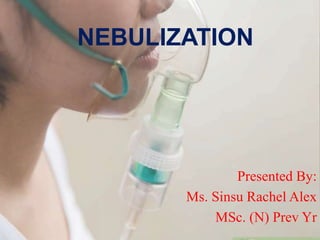
NEBULIZATION
Presented By:
Ms. Sinsu Rachel Alex
MSc. (N) Prev Yr
DEFINITION
• Process of dispersing a liquid (medication)
into microscopic particles and delivering into
lungs as patient inhales through the nebulizer.
• It is used to liquefy and remove retained
secretions from the respiratory tract.
 Most aerosol medication have broncho
dilating effects and are administered by
respiratory therapy personnel.
PURPOSES
• To relieve respiratory insufficiency due to
broncho spasm.
• To correct the underlying respiratory disorders
responsible for broncho spasm.
• To liquefy and remove retained thick
secretions.
• To reduce inflammatory and allergic responses
of the upper respiratory tract.
• To correct humidify deficit resulting from
inspired air by passing the airway during the
use of mechanical ventilation in critically and
post surgical patents.
• When a person has a acute asthma attack.
• When a person is in respiratory distress.
• If a person is unable to use a inhaler.
• If a person has stridor.
• Respiratory congestions
• Pneumonia
• Atelectasis
• Asthma
HISTORY
• The first "powered" or pressurized inhaler was
invented in France by Sales-Girons in
1858. This device used pressure to atomize the
liquid medication. The pump handle is
operated like a bicycle pump. When the pump
is pulled up, it draws liquid from the reservoir,
and upon the force of the user's hand, the
liquid is pressurized through an atomizer, to be
sprayed out for inhalation near the user's
mouth.
• In 1864, the first steam-driven nebulizer was
invented in Germany. This inhaler, known as
"Siegle’s steam spray inhaler”.
• The first electrical nebulizer was invented in
the 1930s and called a Pneumostat.
BERNOULIIS PRINCIPLE:
• By the mid 19th century the search was on for a device that
would turn a solution into a spray. It was believed that such
a device would break down the solution into atoms, and in
this way the solution could be inhaled. This breakdown was
thus referred to as atomization, pulverizing or nebulizing,
and the devices created were often referred to as atomizers,
pulverizers or nebulizers.
• Yet no such machine would have been invented if not for
the discovery of the Bernoulli Principle. Daniel Bernoulli
observed that when water hits a rock it creates a mist that
can be inhaled. He published a book in 1738 where he
described that a similar effect could be created by forcing
water through a narrow tube.
• His concept was based on the fact that the faster water flows
through a tube, the less the lateral pressure will be. A
decreased lateral pressure is also referred to as a negative side
stream pressure. If there is a hole in the side of the tube, the
negative pressure will force water into the stream.
• This same concept was used in creating the first nebulizers,
only using air. Air is forced through a tube, and a hole in the
tube is connected to a container with a solution in it that
contains the medication. The fluid is basically sucked in due
to the negative sidewall pressure, and turned into a spray or
mist.
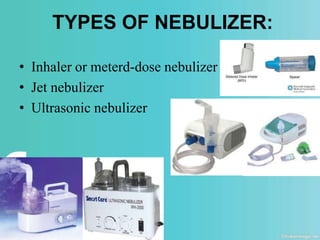
TYPES OF NEBULIZER:
• Inhaler or meterd-dose nebulizer
• Jet nebulizer
• Ultrasonic nebulizer
FUNCTION:
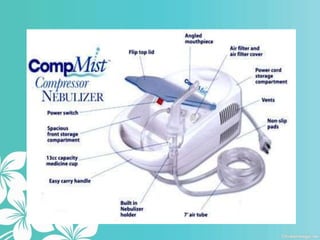
• A nebulizer is a device that uses a small
compressor to convert liquid medication into
tiny droplets of mist that can be inhaled
directly into the lungs.
• Since the medication goes straight to the
lungs, onset of the medication’s action often
takes place rapidly.
• This promotes quick symptom relief in the
case of illnesses such as asthma, where fast
relief is desirable.
• Also, it minimizes the risk of side effects of
the medication, preventing the medication
from being metabolized into a less effective
form by the body.
EQUIPMENTS:
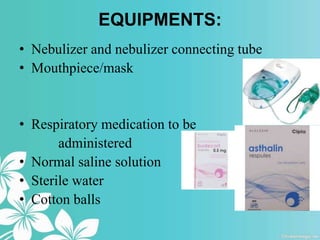
• Nebulizer and nebulizer connecting tube
• Mouthpiece/mask
• Respiratory medication to be
administered
• Normal saline solution
• Sterile water
• Cotton balls
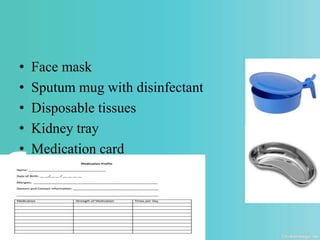
• Face mask
• Sputum mug with disinfectant
• Disposable tissues
• Kidney tray
• Medication card
SNO. PROCEDURE RATIONALE
1. Identify patient and check
physician’s instructions.
Ensures that the right procedure has
been done for the patent.
2. Monitor heart rate before and after
the treatment for patients using
bronchodilator drugs.
Drugs may cause tachycardia
palpitation, dizziness, nausea, or
nervousness
3. Explain the procedure to the
patient. This therapy depends on
the patient’s effort.
Proper explanation of the procedure
helps to ensure patient’s cooperation
and effectiveness of the treatment.
4. Place the pt in a comfortable
sitting or a semi fowlers position.
Diaphragmatic excursion and lung
compliance are greater in this position.
This ensures maximal distribution and
deposition of aerosolized particles tp the
base of lungs.
5. Add the prescribed amount of
medications to the medicine chamber of
the tubing. Connect the tube to the
compressor.
A fine mist from the device should be
visible.
Aerosol particles enable deep
penetration into tracheobronchial
tree.
6. Place the mask on patient’s face to cover
his mouth and nose and instruct him to
inhale deeply and slowly through mouth,
hold breath and then exhale several
times.
This encourages optimal
dispersion of the medication.
7. Observe expansion of chest to ascertain
that patient is taking deep breaths.
This will ensure that the
medication is deposited below the
level in the oropharynx.
8. Instruct the pt to breath slowly and
deeply until all the medications is
nebulized.
Medication will usually be
nebulized within 15 mins.
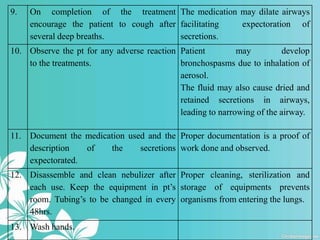
9. On completion of the treatment
encourage the patient to cough after
several deep breaths.
The medication may dilate airways
facilitating expectoration of
secretions.
10. Observe the pt for any adverse reaction
to the treatments.
Patient may develop
bronchospasms due to inhalation of
aerosol.
The fluid may also cause dried and
retained secretions in airways,
leading to narrowing of the airway.
11. Document the medication used and the
description of the secretions
expectorated.
Proper documentation is a proof of
work done and observed.
12. Disassemble and clean nebulizer after
each use. Keep the equipment in pt’s
room. Tubing’s to be changed in every
48hrs.
Proper cleaning, sterilization and
storage of equipments prevents
organisms from entering the lungs.
13. Wash hands.
PROCEDURE:
1.Position the patient appropriately, allowing
optimal ventilation. (semi fowlers position)
2.Assess and record breath sounds, respiratory
status, pulse rate and other significant
respiratory functions.
3.Teach patient the proper way of inhalation.
4.Prepare equipments at hand
5.Check doctor’s orders for the medication, prepare
thereafter
6.Place the medication in the nebulizer (can add a
amount of saline solution if ordered)
7.Attach the nebulizer to the compressed gas source
8.Attach the connecting tubes and mouthpiece to
the nebulizer
Turn the machine on (notice the mist produced
by the nebulizer)
10. Offer the nebulizer to the patient, offer
assistance until he is able to perform proper
inhalation (if unable to hold the nebulizer
[pediatric/geriatric/special cases], replace the
mouthpiece with mask.
AFTER CARE
• Each time it is used, wash the nebulizer
chamber in warm water or clean with a spirit
swab and then rinse thoroughly with clean
water. Do not use a brush to clean the
nebulizer chamber as it may damage it.
• Reconnect the nebulizer chamber to the
tubing and blow air from it.
• This will dry the nebulizer chamber and
tubing. Disconnect the nebulizer chamber
from the tubing and allow it to dry completely.
Disconnect the tubing from the compressor
unit.
SIDE EFFECTS
• Dry or irritated throat, temporary or occasional
cough
• Sneezing, stuffy or itchy nose, watery eyes.
• Burning or bleeding of your nose
• Nausea, heartburn, stomach pain.
• Urinating more or less than usual.
• Dizziness, drowsiness, headache.
• Unusual or unpleasant taste in your mouth.
CONTRAINDICATIONS:
• In some cases, nebulization is restricted or
avoided due to possible untoward results or rather
decreased effectiveness such as:
• Patients with unstable and increased blood
pressure
• Individuals with cardiac irritability (may result to
dysrhythmias)
• Persons with increased pulses
• Unconscious patients (inhalation may be done via
mask but the therapeutic effect may be
significantly low)
Nebulization

Nebulization

  • 1.
    NEBULIZATION Presented By: Ms. SinsuRachel Alex MSc. (N) Prev Yr
  • 3.
    DEFINITION • Process ofdispersing a liquid (medication) into microscopic particles and delivering into lungs as patient inhales through the nebulizer. • It is used to liquefy and remove retained secretions from the respiratory tract.
  • 4.
     Most aerosolmedication have broncho dilating effects and are administered by respiratory therapy personnel.
  • 5.
    PURPOSES • To relieverespiratory insufficiency due to broncho spasm. • To correct the underlying respiratory disorders responsible for broncho spasm. • To liquefy and remove retained thick secretions. • To reduce inflammatory and allergic responses of the upper respiratory tract.
  • 6.
    • To correcthumidify deficit resulting from inspired air by passing the airway during the use of mechanical ventilation in critically and post surgical patents. • When a person has a acute asthma attack. • When a person is in respiratory distress. • If a person is unable to use a inhaler.
  • 7.
    • If aperson has stridor. • Respiratory congestions • Pneumonia • Atelectasis • Asthma
  • 8.
    HISTORY • The first"powered" or pressurized inhaler was invented in France by Sales-Girons in 1858. This device used pressure to atomize the liquid medication. The pump handle is operated like a bicycle pump. When the pump is pulled up, it draws liquid from the reservoir, and upon the force of the user's hand, the liquid is pressurized through an atomizer, to be sprayed out for inhalation near the user's mouth.
  • 9.
    • In 1864,the first steam-driven nebulizer was invented in Germany. This inhaler, known as "Siegle’s steam spray inhaler”. • The first electrical nebulizer was invented in the 1930s and called a Pneumostat.
  • 10.
    BERNOULIIS PRINCIPLE: • Bythe mid 19th century the search was on for a device that would turn a solution into a spray. It was believed that such a device would break down the solution into atoms, and in this way the solution could be inhaled. This breakdown was thus referred to as atomization, pulverizing or nebulizing, and the devices created were often referred to as atomizers, pulverizers or nebulizers. • Yet no such machine would have been invented if not for the discovery of the Bernoulli Principle. Daniel Bernoulli observed that when water hits a rock it creates a mist that can be inhaled. He published a book in 1738 where he described that a similar effect could be created by forcing water through a narrow tube.
  • 11.
    • His conceptwas based on the fact that the faster water flows through a tube, the less the lateral pressure will be. A decreased lateral pressure is also referred to as a negative side stream pressure. If there is a hole in the side of the tube, the negative pressure will force water into the stream. • This same concept was used in creating the first nebulizers, only using air. Air is forced through a tube, and a hole in the tube is connected to a container with a solution in it that contains the medication. The fluid is basically sucked in due to the negative sidewall pressure, and turned into a spray or mist.
  • 12.
    TYPES OF NEBULIZER: •Inhaler or meterd-dose nebulizer • Jet nebulizer • Ultrasonic nebulizer
  • 13.
    FUNCTION: • A nebulizeris a device that uses a small compressor to convert liquid medication into tiny droplets of mist that can be inhaled directly into the lungs. • Since the medication goes straight to the lungs, onset of the medication’s action often takes place rapidly.
  • 15.
    • This promotesquick symptom relief in the case of illnesses such as asthma, where fast relief is desirable. • Also, it minimizes the risk of side effects of the medication, preventing the medication from being metabolized into a less effective form by the body.
  • 16.
    EQUIPMENTS: • Nebulizer andnebulizer connecting tube • Mouthpiece/mask • Respiratory medication to be administered • Normal saline solution • Sterile water • Cotton balls
  • 17.
    • Face mask •Sputum mug with disinfectant • Disposable tissues • Kidney tray • Medication card
  • 18.
    SNO. PROCEDURE RATIONALE 1.Identify patient and check physician’s instructions. Ensures that the right procedure has been done for the patent. 2. Monitor heart rate before and after the treatment for patients using bronchodilator drugs. Drugs may cause tachycardia palpitation, dizziness, nausea, or nervousness 3. Explain the procedure to the patient. This therapy depends on the patient’s effort. Proper explanation of the procedure helps to ensure patient’s cooperation and effectiveness of the treatment. 4. Place the pt in a comfortable sitting or a semi fowlers position. Diaphragmatic excursion and lung compliance are greater in this position. This ensures maximal distribution and deposition of aerosolized particles tp the base of lungs.
  • 19.
    5. Add theprescribed amount of medications to the medicine chamber of the tubing. Connect the tube to the compressor. A fine mist from the device should be visible. Aerosol particles enable deep penetration into tracheobronchial tree. 6. Place the mask on patient’s face to cover his mouth and nose and instruct him to inhale deeply and slowly through mouth, hold breath and then exhale several times. This encourages optimal dispersion of the medication. 7. Observe expansion of chest to ascertain that patient is taking deep breaths. This will ensure that the medication is deposited below the level in the oropharynx. 8. Instruct the pt to breath slowly and deeply until all the medications is nebulized. Medication will usually be nebulized within 15 mins.
  • 20.
    9. On completionof the treatment encourage the patient to cough after several deep breaths. The medication may dilate airways facilitating expectoration of secretions. 10. Observe the pt for any adverse reaction to the treatments. Patient may develop bronchospasms due to inhalation of aerosol. The fluid may also cause dried and retained secretions in airways, leading to narrowing of the airway. 11. Document the medication used and the description of the secretions expectorated. Proper documentation is a proof of work done and observed. 12. Disassemble and clean nebulizer after each use. Keep the equipment in pt’s room. Tubing’s to be changed in every 48hrs. Proper cleaning, sterilization and storage of equipments prevents organisms from entering the lungs. 13. Wash hands.
  • 21.
    PROCEDURE: 1.Position the patientappropriately, allowing optimal ventilation. (semi fowlers position) 2.Assess and record breath sounds, respiratory status, pulse rate and other significant respiratory functions. 3.Teach patient the proper way of inhalation.
  • 22.
    4.Prepare equipments athand 5.Check doctor’s orders for the medication, prepare thereafter 6.Place the medication in the nebulizer (can add a amount of saline solution if ordered) 7.Attach the nebulizer to the compressed gas source 8.Attach the connecting tubes and mouthpiece to the nebulizer
  • 23.
    Turn the machineon (notice the mist produced by the nebulizer) 10. Offer the nebulizer to the patient, offer assistance until he is able to perform proper inhalation (if unable to hold the nebulizer [pediatric/geriatric/special cases], replace the mouthpiece with mask.
  • 24.
    AFTER CARE • Eachtime it is used, wash the nebulizer chamber in warm water or clean with a spirit swab and then rinse thoroughly with clean water. Do not use a brush to clean the nebulizer chamber as it may damage it. • Reconnect the nebulizer chamber to the tubing and blow air from it.
  • 25.
    • This willdry the nebulizer chamber and tubing. Disconnect the nebulizer chamber from the tubing and allow it to dry completely. Disconnect the tubing from the compressor unit.
  • 26.
    SIDE EFFECTS • Dryor irritated throat, temporary or occasional cough • Sneezing, stuffy or itchy nose, watery eyes. • Burning or bleeding of your nose • Nausea, heartburn, stomach pain.
  • 27.
    • Urinating moreor less than usual. • Dizziness, drowsiness, headache. • Unusual or unpleasant taste in your mouth.
  • 28.
    CONTRAINDICATIONS: • In somecases, nebulization is restricted or avoided due to possible untoward results or rather decreased effectiveness such as: • Patients with unstable and increased blood pressure • Individuals with cardiac irritability (may result to dysrhythmias) • Persons with increased pulses • Unconscious patients (inhalation may be done via mask but the therapeutic effect may be significantly low)