Downloaded 15 times

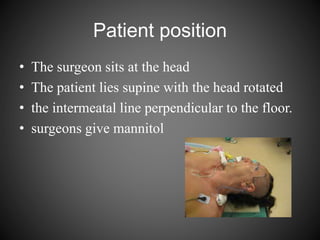
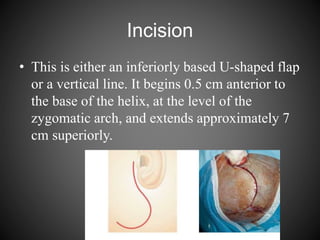
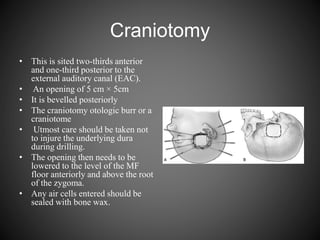
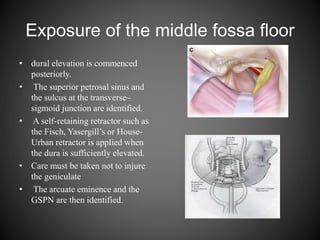
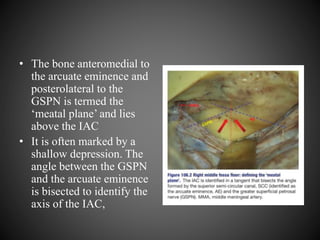
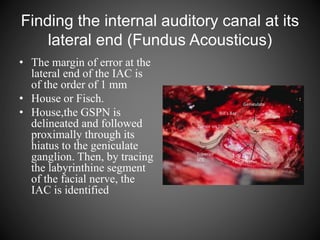
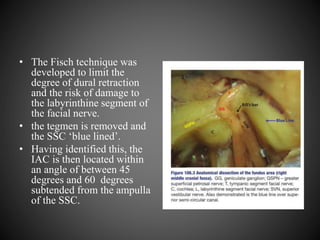


This document describes the surgical technique for middle fossa surgery. It discusses the important anatomical landmarks in the middle fossa approach including the greater superficial petrosal nerve and arcuate eminence. It provides details on patient positioning, incision, craniotomy, exposure of the middle fossa floor, and finding the internal auditory canal medially and laterally. Applications of the middle fossa approach are summarized, including vestibular schwannoma surgery, vestibular neurectomy, facial nerve surgery, repair of tegmen defects, and petrous apicectomy. The middle fossa approach provides superior access while preserving inner ear function and the proximal intratemporal facial nerve.


