LIB 601 Libraries and Learning   Fall 2009Information Literacy: What Is It?Finding a way through the word maze
September 26, 2009Information Literacy2Information Literacyinformation literacy (IL) Skill in finding the information one needs, including an understanding of how libraries are organized, familiarity with the resources they provide (including information formats and automatedsearch tools), and knowledge of commonly used research techniques. ODLIS
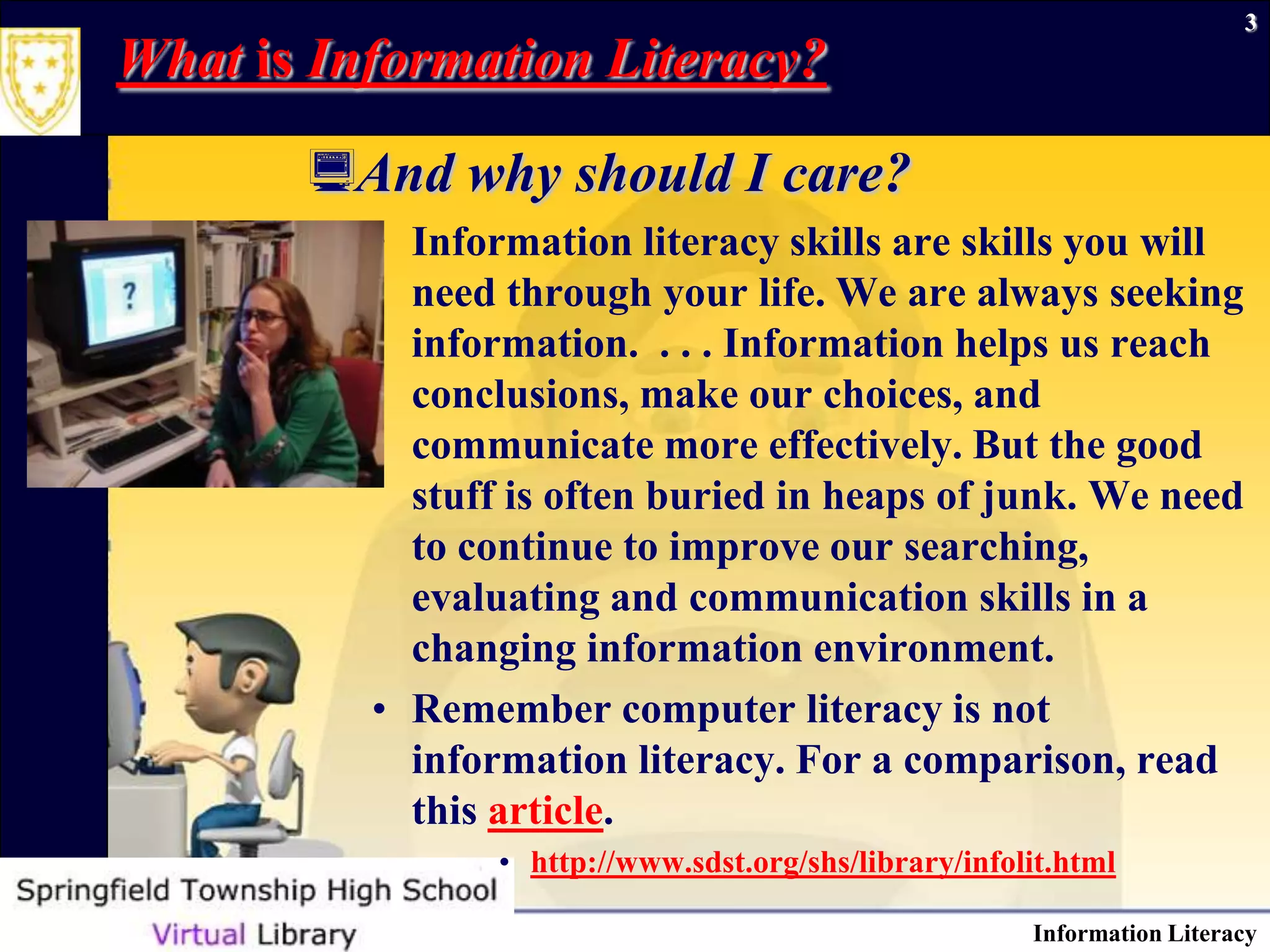
Information Literacy3What is Information Literacy? And why should I care?Information literacy skills are skills you will need through your life. We are always seeking information.  . . . Information helps us reach conclusions, make our choices, and communicate more effectively. But the good stuff is often buried in heaps of junk. We need to continue to improve our searching, evaluating and communication skills in a changing information environment. Remember computer literacy is not information literacy. For a comparison, read this article. http://www.sdst.org/shs/library/infolit.html
September 26, 2009Information Literacy4Why teach information literacy? The information explosion has provided countless opportunities for students and has dramatically altered the knowledge and abilities they will need to live productively in the twenty-first century.  Students must become skillful consumers and producers of information in a range of sources and formats to thrive personally and economically in the communication age. American Association of School Librarians and Association for Educational Communications and Technology.  Information Power: Building Partnerships for Learning.  Chicago: American Library Association, 1998.
September 26, 2009Information Literacy5What is information literacy? If you are information literate, you are able to know when you have a need for information find the information you need evaluate the information you findand use it effectively to meet your needsINTRODUCTION TO INFORMATION LITERACY:  THE PROCESShttp://www.greece.k12.ny.us/ody/library/information%20literacy.htm
September 26, 2009Information Literacy6Another conceptWhat is Information Competence?information competence, at heart, is the ability to find, evaluate, use, and communicate information in all of its various formats.the fusing or the integration of library literacy, computer literacy, media literacy, technological literacy, ethics, critical thinking, and communication skills. http://hcom.csumb.edu/infocomp/aboutic/
September 26, 2009Information Literacy7Literacy, Competence or Competency?Information literacy also known as information competence or information competency is a set of skills that helps students sift through the mass of information now available to them in order to locate and retrieve what is relevant and reliable for their research needs.  Simply put, an information literate student understands how to find, retrieve, analyze, and use information effectively.[1] Teaching Information Literacy at Pasadena City College
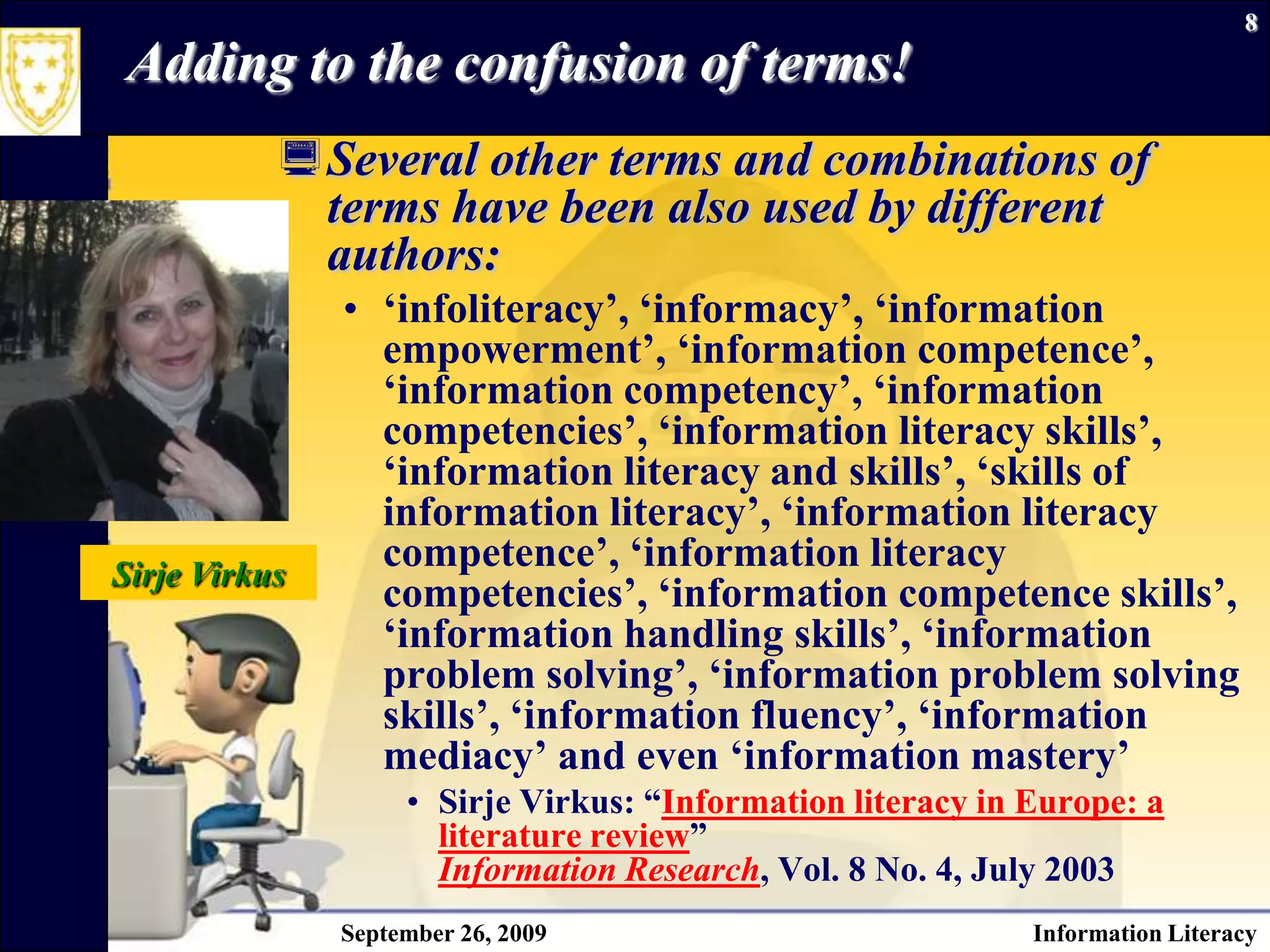
September 26, 2009Information Literacy8Adding to the confusion of terms!Several other terms and combinations of terms have been also used by different authors: ‘infoliteracy’, ‘informacy’, ‘information empowerment’, ‘information competence’, ‘information competency’, ‘information competencies’, ‘information literacy skills’, ‘information literacy and skills’, ‘skills of information literacy’, ‘information literacy competence’, ‘information literacy competencies’, ‘information competence skills’, ‘information handling skills’, ‘information problem solving’, ‘information problem solving skills’, ‘information fluency’, ‘information mediacy’ and even ‘information mastery’ SirjeVirkus: “Information literacy in Europe: a literature review” Information Research, Vol. 8 No. 4, July 2003Sirje Virkus
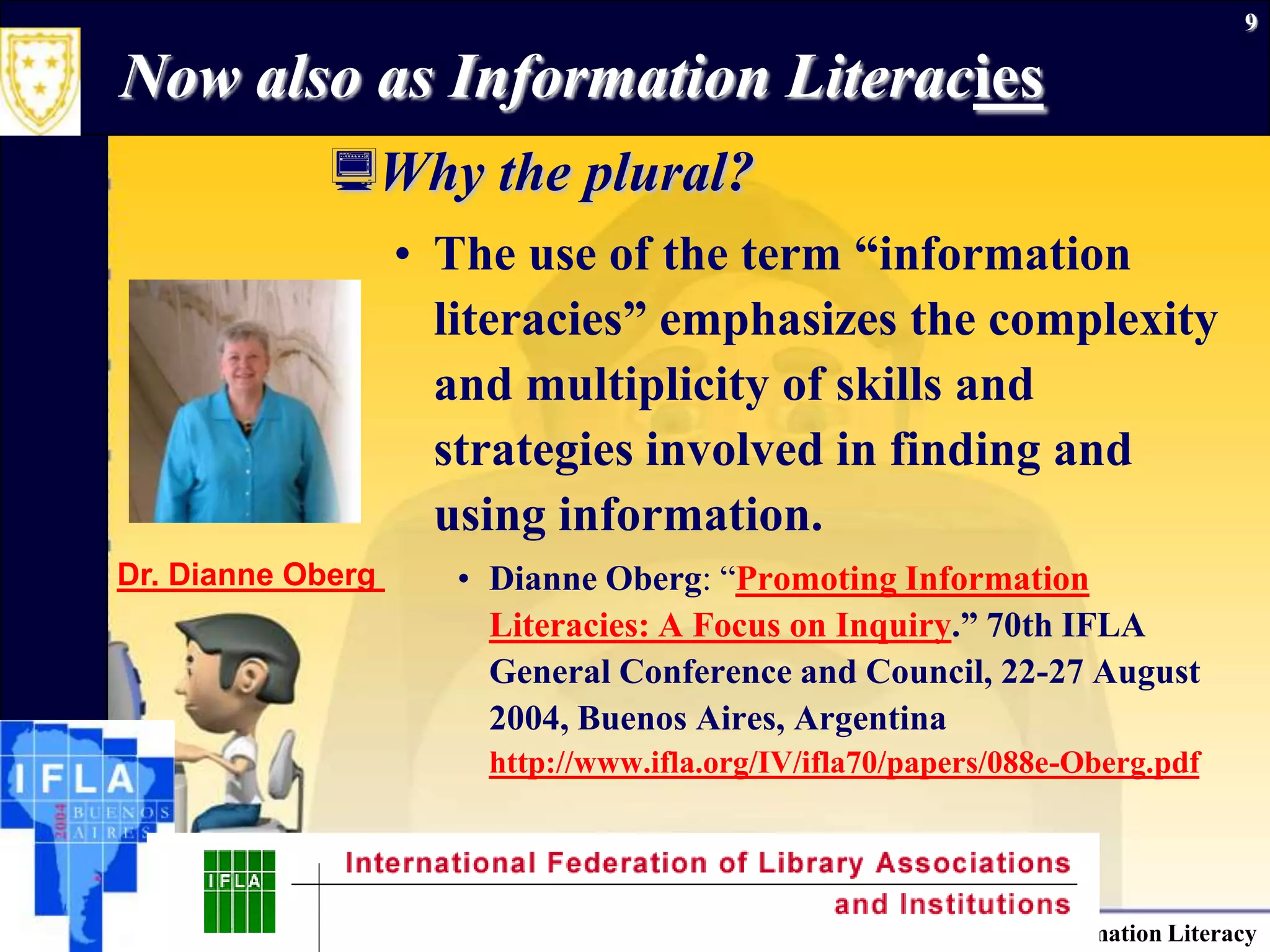
September 26, 2009Information Literacy9Now also as Information LiteraciesWhy the plural?The use of the term “information literacies” emphasizes the complexity and multiplicity of skills and strategies involved in finding and using information.Dianne Oberg: “Promoting Information Literacies: A Focus on Inquiry.” 70th IFLA General Conference and Council, 22-27 August 2004, Buenos Aires, Argentinahttp://www.ifla.org/IV/ifla70/papers/088e-Oberg.pdfDr. Dianne Oberg
September 26, 2009Information Literacy10A related term often used outside library media circlesInquiry-based learningWe learn best when we are at the center of our own learning. Inquiry-based learning is a learning process through questions generated from the interests, curiosities, and perspectives/experiences of the learner. When investigations grow from our own questions, curiosities, and experiences, learning is an organic and motivating process that is intrinsically enjoyable.
September 26, 2009Information Literacy11Project, Problem, and Inquiry-based Learning Explore the Approaches Project-based learning, problem-based learning, and inquiry-based learning all three closely relate to the information processing approach. They all fit well with technology-rich learning environments where the focus is not on the hardware and software, but on the learning experience. Project, Problem, and Inquiry-based Learninghttp://eduscapes.com/tap/topic43.htm
September 26, 2009Information Literacy12Another Related TermResource-Based LearningResource-based learning actively involves students, teachers and teacher-librarians in the effective use of a wide range of print, non print and human resources . . . Students who use a wide range of resources in various mediums for learning have the opportunity to approach a theme, issue or topic of study in ways which allow for a range of learning styles and access to the theme or topic via cognitive or affective appeals.MoreResource-Based Learning: Approaches
September 26, 2009Information Literacy13Yet another related termLifelong learningLifelong learning is the process of acquiring and expanding knowledge, skills, and dispositions throughout your life to foster well-being. It isn't about taking an adult pottery class or reading a nonfiction book occasionally. It's about the decisions you make and the problems you solve in everyday life. From enrolling in an structured, formal education program to considering whether to believe an infomercial's gimmick, lifelong learning takes many forms.
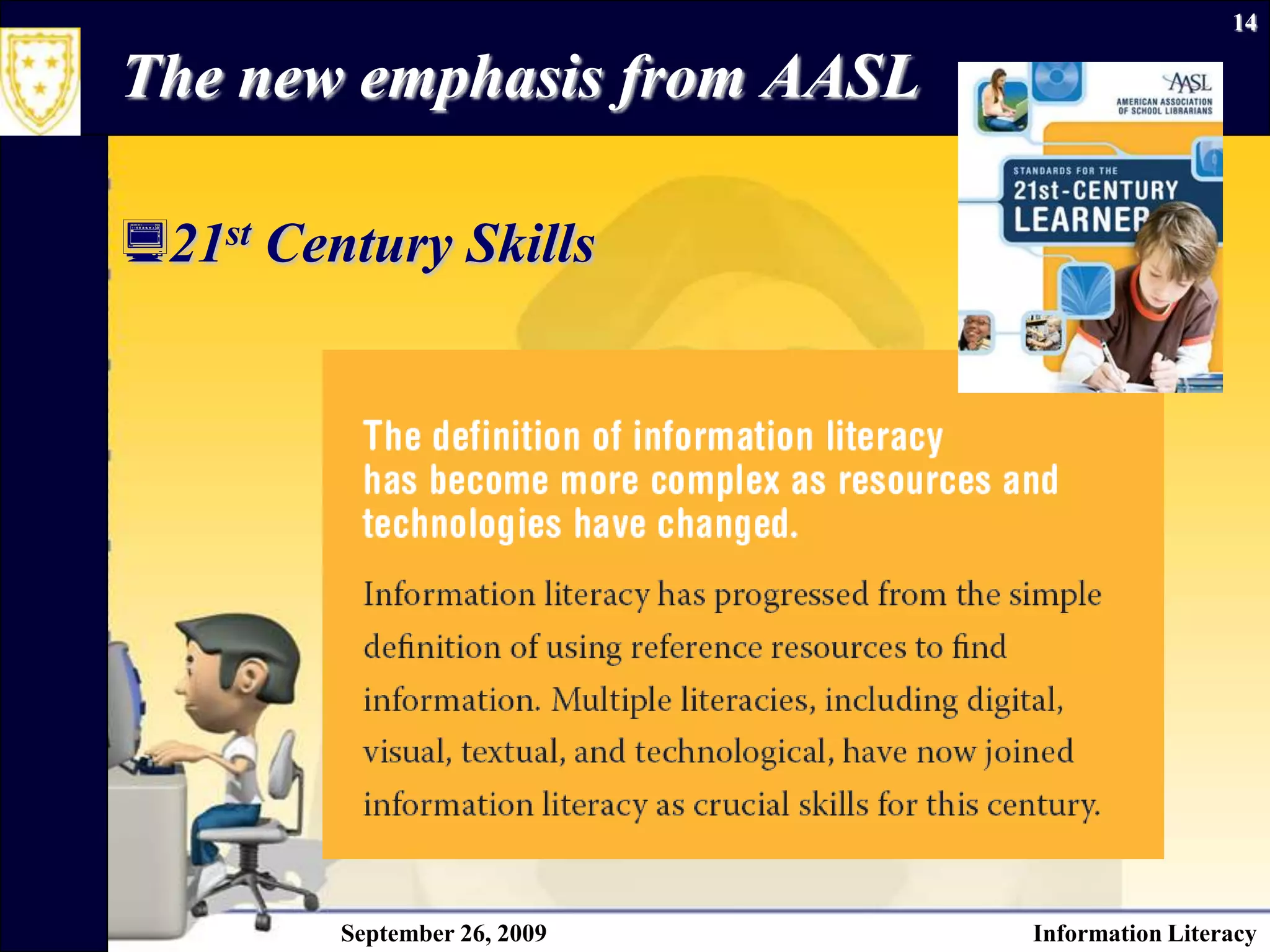
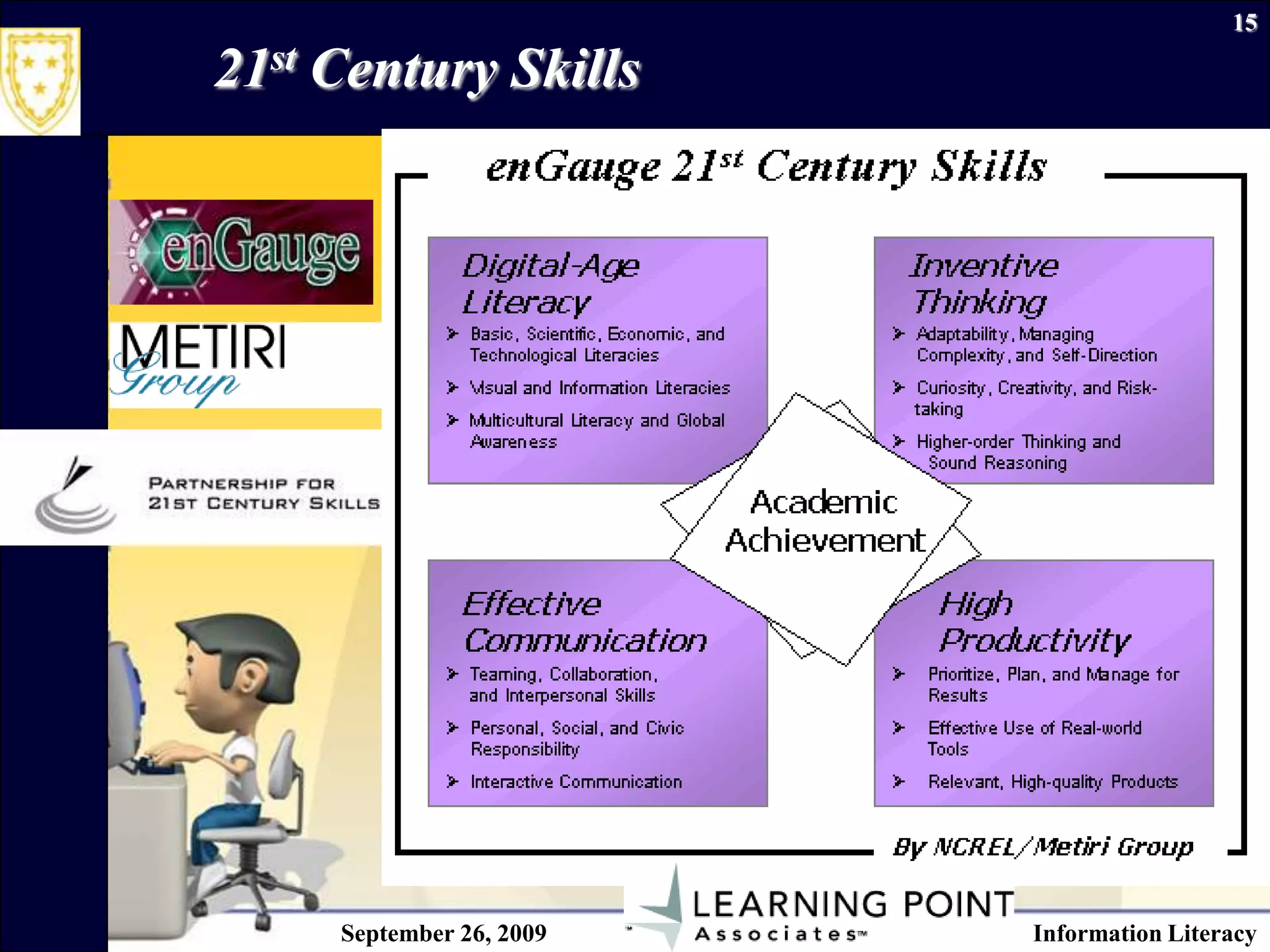
The new emphasis from AASL21st Century SkillsSeptember 26, 2009Information Literacy14
September 26, 2009Information Literacy1521st Century Skills
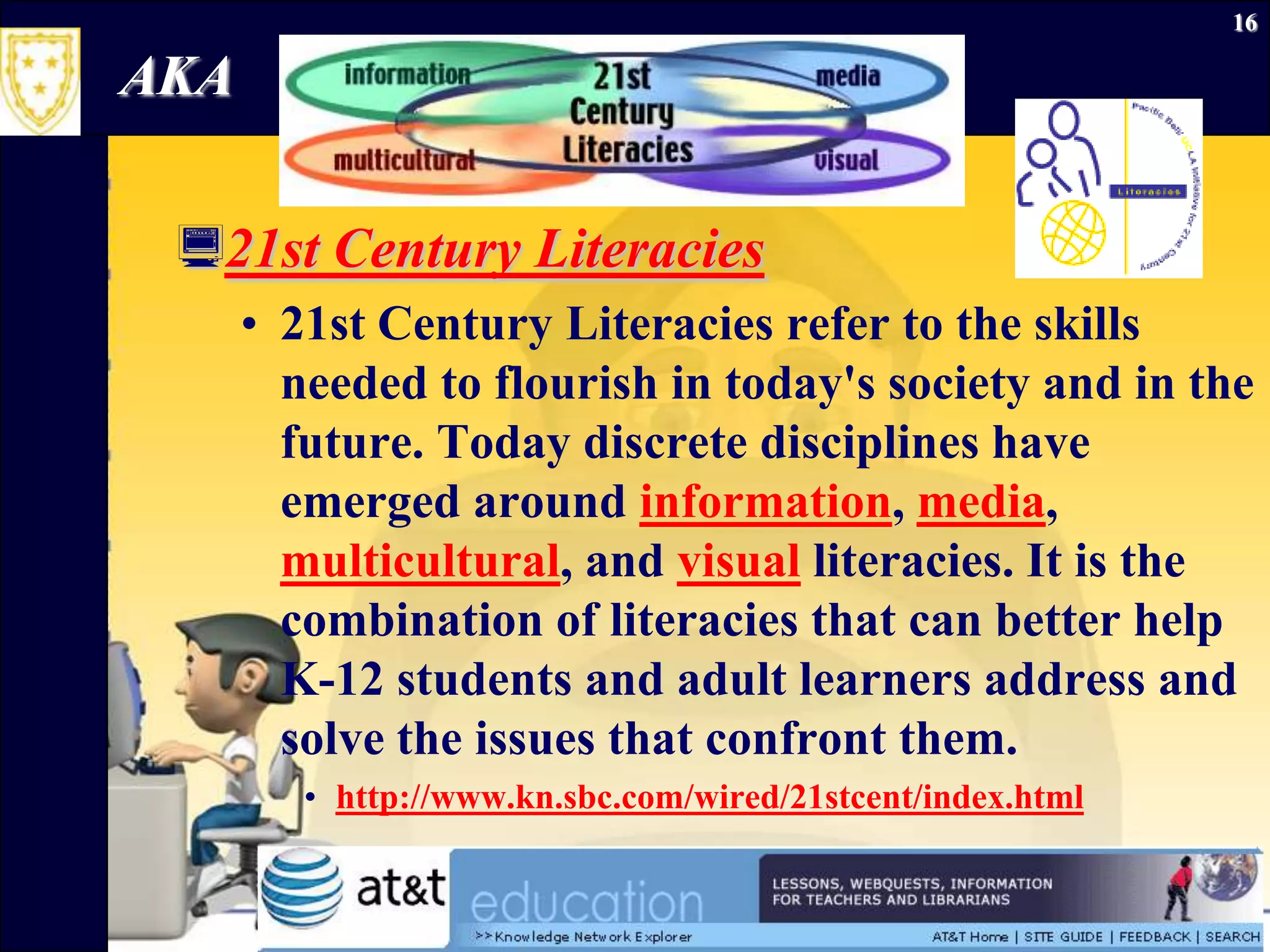
September 26, 2009Information Literacy16AKA21st Century Literacies21st Century Literacies refer to the skills needed to flourish in today's society and in the future. Today discrete disciplines have emerged around information, media, multicultural, and visualliteracies. It is the combination of literacies that can better help K-12 students and adult learners address and solve the issues that confront them. http://www.kn.sbc.com/wired/21stcent/index.html
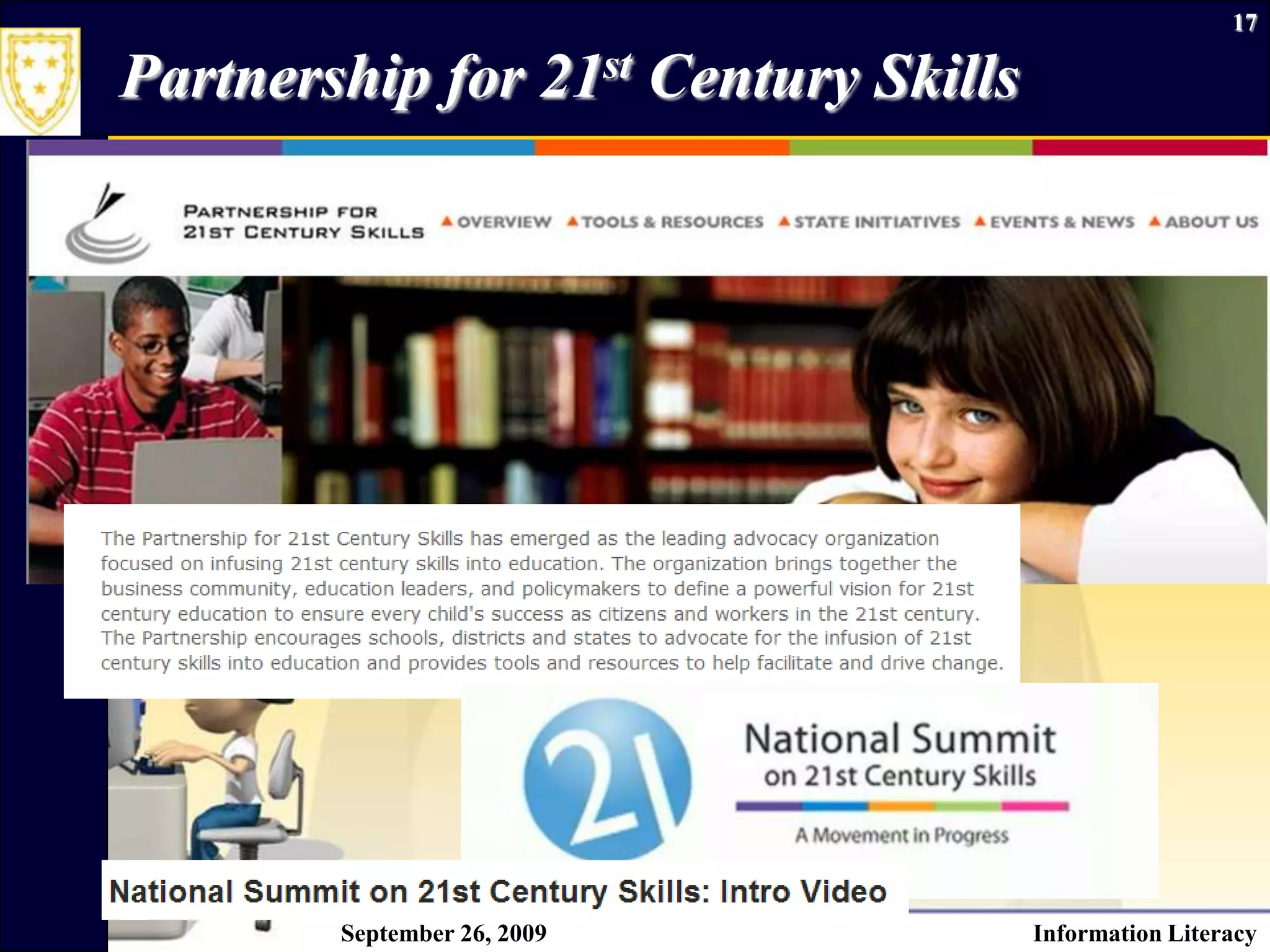
Partnership for 21st Century SkillsSeptember 26, 2009Information Literacy17
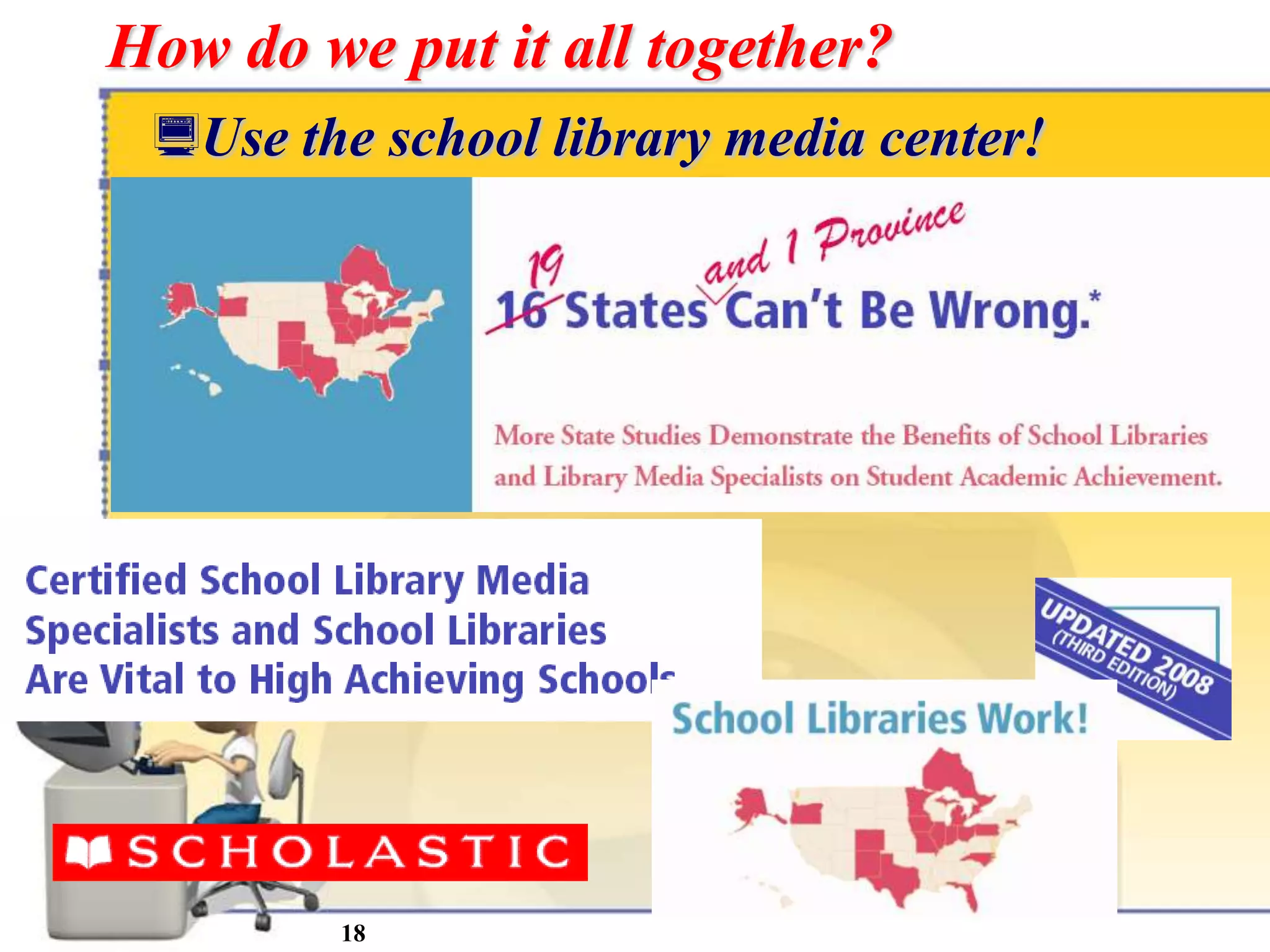
18How do we put it all together?Use the school library media center!
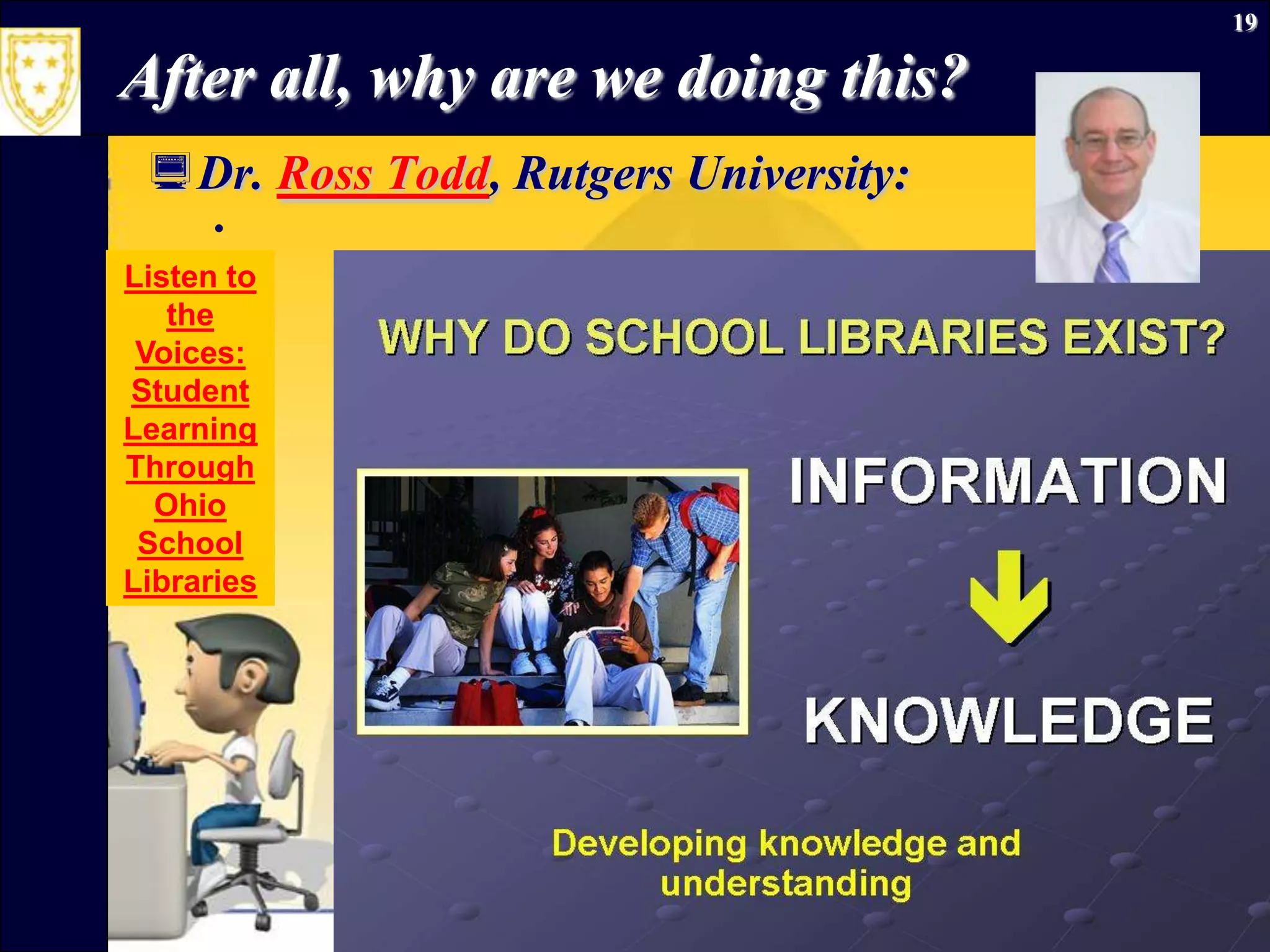
September 26, 2009Information Literacy19After all, why are we doing this?Dr. Ross Todd, Rutgers University:Listen to the Voices:  Student Learning Through Ohio School Libraries
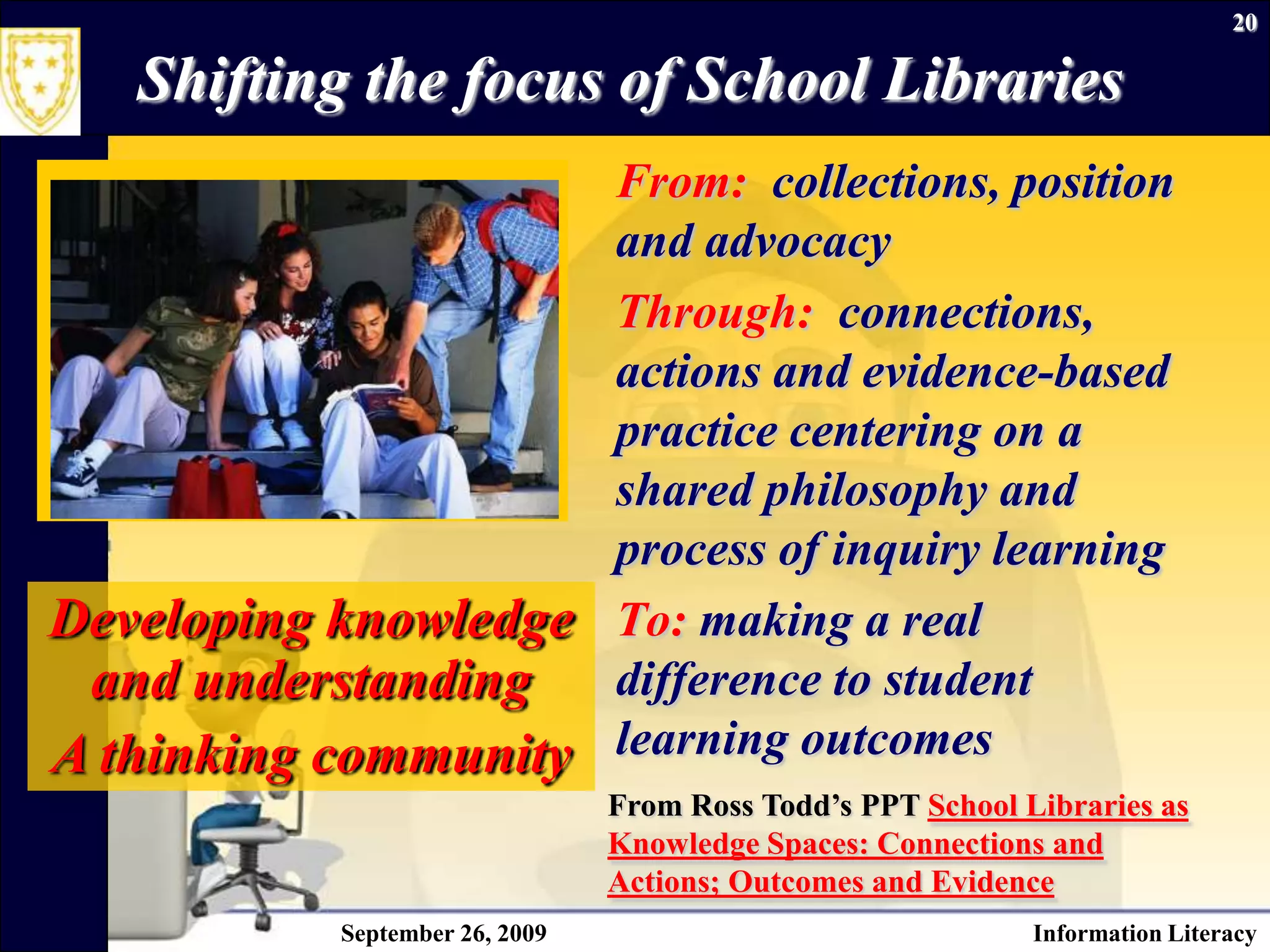
September 26, 2009Information Literacy20Shifting the focus of School LibrariesFrom:  collections, position and advocacyThrough:  connections, actions and evidence-based practice centering on a shared philosophy and process of inquiry learningTo: making a real difference to student learning outcomesDeveloping knowledge and understandingA thinking communityFrom Ross Todd’s PPT School Libraries as Knowledge Spaces: Connections and Actions; Outcomes and Evidence
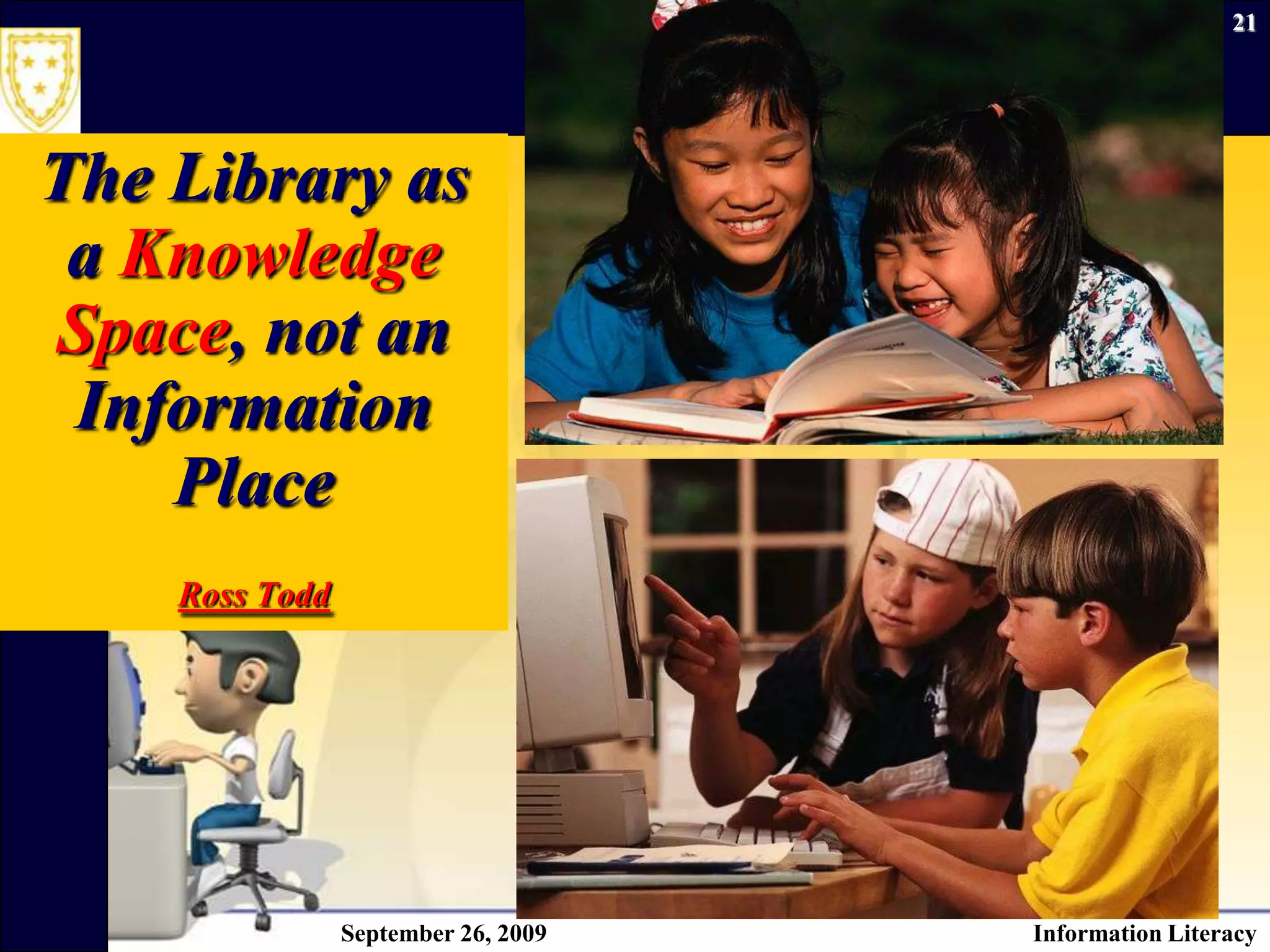
September 26, 2009Information Literacy21The Library as a Knowledge Space, not an Information PlaceRoss Todd
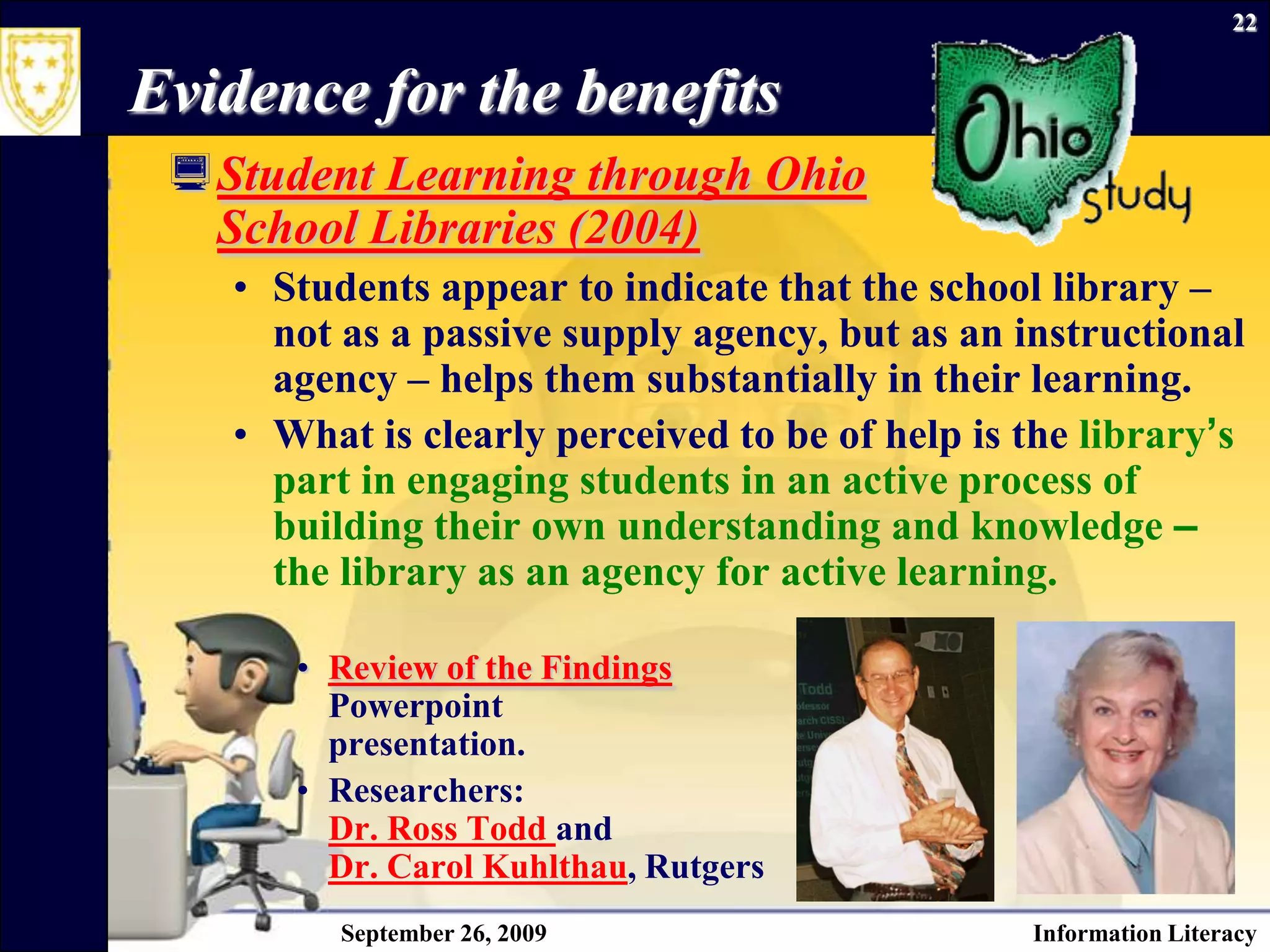
September 26, 2009Information Literacy22Evidence for the benefitsStudent Learning through Ohio School Libraries (2004)Students appear to indicate that the school library – not as a passive supply agency, but as an instructional agency – helps them substantially in their learning.What is clearly perceived to be of help is the library’s part in engaging students in an active process of building their own understanding and knowledge – the library as an agency for active learning.Review of the FindingsPowerpointpresentation.Researchers:  Dr. Ross Todd and Dr. Carol Kuhlthau, Rutgers
September 26, 2009Information Literacy23Keith Curry LanceWhat Research Tells Us About the Importance of School LibrariesAt this point . . . there is a clear consensus in the results now [2002] available for eight states*: School libraries are a powerful force in the lives of America's children. The school library is one of the few factors whose contribution to academic achievement has been documented empirically, and it is a contribution that cannot be explained away by other powerful influences on student performance.White House Conference on School Libraries *Now 15 states—see Actually, 19 states withIndiana 2007
September 26, 2009Information Literacy24A European viewSchool Library and School LibrarianshipThe stream of information from TV channels, Internet, CD-ROMs, computer programmes etc. is unending. If the students, when they become adult citizens, are not to feel lost and helpless in the face of such rich sources of information, they must learn [to] devise personal strategies for information retrieval while they are still at school. Information Literacy and “strategies for independent learning skill development” are key components of any school library.From a White Paper by Gert Larsen, School Library Advisor, Albertslund, Denmark, p. 7Part of Project GrandSlam - General Research and New Development in School Libraries As Multimedia Learning Centres (see project website http://www.gslam.net )
September 26, 2009Information Literacy25The Key Concept?Competence and comfort with information and information sourcesInformation literacy is the solution to Data Smog. It allows us to cope by giving us the skills to know when we need information and where to locate it effectively and efficiently. It includes the technological skills needed to use the modern library as a gateway to information. It enables us to analyze and evaluate the information we find, thus giving us confidence in using that information to make a decision or create a product. Introduction to Information Literacy, Association for College and Research Libraries (a division of the American Library Association)

Information Literacy: What is it?

  • 1.
    LIB 601 Librariesand Learning Fall 2009Information Literacy: What Is It?Finding a way through the word maze
  • 2.
    September 26, 2009InformationLiteracy2Information Literacyinformation literacy (IL) Skill in finding the information one needs, including an understanding of how libraries are organized, familiarity with the resources they provide (including information formats and automatedsearch tools), and knowledge of commonly used research techniques. ODLIS
  • 3.
    Information Literacy3What isInformation Literacy? And why should I care?Information literacy skills are skills you will need through your life. We are always seeking information. . . . Information helps us reach conclusions, make our choices, and communicate more effectively. But the good stuff is often buried in heaps of junk. We need to continue to improve our searching, evaluating and communication skills in a changing information environment. Remember computer literacy is not information literacy. For a comparison, read this article. http://www.sdst.org/shs/library/infolit.html
  • 4.
    September 26, 2009InformationLiteracy4Why teach information literacy? The information explosion has provided countless opportunities for students and has dramatically altered the knowledge and abilities they will need to live productively in the twenty-first century. Students must become skillful consumers and producers of information in a range of sources and formats to thrive personally and economically in the communication age. American Association of School Librarians and Association for Educational Communications and Technology. Information Power: Building Partnerships for Learning. Chicago: American Library Association, 1998.
  • 5.
    September 26, 2009InformationLiteracy5What is information literacy? If you are information literate, you are able to know when you have a need for information find the information you need evaluate the information you findand use it effectively to meet your needsINTRODUCTION TO INFORMATION LITERACY: THE PROCESShttp://www.greece.k12.ny.us/ody/library/information%20literacy.htm
  • 6.
    September 26, 2009InformationLiteracy6Another conceptWhat is Information Competence?information competence, at heart, is the ability to find, evaluate, use, and communicate information in all of its various formats.the fusing or the integration of library literacy, computer literacy, media literacy, technological literacy, ethics, critical thinking, and communication skills. http://hcom.csumb.edu/infocomp/aboutic/
  • 7.
    September 26, 2009InformationLiteracy7Literacy, Competence or Competency?Information literacy also known as information competence or information competency is a set of skills that helps students sift through the mass of information now available to them in order to locate and retrieve what is relevant and reliable for their research needs. Simply put, an information literate student understands how to find, retrieve, analyze, and use information effectively.[1] Teaching Information Literacy at Pasadena City College
  • 8.
    September 26, 2009InformationLiteracy8Adding to the confusion of terms!Several other terms and combinations of terms have been also used by different authors: ‘infoliteracy’, ‘informacy’, ‘information empowerment’, ‘information competence’, ‘information competency’, ‘information competencies’, ‘information literacy skills’, ‘information literacy and skills’, ‘skills of information literacy’, ‘information literacy competence’, ‘information literacy competencies’, ‘information competence skills’, ‘information handling skills’, ‘information problem solving’, ‘information problem solving skills’, ‘information fluency’, ‘information mediacy’ and even ‘information mastery’ SirjeVirkus: “Information literacy in Europe: a literature review” Information Research, Vol. 8 No. 4, July 2003Sirje Virkus
  • 9.
    September 26, 2009InformationLiteracy9Now also as Information LiteraciesWhy the plural?The use of the term “information literacies” emphasizes the complexity and multiplicity of skills and strategies involved in finding and using information.Dianne Oberg: “Promoting Information Literacies: A Focus on Inquiry.” 70th IFLA General Conference and Council, 22-27 August 2004, Buenos Aires, Argentinahttp://www.ifla.org/IV/ifla70/papers/088e-Oberg.pdfDr. Dianne Oberg
  • 10.
    September 26, 2009InformationLiteracy10A related term often used outside library media circlesInquiry-based learningWe learn best when we are at the center of our own learning. Inquiry-based learning is a learning process through questions generated from the interests, curiosities, and perspectives/experiences of the learner. When investigations grow from our own questions, curiosities, and experiences, learning is an organic and motivating process that is intrinsically enjoyable.
  • 11.
    September 26, 2009InformationLiteracy11Project, Problem, and Inquiry-based Learning Explore the Approaches Project-based learning, problem-based learning, and inquiry-based learning all three closely relate to the information processing approach. They all fit well with technology-rich learning environments where the focus is not on the hardware and software, but on the learning experience. Project, Problem, and Inquiry-based Learninghttp://eduscapes.com/tap/topic43.htm
  • 12.
    September 26, 2009InformationLiteracy12Another Related TermResource-Based LearningResource-based learning actively involves students, teachers and teacher-librarians in the effective use of a wide range of print, non print and human resources . . . Students who use a wide range of resources in various mediums for learning have the opportunity to approach a theme, issue or topic of study in ways which allow for a range of learning styles and access to the theme or topic via cognitive or affective appeals.MoreResource-Based Learning: Approaches
  • 13.
    September 26, 2009InformationLiteracy13Yet another related termLifelong learningLifelong learning is the process of acquiring and expanding knowledge, skills, and dispositions throughout your life to foster well-being. It isn't about taking an adult pottery class or reading a nonfiction book occasionally. It's about the decisions you make and the problems you solve in everyday life. From enrolling in an structured, formal education program to considering whether to believe an infomercial's gimmick, lifelong learning takes many forms.
  • 14.
    The new emphasisfrom AASL21st Century SkillsSeptember 26, 2009Information Literacy14
  • 15.
    September 26, 2009InformationLiteracy1521st Century Skills
  • 16.
    September 26, 2009InformationLiteracy16AKA21st Century Literacies21st Century Literacies refer to the skills needed to flourish in today's society and in the future. Today discrete disciplines have emerged around information, media, multicultural, and visualliteracies. It is the combination of literacies that can better help K-12 students and adult learners address and solve the issues that confront them. http://www.kn.sbc.com/wired/21stcent/index.html
  • 17.
    Partnership for 21stCentury SkillsSeptember 26, 2009Information Literacy17
  • 18.
    18How do weput it all together?Use the school library media center!
  • 19.
    September 26, 2009InformationLiteracy19After all, why are we doing this?Dr. Ross Todd, Rutgers University:Listen to the Voices: Student Learning Through Ohio School Libraries
  • 20.
    September 26, 2009InformationLiteracy20Shifting the focus of School LibrariesFrom: collections, position and advocacyThrough: connections, actions and evidence-based practice centering on a shared philosophy and process of inquiry learningTo: making a real difference to student learning outcomesDeveloping knowledge and understandingA thinking communityFrom Ross Todd’s PPT School Libraries as Knowledge Spaces: Connections and Actions; Outcomes and Evidence
  • 21.
    September 26, 2009InformationLiteracy21The Library as a Knowledge Space, not an Information PlaceRoss Todd
  • 22.
    September 26, 2009InformationLiteracy22Evidence for the benefitsStudent Learning through Ohio School Libraries (2004)Students appear to indicate that the school library – not as a passive supply agency, but as an instructional agency – helps them substantially in their learning.What is clearly perceived to be of help is the library’s part in engaging students in an active process of building their own understanding and knowledge – the library as an agency for active learning.Review of the FindingsPowerpointpresentation.Researchers: Dr. Ross Todd and Dr. Carol Kuhlthau, Rutgers
  • 23.
    September 26, 2009InformationLiteracy23Keith Curry LanceWhat Research Tells Us About the Importance of School LibrariesAt this point . . . there is a clear consensus in the results now [2002] available for eight states*: School libraries are a powerful force in the lives of America's children. The school library is one of the few factors whose contribution to academic achievement has been documented empirically, and it is a contribution that cannot be explained away by other powerful influences on student performance.White House Conference on School Libraries *Now 15 states—see Actually, 19 states withIndiana 2007
  • 24.
    September 26, 2009InformationLiteracy24A European viewSchool Library and School LibrarianshipThe stream of information from TV channels, Internet, CD-ROMs, computer programmes etc. is unending. If the students, when they become adult citizens, are not to feel lost and helpless in the face of such rich sources of information, they must learn [to] devise personal strategies for information retrieval while they are still at school. Information Literacy and “strategies for independent learning skill development” are key components of any school library.From a White Paper by Gert Larsen, School Library Advisor, Albertslund, Denmark, p. 7Part of Project GrandSlam - General Research and New Development in School Libraries As Multimedia Learning Centres (see project website http://www.gslam.net )
  • 25.
    September 26, 2009InformationLiteracy25The Key Concept?Competence and comfort with information and information sourcesInformation literacy is the solution to Data Smog. It allows us to cope by giving us the skills to know when we need information and where to locate it effectively and efficiently. It includes the technological skills needed to use the modern library as a gateway to information. It enables us to analyze and evaluate the information we find, thus giving us confidence in using that information to make a decision or create a product. Introduction to Information Literacy, Association for College and Research Libraries (a division of the American Library Association)