The Defining Paradigm of Modern Education 
BY: 
LIEZL T. MOJICO 
BEED – 4B
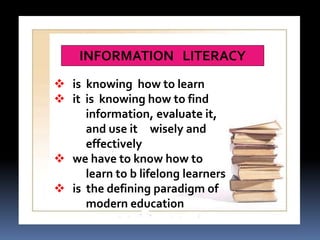
INFORMATION LITERACY 
 is knowing how to learn 
 it is knowing how to find 
information, evaluate it, 
and use it wisely and 
effectively 
 we have to know how to 
learn to b lifelong learners 
 is the defining paradigm of 
modern education
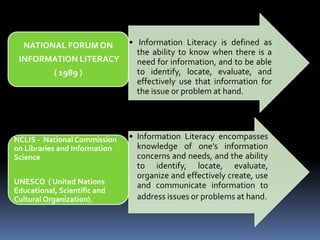
• Information Literacy is defined as 
the ability to know when there is a 
need for information, and to be able 
to identify, locate, evaluate, and 
effectively use that information for 
the issue or problem at hand. 
NATIONAL FORUM ON 
INFORMATION LITERACY 
( 1989 ) 
• Information Literacy encompasses 
knowledge of one’s information 
concerns and needs, and the ability 
to identify, locate, evaluate, 
organize and effectively create, use 
and communicate information to 
address issues or problems at hand. 
NCLIS - National Commission 
on Libraries and Information 
Science 
UNESCO ( United Nations 
Educational, Scientific and 
Cultural Organization).
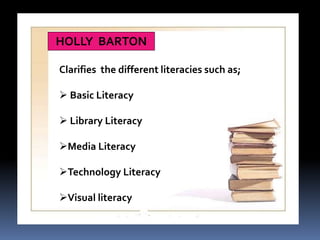
HOLLY BARTON 
Clarifies the different literacies such as; 
 Basic Literacy 
 Library Literacy 
Media Literacy 
Technology Literacy 
Visual literacy
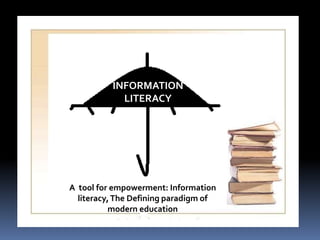
INFORMATION 
LITERACY 
A tool for empowerment: Information 
literacy, The Defining paradigm of 
modern education
BASIC LITERACY 
> Includes the skills of reading, writing, speaking, 
listening, counting, perceiving and drawing. 
> Every one of these skills should be taught and 
reinforced by every teacher, in every subject, 
and with gradually increasing levels of 
sophistication, in every grade K through 12. 
> In our day , a person lacking any of these skills cannot 
truly be considered “ literate”.
LIBRARY LITERACY 
> Is too important to be left to chance. 
> Every student needs to understand the difference 
between fiction and non- fiction. 
> Every student needs to know how to effectively use the 
reference books and periodicals. 
> Student need to understand the Dewey Decimal 
System as a useful, logical system of hierarchical 
organization and recognize its similarities to 
other such systems. 
> Students should use indexes and the library catalog so 
often it that becomes a subconscious skill.
MEDIA LITERACY 
> Includes an understanding of the many different types 
of media and the purposes for which they can be 
used. 
> Students should be taught the difference between fact 
and opinion, and be able to distinguish between 
information, entertainment , and persuasion. 
> They should learn that all information has a source and 
that knowing the source and its biases is an 
important part of understanding any information.
COMPUTER LITERACY 
> Every student should be thoroughly grounded in both 
the ethics and etiquette of technology use. 
> Most importantly, every student should have frequent 
opportunities to use technological tools to 
create his/ her own information artifacts– in print, on 
the screen, and online.
VISUAL LITERACY 
> Is the link between Media Literacy and Technology 
Literacy. 
> Media images and sound are end products created 
using the tools of digital technology. 
“ Visual Literacy means the skills and learning needed 
to view visual and audio/ visual materials skeptically,
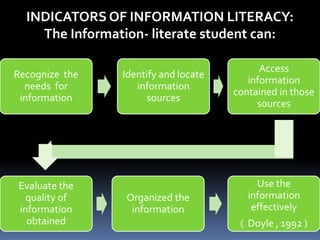
INDICATORS OF INFORMATION LITERACY: 
The Information- literate student can: 
Recognize the 
needs for 
information 
Identify and locate 
information 
sources 
Access 
information 
contained in those 
sources 
Evaluate the 
quality of 
information 
obtained 
Organized the 
information 
Use the 
information 
effectively 
( Doyle , 1992 )
CHANGINGVIEWSOF EDUCATION 
(THOMPSONAND HENLEY, 2000) 
> Research in brain development, multiple 
intelligences, and learning styles has caused 
us to rethink how students should be taught. 
> The increasing amount and ever-changing 
amount of 
information being discovered 
has caused us to re- think what 
we want students to learn.
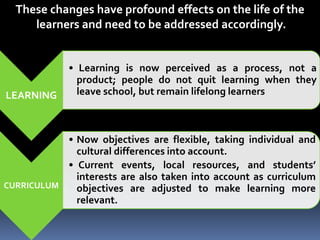
These changes have profound effects on the life of the 
learners and need to be addressed accordingly. 
LEARNING 
• Learning is now perceived as a process, not a 
product; people do not quit learning when they 
leave school, but remain lifelong learners 
CURRICULUM 
• Now objectives are flexible, taking individual and 
cultural differences into account. 
• Current events, local resources, and students’ 
interests are also taken into account as curriculum 
objectives are adjusted to make learning more 
relevant.
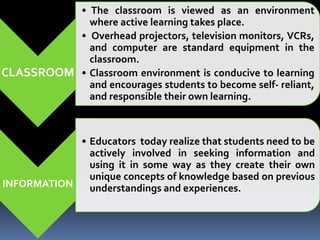
CLASSROOM 
• The classroom is viewed as an environment 
where active learning takes place. 
• Overhead projectors, television monitors, VCRs, 
and computer are standard equipment in the 
classroom. 
• Classroom environment is conducive to learning 
and encourages students to become self- reliant, 
and responsible their own learning. 
INFORMATION 
• Educators today realize that students need to be 
actively involved in seeking information and 
using it in some way as they create their own 
unique concepts of knowledge based on previous 
understandings and experiences.
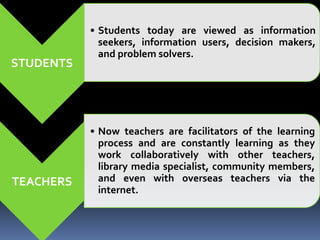
STUDENTS 
• Students today are viewed as information 
seekers, information users, decision makers, 
and problem solvers. 
TEACHERS 
• Now teachers are facilitators of the learning 
process and are constantly learning as they 
work collaboratively with other teachers, 
library media specialist, community members, 
and even with overseas teachers via the 
internet.
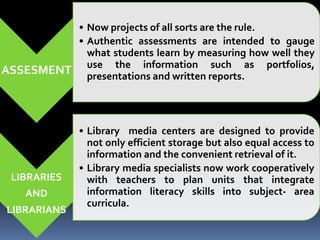
ASSESMENT 
• Now projects of all sorts are the rule. 
• Authentic assessments are intended to gauge 
what students learn by measuring how well they 
use the information such as portfolios, 
presentations and written reports. 
LIBRARIES 
AND 
LIBRARIANS 
• Library media centers are designed to provide 
not only efficient storage but also equal access to 
information and the convenient retrieval of it. 
• Library media specialists now work cooperatively 
with teachers to plan units that integrate 
information literacy skills into subject- area 
curricula.
METHODS 
OF 
TEACHING 
• The identification of information 
literacy skills needed for lifelong 
learning and thinking promotes a 
change in what is taught. 
• Brain- based research that shows 
how students learn and the 
abundance of information in all 
formats dictates a change in how 
teachers teach.
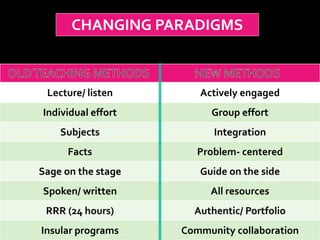
CHANGING PARADIGMS 
Lecture/ listen Actively engaged 
Individual effort Group effort 
Subjects Integration 
Facts Problem- centered 
Sage on the stage Guide on the side 
Spoken/ written All resources 
RRR (24 hours) Authentic/ Portfolio 
Insular programs Community collaboration
EDUCATIONAL IMPLICATIONS 
 The best hope for citizens to understand and 
function effectively in this data- intensive world is 
a comprehensive, hands- on, universal education 
in Information Literacy concepts and skills 
through schools. 
 This course of study can and should be 
integrated with the traditional school subjects 
areas, but it should also be considered as a 
separate core discipline specially for a purposes of 
goal setting, curriculum design and evaluation.
 This means shifting some of the responsibility of 
gaining knowledge from the teacher to the student 
and allowing students to develop questions, 
strategies to search the answers, and formulate 
conclusions. 
 Teachers of all subjects must blend their traditional 
fact- based approach with an emphasis on learner-based 
inquiry and the scientific inquiry process ( 
Lenox 1993 ). 
 Schools swill need to integrate information literacy 
skills across the curriculum in all subject areas 
beginning in the earliest grades.

Information Literacy

  • 1.
    The Defining Paradigmof Modern Education BY: LIEZL T. MOJICO BEED – 4B
  • 2.
    INFORMATION LITERACY is knowing how to learn  it is knowing how to find information, evaluate it, and use it wisely and effectively  we have to know how to learn to b lifelong learners  is the defining paradigm of modern education
  • 3.
    • Information Literacyis defined as the ability to know when there is a need for information, and to be able to identify, locate, evaluate, and effectively use that information for the issue or problem at hand. NATIONAL FORUM ON INFORMATION LITERACY ( 1989 ) • Information Literacy encompasses knowledge of one’s information concerns and needs, and the ability to identify, locate, evaluate, organize and effectively create, use and communicate information to address issues or problems at hand. NCLIS - National Commission on Libraries and Information Science UNESCO ( United Nations Educational, Scientific and Cultural Organization).
  • 4.
    HOLLY BARTON Clarifiesthe different literacies such as;  Basic Literacy  Library Literacy Media Literacy Technology Literacy Visual literacy
  • 5.
    INFORMATION LITERACY Atool for empowerment: Information literacy, The Defining paradigm of modern education
  • 6.
    BASIC LITERACY >Includes the skills of reading, writing, speaking, listening, counting, perceiving and drawing. > Every one of these skills should be taught and reinforced by every teacher, in every subject, and with gradually increasing levels of sophistication, in every grade K through 12. > In our day , a person lacking any of these skills cannot truly be considered “ literate”.
  • 7.
    LIBRARY LITERACY >Is too important to be left to chance. > Every student needs to understand the difference between fiction and non- fiction. > Every student needs to know how to effectively use the reference books and periodicals. > Student need to understand the Dewey Decimal System as a useful, logical system of hierarchical organization and recognize its similarities to other such systems. > Students should use indexes and the library catalog so often it that becomes a subconscious skill.
  • 8.
    MEDIA LITERACY >Includes an understanding of the many different types of media and the purposes for which they can be used. > Students should be taught the difference between fact and opinion, and be able to distinguish between information, entertainment , and persuasion. > They should learn that all information has a source and that knowing the source and its biases is an important part of understanding any information.
  • 9.
    COMPUTER LITERACY >Every student should be thoroughly grounded in both the ethics and etiquette of technology use. > Most importantly, every student should have frequent opportunities to use technological tools to create his/ her own information artifacts– in print, on the screen, and online.
  • 10.
    VISUAL LITERACY >Is the link between Media Literacy and Technology Literacy. > Media images and sound are end products created using the tools of digital technology. “ Visual Literacy means the skills and learning needed to view visual and audio/ visual materials skeptically,
  • 11.
    INDICATORS OF INFORMATIONLITERACY: The Information- literate student can: Recognize the needs for information Identify and locate information sources Access information contained in those sources Evaluate the quality of information obtained Organized the information Use the information effectively ( Doyle , 1992 )
  • 12.
    CHANGINGVIEWSOF EDUCATION (THOMPSONANDHENLEY, 2000) > Research in brain development, multiple intelligences, and learning styles has caused us to rethink how students should be taught. > The increasing amount and ever-changing amount of information being discovered has caused us to re- think what we want students to learn.
  • 13.
    These changes haveprofound effects on the life of the learners and need to be addressed accordingly. LEARNING • Learning is now perceived as a process, not a product; people do not quit learning when they leave school, but remain lifelong learners CURRICULUM • Now objectives are flexible, taking individual and cultural differences into account. • Current events, local resources, and students’ interests are also taken into account as curriculum objectives are adjusted to make learning more relevant.
  • 14.
    CLASSROOM • Theclassroom is viewed as an environment where active learning takes place. • Overhead projectors, television monitors, VCRs, and computer are standard equipment in the classroom. • Classroom environment is conducive to learning and encourages students to become self- reliant, and responsible their own learning. INFORMATION • Educators today realize that students need to be actively involved in seeking information and using it in some way as they create their own unique concepts of knowledge based on previous understandings and experiences.
  • 15.
    STUDENTS • Studentstoday are viewed as information seekers, information users, decision makers, and problem solvers. TEACHERS • Now teachers are facilitators of the learning process and are constantly learning as they work collaboratively with other teachers, library media specialist, community members, and even with overseas teachers via the internet.
  • 16.
    ASSESMENT • Nowprojects of all sorts are the rule. • Authentic assessments are intended to gauge what students learn by measuring how well they use the information such as portfolios, presentations and written reports. LIBRARIES AND LIBRARIANS • Library media centers are designed to provide not only efficient storage but also equal access to information and the convenient retrieval of it. • Library media specialists now work cooperatively with teachers to plan units that integrate information literacy skills into subject- area curricula.
  • 17.
    METHODS OF TEACHING • The identification of information literacy skills needed for lifelong learning and thinking promotes a change in what is taught. • Brain- based research that shows how students learn and the abundance of information in all formats dictates a change in how teachers teach.
  • 18.
    CHANGING PARADIGMS Lecture/listen Actively engaged Individual effort Group effort Subjects Integration Facts Problem- centered Sage on the stage Guide on the side Spoken/ written All resources RRR (24 hours) Authentic/ Portfolio Insular programs Community collaboration
  • 19.
    EDUCATIONAL IMPLICATIONS The best hope for citizens to understand and function effectively in this data- intensive world is a comprehensive, hands- on, universal education in Information Literacy concepts and skills through schools.  This course of study can and should be integrated with the traditional school subjects areas, but it should also be considered as a separate core discipline specially for a purposes of goal setting, curriculum design and evaluation.
  • 20.
     This meansshifting some of the responsibility of gaining knowledge from the teacher to the student and allowing students to develop questions, strategies to search the answers, and formulate conclusions.  Teachers of all subjects must blend their traditional fact- based approach with an emphasis on learner-based inquiry and the scientific inquiry process ( Lenox 1993 ).  Schools swill need to integrate information literacy skills across the curriculum in all subject areas beginning in the earliest grades.