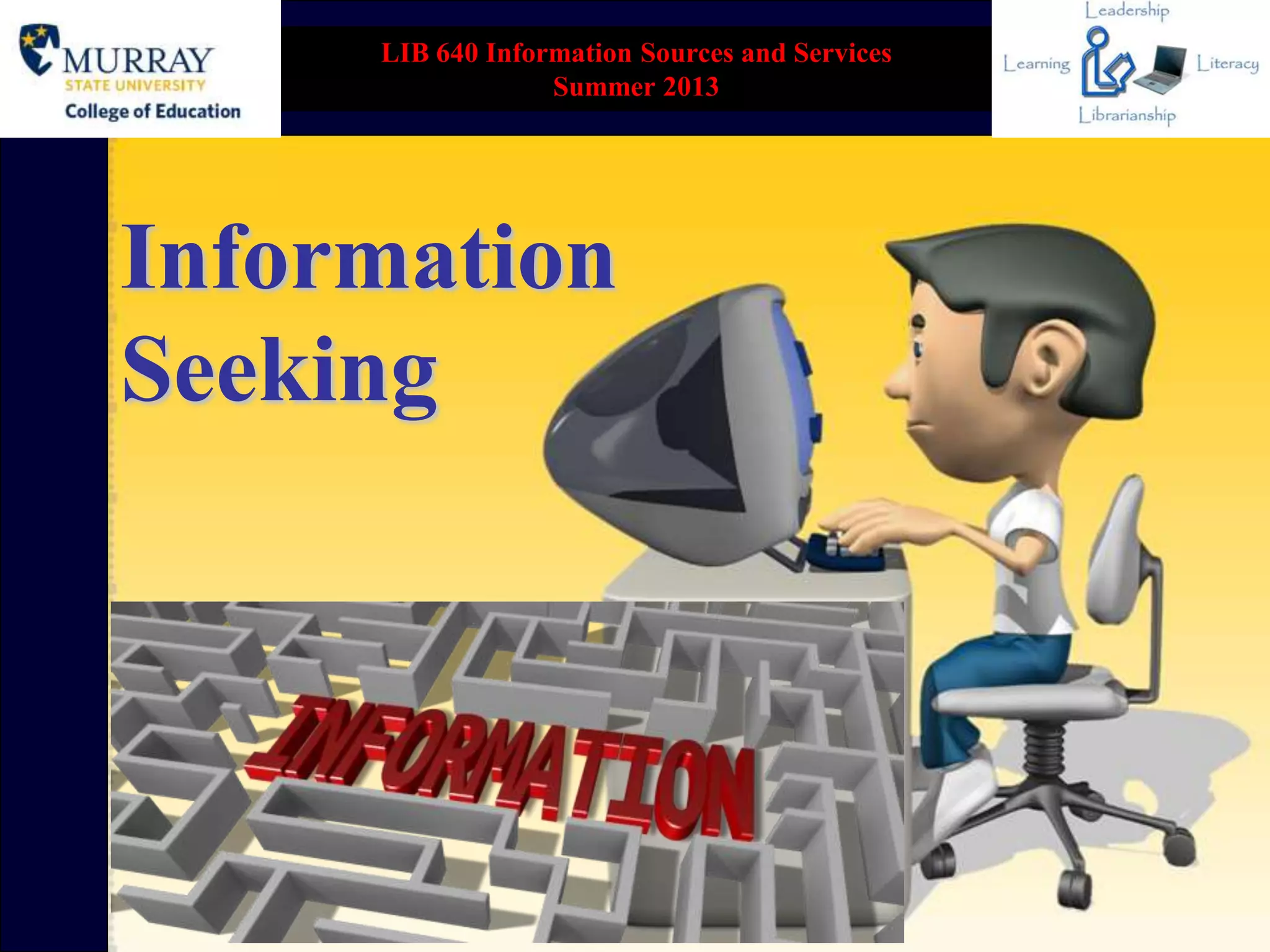
Information
Seeking
LIB 640 Information Sources and Services
Summer 2013
What Is Information Seeking?
• In the simplest terms, information seeking
involves the search, retrieval, recognition,
and application of meaningful content. This
search may be explicit or implicit, the
retrieval may be the result of specific
strategies or serendipity, the resulting
information may be embraced or rejected,
the entire experience may be carried through
to a logical conclusion or aborted in
midstream, and there may be a million other
potential results.
• Kingrey, K. P. (2002, Spring). Concepts of information seeking
and their presence in the practical library literature.
Library Philosophy and Practice, 4, 2
2
What is information seeking?
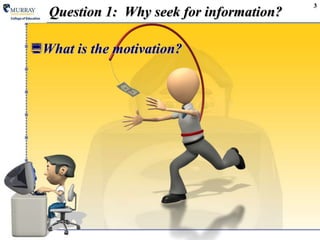
Question 1: Why seek for information?
What is the motivation?
3
4
Why Seek? Theory 1
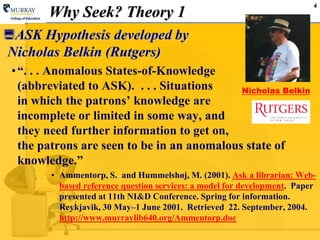
ASK Hypothesis developed by
Nicholas Belkin (Rutgers)
•“. . . Anomalous States-of-Knowledge
(abbreviated to ASK). . . . Situations
in which the patrons‟ knowledge are
incomplete or limited in some way, and
they need further information to get on,
the patrons are seen to be in an anomalous state of
knowledge.”
• Ammentorp, S. and Hummelshøj, M. (2001). Ask a librarian: Web-
based reference question services: a model for development. Paper
presented at 11th NI&D Conference. Spring for information.
Reykjavik, 30 May–1 June 2001. Retrieved 22. September, 2004.
http://www.murraylib640.org/Ammentorp.doc
Nicholas Belkin
5
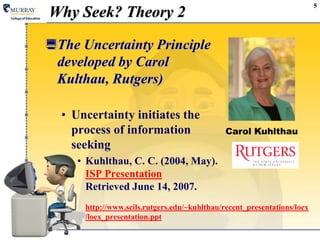
Why Seek? Theory 2
The Uncertainty Principle
developed by Carol
Kulthau, Rutgers)
• Uncertainty initiates the
process of information
seeking
• Kuhlthau, C. C. (2004, May).
ISP Presentation
Retrieved June 14, 2007.
http://www.scils.rutgers.edu/~kuhlthau/recent_presentations/loex
/loex_presentation.ppt
Carol Kuhlthau
6
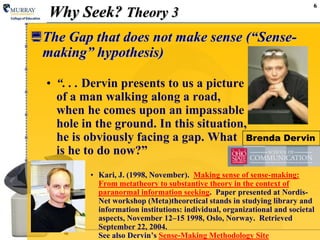
Why Seek? Theory 3
The Gap that does not make sense (“Sense-
making” hypothesis)
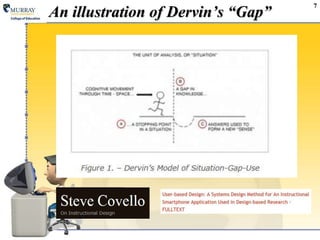
• “. . . Dervin presents to us a picture
of a man walking along a road,
when he comes upon an impassable
hole in the ground. In this situation,
he is obviously facing a gap. What
is he to do now?”
• Kari, J. (1998, November). Making sense of sense-making:
From metatheory to substantive theory in the context of
paranormal information seeking. Paper presented at Nordis-
Net workshop (Meta)theoretical stands in studying library and
information institutions: individual, organizational and societal
aspects, November 12–15 1998, Oslo, Norway. Retrieved
September 22, 2004.
See also Dervin‟s Sense-Making Methodology Site
Brenda Dervin
An illustration of Dervin’s “Gap”
7
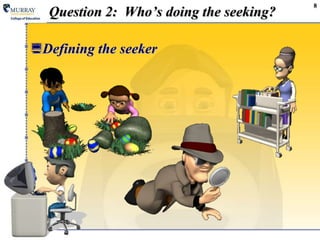
Question 2: Who’s doing the seeking?
Defining the seeker
8
9
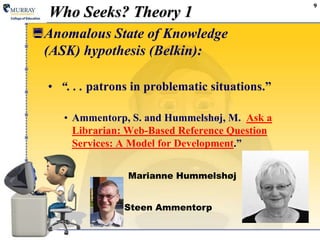
Who Seeks? Theory 1
Anomalous State of Knowledge
(ASK) hypothesis (Belkin):
• “. . . patrons in problematic situations.”
• Ammentorp, S. and Hummelshøj, M. Ask a
Librarian: Web-Based Reference Question
Services: A Model for Development.”
Marianne Hummelshøj
Steen Ammentorp
10
Who Seeks? Theory 2
Kulthau’s Information Search Process:
• People experience the ISP [Information Search
Process] holistically with an interplay of
thoughts, feelings, and actions.
• Kuhlthau, Carol C. “An Overview of the Information
Search Process.” Retrieved June 14, 2007.
http://www.scils.rutgers.edu/~kuhlthau/information_search_process.htm
Carol Kuhlthau
11
Who Seeks? Theory 3
Sense-Making Hypothesis:
• “. . . [a] patron [who] is seen as being locked
in a situation unable to move further because
of some kind of gap in his knowledge.”
• Ammentorp and Hummelshøj, Ask a librarian:
web-based reference question services: A model
for development.
Brenda Dervin
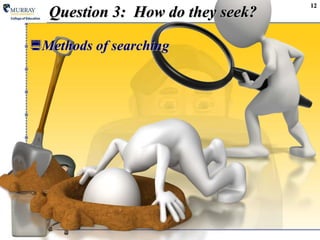
Question 3: How do they seek?
Methods of searching
12
13
How Do They Seek? Theory 1
Belkin’s ASK:
• “. . . users performing some activity feel that
they have a knowledge gap that cannot be
filled directly, and consequently they engage
into an information seeking process. . .”
• Brajnik, G. (1999, June). Information seeking as
explorative learning. Retrieved Sept. 7th, 2003.
http://www.bcs.org/upload/pdf/ewic_mi99_paper2.pdf
Giorgio Brajnik
Assistant Professor in
Computer Science, University
of Udine, Italy
14
How Do They Seek? Theory 2
Kuhlthau’s ISP:
• “The critical component of the
ISP is the person‟s own
formulation of a focus that
involves gaining a personal
perspective of the topic or subject
while using a variety of sources of information.
In other words, users are constructing their
own understandings through inquiry.”
• Kuhlthau, C. “Research Interests.” Last Updated January
2012. Retrieved June 10, 2012.
• http://www.scils.rutgers.edu/~kuhlthau/research_interests.htm
15
How Do They Seek? Theory 3
Dervin’s Sense-Making:
• “ . . . the patron is seen as being locked in a
situation unable to move further because
of some kind of gap in his knowledge.
However the patron tries to bridge this gap
by asking questions and using the answers
to closing the gap, making new sense. As
Belkin, Dervin sees the nature of the
information need as something situational
changing as the patrons tries to bridge the
gap.”
• Ammentorp and Hummelshøj, “Ask a Librarian: Web-
Based Reference Question Services: A Model for
Development.”
16
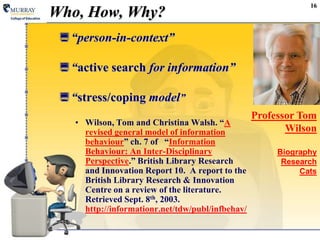
Who, How, Why?
“person-in-context”
“active search for information”
“stress/coping model”
• Wilson, Tom and Christina Walsh. “A
revised general model of information
behaviour” ch. 7 of “Information
Behaviour: An Inter-Disciplinary
Perspective.” British Library Research
and Innovation Report 10. A report to the
British Library Research & Innovation
Centre on a review of the literature.
Retrieved Sept. 8th, 2003.
http://informationr.net/tdw/publ/infbehav/
Professor Tom
Wilson
Biography
Research
Cats
17
Another Motivation to Consider
Self-Generated or Imposed?
• internally motivated by personal context
OR
• thought up by one person then given to
someone else to resolve
• Gross, M. (2001, January). Imposed
information seeking in public libraries and
school library media centers: a common
behaviour? Information Research, 6, 2.
Retrieved Sept. 8th, 2003.
http://informationr.net/ir/6-2/paper100.html
18
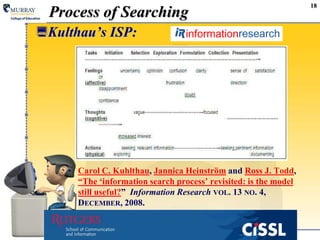
Process of Searching
Kulthau’s ISP:
• Carol C. Kuhlthau, Jannica Heinström and Ross J. Todd,
“The „information search process‟ revisited: is the model
still useful?” Information Research VOL. 13 NO. 4,
DECEMBER, 2008.

Information Seeking

  • 1.
    Information Seeking LIB 640 InformationSources and Services Summer 2013
  • 2.
    What Is InformationSeeking? • In the simplest terms, information seeking involves the search, retrieval, recognition, and application of meaningful content. This search may be explicit or implicit, the retrieval may be the result of specific strategies or serendipity, the resulting information may be embraced or rejected, the entire experience may be carried through to a logical conclusion or aborted in midstream, and there may be a million other potential results. • Kingrey, K. P. (2002, Spring). Concepts of information seeking and their presence in the practical library literature. Library Philosophy and Practice, 4, 2 2 What is information seeking?
  • 3.
    Question 1: Whyseek for information? What is the motivation? 3
  • 4.
    4 Why Seek? Theory1 ASK Hypothesis developed by Nicholas Belkin (Rutgers) •“. . . Anomalous States-of-Knowledge (abbreviated to ASK). . . . Situations in which the patrons‟ knowledge are incomplete or limited in some way, and they need further information to get on, the patrons are seen to be in an anomalous state of knowledge.” • Ammentorp, S. and Hummelshøj, M. (2001). Ask a librarian: Web- based reference question services: a model for development. Paper presented at 11th NI&D Conference. Spring for information. Reykjavik, 30 May–1 June 2001. Retrieved 22. September, 2004. http://www.murraylib640.org/Ammentorp.doc Nicholas Belkin
  • 5.
    5 Why Seek? Theory2 The Uncertainty Principle developed by Carol Kulthau, Rutgers) • Uncertainty initiates the process of information seeking • Kuhlthau, C. C. (2004, May). ISP Presentation Retrieved June 14, 2007. http://www.scils.rutgers.edu/~kuhlthau/recent_presentations/loex /loex_presentation.ppt Carol Kuhlthau
  • 6.
    6 Why Seek? Theory3 The Gap that does not make sense (“Sense- making” hypothesis) • “. . . Dervin presents to us a picture of a man walking along a road, when he comes upon an impassable hole in the ground. In this situation, he is obviously facing a gap. What is he to do now?” • Kari, J. (1998, November). Making sense of sense-making: From metatheory to substantive theory in the context of paranormal information seeking. Paper presented at Nordis- Net workshop (Meta)theoretical stands in studying library and information institutions: individual, organizational and societal aspects, November 12–15 1998, Oslo, Norway. Retrieved September 22, 2004. See also Dervin‟s Sense-Making Methodology Site Brenda Dervin
  • 7.
    An illustration ofDervin’s “Gap” 7
  • 8.
    Question 2: Who’sdoing the seeking? Defining the seeker 8
  • 9.
    9 Who Seeks? Theory1 Anomalous State of Knowledge (ASK) hypothesis (Belkin): • “. . . patrons in problematic situations.” • Ammentorp, S. and Hummelshøj, M. Ask a Librarian: Web-Based Reference Question Services: A Model for Development.” Marianne Hummelshøj Steen Ammentorp
  • 10.
    10 Who Seeks? Theory2 Kulthau’s Information Search Process: • People experience the ISP [Information Search Process] holistically with an interplay of thoughts, feelings, and actions. • Kuhlthau, Carol C. “An Overview of the Information Search Process.” Retrieved June 14, 2007. http://www.scils.rutgers.edu/~kuhlthau/information_search_process.htm Carol Kuhlthau
  • 11.
    11 Who Seeks? Theory3 Sense-Making Hypothesis: • “. . . [a] patron [who] is seen as being locked in a situation unable to move further because of some kind of gap in his knowledge.” • Ammentorp and Hummelshøj, Ask a librarian: web-based reference question services: A model for development. Brenda Dervin
  • 12.
    Question 3: Howdo they seek? Methods of searching 12
  • 13.
    13 How Do TheySeek? Theory 1 Belkin’s ASK: • “. . . users performing some activity feel that they have a knowledge gap that cannot be filled directly, and consequently they engage into an information seeking process. . .” • Brajnik, G. (1999, June). Information seeking as explorative learning. Retrieved Sept. 7th, 2003. http://www.bcs.org/upload/pdf/ewic_mi99_paper2.pdf Giorgio Brajnik Assistant Professor in Computer Science, University of Udine, Italy
  • 14.
    14 How Do TheySeek? Theory 2 Kuhlthau’s ISP: • “The critical component of the ISP is the person‟s own formulation of a focus that involves gaining a personal perspective of the topic or subject while using a variety of sources of information. In other words, users are constructing their own understandings through inquiry.” • Kuhlthau, C. “Research Interests.” Last Updated January 2012. Retrieved June 10, 2012. • http://www.scils.rutgers.edu/~kuhlthau/research_interests.htm
  • 15.
    15 How Do TheySeek? Theory 3 Dervin’s Sense-Making: • “ . . . the patron is seen as being locked in a situation unable to move further because of some kind of gap in his knowledge. However the patron tries to bridge this gap by asking questions and using the answers to closing the gap, making new sense. As Belkin, Dervin sees the nature of the information need as something situational changing as the patrons tries to bridge the gap.” • Ammentorp and Hummelshøj, “Ask a Librarian: Web- Based Reference Question Services: A Model for Development.”
  • 16.
    16 Who, How, Why? “person-in-context” “activesearch for information” “stress/coping model” • Wilson, Tom and Christina Walsh. “A revised general model of information behaviour” ch. 7 of “Information Behaviour: An Inter-Disciplinary Perspective.” British Library Research and Innovation Report 10. A report to the British Library Research & Innovation Centre on a review of the literature. Retrieved Sept. 8th, 2003. http://informationr.net/tdw/publ/infbehav/ Professor Tom Wilson Biography Research Cats
  • 17.
    17 Another Motivation toConsider Self-Generated or Imposed? • internally motivated by personal context OR • thought up by one person then given to someone else to resolve • Gross, M. (2001, January). Imposed information seeking in public libraries and school library media centers: a common behaviour? Information Research, 6, 2. Retrieved Sept. 8th, 2003. http://informationr.net/ir/6-2/paper100.html
  • 18.
    18 Process of Searching Kulthau’sISP: • Carol C. Kuhlthau, Jannica Heinström and Ross J. Todd, “The „information search process‟ revisited: is the model still useful?” Information Research VOL. 13 NO. 4, DECEMBER, 2008.