Information literacy (What is Info. Literacy, Need and Importance)
The document discusses the concept and importance of information literacy, defined as the ability to recognize when information is needed and to locate, evaluate, and use that information effectively. It highlights the need for information literacy in promoting personal, social, and educational goals, and outlines various models to achieve it, such as the Big 6 and the Plus Model. The conclusion emphasizes that developing these skills leads to lifelong learning and effective problem-solving in personal and professional contexts.
Explores the concept, need, and importance of information literacy guided by Miss Udita. Covers definitions, models, and its role in developing critical skills.
Information literacy (What is Info. Literacy, Need and Importance)
1.
Information Literacy
Concept, Needand Importance
Guided by:
Miss Udita Ma’am
SOE, CUH
Presented by:
Km Keerti Singh
B.Ed, Sec. B
Roll no. 200142
2.
Concept of InformationLiteracy
❖ The term “Information Literacy” propounded by American researcher Paul Zurkowski
who stated that persons with skills in information area are “educated people with the
purpose of applying information resources in their workplace.”
❖ A responsible citizen—a student or a professional—should be able to know the need of
information, to locate information, identify, access, recover, evaluate, organize and use
it. A person with information literacy is able to:
➔ Prospect—the ability of locating the relevant information, of detailed and critical
examination and selection;
➔ Interpret—ability of transforming information and data into knowledge, insight and
understanding; and
➔ Generate ideas—ability of developing new cognitive perspectives.
3.
Definitions
❖ "To beinformation literate, a person must be able to recognize when information is
needed and have the ability to locate, evaluate, and use effectively the needed
information." -American Library Association Presidential Committee on Information
Literacy, Final Report, 1989
❖ "The ability to locate, evaluate, and use information to become independent lifelong
learners" - Commission on Colleges, Southern Association of Colleges and Schools
(SACS).
❖ "Information literacy is the set of integrated abilities encompassing the reflective
discovery of information, the understanding of how information is produced and valued,
and the use of information in creating new knowledge and participating ethically in
communities of learning." -ACRL Framework for Information Literacy for Higher
Education 2015
4.
Need of InformationLiteracy
"Information literacy empowers people in all walks of life to seek, evaluate,
use and create information effectively to achieve their personal, social,
occupational and educational goals. It is a basic human right in a digital world and
promotes social inclusion in all nations."
5.
Some Models toachieve IL:
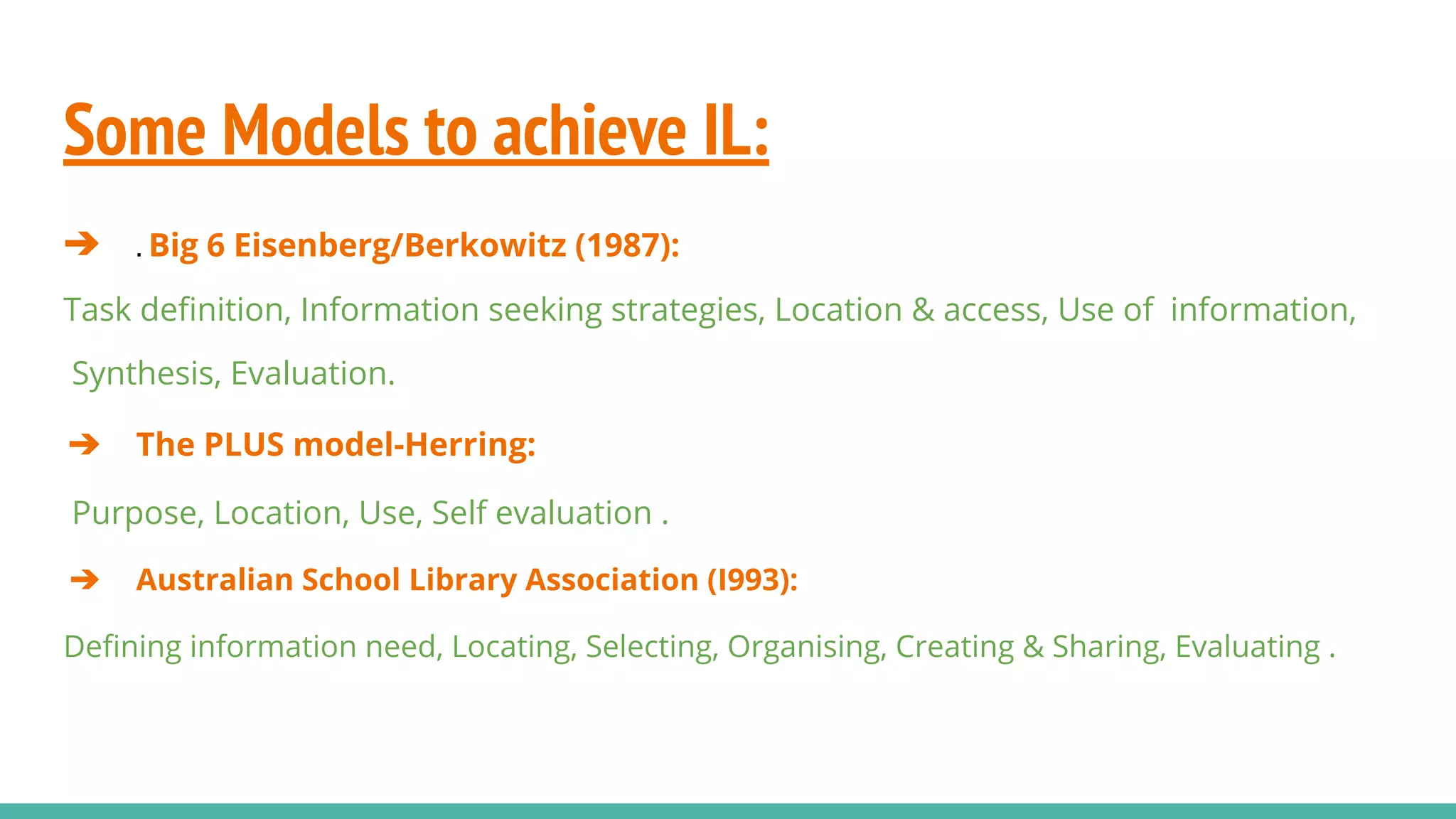
➔ . Big 6 Eisenberg/Berkowitz (1987):
Task definition, Information seeking strategies, Location & access, Use of information,
Synthesis, Evaluation.
➔ The PLUS model-Herring:
Purpose, Location, Use, Self evaluation .
➔ Australian School Library Association (I993):
Defining information need, Locating, Selecting, Organising, Creating & Sharing, Evaluating .
6.
Information literacy isimportant for today’s learners, it promotes problem
solving approaches and thinking skills – asking questions and seeking answers,
finding information, forming opinions, evaluating sources and making decisions
fostering successful learners, effective contributors, confident individuals and
responsible citizens.
Importance of Information Literacy
7.
● Awareness ofhow you engage with the digital world,
● how you find meaning in the information you discover,
● how to articulate what kind of information you require,
● how to use information ethically,
● understand the role you can play in the communication in your profession,
and
● how you evaluate information for credibility and authority..
8.
Conclusion:
The student willbe equipped with the ability to identify, search, evaluate, use,
and present information effectively to address various problems in their daily lives,
their academic study and future profession. The achievement of these capabilities is
very important because, in the long run, the student will have learned how to learn.
You will know how knowledge is organised, how to locate information and to
integrate new materials with what you already know to deal with problems for your
personal and business needs, and thereby achieve the goal of life-long learning.