Conventional Methods of Organizing and Retrieving InformationLORD ALLEN M. HERNANDEZLIS 26 Instructor , BLISCollege of Education, Silliman University
Library ToolsEarly libraries concentrated on the physical arrangement of books on shelves in order. As the number of books increase, however, additional organization was necessary to make the content of the library collection more accessible.Development of subject classification schemes, the card catalog and other tools.Tools : Keystone of the structure for control of the library collection and are the basic finding aids.
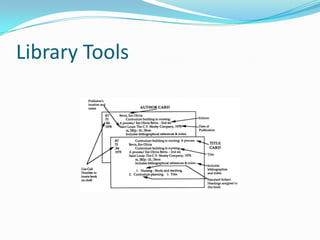
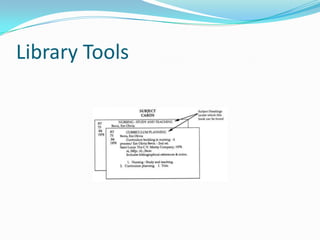
Library ToolsThe CatalogServes as the library’s main index to the printed contents of its collection by indicating what material the library holds and where it may be found.Forms : Card or Book
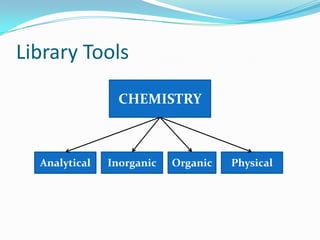
Library ToolsSubject Heading System consists of the selection of words or phrases as main headings and the use of additional words and phrases as subdivisions.Subject Headings --> Alphabetical orderSub-divisions --> Alphabetical order
Library ToolsCHEMISTRYAnalyticalInorganicOrganicPhysical
Library ToolsDrawback of the Subject Heading SystemUser will not always agree with the indexer’s choice – the semantics of the heading may change with time, and the concepts underlying the indexer’s choice may themselves change.
Library Tools
Library Tools
Library ToolsShelf list – is an internal library catalog generally available only to librarians.Consists of one entry for every item in the collection and is arranged in a sequence which duplicates the order of the books on the shelves.
Can be referred to as “inventory catalog”
“Class catalog” – Cards are arranged by class number.Library ToolsClassification  - logical system for the arrangement of knowledge.      - Grouping together like things according to common quality or characteristic.
Library ToolsThe Classification SchemeClassification is designed to organize books on shelves in a manner most conducive to their use. Many books and ideas are related either by subject or by some accidental property of the things beings classified. Thus books can be separated by such characteristics as language, alphabet, form, or date.
Library Tools
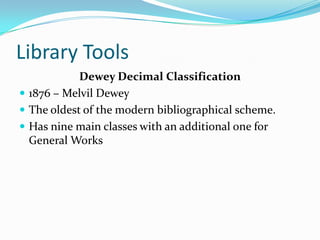
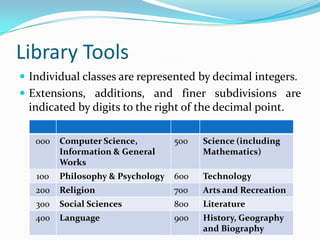
Library ToolsDewey Decimal Classification1876 – Melvil DeweyThe oldest of the modern bibliographical scheme.Has nine main classes with an additional one for General Works
Library ToolsIndividual classes are represented by decimal integers.Extensions, additions, and finer subdivisions are indicated by digits to the right of the decimal point.
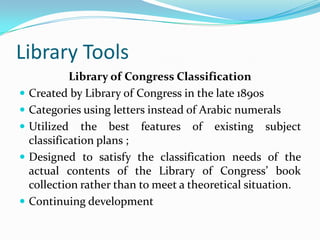
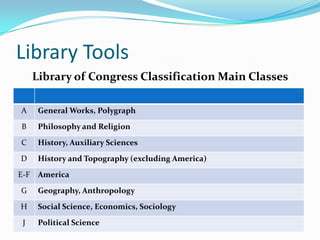
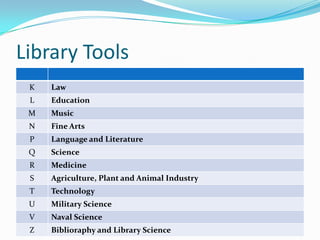
Library ToolsLibrary of Congress ClassificationCreated by Library of Congress in the late 1890sCategories using letters instead of Arabic numeralsUtilized the best features of existing subject classification plans ;Designed to satisfy the classification needs of the actual contents of the Library of Congress’ book collection rather than to meet a theoretical situation.Continuing development
Library ToolsLibrary of Congress Classification Main Classes
Library Tools
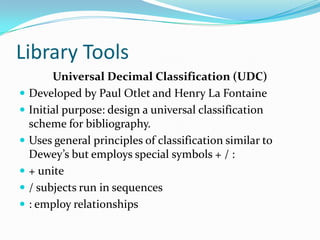
Library ToolsUniversal Decimal Classification (UDC)Developed by Paul Otlet and Henry La FontaineInitial purpose: design a universal classification scheme for bibliography.Uses general principles of classification similar to Dewey’s but employs special symbols + / : + unite/ subjects run in sequences: employ relationships
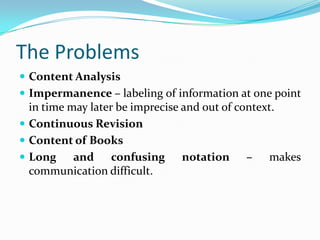
The ProblemsContent AnalysisImpermanence – labeling of information at one point in time may later be imprecise and out of context.Continuous RevisionContent of BooksLong and confusing notation – makes communication difficult.

Conventional Methods of Organizing and Retrieving Information

  • 1.
    Conventional Methods ofOrganizing and Retrieving InformationLORD ALLEN M. HERNANDEZLIS 26 Instructor , BLISCollege of Education, Silliman University
  • 2.
    Library ToolsEarly librariesconcentrated on the physical arrangement of books on shelves in order. As the number of books increase, however, additional organization was necessary to make the content of the library collection more accessible.Development of subject classification schemes, the card catalog and other tools.Tools : Keystone of the structure for control of the library collection and are the basic finding aids.
  • 3.
    Library ToolsThe CatalogServesas the library’s main index to the printed contents of its collection by indicating what material the library holds and where it may be found.Forms : Card or Book
  • 4.
    Library ToolsSubject HeadingSystem consists of the selection of words or phrases as main headings and the use of additional words and phrases as subdivisions.Subject Headings --> Alphabetical orderSub-divisions --> Alphabetical order
  • 5.
  • 6.
    Library ToolsDrawback ofthe Subject Heading SystemUser will not always agree with the indexer’s choice – the semantics of the heading may change with time, and the concepts underlying the indexer’s choice may themselves change.
  • 7.
  • 8.
  • 9.
    Library ToolsShelf list– is an internal library catalog generally available only to librarians.Consists of one entry for every item in the collection and is arranged in a sequence which duplicates the order of the books on the shelves.
  • 10.
    Can be referredto as “inventory catalog”
  • 11.
    “Class catalog” –Cards are arranged by class number.Library ToolsClassification - logical system for the arrangement of knowledge. - Grouping together like things according to common quality or characteristic.
  • 12.
    Library ToolsThe ClassificationSchemeClassification is designed to organize books on shelves in a manner most conducive to their use. Many books and ideas are related either by subject or by some accidental property of the things beings classified. Thus books can be separated by such characteristics as language, alphabet, form, or date.
  • 13.
  • 14.
    Library ToolsDewey DecimalClassification1876 – Melvil DeweyThe oldest of the modern bibliographical scheme.Has nine main classes with an additional one for General Works
  • 15.
    Library ToolsIndividual classesare represented by decimal integers.Extensions, additions, and finer subdivisions are indicated by digits to the right of the decimal point.
  • 16.
    Library ToolsLibrary ofCongress ClassificationCreated by Library of Congress in the late 1890sCategories using letters instead of Arabic numeralsUtilized the best features of existing subject classification plans ;Designed to satisfy the classification needs of the actual contents of the Library of Congress’ book collection rather than to meet a theoretical situation.Continuing development
  • 17.
    Library ToolsLibrary ofCongress Classification Main Classes
  • 18.
  • 19.
    Library ToolsUniversal DecimalClassification (UDC)Developed by Paul Otlet and Henry La FontaineInitial purpose: design a universal classification scheme for bibliography.Uses general principles of classification similar to Dewey’s but employs special symbols + / : + unite/ subjects run in sequences: employ relationships
  • 20.
    The ProblemsContent AnalysisImpermanence– labeling of information at one point in time may later be imprecise and out of context.Continuous RevisionContent of BooksLong and confusing notation – makes communication difficult.