


data & content design
Frieda Brioschi - frieda.brioschi@gmail.com
Emma Tracanella - emma.tracanella@gmail.com
STORYTELLING WITH DATA
LESSON 9 - 2019/20
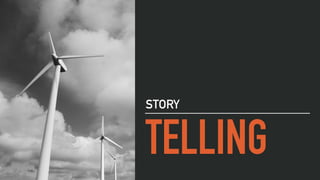
TELLING
STORY
data & content design
LESSON 9
NARRARE NECESSE EST
We all need to tell a story.
This is because storytelling is a universal phenomenon and the human activities
that involve the use of stories are virtually endless, and every time we tell a story,
our brain circuits come into play. We are, literally, made of stories.
All stories are stories that have content. But not all content generates stories.
▸ https://www.morningfuture.com/en/article/2019/09/09/capital-narrative-storytelling-enterprise/722/
4
data & content design
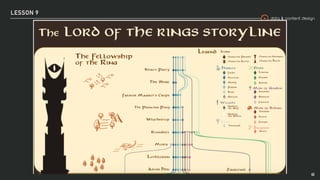
STORYTELLING MEANS COMMUNICATING THROUGH
STORIES AND REPRESENTATIONS THAT START FROM
THEIR OWN LIFE EXPERIENCES AND THEY TEND TO
BE EXCITING
Andrea Fontana, sociologist
LESSON 9
5
data & content design
LESSON 9
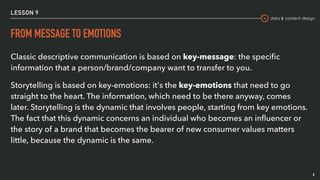
FROM MESSAGE TO EMOTIONS
Classic descriptive communication is based on key-message: the specific
information that a person/brand/company want to transfer to you.
Storytelling is based on key-emotions: it's the key-emotions that need to go
straight to the heart. The information, which need to be there anyway, comes
later. Storytelling is the dynamic that involves people, starting from key emotions.
The fact that this dynamic concerns an individual who becomes an influencer or
the story of a brand that becomes the bearer of new consumer values matters
little, because the dynamic is the same.
6
data & content design
LESSON 9
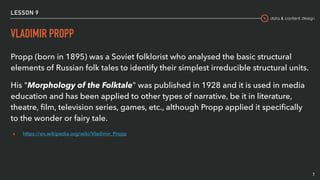
VLADIMIR PROPP
7
Propp (born in 1895) was a Soviet folklorist who analysed the basic structural
elements of Russian folk tales to identify their simplest irreducible structural units.
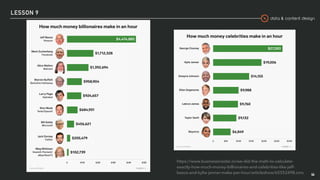
His "Morphology of the Folktale" was published in 1928 and it is used in media
education and has been applied to other types of narrative, be it in literature,
theatre, film, television series, games, etc., although Propp applied it specifically
to the wonder or fairy tale.
▸ https://en.wikipedia.org/wiki/Vladimir_Propp
data & content design
LESSON 9
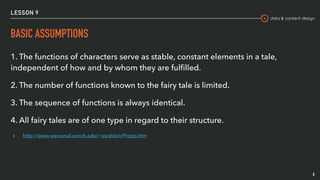
BASIC ASSUMPTIONS
8
1. The functions of characters serve as stable, constant elements in a tale,
independent of how and by whom they are fulfilled.
2. The number of functions known to the fairy tale is limited.
3. The sequence of functions is always identical.
4. All fairy tales are of one type in regard to their structure.
▸ http://www-personal.umich.edu/~esrabkin/Propp.htm
data & content design
LESSON 9
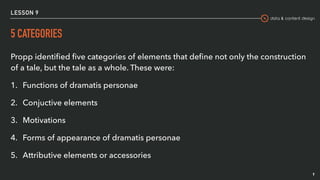
5 CATEGORIES
9
Propp identified five categories of elements that define not only the construction
of a tale, but the tale as a whole. These were:
1. Functions of dramatis personae
2. Conjuctive elements
3. Motivations
4. Forms of appearance of dramatis personae
5. Attributive elements or accessories
data & content design
LESSON 9
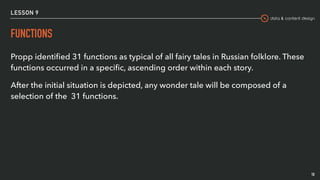
FUNCTIONS
10
Propp identified 31 functions as typical of all fairy tales in Russian folklore. These
functions occurred in a specific, ascending order within each story.
After the initial situation is depicted, any wonder tale will be composed of a
selection of the 31 functions.
data & content design
LESSON 9
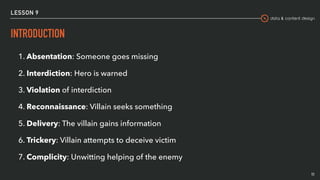
INTRODUCTION
11
1. Absentation: Someone goes missing
2. Interdiction: Hero is warned
3. Violation of interdiction
4. Reconnaissance: Villain seeks something
5. Delivery: The villain gains information
6. Trickery: Villain attempts to deceive victim
7. Complicity: Unwitting helping of the enemy
data & content design
LESSON 9
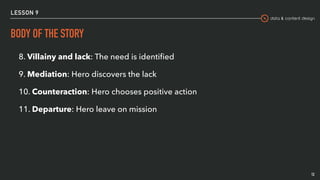
BODY OF THE STORY
12
8. Villainy and lack: The need is identified
9. Mediation: Hero discovers the lack
10. Counteraction: Hero chooses positive action
11. Departure: Hero leave on mission
data & content design
LESSON 9
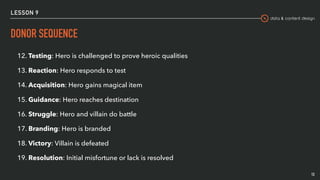
DONOR SEQUENCE
13
12. Testing: Hero is challenged to prove heroic qualities
13. Reaction: Hero responds to test
14. Acquisition: Hero gains magical item
15. Guidance: Hero reaches destination
16. Struggle: Hero and villain do battle
17. Branding: Hero is branded
18. Victory: Villain is defeated
19. Resolution: Initial misfortune or lack is resolved
data & content design
LESSON 9
HERO’S RETURN
14
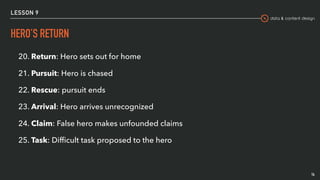
20. Return: Hero sets out for home
21. Pursuit: Hero is chased
22. Rescue: pursuit ends
23. Arrival: Hero arrives unrecognized
24. Claim: False hero makes unfounded claims
25. Task: Difficult task proposed to the hero
data & content design
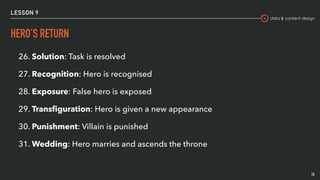
26. Solution: Task is resolved
27. Recognition: Hero is recognised
28. Exposure: False hero is exposed
29. Transfiguration: Hero is given a new appearance
30. Punishment: Villain is punished
31. Wedding: Hero marries and ascends the throne
LESSON 9
HERO’S RETURN
15
data & content design
LESSON 9
CHARACTERS
16
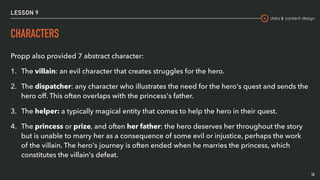
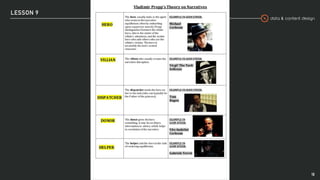
Propp also provided 7 abstract character:
1. The villain: an evil character that creates struggles for the hero.
2. The dispatcher: any character who illustrates the need for the hero's quest and sends the
hero off. This often overlaps with the princess's father.
3. The helper: a typically magical entity that comes to help the hero in their quest.
4. The princess or prize, and often her father: the hero deserves her throughout the story
but is unable to marry her as a consequence of some evil or injustice, perhaps the work
of the villain. The hero's journey is often ended when he marries the princess, which
constitutes the villain's defeat.
data & content design
LESSON 9
CHARACTERS
17
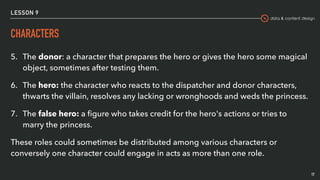
5. The donor: a character that prepares the hero or gives the hero some magical
object, sometimes after testing them.
6. The hero: the character who reacts to the dispatcher and donor characters,
thwarts the villain, resolves any lacking or wronghoods and weds the princess.
7. The false hero: a figure who takes credit for the hero's actions or tries to
marry the princess.
These roles could sometimes be distributed among various characters or
conversely one character could engage in acts as more than one role.
data & content design
LESSON 9
18
data & content design
LESSON 9
19
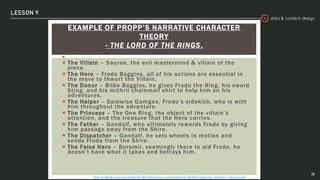
The Villain – Sauron, the evil mastermind & villain of the
piece.
The Hero – Frodo Baggins, all of his actions are essential in
the move to thwart the Villain.
The Donor – Bilbo Baggins, he gives Frodo the Ring, his sword
Sting, and his mithril chainmail shirt to help him on his
adventures.
The Helper – Samwise Gamgee, Frodo’s sidekick, who is with
him throughout the adventure.
The Princess – The One Ring, the object of the villain’s
attention, and the treasure that the Hero carries.
The Father – Gandalf, who ultimately rewards Frodo by giving
him passage away from the Shire.
The Dispatcher – Gandalf, he sets wheels in motion and
sends Frodo from the Shire.
The False Hero – Boromir, seemingly there to aid Frodo, he
doesn’t have what it takes and betrays him.
EXAMPLE OF PROPP’S NARRATIVE CHARACTER
THEORY
- THE LORD OF THE RINGS.
http://todhigh.com/clickandbuilds/WordPress/wp-content/uploads/2018/02/Applying-Narrative-Theories.pdf
data & content design
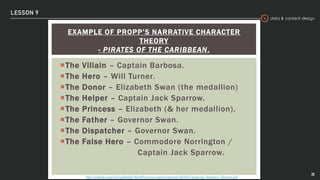
The Villain – Captain Barbosa.
The Hero – Will Turner.
The Donor – Elizabeth Swan (the medallion)
The Helper – Captain Jack Sparrow.
The Princess – Elizabeth (& her medallion).
The Father – Governor Swan.
The Dispatcher – Governor Swan.
The False Hero – Commodore Norrington /
Captain Jack Sparrow.
EXAMPLE OF PROPP’S NARRATIVE CHARACTER
THEORY
- PIRATES OF THE CARIBBEAN.
LESSON 9
20
http://todhigh.com/clickandbuilds/WordPress/wp-content/uploads/2018/02/Applying-Narrative-Theories.pdf
data & content design
LESSON 9
21
data & content design
LESSON 9
SETH GODIN’S HINTS: A MARKETING PERSPECTIVE
22
▸ Stories make it easier to understand the world. Stories are the only way we
know to spread an idea. Marketers didn’t invent storytelling. They just
perfected it
▸ A great story is true. Not true because it’s factual, but true because it’s
consistent and authentic.
▸ A great story makes a promise. They promise fun or money, safety or a
shortcut. The promise is bold and audacious and not just very good – it’s
exceptional or it’s not worth listening to.
https://www.lindafranzosi.com/single-post/2018/04/10/Seth-Godin-and-10-sharp-advices-on-marketing-storytelling
data & content design
LESSON 9
23
DATA
PRESENTING
data & content design
POWER CORRUPTS. POWERPOINT
CORRUPTS ABSOLUTELY.
Edward Tufte, Yale Professor Emeritus
LESSON 9
25
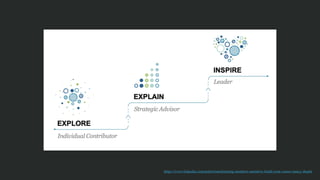
https://www.linkedin.com/pulse/transforming-numbers-narrative-build-your-career-nancy-duarte
data & content design
LESSON 9
EXPLORE AND EXPLAIN
27
Having all the information in the world at our fingertips doesn’t make it easier to
communicate: it makes it harder. The more information you’re dealing with, the
more difficult it is to filter down to the most important bits.
Exploratory analysis is what you do to understand the data and figure out what
might be noteworthy or interesting to highlight to others.

When we’re at the point of communicating our analysis to our audience, we
really want to be in the explanatory space, meaning you have a specific thing
you want to explain, a specific story you want to tell.
https://www.linkedin.com/pulse/transforming-numbers-narrative-build-your-career-nancy-duarte
data & content design
LESSON 9
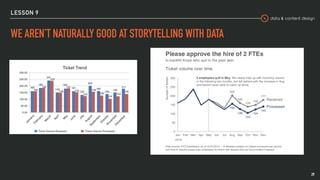
WE AREN’T NATURALLY GOOD AT STORYTELLING WITH DATA
29
data & content design
LESSON 9
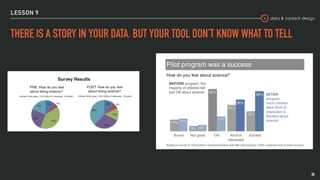
THERE IS A STORY IN YOUR DATA. BUT YOUR TOOL DON’T KNOW WHAT TO TELL
30
data & content design
LESSON 9
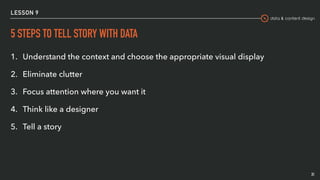
5 STEPS TO TELL STORY WITH DATA
1. Understand the context and choose the appropriate visual display
2. Eliminate clutter
3. Focus attention where you want it
4. Think like a designer
5. Tell a story
31
data & content design
LESSON 9
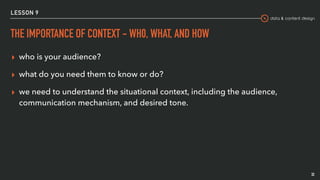
THE IMPORTANCE OF CONTEXT - WH0, WHAT, AND HOW
▸ who is your audience?
▸ what do you need them to know or do?
▸ we need to understand the situational context, including the audience,
communication mechanism, and desired tone.
32
data & content design
LESSON 9
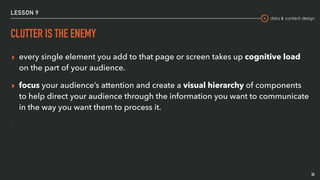
CLUTTER IS THE ENEMY
▸ every single element you add to that page or screen takes up cognitive load
on the part of your audience.
▸ focus your audience’s attention and create a visual hierarchy of components
to help direct your audience through the information you want to communicate
in the way you want them to process it.
▸
33
data & content design
LESSON 9
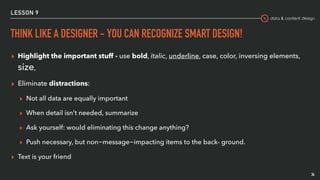
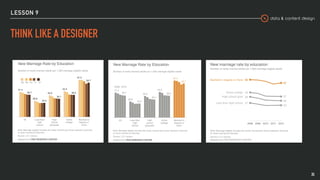
THINK LIKE A DESIGNER - YOU CAN RECOGNIZE SMART DESIGN!
▸ Highlight the important stuff - use bold, italic, underline, case, color, inversing elements,
size,
▸ Eliminate distractions:
▸ Not all data are equally important
▸ When detail isn’t needed, summarize
▸ Ask yourself: would eliminating this change anything?
▸ Push necessary, but non-message-impacting items to the back- ground.
▸ Text is your friend
34
data & content design
LESSON 9
THINK LIKE A DESIGNER
35
data & content design
LESSON 9
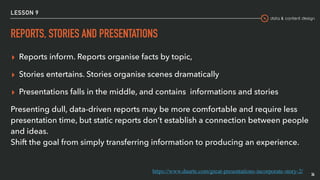
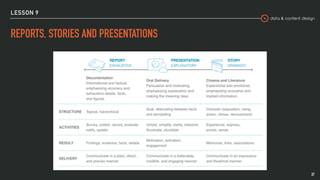
REPORTS, STORIES AND PRESENTATIONS
▸ Reports inform. Reports organise facts by topic,
▸ Stories entertains. Stories organise scenes dramatically
▸ Presentations falls in the middle, and contains informations and stories
Presenting dull, data-driven reports may be more comfortable and require less
presentation time, but static reports don’t establish a connection between people
and ideas. 

Shift the goal from simply transferring information to producing an experience.
36
https://www.duarte.com/great-presentations-incorporate-story-2/
data & content design
LESSON 9
REPORTS, STORIES AND PRESENTATIONS
37
data & content design
LESSON 9
STORYTELLING TECHNIQUES
A story has a clear beginning, a middle, and an end.
Use the power of repetition, narrative flow, considerations with spoken and
written narratives, and various tactics to ensure that our story comes across
clearly in our communications.
38
HINTS AND EXAMPLES
SOME
PHOTO BY JAREDD CRAIG ON UNSPLASH
data & content design
LESSON 9
HELP PEOPLE UNDERSTAND WHAT YOUR DATA MEANS
40
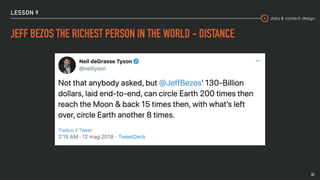
▸ Connect Data to Relatable Size - by comparing length, width,
height, thickness, or distance.
▸ Connect Data to Relatable Time - also work hours, flight time
between cities, an episode of a sitcom, a TED talk, or the time it
takes to microwave a bag of popcorn.
▸ Connect Data to Relatable Things - use nouns, or people, places,
and things that are familiar to them.
data & content design
LESSON 9
JEFF BEZOS THE RICHEST PERSON IN THE WORLD - DISTANCE
41
data & content design
LESSON 9
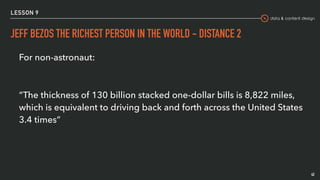
JEFF BEZOS THE RICHEST PERSON IN THE WORLD - DISTANCE 2
42
For non-astronaut:
“The thickness of 130 billion stacked one-dollar bills is 8,822 miles,
which is equivalent to driving back and forth across the United States
3.4 times” 
data & content design
LESSON 9
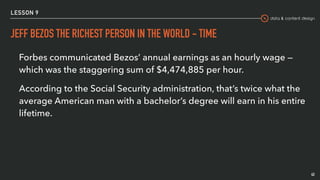
JEFF BEZOS THE RICHEST PERSON IN THE WORLD - TIME
43
Forbes communicated Bezos’ annual earnings as an hourly wage —
which was the staggering sum of $4,474,885 per hour.
According to the Social Security administration, that’s twice what the
average American man with a bachelor’s degree will earn in his entire
lifetime.
data & content design
LESSON 9
44
https://www.businessinsider.in/we-did-the-math-to-calculate-
exactly-how-much-money-billionaires-and-celebrities-like-jeff-
bezos-and-kylie-jenner-make-per-hour/articleshow/65552498.cms
data & content design
LESSON 9
45
data & content design
LESSON 9
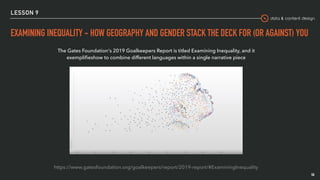
EXAMINING INEQUALITY - HOW GEOGRAPHY AND GENDER STACK THE DECK FOR (OR AGAINST) YOU
46
https://www.gatesfoundation.org/goalkeepers/report/2019-report/#ExaminingInequality
The Gates Foundation's 2019 Goalkeepers Report is titled Examining Inequality, and it
exemplifieshow to combine different languages within a single narrative piece
data & content design
LESSON 9
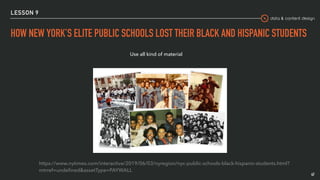
HOW NEW YORK’S ELITE PUBLIC SCHOOLS LOST THEIR BLACK AND HISPANIC STUDENTS
47
https://www.nytimes.com/interactive/2019/06/03/nyregion/nyc-public-schools-black-hispanic-students.html?
mtrref=undefined&assetType=PAYWALL
Use all kind of material
data & content design
LESSON 9
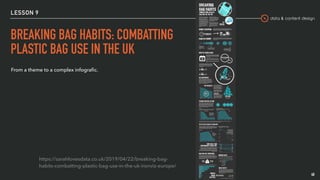
BREAKING BAG HABITS: COMBATTING
PLASTIC BAG USE IN THE UK
48
https://sarahlovesdata.co.uk/2019/04/22/breaking-bag-
habits-combatting-plastic-bag-use-in-the-uk-ironviz-europe/
From a theme to a complex infografic.
IT’S YOUR TURN
NOW
data & content design
LESSON 9
50
UPDATES ON YOUR PROJECT
Photo by William Iven on Unsplash

Storytelling with data

  • 1.
    data & contentdesign Frieda Brioschi - frieda.brioschi@gmail.com Emma Tracanella - emma.tracanella@gmail.com STORYTELLING WITH DATA LESSON 9 - 2019/20
  • 2.
  • 3.
    data & contentdesign LESSON 9 NARRARE NECESSE EST We all need to tell a story. This is because storytelling is a universal phenomenon and the human activities that involve the use of stories are virtually endless, and every time we tell a story, our brain circuits come into play. We are, literally, made of stories. All stories are stories that have content. But not all content generates stories. ▸ https://www.morningfuture.com/en/article/2019/09/09/capital-narrative-storytelling-enterprise/722/ 4
  • 4.
    data & contentdesign STORYTELLING MEANS COMMUNICATING THROUGH STORIES AND REPRESENTATIONS THAT START FROM THEIR OWN LIFE EXPERIENCES AND THEY TEND TO BE EXCITING Andrea Fontana, sociologist LESSON 9 5
  • 5.
    data & contentdesign LESSON 9 FROM MESSAGE TO EMOTIONS Classic descriptive communication is based on key-message: the specific information that a person/brand/company want to transfer to you. Storytelling is based on key-emotions: it's the key-emotions that need to go straight to the heart. The information, which need to be there anyway, comes later. Storytelling is the dynamic that involves people, starting from key emotions. The fact that this dynamic concerns an individual who becomes an influencer or the story of a brand that becomes the bearer of new consumer values matters little, because the dynamic is the same. 6
  • 6.
    data & contentdesign LESSON 9 VLADIMIR PROPP 7 Propp (born in 1895) was a Soviet folklorist who analysed the basic structural elements of Russian folk tales to identify their simplest irreducible structural units. His "Morphology of the Folktale" was published in 1928 and it is used in media education and has been applied to other types of narrative, be it in literature, theatre, film, television series, games, etc., although Propp applied it specifically to the wonder or fairy tale. ▸ https://en.wikipedia.org/wiki/Vladimir_Propp
  • 7.
    data & contentdesign LESSON 9 BASIC ASSUMPTIONS 8 1. The functions of characters serve as stable, constant elements in a tale, independent of how and by whom they are fulfilled. 2. The number of functions known to the fairy tale is limited. 3. The sequence of functions is always identical. 4. All fairy tales are of one type in regard to their structure. ▸ http://www-personal.umich.edu/~esrabkin/Propp.htm
  • 8.
    data & contentdesign LESSON 9 5 CATEGORIES 9 Propp identified five categories of elements that define not only the construction of a tale, but the tale as a whole. These were: 1. Functions of dramatis personae 2. Conjuctive elements 3. Motivations 4. Forms of appearance of dramatis personae 5. Attributive elements or accessories
  • 9.
    data & contentdesign LESSON 9 FUNCTIONS 10 Propp identified 31 functions as typical of all fairy tales in Russian folklore. These functions occurred in a specific, ascending order within each story. After the initial situation is depicted, any wonder tale will be composed of a selection of the 31 functions.
  • 10.
    data & contentdesign LESSON 9 INTRODUCTION 11 1. Absentation: Someone goes missing 2. Interdiction: Hero is warned 3. Violation of interdiction 4. Reconnaissance: Villain seeks something 5. Delivery: The villain gains information 6. Trickery: Villain attempts to deceive victim 7. Complicity: Unwitting helping of the enemy
  • 11.
    data & contentdesign LESSON 9 BODY OF THE STORY 12 8. Villainy and lack: The need is identified 9. Mediation: Hero discovers the lack 10. Counteraction: Hero chooses positive action 11. Departure: Hero leave on mission
  • 12.
    data & contentdesign LESSON 9 DONOR SEQUENCE 13 12. Testing: Hero is challenged to prove heroic qualities 13. Reaction: Hero responds to test 14. Acquisition: Hero gains magical item 15. Guidance: Hero reaches destination 16. Struggle: Hero and villain do battle 17. Branding: Hero is branded 18. Victory: Villain is defeated 19. Resolution: Initial misfortune or lack is resolved
  • 13.
    data & contentdesign LESSON 9 HERO’S RETURN 14 20. Return: Hero sets out for home 21. Pursuit: Hero is chased 22. Rescue: pursuit ends 23. Arrival: Hero arrives unrecognized 24. Claim: False hero makes unfounded claims 25. Task: Difficult task proposed to the hero
  • 14.
    data & contentdesign 26. Solution: Task is resolved 27. Recognition: Hero is recognised 28. Exposure: False hero is exposed 29. Transfiguration: Hero is given a new appearance 30. Punishment: Villain is punished 31. Wedding: Hero marries and ascends the throne LESSON 9 HERO’S RETURN 15
  • 15.
    data & contentdesign LESSON 9 CHARACTERS 16 Propp also provided 7 abstract character: 1. The villain: an evil character that creates struggles for the hero. 2. The dispatcher: any character who illustrates the need for the hero's quest and sends the hero off. This often overlaps with the princess's father. 3. The helper: a typically magical entity that comes to help the hero in their quest. 4. The princess or prize, and often her father: the hero deserves her throughout the story but is unable to marry her as a consequence of some evil or injustice, perhaps the work of the villain. The hero's journey is often ended when he marries the princess, which constitutes the villain's defeat.
  • 16.
    data & contentdesign LESSON 9 CHARACTERS 17 5. The donor: a character that prepares the hero or gives the hero some magical object, sometimes after testing them. 6. The hero: the character who reacts to the dispatcher and donor characters, thwarts the villain, resolves any lacking or wronghoods and weds the princess. 7. The false hero: a figure who takes credit for the hero's actions or tries to marry the princess. These roles could sometimes be distributed among various characters or conversely one character could engage in acts as more than one role.
  • 17.
    data & contentdesign LESSON 9 18
  • 18.
    data & contentdesign LESSON 9 19 The Villain – Sauron, the evil mastermind & villain of the piece. The Hero – Frodo Baggins, all of his actions are essential in the move to thwart the Villain. The Donor – Bilbo Baggins, he gives Frodo the Ring, his sword Sting, and his mithril chainmail shirt to help him on his adventures. The Helper – Samwise Gamgee, Frodo’s sidekick, who is with him throughout the adventure. The Princess – The One Ring, the object of the villain’s attention, and the treasure that the Hero carries. The Father – Gandalf, who ultimately rewards Frodo by giving him passage away from the Shire. The Dispatcher – Gandalf, he sets wheels in motion and sends Frodo from the Shire. The False Hero – Boromir, seemingly there to aid Frodo, he doesn’t have what it takes and betrays him. EXAMPLE OF PROPP’S NARRATIVE CHARACTER THEORY - THE LORD OF THE RINGS. http://todhigh.com/clickandbuilds/WordPress/wp-content/uploads/2018/02/Applying-Narrative-Theories.pdf
  • 19.
    data & contentdesign The Villain – Captain Barbosa. The Hero – Will Turner. The Donor – Elizabeth Swan (the medallion) The Helper – Captain Jack Sparrow. The Princess – Elizabeth (& her medallion). The Father – Governor Swan. The Dispatcher – Governor Swan. The False Hero – Commodore Norrington / Captain Jack Sparrow. EXAMPLE OF PROPP’S NARRATIVE CHARACTER THEORY - PIRATES OF THE CARIBBEAN. LESSON 9 20 http://todhigh.com/clickandbuilds/WordPress/wp-content/uploads/2018/02/Applying-Narrative-Theories.pdf
  • 20.
    data & contentdesign LESSON 9 21
  • 21.
    data & contentdesign LESSON 9 SETH GODIN’S HINTS: A MARKETING PERSPECTIVE 22 ▸ Stories make it easier to understand the world. Stories are the only way we know to spread an idea. Marketers didn’t invent storytelling. They just perfected it ▸ A great story is true. Not true because it’s factual, but true because it’s consistent and authentic. ▸ A great story makes a promise. They promise fun or money, safety or a shortcut. The promise is bold and audacious and not just very good – it’s exceptional or it’s not worth listening to. https://www.lindafranzosi.com/single-post/2018/04/10/Seth-Godin-and-10-sharp-advices-on-marketing-storytelling
  • 22.
    data & contentdesign LESSON 9 23
  • 23.
  • 24.
    data & contentdesign POWER CORRUPTS. POWERPOINT CORRUPTS ABSOLUTELY. Edward Tufte, Yale Professor Emeritus LESSON 9 25
  • 25.
  • 26.
    data & contentdesign LESSON 9 EXPLORE AND EXPLAIN 27 Having all the information in the world at our fingertips doesn’t make it easier to communicate: it makes it harder. The more information you’re dealing with, the more difficult it is to filter down to the most important bits. Exploratory analysis is what you do to understand the data and figure out what might be noteworthy or interesting to highlight to others.
 When we’re at the point of communicating our analysis to our audience, we really want to be in the explanatory space, meaning you have a specific thing you want to explain, a specific story you want to tell.
  • 27.
  • 28.
    data & contentdesign LESSON 9 WE AREN’T NATURALLY GOOD AT STORYTELLING WITH DATA 29
  • 29.
    data & contentdesign LESSON 9 THERE IS A STORY IN YOUR DATA. BUT YOUR TOOL DON’T KNOW WHAT TO TELL 30
  • 30.
    data & contentdesign LESSON 9 5 STEPS TO TELL STORY WITH DATA 1. Understand the context and choose the appropriate visual display 2. Eliminate clutter 3. Focus attention where you want it 4. Think like a designer 5. Tell a story 31
  • 31.
    data & contentdesign LESSON 9 THE IMPORTANCE OF CONTEXT - WH0, WHAT, AND HOW ▸ who is your audience? ▸ what do you need them to know or do? ▸ we need to understand the situational context, including the audience, communication mechanism, and desired tone. 32
  • 32.
    data & contentdesign LESSON 9 CLUTTER IS THE ENEMY ▸ every single element you add to that page or screen takes up cognitive load on the part of your audience. ▸ focus your audience’s attention and create a visual hierarchy of components to help direct your audience through the information you want to communicate in the way you want them to process it. ▸ 33
  • 33.
    data & contentdesign LESSON 9 THINK LIKE A DESIGNER - YOU CAN RECOGNIZE SMART DESIGN! ▸ Highlight the important stuff - use bold, italic, underline, case, color, inversing elements, size, ▸ Eliminate distractions: ▸ Not all data are equally important ▸ When detail isn’t needed, summarize ▸ Ask yourself: would eliminating this change anything? ▸ Push necessary, but non-message-impacting items to the back- ground. ▸ Text is your friend 34
  • 34.
    data & contentdesign LESSON 9 THINK LIKE A DESIGNER 35
  • 35.
    data & contentdesign LESSON 9 REPORTS, STORIES AND PRESENTATIONS ▸ Reports inform. Reports organise facts by topic, ▸ Stories entertains. Stories organise scenes dramatically ▸ Presentations falls in the middle, and contains informations and stories Presenting dull, data-driven reports may be more comfortable and require less presentation time, but static reports don’t establish a connection between people and ideas. 
 Shift the goal from simply transferring information to producing an experience. 36 https://www.duarte.com/great-presentations-incorporate-story-2/
  • 36.
    data & contentdesign LESSON 9 REPORTS, STORIES AND PRESENTATIONS 37
  • 37.
    data & contentdesign LESSON 9 STORYTELLING TECHNIQUES A story has a clear beginning, a middle, and an end. Use the power of repetition, narrative flow, considerations with spoken and written narratives, and various tactics to ensure that our story comes across clearly in our communications. 38
  • 38.
    HINTS AND EXAMPLES SOME PHOTOBY JAREDD CRAIG ON UNSPLASH
  • 39.
    data & contentdesign LESSON 9 HELP PEOPLE UNDERSTAND WHAT YOUR DATA MEANS 40 ▸ Connect Data to Relatable Size - by comparing length, width, height, thickness, or distance. ▸ Connect Data to Relatable Time - also work hours, flight time between cities, an episode of a sitcom, a TED talk, or the time it takes to microwave a bag of popcorn. ▸ Connect Data to Relatable Things - use nouns, or people, places, and things that are familiar to them.
  • 40.
    data & contentdesign LESSON 9 JEFF BEZOS THE RICHEST PERSON IN THE WORLD - DISTANCE 41
  • 41.
    data & contentdesign LESSON 9 JEFF BEZOS THE RICHEST PERSON IN THE WORLD - DISTANCE 2 42 For non-astronaut: “The thickness of 130 billion stacked one-dollar bills is 8,822 miles, which is equivalent to driving back and forth across the United States 3.4 times” 
  • 42.
    data & contentdesign LESSON 9 JEFF BEZOS THE RICHEST PERSON IN THE WORLD - TIME 43 Forbes communicated Bezos’ annual earnings as an hourly wage — which was the staggering sum of $4,474,885 per hour. According to the Social Security administration, that’s twice what the average American man with a bachelor’s degree will earn in his entire lifetime.
  • 43.
    data & contentdesign LESSON 9 44 https://www.businessinsider.in/we-did-the-math-to-calculate- exactly-how-much-money-billionaires-and-celebrities-like-jeff- bezos-and-kylie-jenner-make-per-hour/articleshow/65552498.cms
  • 44.
    data & contentdesign LESSON 9 45
  • 45.
    data & contentdesign LESSON 9 EXAMINING INEQUALITY - HOW GEOGRAPHY AND GENDER STACK THE DECK FOR (OR AGAINST) YOU 46 https://www.gatesfoundation.org/goalkeepers/report/2019-report/#ExaminingInequality The Gates Foundation's 2019 Goalkeepers Report is titled Examining Inequality, and it exemplifieshow to combine different languages within a single narrative piece
  • 46.
    data & contentdesign LESSON 9 HOW NEW YORK’S ELITE PUBLIC SCHOOLS LOST THEIR BLACK AND HISPANIC STUDENTS 47 https://www.nytimes.com/interactive/2019/06/03/nyregion/nyc-public-schools-black-hispanic-students.html? mtrref=undefined&assetType=PAYWALL Use all kind of material
  • 47.
    data & contentdesign LESSON 9 BREAKING BAG HABITS: COMBATTING PLASTIC BAG USE IN THE UK 48 https://sarahlovesdata.co.uk/2019/04/22/breaking-bag- habits-combatting-plastic-bag-use-in-the-uk-ironviz-europe/ From a theme to a complex infografic.
  • 48.
  • 49.
    data & contentdesign LESSON 9 50 UPDATES ON YOUR PROJECT Photo by William Iven on Unsplash