Information and Network Security:15
Other PolyAlphabatic Ciphers
Prof Neeraj Bhargava
Vaibhav Khanna
Department of Computer Science
School of Engineering and Systems Sciences
Maharshi Dayanand Saraswati University Ajmer
Kasiski Method
• method developed by Babbage / Kasiski
• repetitions in ciphertext give clues to period
• so find same plaintext an exact period apart
• which results in the same ciphertext
• of course, could also be random fluke
• eg repeated “VTW” in previous example
• suggests size of 3 or 9
• then attack each monoalphabetic cipher individually using same
techniques as before
• For some centuries the Vigenère cipher was le chiffre
indéchiffrable (the unbreakable cipher). As a result of a
challenge, it was broken by Charles Babbage (the inventor of
the computer) in 1854 but kept secret (possibly because of the
Crimean War - not the first time governments have kept
advances to themselves!).
• The method was independently reinvented by a Prussian,
Friedrich Kasiski, who published the attack now named after
him in 1863.
• However lack of major advances meant that various polyalphabetic
substitution ciphers were used into the 20C. One very famous
incident was the breaking of the Zimmermann telegram in WW1
which resulted in the USA entering the war. The important is that if
two identical sequences of plaintext letters occur at a distance that is
an integer multiple of the keyword length, they will generate identical
ciphertext sequences.
• In general the approach is to find a number of duplicated sequences,
collect all their distances apart, look for common factors,
remembering that some will be random flukes and need to be
discarded. Now have a series of monoalphabetic ciphers, each with
original language letter frequency characteristics. Can attack these
in turn to break the cipher.
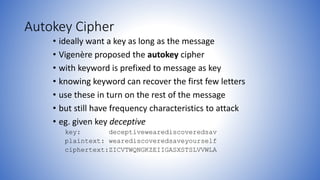
Autokey Cipher
• ideally want a key as long as the message
• Vigenère proposed the autokey cipher
• with keyword is prefixed to message as key
• knowing keyword can recover the first few letters
• use these in turn on the rest of the message
• but still have frequency characteristics to attack
• eg. given key deceptive
key: deceptivewearediscoveredsav
plaintext: wearediscoveredsaveyourself
ciphertext:ZICVTWQNGKZEIIGASXSTSLVVWLA
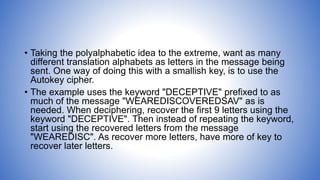
• Taking the polyalphabetic idea to the extreme, want as many
different translation alphabets as letters in the message being
sent. One way of doing this with a smallish key, is to use the
Autokey cipher.
• The example uses the keyword "DECEPTIVE" prefixed to as
much of the message "WEAREDISCOVEREDSAV" as is
needed. When deciphering, recover the first 9 letters using the
keyword "DECEPTIVE". Then instead of repeating the keyword,
start using the recovered letters from the message
"WEAREDISC". As recover more letters, have more of key to
recover later letters.
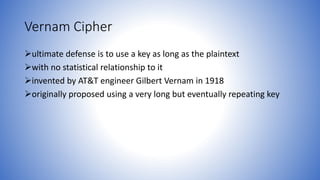
Vernam Cipher
ultimate defense is to use a key as long as the plaintext
with no statistical relationship to it
invented by AT&T engineer Gilbert Vernam in 1918
originally proposed using a very long but eventually repeating key
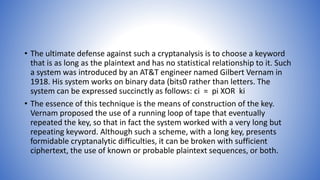
• The ultimate defense against such a cryptanalysis is to choose a keyword
that is as long as the plaintext and has no statistical relationship to it. Such
a system was introduced by an AT&T engineer named Gilbert Vernam in
1918. His system works on binary data (bits0 rather than letters. The
system can be expressed succinctly as follows: ci = pi XOR ki
• The essence of this technique is the means of construction of the key.
Vernam proposed the use of a running loop of tape that eventually
repeated the key, so that in fact the system worked with a very long but
repeating keyword. Although such a scheme, with a long key, presents
formidable cryptanalytic difficulties, it can be broken with sufficient
ciphertext, the use of known or probable plaintext sequences, or both.
One-Time Pad
• if a truly random key as long as the message is used, the cipher will be
secure
• called a One-Time pad
• is unbreakable since ciphertext bears no statistical relationship to the
plaintext
• since for any plaintext & any ciphertext there exists a key mapping
one to other
• can only use the key once though
• problems in generation & safe distribution of key
• The One-Time Pad is an evolution of the Vernham cipher. An Army
Signal Corp officer, Joseph Mauborgne, proposed an improvement
using a random key that was truly as long as the message, with no
repetitions, which thus totally obscures the original message.
• It produces random output that bears no statistical relationship to the
plaintext. Because the ciphertext contains no information whatsoever
about the plaintext, there is simply no way to break the code, since
any plaintext can be mapped to any ciphertext given some key.
• The one-time pad offers complete security but, in practice, has two
fundamental difficulties:
• There is the practical problem of making large quantities of random
keys.
• And the problem of key distribution and protection, where for every
message to be sent, a key of equal length is needed by both sender
and receiver.
• Because of these difficulties, the one-time pad is of limited utility, and
is useful primarily for low-bandwidth channels requiring very high
security. The one-time pad is the only cryptosystem that exhibits what
is referred to as perfect secrecy.
Assignment
• Explain Kasiski Method and its importance
• Explain the upgradation provided by Vernam Cipher
• Explain the advantages of One time Pad Cipher

Information and network security 15 other poly alphabatic ciphers

  • 1.
    Information and NetworkSecurity:15 Other PolyAlphabatic Ciphers Prof Neeraj Bhargava Vaibhav Khanna Department of Computer Science School of Engineering and Systems Sciences Maharshi Dayanand Saraswati University Ajmer
  • 2.
    Kasiski Method • methoddeveloped by Babbage / Kasiski • repetitions in ciphertext give clues to period • so find same plaintext an exact period apart • which results in the same ciphertext • of course, could also be random fluke • eg repeated “VTW” in previous example • suggests size of 3 or 9 • then attack each monoalphabetic cipher individually using same techniques as before
  • 3.
    • For somecenturies the Vigenère cipher was le chiffre indéchiffrable (the unbreakable cipher). As a result of a challenge, it was broken by Charles Babbage (the inventor of the computer) in 1854 but kept secret (possibly because of the Crimean War - not the first time governments have kept advances to themselves!). • The method was independently reinvented by a Prussian, Friedrich Kasiski, who published the attack now named after him in 1863.
  • 4.
    • However lackof major advances meant that various polyalphabetic substitution ciphers were used into the 20C. One very famous incident was the breaking of the Zimmermann telegram in WW1 which resulted in the USA entering the war. The important is that if two identical sequences of plaintext letters occur at a distance that is an integer multiple of the keyword length, they will generate identical ciphertext sequences. • In general the approach is to find a number of duplicated sequences, collect all their distances apart, look for common factors, remembering that some will be random flukes and need to be discarded. Now have a series of monoalphabetic ciphers, each with original language letter frequency characteristics. Can attack these in turn to break the cipher.
  • 5.
    Autokey Cipher • ideallywant a key as long as the message • Vigenère proposed the autokey cipher • with keyword is prefixed to message as key • knowing keyword can recover the first few letters • use these in turn on the rest of the message • but still have frequency characteristics to attack • eg. given key deceptive key: deceptivewearediscoveredsav plaintext: wearediscoveredsaveyourself ciphertext:ZICVTWQNGKZEIIGASXSTSLVVWLA
  • 6.
    • Taking thepolyalphabetic idea to the extreme, want as many different translation alphabets as letters in the message being sent. One way of doing this with a smallish key, is to use the Autokey cipher. • The example uses the keyword "DECEPTIVE" prefixed to as much of the message "WEAREDISCOVEREDSAV" as is needed. When deciphering, recover the first 9 letters using the keyword "DECEPTIVE". Then instead of repeating the keyword, start using the recovered letters from the message "WEAREDISC". As recover more letters, have more of key to recover later letters.
  • 7.
    Vernam Cipher ultimate defenseis to use a key as long as the plaintext with no statistical relationship to it invented by AT&T engineer Gilbert Vernam in 1918 originally proposed using a very long but eventually repeating key
  • 8.
    • The ultimatedefense against such a cryptanalysis is to choose a keyword that is as long as the plaintext and has no statistical relationship to it. Such a system was introduced by an AT&T engineer named Gilbert Vernam in 1918. His system works on binary data (bits0 rather than letters. The system can be expressed succinctly as follows: ci = pi XOR ki • The essence of this technique is the means of construction of the key. Vernam proposed the use of a running loop of tape that eventually repeated the key, so that in fact the system worked with a very long but repeating keyword. Although such a scheme, with a long key, presents formidable cryptanalytic difficulties, it can be broken with sufficient ciphertext, the use of known or probable plaintext sequences, or both.
  • 9.
    One-Time Pad • ifa truly random key as long as the message is used, the cipher will be secure • called a One-Time pad • is unbreakable since ciphertext bears no statistical relationship to the plaintext • since for any plaintext & any ciphertext there exists a key mapping one to other • can only use the key once though • problems in generation & safe distribution of key
  • 10.
    • The One-TimePad is an evolution of the Vernham cipher. An Army Signal Corp officer, Joseph Mauborgne, proposed an improvement using a random key that was truly as long as the message, with no repetitions, which thus totally obscures the original message. • It produces random output that bears no statistical relationship to the plaintext. Because the ciphertext contains no information whatsoever about the plaintext, there is simply no way to break the code, since any plaintext can be mapped to any ciphertext given some key.
  • 11.
    • The one-timepad offers complete security but, in practice, has two fundamental difficulties: • There is the practical problem of making large quantities of random keys. • And the problem of key distribution and protection, where for every message to be sent, a key of equal length is needed by both sender and receiver. • Because of these difficulties, the one-time pad is of limited utility, and is useful primarily for low-bandwidth channels requiring very high security. The one-time pad is the only cryptosystem that exhibits what is referred to as perfect secrecy.
  • 12.
    Assignment • Explain KasiskiMethod and its importance • Explain the upgradation provided by Vernam Cipher • Explain the advantages of One time Pad Cipher