Dr.A.K.Panigrahi
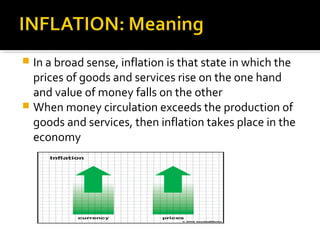
 In a broad sense, inflation is that state in which the 
prices of goods and services rise on the one hand 
and value of money falls on the other 
 When money circulation exceeds the production of 
goods and services, then inflation takes place in the 
economy
 Inflation- The rise in the general level of prices 
 In the long term, inflation erodes consumer purchasing 
power. 
 That means accumulated wealth buys less and less, with 
the passage of time. 
 Where there is high inflation it is difficult for businesses to 
plan for the future as there is uncertainty regarding the cost 
of raw materials
Deflation occurs when the general level of 
prices is falling. Deflation have been rare in 
the late twentieth century. 
Disinflation denotes a decline in the rate of 
inflation. 
4
It is a continuous process. 
It refers to a rise in prices in general. 
It involves a considerable increase in prices. 
It causes a decline in the purchasing power of 
money.
1. Demand Pull Inflation 
2. Cost Push Inflation
 Inflation results when the macro economy has too much 
demand for available production. These alternatives fall 
under two general categories: 
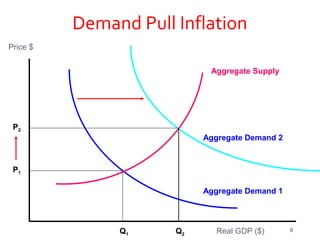
 Demand-Pull Inflation: This inflation occurs when 
household, business, government, and foreign industries 
collectively try to purchase more output than the economy 
is capable of producing. In effect, the demand side of the 
aggregate market is "pulling" the price level higher. 
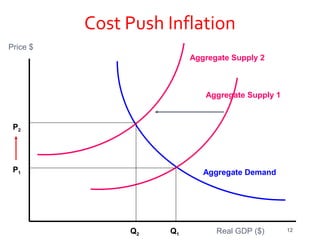
 Cost-Push Inflation: Cost-push inflation is inflation 
attributable to decreases in supply, primarily due to 
increases in production cost
 The demand for goods and services increases and production 
remains the same or does not increase as fast. The excess 
demand results in prices being “pulled up”. 
 Affected by: 
I. Greater spending by households(C) (Also because credit has 
become more readily available). 
II. Investment spending by firms increases as a result of a drop in 
interest rates and/or a positive business climate (I). 
III.Increased government spending (G). 
IV.Higher earnings from exports (X).
9 
Demand Pull Inflation 
P2 
P1 
Q1 Q2 
Aggregate Supply 
Aggregate Demand 2 
Aggregate Demand 1 
Price $ 
Real GDP ($)
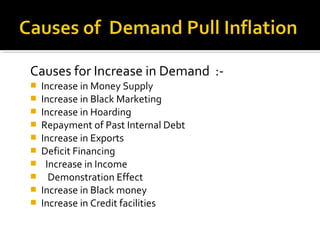
Causes for Increase in Demand :- 
 Increase in Money Supply 
 Increase in Black Marketing 
 Increase in Hoarding 
 Repayment of Past Internal Debt 
 Increase in Exports 
 Deficit Financing 
 Increase in Income 
 Demonstration Effect 
 Increase in Black money 
 Increase in Credit facilities
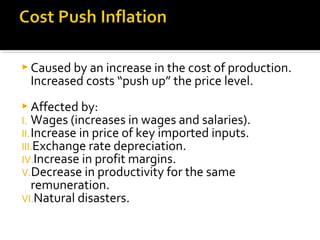
 Caused by an increase in the cost of production. 
Increased costs “push up” the price level. 
Affected by: 
I. Wages (increases in wages and salaries). 
II.Increase in price of key imported inputs. 
III.Exchange rate depreciation. 
IV.Increase in profit margins. 
V.Decrease in productivity for the same 
remuneration. 
VI.Natural disasters.
12 
Cost Push Inflation 
P2 
P1 
Q2 Q1 
Aggregate Supply 2 
Aggregate Supply 1 
Aggregate Demand 
Price $ 
Real GDP ($)
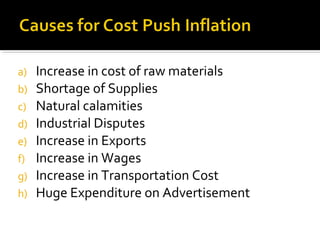
a) Increase in cost of raw materials 
b) Shortage of Supplies 
c) Natural calamities 
d) Industrial Disputes 
e) Increase in Exports 
f) Increase in Wages 
g) Increase in Transportation Cost 
h) Huge Expenditure on Advertisement
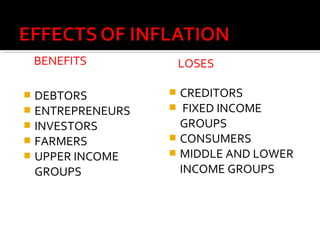
BENEFITS LOSES 
 DEBTORS 
 ENTREPRENEURS 
 INVESTORS 
 FARMERS 
 UPPER INCOME 
GROUPS 
 CREDITORS 
 FIXED INCOME 
GROUPS 
 CONSUMERS 
 MIDDLE AND LOWER 
INCOME GROUPS
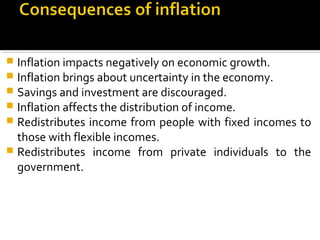
 Inflation impacts negatively on economic growth. 
 Inflation brings about uncertainty in the economy. 
 Savings and investment are discouraged. 
 Inflation affects the distribution of income. 
 Redistributes income from people with fixed incomes to 
those with flexible incomes. 
 Redistributes income from private individuals to the 
government.
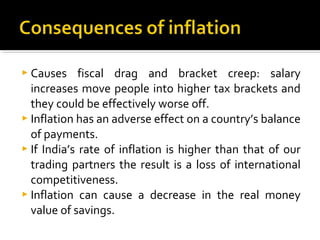
 Causes fiscal drag and bracket creep: salary 
increases move people into higher tax brackets and 
they could be effectively worse off. 
 Inflation has an adverse effect on a country’s balance 
of payments. 
 If India’s rate of inflation is higher than that of our 
trading partners the result is a loss of international 
competitiveness. 
 Inflation can cause a decrease in the real money 
value of savings.
Fiscal Measures 
Monetary Measures 
General Measures
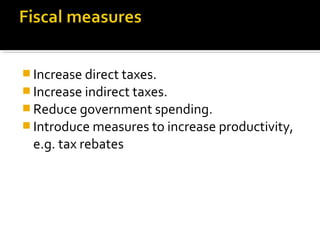
Increase direct taxes. 
Increase indirect taxes. 
Reduce government spending. 
Introduce measures to increase productivity, 
e.g. tax rebates
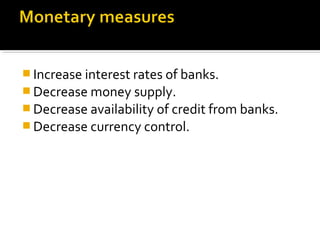
Increase interest rates of banks. 
Decrease money supply. 
Decrease availability of credit from banks. 
Decrease currency control.
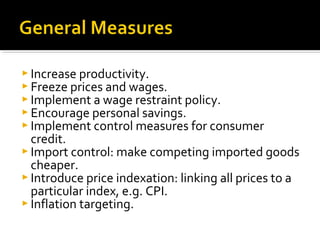
 Increase productivity. 
 Freeze prices and wages. 
 Implement a wage restraint policy. 
 Encourage personal savings. 
 Implement control measures for consumer 
credit. 
 Import control: make competing imported goods 
cheaper. 
 Introduce price indexation: linking all prices to a 
particular index, e.g. CPI. 
 Inflation targeting.
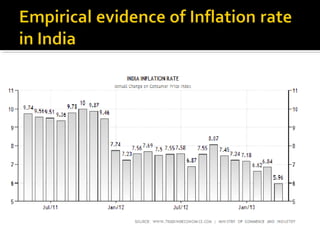
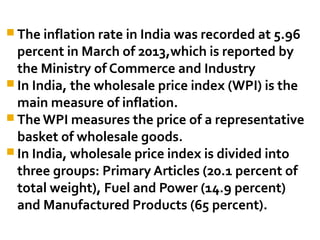
The inflation rate in India was recorded at 5.96 
percent in March of 2013,which is reported by 
the Ministry of Commerce and Industry 
In India, the wholesale price index (WPI) is the 
main measure of inflation. 
The WPI measures the price of a representative 
basket of wholesale goods. 
In India, wholesale price index is divided into 
three groups: Primary Articles (20.1 percent of 
total weight), Fuel and Power (14.9 percent) 
and Manufactured Products (65 percent).
Deflation is that state in which the value of 
goods and services falls 
A sustained decrease in average price level is 
called deflation 
Prices fall 
opposite of inflation 
Not the same as disinflation, which is a 
reduction in the rate of inflation 
The inflation rate measures the trend in the 
average price level
 Govt. withdraws money from circulation 
 Govt. imposes heavy direct taxes or takes heavy loans 
from the public 
 Central bank sells the securities in open market 
 Central bank controls the credit money and adopts 
various measures such as increase in CRR, credit rationing 
and direct action 
 The central bank increases the bank rate 
 State of over-production takes place in the economy
1. To increase money supply 
2. To promote credit creation by the banks 
3. Curtailment in taxes so as to increase the 
purchasing power of the people 
4. To increase the public expenditure and to 
increase the employment opportunities in the 
economy 
5. To increase the money supply in circulation by 
repayment of old public debts 
6. To provide economic subsidy by the govt. to the 
industrial sector of the economy
Inflation and deflation

Inflation and deflation

  • 1.
  • 2.
     In abroad sense, inflation is that state in which the prices of goods and services rise on the one hand and value of money falls on the other  When money circulation exceeds the production of goods and services, then inflation takes place in the economy
  • 3.
     Inflation- Therise in the general level of prices  In the long term, inflation erodes consumer purchasing power.  That means accumulated wealth buys less and less, with the passage of time.  Where there is high inflation it is difficult for businesses to plan for the future as there is uncertainty regarding the cost of raw materials
  • 4.
    Deflation occurs whenthe general level of prices is falling. Deflation have been rare in the late twentieth century. Disinflation denotes a decline in the rate of inflation. 4
  • 5.
    It is acontinuous process. It refers to a rise in prices in general. It involves a considerable increase in prices. It causes a decline in the purchasing power of money.
  • 6.
    1. Demand PullInflation 2. Cost Push Inflation
  • 7.
     Inflation resultswhen the macro economy has too much demand for available production. These alternatives fall under two general categories:  Demand-Pull Inflation: This inflation occurs when household, business, government, and foreign industries collectively try to purchase more output than the economy is capable of producing. In effect, the demand side of the aggregate market is "pulling" the price level higher.  Cost-Push Inflation: Cost-push inflation is inflation attributable to decreases in supply, primarily due to increases in production cost
  • 8.
     The demandfor goods and services increases and production remains the same or does not increase as fast. The excess demand results in prices being “pulled up”.  Affected by: I. Greater spending by households(C) (Also because credit has become more readily available). II. Investment spending by firms increases as a result of a drop in interest rates and/or a positive business climate (I). III.Increased government spending (G). IV.Higher earnings from exports (X).
  • 9.
    9 Demand PullInflation P2 P1 Q1 Q2 Aggregate Supply Aggregate Demand 2 Aggregate Demand 1 Price $ Real GDP ($)
  • 10.
    Causes for Increasein Demand :-  Increase in Money Supply  Increase in Black Marketing  Increase in Hoarding  Repayment of Past Internal Debt  Increase in Exports  Deficit Financing  Increase in Income  Demonstration Effect  Increase in Black money  Increase in Credit facilities
  • 11.
     Caused byan increase in the cost of production. Increased costs “push up” the price level. Affected by: I. Wages (increases in wages and salaries). II.Increase in price of key imported inputs. III.Exchange rate depreciation. IV.Increase in profit margins. V.Decrease in productivity for the same remuneration. VI.Natural disasters.
  • 12.
    12 Cost PushInflation P2 P1 Q2 Q1 Aggregate Supply 2 Aggregate Supply 1 Aggregate Demand Price $ Real GDP ($)
  • 13.
    a) Increase incost of raw materials b) Shortage of Supplies c) Natural calamities d) Industrial Disputes e) Increase in Exports f) Increase in Wages g) Increase in Transportation Cost h) Huge Expenditure on Advertisement
  • 14.
    BENEFITS LOSES DEBTORS  ENTREPRENEURS  INVESTORS  FARMERS  UPPER INCOME GROUPS  CREDITORS  FIXED INCOME GROUPS  CONSUMERS  MIDDLE AND LOWER INCOME GROUPS
  • 15.
     Inflation impactsnegatively on economic growth.  Inflation brings about uncertainty in the economy.  Savings and investment are discouraged.  Inflation affects the distribution of income.  Redistributes income from people with fixed incomes to those with flexible incomes.  Redistributes income from private individuals to the government.
  • 16.
     Causes fiscaldrag and bracket creep: salary increases move people into higher tax brackets and they could be effectively worse off.  Inflation has an adverse effect on a country’s balance of payments.  If India’s rate of inflation is higher than that of our trading partners the result is a loss of international competitiveness.  Inflation can cause a decrease in the real money value of savings.
  • 17.
    Fiscal Measures MonetaryMeasures General Measures
  • 18.
    Increase direct taxes. Increase indirect taxes. Reduce government spending. Introduce measures to increase productivity, e.g. tax rebates
  • 19.
    Increase interest ratesof banks. Decrease money supply. Decrease availability of credit from banks. Decrease currency control.
  • 20.
     Increase productivity.  Freeze prices and wages.  Implement a wage restraint policy.  Encourage personal savings.  Implement control measures for consumer credit.  Import control: make competing imported goods cheaper.  Introduce price indexation: linking all prices to a particular index, e.g. CPI.  Inflation targeting.
  • 22.
    The inflation ratein India was recorded at 5.96 percent in March of 2013,which is reported by the Ministry of Commerce and Industry In India, the wholesale price index (WPI) is the main measure of inflation. The WPI measures the price of a representative basket of wholesale goods. In India, wholesale price index is divided into three groups: Primary Articles (20.1 percent of total weight), Fuel and Power (14.9 percent) and Manufactured Products (65 percent).
  • 23.
    Deflation is thatstate in which the value of goods and services falls A sustained decrease in average price level is called deflation Prices fall opposite of inflation Not the same as disinflation, which is a reduction in the rate of inflation The inflation rate measures the trend in the average price level
  • 24.
     Govt. withdrawsmoney from circulation  Govt. imposes heavy direct taxes or takes heavy loans from the public  Central bank sells the securities in open market  Central bank controls the credit money and adopts various measures such as increase in CRR, credit rationing and direct action  The central bank increases the bank rate  State of over-production takes place in the economy
  • 25.
    1. To increasemoney supply 2. To promote credit creation by the banks 3. Curtailment in taxes so as to increase the purchasing power of the people 4. To increase the public expenditure and to increase the employment opportunities in the economy 5. To increase the money supply in circulation by repayment of old public debts 6. To provide economic subsidy by the govt. to the industrial sector of the economy