Inflation: A Comprehensive
Overview
I’msure we are all familiar with the concept of inflation which effects our
daily lives, be it constant small increases in the prices of gasoline or its
drastic effects on a nation’s GDP.
Inflation can be defined as a general increase in prices and fall in the
purchasing value of money.
Inflation happens when demand for goods exceeds supply or when
production costs rise, causing businesses to charge higher prices.
For the past 5 years, India's infaltion has averaged between 5-7%, which is
considered healthy for a developing country.
One of the highest inflation rates in India occurred in 1974, when inflation
peaked at 34%. This was fueled by global oil price shocks during the 1973
oil crisis.
3.
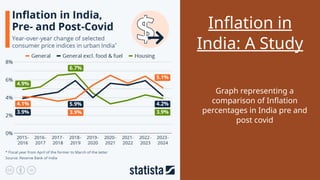
Inflation in
India: AStudy
Graph representing a
comparison of Inflation
percentages in India pre and
post covid
4.
Root Causes of
Inflation
Demand-Pull
Inflation
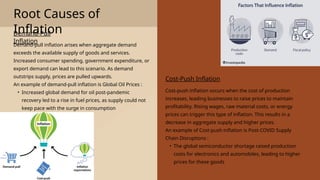
Demand-pullinflation arises when aggregate demand
exceeds the available supply of goods and services.
Increased consumer spending, government expenditure, or
export demand can lead to this scenario. As demand
outstrips supply, prices are pulled upwards.
An example of demand-pull inflation is Global Oil Prices :
• Increased global demand for oil post-pandemic
recovery led to a rise in fuel prices, as supply could not
keep pace with the surge in consumption
Cost-Push Inflation
Cost-push inflation occurs when the cost of production
increases, leading businesses to raise prices to maintain
profitability. Rising wages, raw material costs, or energy
prices can trigger this type of inflation. This results in a
decrease in aggregate supply and higher prices.
An example of Cost-push inflation is Post-COVID Supply
Chain Disruptions :
• The global semiconductor shortage raised production
costs for electronics and automobiles, leading to higher
prices for these goods
5.
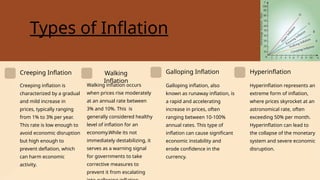
Types of Inflation
CreepingInflation
Creeping inflation is
characterized by a gradual
and mild increase in
prices, typically ranging
from 1% to 3% per year.
This rate is low enough to
avoid economic disruption
but high enough to
prevent deflation, which
can harm economic
activity.
Galloping Inflation
Galloping inflation, also
known as runaway inflation, is
a rapid and accelerating
increase in prices, often
ranging between 10-100%
annual rates. This type of
inflation can cause significant
economic instability and
erode confidence in the
currency.
Hyperinflation
Hyperinflation represents an
extreme form of inflation,
where prices skyrocket at an
astronomical rate, often
exceeding 50% per month.
Hyperinflation can lead to
the collapse of the monetary
system and severe economic
disruption.
Walking
Inflation
Walking inflation occurs
when prices rise moderately
at an annual rate between
3% and 10%. This is
generally considered healthy
level of inflation for an
economy.While its not
immediately destabilizing, it
serves as a warning signal
for governments to take
corrective measures to
prevent it from escalating
6.
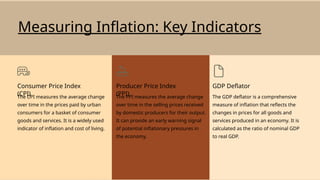
Measuring Inflation: KeyIndicators
Consumer Price Index
(CPI)
The CPI measures the average change
over time in the prices paid by urban
consumers for a basket of consumer
goods and services. It is a widely used
indicator of inflation and cost of living.
Producer Price Index
(PPI)
The PPI measures the average change
over time in the selling prices received
by domestic producers for their output.
It can provide an early warning signal
of potential inflationary pressures in
the economy.
GDP Deflator
The GDP deflator is a comprehensive
measure of inflation that reflects the
changes in prices for all goods and
services produced in an economy. It is
calculated as the ratio of nominal GDP
to real GDP.
7.
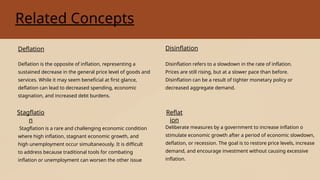
Related Concepts
Deflation
Deflation isthe opposite of inflation, representing a
sustained decrease in the general price level of goods and
services. While it may seem beneficial at first glance,
deflation can lead to decreased spending, economic
stagnation, and increased debt burdens.
Disinflation
Disinflation refers to a slowdown in the rate of inflation.
Prices are still rising, but at a slower pace than before.
Disinflation can be a result of tighter monetary policy or
decreased aggregate demand.
Stagflatio
n
Stagflation is a rare and challenging economic condition
where high inflation, stagnant economic growth, and
high unemployment occur simultaneously. It is difficult
to address because traditional tools for combating
inflation or unemployment can worsen the other issue
Reflat
ion
Deliberate measures by a government to increase inflation o
stimulate economic growth after a period of economic slowdown,
deflation, or recession. The goal is to restore price levels, increase
demand, and encourage investment without causing excessive
inflation.
8.
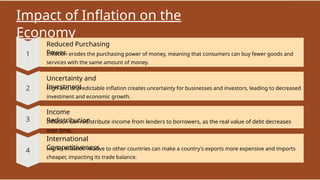
Impact of Inflationon the
Economy
Reduced Purchasing
Power
Inflation erodes the purchasing power of money, meaning that consumers can buy fewer goods and
services with the same amount of money.
Uncertainty and
Investment
High and unpredictable inflation creates uncertainty for businesses and investors, leading to decreased
investment and economic growth.
Income
Redistribution
Inflation can redistribute income from lenders to borrowers, as the real value of debt decreases
over time.
International
Competitiveness
Higher inflation relative to other countries can make a country's exports more expensive and imports
cheaper, impacting its trade balance.
9.
Conclusion
Inflation is acomplex economic phenomenon with far-reaching
consequences. Understanding its causes, types, and measures is
crucial for informed decision-making by individuals, businesses, and
policymakers. By monitoring key indicators, implementing
appropriate policies, and fostering economic stability, we can
mitigate the adverse effects of inflation and promote sustainable
economic growth.