Inflation
Control
Subtitle
Content
• Introduction
• Types of Inflation
• Causes of Inflation
• Measures to Control Inflation
• Example & Cases
Introduction
Inflation
• Inflation is a sustained increase in the general price level of the goods
and services in an economy over a period of time.
• Reduction in the purchasing power per unit of money-a loss of real value
in the medium of exchange and unit of account within the economy.
• Measured as percentage rate of change of price index.
• The annualised inflation rate in India is 5.4% as of June 2015, as per
the Indian Ministry of Statistics and Programme Implementation.
Types of Inflation
• prices rise by not more than 3% per annum (year)
Creeping Inflation
• If creeping inflation persist (continues to increase) for a longer period of time
Chronic Inflation
• rate of rising prices is more than the Creeping Inflation
• prices rise by more than 3% but less than 10% per annum(single digit)
Walking or Moderate Inflation
Types of Inflation
• price rise between 10% to 20% per annum (double digit inflation rate)
Running Inflation
• prices rise by more than 20% but less than 1000% per annum(double or triple
digit inflation rates)
Galloping Inflation
• prices rise so fast that it becomes very difficult to measure its magnitude
• prices rise above 1000% per annum (quadruple or four digit inflation rate)
Hyperinflation
Causes of Inflation
There are two theories related to the causes of the inflation
1. Demand pull inflation
• Excess aggregate demand in the overall economy
• Business respond to high demand by raising prices to increase profit
margin
Causes of Inflation
2. Cost push inflation
Cost of production or operation are increasing due to
• Increase in wages
• Increase in cost of production inputs
• Increased cost of imported components
Measures to Control Inflation
The basic causes of the Inflation
are
1.Excess money supply in an
Economy
2.Excess purchasing power in the
hands of public.
So it is more important to deal with
these factors to bring inflation in
control.
• Adopted by the Central Bank
of a Country (RBI)
Monetary Measures
• Adopted by the Government
Fiscal Measures
Other Measures
Monetary Measures
To control the Money Supply
Bank Rate Policy or Credit Control
Cash Reserve Ratio
Open Market Operation
Maintaining Gold Standard
Fixed Exchange Rates
Bank Rate Policy
• Bank rate-Interest rate at which RBI lends money to the domestic banks
 Increase in bank rates leads to – Increase in deposit rate
- Increase in lending rate
• Discourages businessmen and consumers to take loans
• Hence the controlled supply of money reduces the inflationary pressure
on the economy
Open Market Operations
• Sales and purchase of government securities and bonds by the central
bank.
• Gov. securities- Bonds & Debentures with certain maturity period
are issued by a government to raise the fund necessary to pay for its
expenses.
• Sale of the securities in the open market helps to regulate the inflation.
Cash Reserve Ratio
• Banks are required to hold a certain proportion of the deposit in the
form of cash.
• Higher the Cash Reserve Ratio=> Lower the amount for lending and
investments with the banks.
• Tool for the RBI to control the amount that banks lent
i.e. to control the liquidity in the banking system and the country.
Maintaining Gold Standard & Fixed
Exchange Rates
• Fix the prices of their domestic currencies in terms of a specified
amount of gold.
• National money and other forms of money (bank deposits and notes)
were freely converted into gold at the fixed price.
• A country's exchange rate regime under which the government or
central bank ties the official exchange rate to another country's
currency
• Because exchange rates were fixed, the gold standard caused price levels
around the world to move together.
Fiscal Measures
• Government Expenditure-Gov. has to reduce their expenditure and
increase their savings to control the supply of money
• Taxation-Increasing some tax rates and imposing some new taxes
• Public Borrowings- the objective is to take away from the public excess
purchasing power. Public borrowing may be voluntary or compulsory.
• Debt Management-Stop the repayment of public debt to control the
inflationary pressure
• Adopt surplus budget
Fiscal Measures
Over-valuation-To control the over valuation of money it is essential to
encourage imports and discourage exports
Overvaluation of domestic currency in terms of foreign currencies will
serve as an anti-inflationary measure as
(i) it will discourage exports and thereby result in an increased
availability of good and services at home
(ii) encourage imports – add to domestic stock of goods and services,
(iii) by lowering the price of foreign inputs, it will help in checking the
upward cost-price spiral.
Other Measures
Expansion of Output
• This lowers the excess demand of a commodity and lowers its price.
Rational Wage Policy
• Wages should be allowed to rise only if there is an increase in the productivity
• In such a situation, higher wages will not give rise to higher costs and
hence to higher prices
Price Control & Rationing
• The objective of price control is to lay down the upper limit beyond which, the
price of a particular commodity will not be allowed to rise.
• Demand can also be controlled through rationing of essential commodities
5 Extreme Cases of
hyperinflation
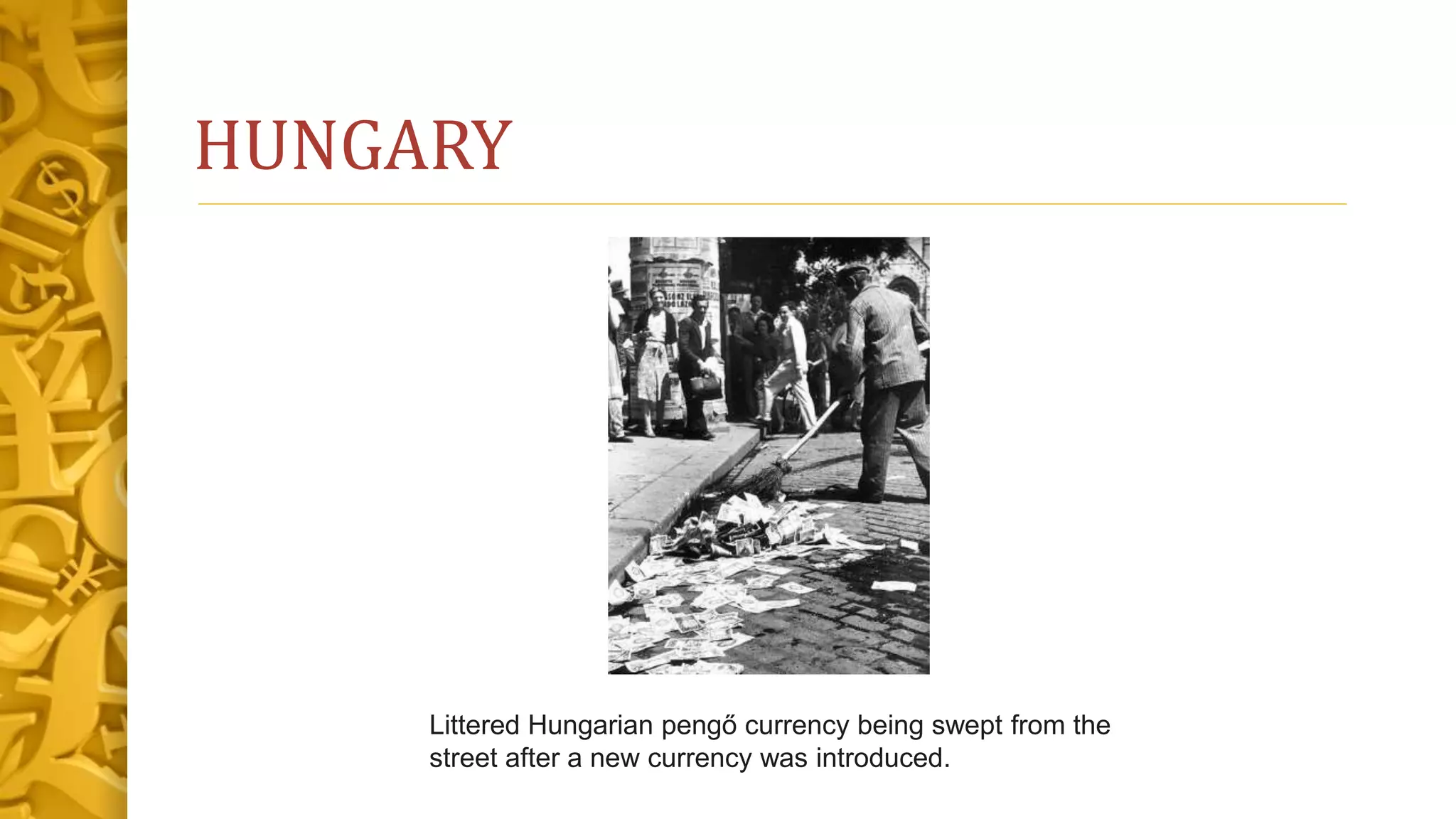
HUNGARY
Littered Hungarian pengő currency being swept from the
street after a new currency was introduced.
Highest monthly inflation
rate: 13,600,000,000,000,000%
Highest currency denomination: One trillion
Time it took prices to double: 15.6 hours
HUNGARY
• Hungary’s hyperinflation of 1945-46 was the most severe instance of
hyperinflation in history. Costs of preparing for World War II led to loose
monetary policy and depreciation of the Hungarian pengő currency. At
the end of the war the Hungarian government began rampantly printing
money. Denominations got so high that milpengő (1 million pengő) and
bilpengő (1 billion pengő) denominations were introduced to reduce the
number of zeros and make calculations easier. Prices could more than
double in just one day. A new currency called the forint was introduced
in 1946, and old pengő were littered in the streets.
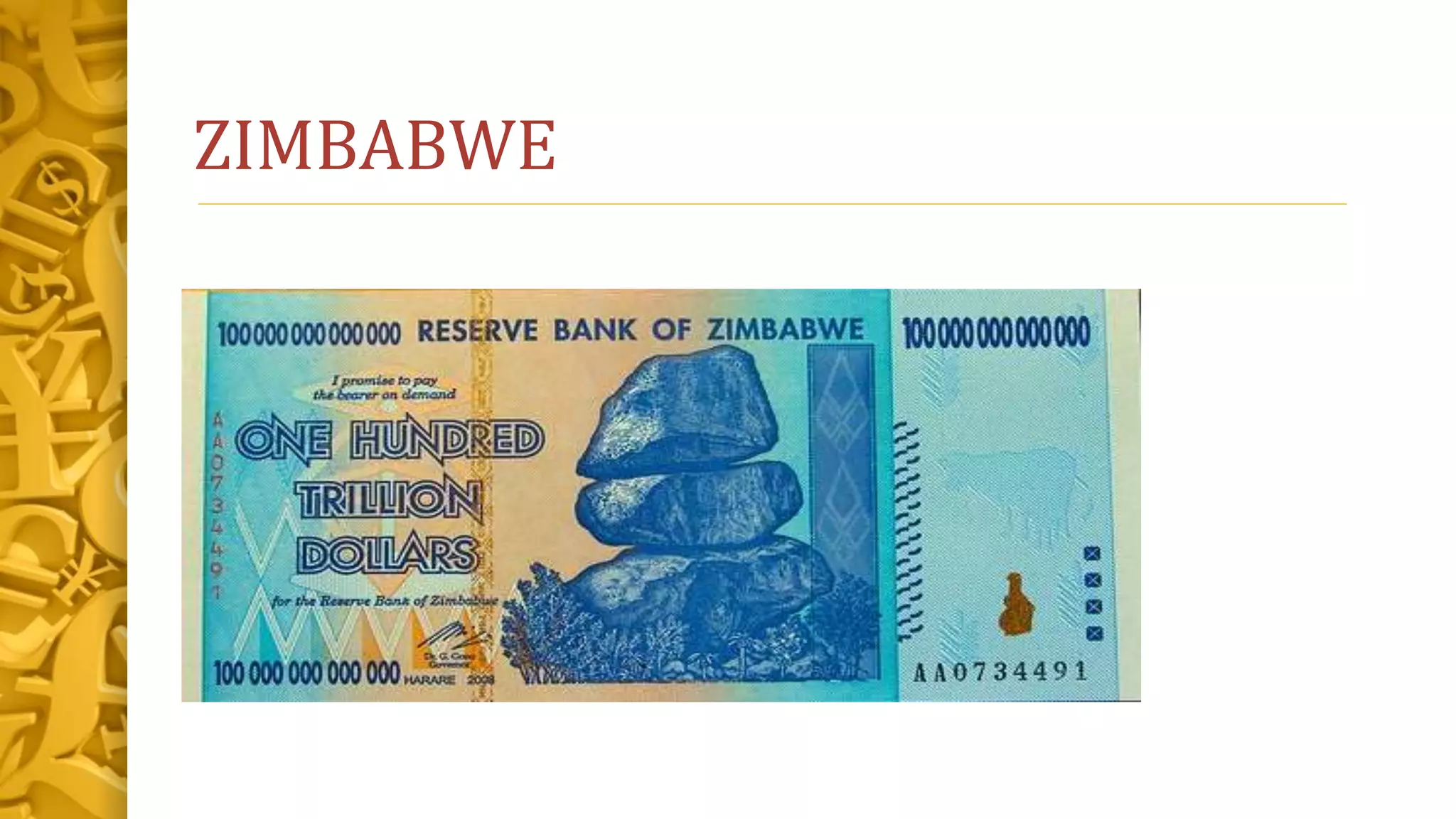
ZIMBABWE
Highest monthly inflation rate: 79,600,000,000%
Highest currency denomination: 100 trillion
Time it took prices to double: 24.7 hours
Inflation in Zimbabwe
December,2008:
Inflation at 6.5
quindecillion
novemdecillion
percent(65 followed
by 107 zeroes)
Inflation in Zimbabwe
Causes
• Post Independence Land Re-distribution System-During the reform
program most of the farm lands were taken over by local people and
other government officials who had only little knowledge about the
agriculture and related activities.
• War Funding-Mugabe government printed more money to help
financing the war
• Economic Mismanagement-Over-printing of money-To deal with the
issue of financial crunch which the war brought, the govt printed money
and a lot of them
Causes
• Governments often implement price controls in an attempt to control
inflation. This frequently leads to shortages, as producers opt for
alternative markets to avoid the mandated price ceilings that don’t cover
production costs.
Effects of Hyperinflation in
Zimbabwe
• Severe Unemployment
• Severe food crisis
• Population Displacement-
Yugoslavia/Republika Srpska
500 billion dinar banknote
Highest monthly inflation rate:
313,000,000%
Highest currency denomination:
500 billion
Time it took prices to double: 1.4 days
GERMANY
50 million mark banknote
Highest monthly inflation rate: 29,500%
Highest currency denomination:
100 trillion
Time it took prices to double: 3.7 days
Greece
Highest monthly inflation rate: 13,800%
Highest currency denomination: 100
billion
Time it took prices to double: 4.3 days
POLICY IN INDIA REGARDING INFLATION
• The Reserve Bank of India’s (RBI) has a target of 8% by January 2015
and 6% by January 2016.
• Recently, while cutting the CRR rates by 0.25 basis points, RBI said
higher diesel prices would increase inflation in the short term, but the
reform measures were “significant” as they would strengthen the
country’s economic fundamentals.
• The central bank said the government’s recent actions had paved the
way for more favourable economic conditions by initiating a shift in
expenditure away from consumption by reducing fuel subsidies and
toward investment, including through foreign direct investment. Further,
RBI is supposedly did not reduced the interest rates just to not to put
pressure on the inflation.
References:
• Wikipedia
• https://www.globalfinancialdata.com/gfdblog/?p=2382
• http://www.cnbc.com/id/41532451
• http://www.businessinsider.com/worst-hyperinflation-episodes-in-history-2014-4
• http://www.nytimes.com/1993/12/31/world/where-zillion-loses-meaning.html
Thank You

Inflation control

  • 1.
  • 2.
    Content • Introduction • Typesof Inflation • Causes of Inflation • Measures to Control Inflation • Example & Cases
  • 3.
  • 4.
    Inflation • Inflation isa sustained increase in the general price level of the goods and services in an economy over a period of time. • Reduction in the purchasing power per unit of money-a loss of real value in the medium of exchange and unit of account within the economy. • Measured as percentage rate of change of price index. • The annualised inflation rate in India is 5.4% as of June 2015, as per the Indian Ministry of Statistics and Programme Implementation.
  • 5.
    Types of Inflation •prices rise by not more than 3% per annum (year) Creeping Inflation • If creeping inflation persist (continues to increase) for a longer period of time Chronic Inflation • rate of rising prices is more than the Creeping Inflation • prices rise by more than 3% but less than 10% per annum(single digit) Walking or Moderate Inflation
  • 6.
    Types of Inflation •price rise between 10% to 20% per annum (double digit inflation rate) Running Inflation • prices rise by more than 20% but less than 1000% per annum(double or triple digit inflation rates) Galloping Inflation • prices rise so fast that it becomes very difficult to measure its magnitude • prices rise above 1000% per annum (quadruple or four digit inflation rate) Hyperinflation
  • 7.
    Causes of Inflation Thereare two theories related to the causes of the inflation 1. Demand pull inflation • Excess aggregate demand in the overall economy • Business respond to high demand by raising prices to increase profit margin
  • 8.
    Causes of Inflation 2.Cost push inflation Cost of production or operation are increasing due to • Increase in wages • Increase in cost of production inputs • Increased cost of imported components
  • 9.
    Measures to ControlInflation The basic causes of the Inflation are 1.Excess money supply in an Economy 2.Excess purchasing power in the hands of public. So it is more important to deal with these factors to bring inflation in control. • Adopted by the Central Bank of a Country (RBI) Monetary Measures • Adopted by the Government Fiscal Measures Other Measures
  • 10.
    Monetary Measures To controlthe Money Supply Bank Rate Policy or Credit Control Cash Reserve Ratio Open Market Operation Maintaining Gold Standard Fixed Exchange Rates
  • 11.
    Bank Rate Policy •Bank rate-Interest rate at which RBI lends money to the domestic banks  Increase in bank rates leads to – Increase in deposit rate - Increase in lending rate • Discourages businessmen and consumers to take loans • Hence the controlled supply of money reduces the inflationary pressure on the economy
  • 12.
    Open Market Operations •Sales and purchase of government securities and bonds by the central bank. • Gov. securities- Bonds & Debentures with certain maturity period are issued by a government to raise the fund necessary to pay for its expenses. • Sale of the securities in the open market helps to regulate the inflation.
  • 13.
    Cash Reserve Ratio •Banks are required to hold a certain proportion of the deposit in the form of cash. • Higher the Cash Reserve Ratio=> Lower the amount for lending and investments with the banks. • Tool for the RBI to control the amount that banks lent i.e. to control the liquidity in the banking system and the country.
  • 14.
    Maintaining Gold Standard& Fixed Exchange Rates • Fix the prices of their domestic currencies in terms of a specified amount of gold. • National money and other forms of money (bank deposits and notes) were freely converted into gold at the fixed price. • A country's exchange rate regime under which the government or central bank ties the official exchange rate to another country's currency • Because exchange rates were fixed, the gold standard caused price levels around the world to move together.
  • 15.
    Fiscal Measures • GovernmentExpenditure-Gov. has to reduce their expenditure and increase their savings to control the supply of money • Taxation-Increasing some tax rates and imposing some new taxes • Public Borrowings- the objective is to take away from the public excess purchasing power. Public borrowing may be voluntary or compulsory. • Debt Management-Stop the repayment of public debt to control the inflationary pressure • Adopt surplus budget
  • 16.
    Fiscal Measures Over-valuation-To controlthe over valuation of money it is essential to encourage imports and discourage exports Overvaluation of domestic currency in terms of foreign currencies will serve as an anti-inflationary measure as (i) it will discourage exports and thereby result in an increased availability of good and services at home (ii) encourage imports – add to domestic stock of goods and services, (iii) by lowering the price of foreign inputs, it will help in checking the upward cost-price spiral.
  • 17.
    Other Measures Expansion ofOutput • This lowers the excess demand of a commodity and lowers its price. Rational Wage Policy • Wages should be allowed to rise only if there is an increase in the productivity • In such a situation, higher wages will not give rise to higher costs and hence to higher prices Price Control & Rationing • The objective of price control is to lay down the upper limit beyond which, the price of a particular commodity will not be allowed to rise. • Demand can also be controlled through rationing of essential commodities
  • 18.
    5 Extreme Casesof hyperinflation
  • 19.
    HUNGARY Littered Hungarian pengőcurrency being swept from the street after a new currency was introduced.
  • 20.
    Highest monthly inflation rate:13,600,000,000,000,000% Highest currency denomination: One trillion Time it took prices to double: 15.6 hours
  • 21.
    HUNGARY • Hungary’s hyperinflationof 1945-46 was the most severe instance of hyperinflation in history. Costs of preparing for World War II led to loose monetary policy and depreciation of the Hungarian pengő currency. At the end of the war the Hungarian government began rampantly printing money. Denominations got so high that milpengő (1 million pengő) and bilpengő (1 billion pengő) denominations were introduced to reduce the number of zeros and make calculations easier. Prices could more than double in just one day. A new currency called the forint was introduced in 1946, and old pengő were littered in the streets.
  • 22.
  • 23.
    Highest monthly inflationrate: 79,600,000,000% Highest currency denomination: 100 trillion Time it took prices to double: 24.7 hours
  • 24.
    Inflation in Zimbabwe December,2008: Inflationat 6.5 quindecillion novemdecillion percent(65 followed by 107 zeroes)
  • 25.
  • 26.
    Causes • Post IndependenceLand Re-distribution System-During the reform program most of the farm lands were taken over by local people and other government officials who had only little knowledge about the agriculture and related activities. • War Funding-Mugabe government printed more money to help financing the war • Economic Mismanagement-Over-printing of money-To deal with the issue of financial crunch which the war brought, the govt printed money and a lot of them
  • 27.
    Causes • Governments oftenimplement price controls in an attempt to control inflation. This frequently leads to shortages, as producers opt for alternative markets to avoid the mandated price ceilings that don’t cover production costs.
  • 28.
    Effects of Hyperinflationin Zimbabwe • Severe Unemployment • Severe food crisis • Population Displacement-
  • 29.
  • 30.
    Highest monthly inflationrate: 313,000,000% Highest currency denomination: 500 billion Time it took prices to double: 1.4 days
  • 31.
  • 32.
    Highest monthly inflationrate: 29,500% Highest currency denomination: 100 trillion Time it took prices to double: 3.7 days
  • 33.
  • 34.
    Highest monthly inflationrate: 13,800% Highest currency denomination: 100 billion Time it took prices to double: 4.3 days
  • 35.
    POLICY IN INDIAREGARDING INFLATION • The Reserve Bank of India’s (RBI) has a target of 8% by January 2015 and 6% by January 2016. • Recently, while cutting the CRR rates by 0.25 basis points, RBI said higher diesel prices would increase inflation in the short term, but the reform measures were “significant” as they would strengthen the country’s economic fundamentals. • The central bank said the government’s recent actions had paved the way for more favourable economic conditions by initiating a shift in expenditure away from consumption by reducing fuel subsidies and toward investment, including through foreign direct investment. Further, RBI is supposedly did not reduced the interest rates just to not to put pressure on the inflation.
  • 36.
    References: • Wikipedia • https://www.globalfinancialdata.com/gfdblog/?p=2382 •http://www.cnbc.com/id/41532451 • http://www.businessinsider.com/worst-hyperinflation-episodes-in-history-2014-4 • http://www.nytimes.com/1993/12/31/world/where-zillion-loses-meaning.html
  • 37.