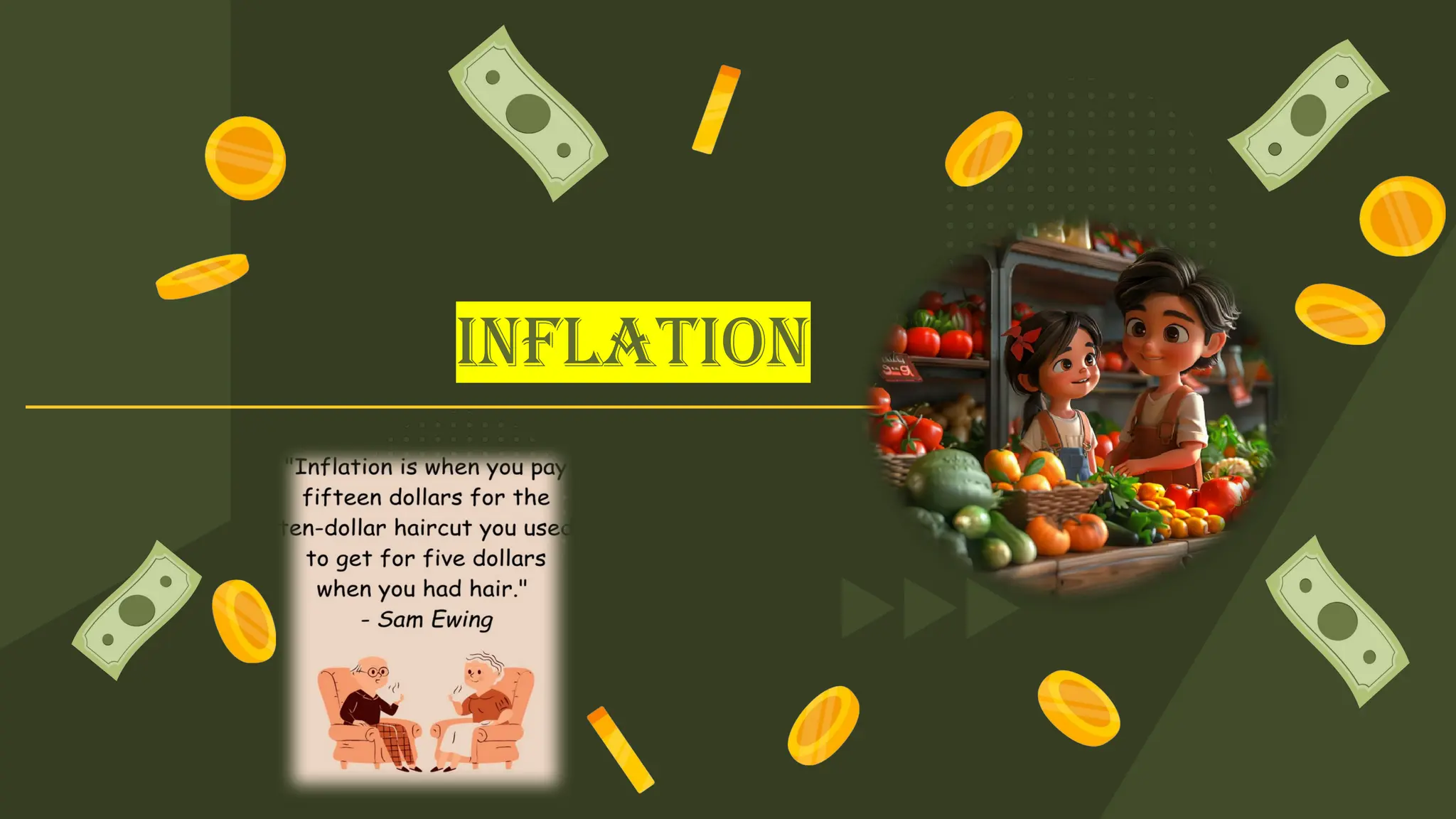
INFLATION
WHAT IS
INFLATION?
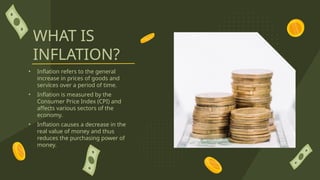
• Inflation refers to the general
increase in prices of goods and
services over a period of time.
• Inflation is measured by the
Consumer Price Index (CPI) and
affects various sectors of the
economy.
• Inflation causes a decrease in the
real value of money and thus
reduces the purchasing power of
money.
Inflation is a critical economic concept
that affects purchasing power and
overall economic stability.
Understanding its causes, impacts, and
mitigation strategies is essential for
both policymakers and individuals. This
presentation aims to provide a
comprehensive overview of inflation
and its significance in today's economy.
WHY SHOULD WE
KNOW ABOUT
INFLATION?
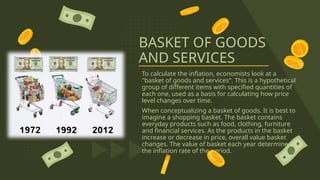
To calculate the inflation, economists look at a
"basket of goods and services". This is a hypothetical
group of different items with specified quantities of
each one, used as a basis for calculating how price
level changes over time.
When conceptualizing a basket of goods. It is best to
imagine a shopping basket. The basket contains
everyday products such as food, clothing, furniture
and financial services. As the products in the basket
increase or decrease in price, overall value basket
changes. The value of basket each year determines
the inflation rate of the period.
BASKET OF GOODS
AND SERVICES
Cost-push inflation occurs
when the costs of production
increase, causing businesses
to raise prices to maintain
profit margins. Key factors
include rising wages,
increased raw material costs,
and supply chain disruptions.
This type of inflation can be
more challenging to control.
Demand-pull inflation happens
when consumer demand
outstrips supply, leading to
higher prices. Factors
contributing to this include
increased consumer spending,
government expenditure, and
export demand.
Understanding this can help in
predicting inflation trends.
CAUSES OF INFLATION
COST PUSH
INFLATION
DEMAND PULL
INFLATION
Inflation can be driven by several factors, including demand-pull inflation, which
occurs when demand exceeds supply and cost-push inflation, where rising
production costs lead to increased prices. Other factors include monetary policy and
fiscal stimulus.
METHODS OF MEASURING
INFLATION
Measuring inflation involves several methods, each providing insights into
price changes in an economy. Here are some of the most common methods:
• Consumer Price Index (CPI)
CPI is one of the most widely used indicators for measuring inflation. It reflects the
average change in prices over time that consumers pay for a basket of goods and
services. The WPI is calculated by taking a weighted average of price changes for a
basket of goods.
• The Wholesale Price Index (WPI)
WPI measures the average change over time in the selling prices received by domestic
producers for their output. It serves as an important indicator of inflation at the
wholesale level before it reaches consumers. The WPI is calculated by taking a
weighted average of price changes for a basket of goods.
• GDP Deflator
GDP Deflator refers to the ratio between the GDP at current prices to GDP at
constant prices.
IMPACTS OF INFLATION
Inflation affects the economy in various ways, including decreased
purchasing power, uncertainty in investments, and redistribution of wealth. It
can erode savings and impact
fixed-income earners, making it essential to understand its broader
implications.
Effects on
Consumers:
Consumers face
challenges during
inflation, such as rising
prices for goods and
services, which can lead
to reduced
consumption.
Additionally, inflation
can disproportionately
affect low-income
households, making it
crucial to consider its
Effects on Businesses:
Businesses may
experience increased
costs and uncertainty
during inflationary
periods, leading to
potential layoffs or
reduced investment.
Companies must adapt
their pricing strategies
and operational
efficiencies to mitigate the
impacts of rising costs.
REAL LIFE EXAMPLE OF INFLATION:
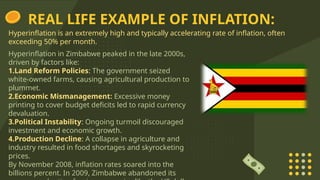
Hyperinflation in Zimbabwe peaked in the late 2000s,
driven by factors like:
1.Land Reform Policies: The government seized
white-owned farms, causing agricultural production to
plummet.
2.Economic Mismanagement: Excessive money
printing to cover budget deficits led to rapid currency
devaluation.
3.Political Instability: Ongoing turmoil discouraged
investment and economic growth.
4.Production Decline: A collapse in agriculture and
industry resulted in food shortages and skyrocketing
prices.
By November 2008, inflation rates soared into the
billions percent. In 2009, Zimbabwe abandoned its
Hyperinflation is an extremely high and typically accelerating rate of inflation, often
exceeding 50% per month.
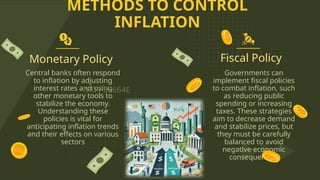
METHODS TO CONTROL
INFLATION
Central banks often respond
to inflation by adjusting
interest rates and using
other monetary tools to
stabilize the economy.
Understanding these
policies is vital for
anticipating inflation trends
and their effects on various
sectors
Monetary Policy
Governments can
implement fiscal policies
to combat inflation, such
as reducing public
spending or increasing
taxes. These strategies
aim to decrease demand
and stabilize prices, but
they must be carefully
balanced to avoid
negative economic
consequences.
Fiscal Policy
NKFPS2664E
MONETARY POLICY STRATEGIES
Monetary policy for inflation control involves strategies implemented by central banks to
manage inflation rates and stabilize the economy. Here are key components and tools used in
this process:
Key Objectives
1. Price Stability:
The primary goal is to maintain a stable price level,
keeping inflation within a target range.
2. Economic Growth:
Balancing inflation control with supporting sustainable
economic growth.
3. Employment:
Ensuring that inflation control does not adversely affect
employment levels.
TOOLS OF MONETARY POLICY:
• Bank Rate Policy:
Raising Interest Rates: When inflation is high, central banks may increase
benchmark interest rates to reduce borrowing and spending, which can
help cool down inflation.
Lowering Interest Rates: Conversely, if inflation is low, lowering rates can
encourage borrowing and investment, spurring economic activity.
• Open Market Operations (OMO):
It involves buying and selling government securities to influence the money
supply.
Selling Securities: Reduces the money supply, which can help control
inflation.
Buying Securities: Increases the money supply and can help stimulate the
economy in low-inflation scenarios.
• Cash Reserve Ratio (CRR):
It is a monetary policy tool used by central banks to regulate the amount of
funds that commercial banks must hold in reserve against their total
deposits. During inflation,
CRR is increased.
• Statutory Liquidity Ratio (SLR):
It is a regulatory requirement for commercial banks that mandates them to
FISCAL POLICY STRATEGIES:
Apart from monetary policy, the government also uses fiscal measures to
control inflation. The two main components of fiscal policy are
government revenue and government expenditure.
In fiscal policy, the government controls inflation either by reducing
private spending or by decreasing government expenditure, or
by using both.
It reduces private spending by increasing taxes on private businesses.
When private spending is more, the government reduces its expenditure
to control inflation. Besides this, the government expenditures are
essential for other areas, such as defense, health, education, and law and
order. In such a case, reducing private spending is more preferable
rather than decreasing government expenditure. When the government
reduces private spending by increasing taxes, individuals decrease their
total expenditure.
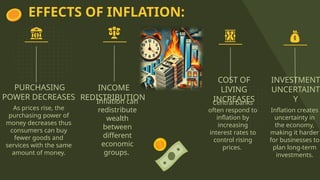
EFFECTS OF INFLATION:
INVESTMENT
UNCERTAINT
Y
Inflation creates
uncertainty in
the economy,
making it harder
for businesses to
plan long-term
investments.
As prices rise, the
purchasing power of
money decreases thus
consumers can buy
fewer goods and
services with the same
amount of money.
Inflation can
redistribute
wealth
between
different
economic
groups.
COST OF
LIVING
INCREASES
Central banks
often respond to
inflation by
increasing
interest rates to
control rising
prices.
PURCHASING
POWER DECREASES
INCOME
REDISTRIBUTION
CREDITS: This presentation template was created by Slidesgo, and includes
icons by Flaticon, and infographics & images by Freepik
THANK YOU
Created by:
Sandeepa Sinha
(IISWBM
Batch 2024-26)
Please keep this slide for attribution
RESOURCES
• www.investopedia.com
• Frank ICSE Class XII book by U Andrews
• www.rbi.org.in

Inflation - Definition, Causes, Types, Measures, Policy, Case Study

  • 1.
  • 2.
    WHAT IS INFLATION? • Inflationrefers to the general increase in prices of goods and services over a period of time. • Inflation is measured by the Consumer Price Index (CPI) and affects various sectors of the economy. • Inflation causes a decrease in the real value of money and thus reduces the purchasing power of money.
  • 3.
    Inflation is acritical economic concept that affects purchasing power and overall economic stability. Understanding its causes, impacts, and mitigation strategies is essential for both policymakers and individuals. This presentation aims to provide a comprehensive overview of inflation and its significance in today's economy. WHY SHOULD WE KNOW ABOUT INFLATION?
  • 4.
    To calculate theinflation, economists look at a "basket of goods and services". This is a hypothetical group of different items with specified quantities of each one, used as a basis for calculating how price level changes over time. When conceptualizing a basket of goods. It is best to imagine a shopping basket. The basket contains everyday products such as food, clothing, furniture and financial services. As the products in the basket increase or decrease in price, overall value basket changes. The value of basket each year determines the inflation rate of the period. BASKET OF GOODS AND SERVICES
  • 5.
    Cost-push inflation occurs whenthe costs of production increase, causing businesses to raise prices to maintain profit margins. Key factors include rising wages, increased raw material costs, and supply chain disruptions. This type of inflation can be more challenging to control. Demand-pull inflation happens when consumer demand outstrips supply, leading to higher prices. Factors contributing to this include increased consumer spending, government expenditure, and export demand. Understanding this can help in predicting inflation trends. CAUSES OF INFLATION COST PUSH INFLATION DEMAND PULL INFLATION Inflation can be driven by several factors, including demand-pull inflation, which occurs when demand exceeds supply and cost-push inflation, where rising production costs lead to increased prices. Other factors include monetary policy and fiscal stimulus.
  • 6.
    METHODS OF MEASURING INFLATION Measuringinflation involves several methods, each providing insights into price changes in an economy. Here are some of the most common methods: • Consumer Price Index (CPI) CPI is one of the most widely used indicators for measuring inflation. It reflects the average change in prices over time that consumers pay for a basket of goods and services. The WPI is calculated by taking a weighted average of price changes for a basket of goods. • The Wholesale Price Index (WPI) WPI measures the average change over time in the selling prices received by domestic producers for their output. It serves as an important indicator of inflation at the wholesale level before it reaches consumers. The WPI is calculated by taking a weighted average of price changes for a basket of goods. • GDP Deflator GDP Deflator refers to the ratio between the GDP at current prices to GDP at constant prices.
  • 7.
    IMPACTS OF INFLATION Inflationaffects the economy in various ways, including decreased purchasing power, uncertainty in investments, and redistribution of wealth. It can erode savings and impact fixed-income earners, making it essential to understand its broader implications. Effects on Consumers: Consumers face challenges during inflation, such as rising prices for goods and services, which can lead to reduced consumption. Additionally, inflation can disproportionately affect low-income households, making it crucial to consider its Effects on Businesses: Businesses may experience increased costs and uncertainty during inflationary periods, leading to potential layoffs or reduced investment. Companies must adapt their pricing strategies and operational efficiencies to mitigate the impacts of rising costs.
  • 8.
    REAL LIFE EXAMPLEOF INFLATION: Hyperinflation in Zimbabwe peaked in the late 2000s, driven by factors like: 1.Land Reform Policies: The government seized white-owned farms, causing agricultural production to plummet. 2.Economic Mismanagement: Excessive money printing to cover budget deficits led to rapid currency devaluation. 3.Political Instability: Ongoing turmoil discouraged investment and economic growth. 4.Production Decline: A collapse in agriculture and industry resulted in food shortages and skyrocketing prices. By November 2008, inflation rates soared into the billions percent. In 2009, Zimbabwe abandoned its Hyperinflation is an extremely high and typically accelerating rate of inflation, often exceeding 50% per month.
  • 9.
    METHODS TO CONTROL INFLATION Centralbanks often respond to inflation by adjusting interest rates and using other monetary tools to stabilize the economy. Understanding these policies is vital for anticipating inflation trends and their effects on various sectors Monetary Policy Governments can implement fiscal policies to combat inflation, such as reducing public spending or increasing taxes. These strategies aim to decrease demand and stabilize prices, but they must be carefully balanced to avoid negative economic consequences. Fiscal Policy NKFPS2664E
  • 10.
    MONETARY POLICY STRATEGIES Monetarypolicy for inflation control involves strategies implemented by central banks to manage inflation rates and stabilize the economy. Here are key components and tools used in this process: Key Objectives 1. Price Stability: The primary goal is to maintain a stable price level, keeping inflation within a target range. 2. Economic Growth: Balancing inflation control with supporting sustainable economic growth. 3. Employment: Ensuring that inflation control does not adversely affect employment levels.
  • 11.
    TOOLS OF MONETARYPOLICY: • Bank Rate Policy: Raising Interest Rates: When inflation is high, central banks may increase benchmark interest rates to reduce borrowing and spending, which can help cool down inflation. Lowering Interest Rates: Conversely, if inflation is low, lowering rates can encourage borrowing and investment, spurring economic activity. • Open Market Operations (OMO): It involves buying and selling government securities to influence the money supply. Selling Securities: Reduces the money supply, which can help control inflation. Buying Securities: Increases the money supply and can help stimulate the economy in low-inflation scenarios. • Cash Reserve Ratio (CRR): It is a monetary policy tool used by central banks to regulate the amount of funds that commercial banks must hold in reserve against their total deposits. During inflation, CRR is increased. • Statutory Liquidity Ratio (SLR): It is a regulatory requirement for commercial banks that mandates them to
  • 12.
    FISCAL POLICY STRATEGIES: Apartfrom monetary policy, the government also uses fiscal measures to control inflation. The two main components of fiscal policy are government revenue and government expenditure. In fiscal policy, the government controls inflation either by reducing private spending or by decreasing government expenditure, or by using both. It reduces private spending by increasing taxes on private businesses. When private spending is more, the government reduces its expenditure to control inflation. Besides this, the government expenditures are essential for other areas, such as defense, health, education, and law and order. In such a case, reducing private spending is more preferable rather than decreasing government expenditure. When the government reduces private spending by increasing taxes, individuals decrease their total expenditure.
  • 13.
    EFFECTS OF INFLATION: INVESTMENT UNCERTAINT Y Inflationcreates uncertainty in the economy, making it harder for businesses to plan long-term investments. As prices rise, the purchasing power of money decreases thus consumers can buy fewer goods and services with the same amount of money. Inflation can redistribute wealth between different economic groups. COST OF LIVING INCREASES Central banks often respond to inflation by increasing interest rates to control rising prices. PURCHASING POWER DECREASES INCOME REDISTRIBUTION
  • 14.
    CREDITS: This presentationtemplate was created by Slidesgo, and includes icons by Flaticon, and infographics & images by Freepik THANK YOU Created by: Sandeepa Sinha (IISWBM Batch 2024-26) Please keep this slide for attribution
  • 15.
    RESOURCES • www.investopedia.com • FrankICSE Class XII book by U Andrews • www.rbi.org.in