INFLATION
an economics presentation
Synopsis:
Introduction
Definition
Types of inflation
● Causes of inflation
● Effects of inflation
● Consequences of Inflation
INTRODUCTION
❏ Inflation is defined as a sustained
increase in the price level or a fall in
the value of money.
❏ When the level of currency of a
country exceeds the level of
production, inflation occurs.
❏ Value of money depreciates with the
occurrence of inflation.
Measures of Inflation:
● Monetary policy
● Credit Control
● Demonetization of
Currency
● Issue of New Currency
● Fiscal policy
● Reduction in Unnecessary
Expenditure
● Increase in Taxes
● Increase in Savings
● Surplus Budgets
● Public Debt
● Increased Production
● Rational Wage Policy
● Price Control
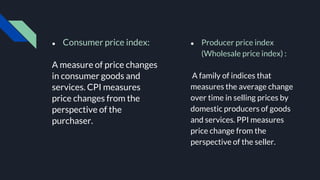
● Consumer price index:
A measure of price changes
in consumer goods and
services. CPI measures
price changes from the
perspective of the
purchaser.
● Producer price index
(Wholesale price index) :
A family of indices that
measures the average change
over time in selling prices by
domestic producers of goods
and services. PPI measures
price change from the
perspective of the seller.
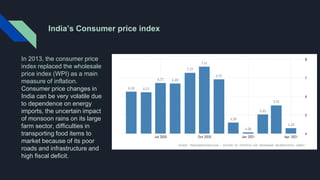
India’s Consumer price index
In 2013, the consumer price
index replaced the wholesale
price index (WPI) as a main
measure of inflation.
Consumer price changes in
India can be very volatile due
to dependence on energy
imports, the uncertain impact
of monsoon rains on its large
farm sector, difficulties in
transporting food items to
market because of its poor
roads and infrastructure and
high fiscal deficit.
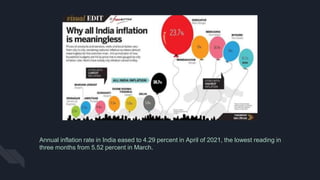
Annual inflation rate in India eased to 4.29 percent in April of 2021, the lowest reading in
three months from 5.52 percent in March.
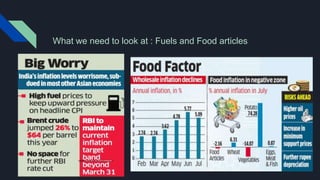
What we need to look at : Fuels and Food articles
India’s wholesale price index
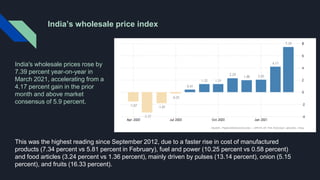
India's wholesale prices rose by
7.39 percent year-on-year in
March 2021, accelerating from a
4.17 percent gain in the prior
month and above market
consensus of 5.9 percent.
This was the highest reading since September 2012, due to a faster rise in cost of manufactured
products (7.34 percent vs 5.81 percent in February), fuel and power (10.25 percent vs 0.58 percent)
and food articles (3.24 percent vs 1.36 percent), mainly driven by pulses (13.14 percent), onion (5.15
percent), and fruits (16.33 percent).
❏ According to C.Crowther, “Inflation is a state in
which the value of money is falling and the prices
are rising.”
❏ In Economics, the word ‘inflation’ refers to general
rise in prices measured against a standard level of
purchasing power.
DEFINITION
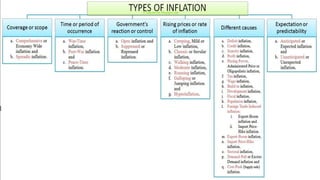
Government’s reaction or control:
Open inflation:
The rate where Costs rise
due to Economic trends
of Spending Products and
Services
Suppressed Inflation:
Existing inflation disguised by
government price controls or other
interferences in the economy such as
subsidies. Such suppression can only
be temporary because no
governmental measure can
completely contain accelerating
inflation in the long run. It is also
called Repressed Inflation.
Rate of Inflation:
Creeping inflation:
Circumstance where the inflation of a nation
increases gradually, but continually, over time.
This tends to be a typically pattern for many
nations. Although the increase is relatively
small in the short-term, as it continues over
time the effect will become greater and
greater.
Hyperinflation:
Hyperinflation is caused mainly by excessive
deficit spending (financed by printing more
money) by a government, some economists
believe that social breakdown leads to
hyperinflation (not vice versa), and that its
roots lie in political rather than economic
causes.
Galloping Inflation:
Very Rapid Inflation which is almost impossible
to reduce.
Different Causes:
Demand-Pull Inflation:
This type of inflation happens
when the aggregate demand
increases more than the
supply.
Business respond to high
demand by raising prices to
increase their profit margin.
Cost-push Inflation:
When cost of production increases the
price level automatically increases.
Cost push inflation is mainly caused due
to the following factors :
• increases in wages
• increase in cost of raw materials
• increased cost of imported component.
Factors on demand side:
● Increase in money supply
● Increase in disposable income
● Deficit financing
● Foreign exchange reserves
Causes Of Inflation
Factors on supply side
● Rise in administered prices
● Erratic agriculture growth
● Agricultural price policy
● Inadequate industrial growth
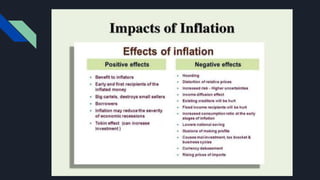
Effects of inflation :
● They add inefficiencies in the
market, and make it difficult for
companies to budget or plan
long-term.
● There can also be negative
impacts to trade from an
increased instability in currency
exchange prices caused by
unpredictable inflation.
● Uncertainty about the future
purchasing power of money
discourages investment and
saving.
● Inflation rate in the economy is
higher than rates in other
countries; this will increase
imports and reduce exports,
leading to a deficit in the
balance of trade.
Consequences of Inflation :
● Adverse effect on
production
● Adverse effect on
distribution of income
● Obstacle to development
● Changes in relative prices
● Adverse effect on the B.O.P.
(Balance of payment)
The balance of payments (BOP) is a statement of all transactions made between
entities in one country and the rest of the world over a defined period of time, such as
a quarter or a year.
Group members
● Nilesh Singh Bais
● Nimesh Singh
● Nisha Maheshwari
● Palak Gupta
● Pankhuri Vapta
Quiz
Q. Which of the following
concept is just opposite to
inflation?
(a) Stagflation
(b) Deflation
(c) Recession
(d) Disinflation
Q. How inflation affects the price of
the commodities?
(a) Price of the commodities
decreases.
(b) Price of the commodities increases.
(c) No effect.
(d) First the price decreases later on
increases.
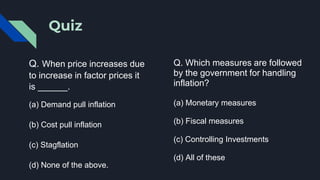
Quiz
Q. When price increases due
to increase in factor prices it
is ______.
(a) Demand pull inflation
(b) Cost pull inflation
(c) Stagflation
(d) None of the above.
Q. Which measures are followed
by the government for handling
inflation?
(a) Monetary measures
(b) Fiscal measures
(c) Controlling Investments
(d) All of these
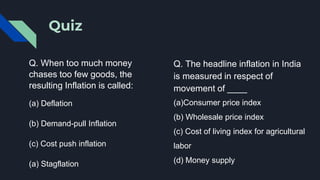
Quiz
Q. When too much money
chases too few goods, the
resulting Inflation is called:
(a) Deflation
(b) Demand-pull Inflation
(c) Cost push inflation
(a) Stagflation
Q. The headline inflation in India
is measured in respect of
movement of ____
(a)Consumer price index
(b) Wholesale price index
(c) Cost of living index for agricultural
labor
(d) Money supply
THANK YOU

Inflation (Economics presentation)

  • 1.
  • 2.
    Synopsis: Introduction Definition Types of inflation ●Causes of inflation ● Effects of inflation ● Consequences of Inflation
  • 3.
    INTRODUCTION ❏ Inflation isdefined as a sustained increase in the price level or a fall in the value of money. ❏ When the level of currency of a country exceeds the level of production, inflation occurs. ❏ Value of money depreciates with the occurrence of inflation.
  • 4.
    Measures of Inflation: ●Monetary policy ● Credit Control ● Demonetization of Currency ● Issue of New Currency ● Fiscal policy ● Reduction in Unnecessary Expenditure ● Increase in Taxes ● Increase in Savings ● Surplus Budgets ● Public Debt ● Increased Production ● Rational Wage Policy ● Price Control
  • 5.
    ● Consumer priceindex: A measure of price changes in consumer goods and services. CPI measures price changes from the perspective of the purchaser. ● Producer price index (Wholesale price index) : A family of indices that measures the average change over time in selling prices by domestic producers of goods and services. PPI measures price change from the perspective of the seller.
  • 6.
    India’s Consumer priceindex In 2013, the consumer price index replaced the wholesale price index (WPI) as a main measure of inflation. Consumer price changes in India can be very volatile due to dependence on energy imports, the uncertain impact of monsoon rains on its large farm sector, difficulties in transporting food items to market because of its poor roads and infrastructure and high fiscal deficit.
  • 7.
    Annual inflation ratein India eased to 4.29 percent in April of 2021, the lowest reading in three months from 5.52 percent in March.
  • 8.
    What we needto look at : Fuels and Food articles
  • 9.
    India’s wholesale priceindex India's wholesale prices rose by 7.39 percent year-on-year in March 2021, accelerating from a 4.17 percent gain in the prior month and above market consensus of 5.9 percent. This was the highest reading since September 2012, due to a faster rise in cost of manufactured products (7.34 percent vs 5.81 percent in February), fuel and power (10.25 percent vs 0.58 percent) and food articles (3.24 percent vs 1.36 percent), mainly driven by pulses (13.14 percent), onion (5.15 percent), and fruits (16.33 percent).
  • 10.
    ❏ According toC.Crowther, “Inflation is a state in which the value of money is falling and the prices are rising.” ❏ In Economics, the word ‘inflation’ refers to general rise in prices measured against a standard level of purchasing power. DEFINITION
  • 12.
    Government’s reaction orcontrol: Open inflation: The rate where Costs rise due to Economic trends of Spending Products and Services Suppressed Inflation: Existing inflation disguised by government price controls or other interferences in the economy such as subsidies. Such suppression can only be temporary because no governmental measure can completely contain accelerating inflation in the long run. It is also called Repressed Inflation.
  • 13.
    Rate of Inflation: Creepinginflation: Circumstance where the inflation of a nation increases gradually, but continually, over time. This tends to be a typically pattern for many nations. Although the increase is relatively small in the short-term, as it continues over time the effect will become greater and greater. Hyperinflation: Hyperinflation is caused mainly by excessive deficit spending (financed by printing more money) by a government, some economists believe that social breakdown leads to hyperinflation (not vice versa), and that its roots lie in political rather than economic causes. Galloping Inflation: Very Rapid Inflation which is almost impossible to reduce.
  • 14.
    Different Causes: Demand-Pull Inflation: Thistype of inflation happens when the aggregate demand increases more than the supply. Business respond to high demand by raising prices to increase their profit margin. Cost-push Inflation: When cost of production increases the price level automatically increases. Cost push inflation is mainly caused due to the following factors : • increases in wages • increase in cost of raw materials • increased cost of imported component.
  • 15.
    Factors on demandside: ● Increase in money supply ● Increase in disposable income ● Deficit financing ● Foreign exchange reserves Causes Of Inflation
  • 16.
    Factors on supplyside ● Rise in administered prices ● Erratic agriculture growth ● Agricultural price policy ● Inadequate industrial growth
  • 17.
    Effects of inflation: ● They add inefficiencies in the market, and make it difficult for companies to budget or plan long-term. ● There can also be negative impacts to trade from an increased instability in currency exchange prices caused by unpredictable inflation. ● Uncertainty about the future purchasing power of money discourages investment and saving. ● Inflation rate in the economy is higher than rates in other countries; this will increase imports and reduce exports, leading to a deficit in the balance of trade.
  • 19.
    Consequences of Inflation: ● Adverse effect on production ● Adverse effect on distribution of income ● Obstacle to development ● Changes in relative prices ● Adverse effect on the B.O.P. (Balance of payment) The balance of payments (BOP) is a statement of all transactions made between entities in one country and the rest of the world over a defined period of time, such as a quarter or a year.
  • 20.
    Group members ● NileshSingh Bais ● Nimesh Singh ● Nisha Maheshwari ● Palak Gupta ● Pankhuri Vapta
  • 21.
    Quiz Q. Which ofthe following concept is just opposite to inflation? (a) Stagflation (b) Deflation (c) Recession (d) Disinflation Q. How inflation affects the price of the commodities? (a) Price of the commodities decreases. (b) Price of the commodities increases. (c) No effect. (d) First the price decreases later on increases.
  • 22.
    Quiz Q. When priceincreases due to increase in factor prices it is ______. (a) Demand pull inflation (b) Cost pull inflation (c) Stagflation (d) None of the above. Q. Which measures are followed by the government for handling inflation? (a) Monetary measures (b) Fiscal measures (c) Controlling Investments (d) All of these
  • 23.
    Quiz Q. When toomuch money chases too few goods, the resulting Inflation is called: (a) Deflation (b) Demand-pull Inflation (c) Cost push inflation (a) Stagflation Q. The headline inflation in India is measured in respect of movement of ____ (a)Consumer price index (b) Wholesale price index (c) Cost of living index for agricultural labor (d) Money supply
  • 24.