INFILTRATION
Presentation on
Agenda
Introduction
Overview of Infiltration
Factors Affecting
infiltration
Summary
Presentation title 2
Introduction
Infiltration is defined as the flow of water from aboveground
into the subsurface. The topic of infiltration has received a great
deal of attention because of its importance to topics as widely
ranging as irrigation, contaminant transport, groundwater recharge,
and ecosystem viability.
Presentation title 3
Overview
Infiltration
Infiltration Overview
Presentation title 5
• Infiltration is defined as the flow of water from aboveground into
the subsurface.
• The topic of infiltration has received a great deal of attention
because of its importance to topics as widely ranging as
irrigation, contaminant transport, groundwater recharge, and
ecosystem viability.
• While the definition of infiltration is simple, it can involve all
aspects of flow through a variably saturated porous medium,
ranging in complexity from steady-state, saturated flow in a
homogeneous, isotropic medium to transient,
unstable, unsaturated flow through an
anisotropic, heterogeneous medium.
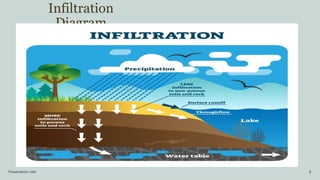
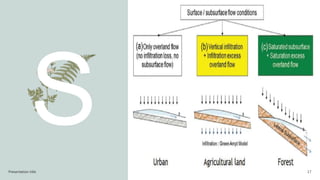
Infiltration
Diagram
Presentation title 6
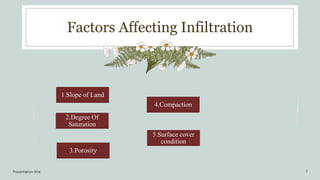
Factors Affecting Infiltration
Presentation title 7
1.Slope of Land
2.Degree Of
Saturation
3.Porosity
4.Compaction
5.Surface cover
condition
Slope of the land
Presentation title 8
• The slope effect on runoff and soil erosion on hilslopes remains a controversial issue. To
examine the essential impact of slope gradient on infiltration, runoff and soil erosion, a theoretical
framework has been developed.
• The slope effect on runoff and soil erosion on hilslopes remains a controversial issue. To
examine the essential impact of slope gradient on infiltration, runoff and soil erosion, a theoretical
framework has been developed.
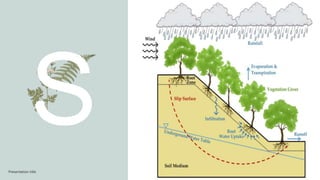
• The amount of soil erosion is directly related to the amount of surface water runoff, which
depends on the water infiltration rate and the % slope. The steeper the slope and the less rapid
the water infiltration rate, the more rapid the water runoff rate for a given soil.
• This, therefore, affects infiltration rate and surface runoff proportion of water from any kind of rainfall
distribution and the tendency of the surface runoff to be higher usually leads to a higher erosion rate on
the slope.
Presentation title 9
Degree Of Saturation
Presentation title 10
• Soil that is already saturated has no more capacity to hold more water, therefore infiltration
capacity has been reached and the rate cannot increase past this point. This leads to much more
surface runoff.
• Based on the theory of gas-liquid two-phase flow, the finite element method was used to simulate rainfall
infiltration in loam soil with different degrees of saturation to investigate the effects of the initial degree
of saturation on rainfall infiltration
• With the variation of the initial degree of saturation, the infiltration rate reaches its maximum or
maximum infiltration rate usually appears in the stage of residual or full saturation, while the minimum
occurs in the unsaturated stage, depending on soil unsaturated characteristics.
Presentation title 11
Porosity
Presentation title 12
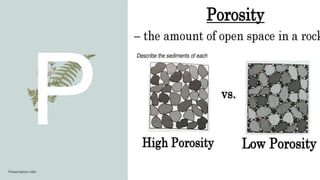
• Soils with higher porosity have more pore space and a higher infiltration rate than those with
lower porosity.
• Steady-state infiltration. —The condition in which the infiltration rate does not increase or
decrease as more water is added. It typically occurs when the soil is nearly saturated.
• Movement of water into soil is called infiltration, and the downward movement of water within the
soil is called percolation, permeability or hydraulic conductivity. Pore space in soil is the conduit
that allows water to infiltrate and percolate. It also serves as the storage compartment for water.
Presentation title 13
Compaction
Presentation title 14
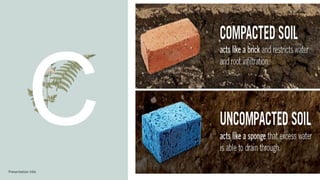
• Inadvertent soil compaction at the urban lot scale is a process that reduces infiltration rates,
which can lead to increased stormwater runoff. This is particularly important in low impact
development strategies where stormwater is intended to infiltrate rather than flow through a
traditional stormwater network to a detention basin.
• The effect of compaction on infiltration rates on sandy soils in North Central Florida was
measured with a double ring infiltrometer on urban construction sites and across various levels of
compaction.
• This implies that construction activity in this region increases the potential for runoff and the need
for large stormwater conveyance networks not only due to the increase in impervious area
associated with development but also because the compacted pervious area effectively
approaches the infiltration behavior of an impervious surface.
Presentation title 15
Surface Cover Condition
Presentation title 16
• If the land is covered by impermeable surfaces, such as pavement, infiltration cannot occur as
the water cannot infiltrate through an impermeable surface This relationship also leads to
increased runoff.
• As soil moisture content increases, the infiltration rate decreases. Soil moisture is affected by
evaporation, water use by plants, residue on surface and plant cover, irrigation, and drainage.
Dry soils tend to have pores and cracks that allow water to enter faster.
• Infiltration is the process by which water ponded or flowing over a soil surface is absorbed into
the soil. There are many situations where a contractor is faced with the task of creating an
infiltration surface
Presentation title 17
Summary
Infiltration is an indicator of the soil's ability to allow water
movement into and through the soil profile. Soil temporarily stores
water, making it available for root uptake, plant growth and habitat
for soil organisms.
In dry soil, water infiltrates rapidly. This is called the initial
infiltration rate. As more water replaces the air in the pores, the
water from the soil surface infiltrates more slowly and eventually
reaches a steady rate. This is called the basic infiltration rate
Presentation title 18
Thank you

INFILTRATION power point presentation.pptx

  • 1.
  • 2.
    Agenda Introduction Overview of Infiltration FactorsAffecting infiltration Summary Presentation title 2
  • 3.
    Introduction Infiltration is definedas the flow of water from aboveground into the subsurface. The topic of infiltration has received a great deal of attention because of its importance to topics as widely ranging as irrigation, contaminant transport, groundwater recharge, and ecosystem viability. Presentation title 3
  • 4.
  • 5.
    Infiltration Overview Presentation title5 • Infiltration is defined as the flow of water from aboveground into the subsurface. • The topic of infiltration has received a great deal of attention because of its importance to topics as widely ranging as irrigation, contaminant transport, groundwater recharge, and ecosystem viability. • While the definition of infiltration is simple, it can involve all aspects of flow through a variably saturated porous medium, ranging in complexity from steady-state, saturated flow in a homogeneous, isotropic medium to transient, unstable, unsaturated flow through an anisotropic, heterogeneous medium.
  • 6.
  • 7.
    Factors Affecting Infiltration Presentationtitle 7 1.Slope of Land 2.Degree Of Saturation 3.Porosity 4.Compaction 5.Surface cover condition
  • 8.
    Slope of theland Presentation title 8 • The slope effect on runoff and soil erosion on hilslopes remains a controversial issue. To examine the essential impact of slope gradient on infiltration, runoff and soil erosion, a theoretical framework has been developed. • The slope effect on runoff and soil erosion on hilslopes remains a controversial issue. To examine the essential impact of slope gradient on infiltration, runoff and soil erosion, a theoretical framework has been developed. • The amount of soil erosion is directly related to the amount of surface water runoff, which depends on the water infiltration rate and the % slope. The steeper the slope and the less rapid the water infiltration rate, the more rapid the water runoff rate for a given soil. • This, therefore, affects infiltration rate and surface runoff proportion of water from any kind of rainfall distribution and the tendency of the surface runoff to be higher usually leads to a higher erosion rate on the slope.
  • 9.
  • 10.
    Degree Of Saturation Presentationtitle 10 • Soil that is already saturated has no more capacity to hold more water, therefore infiltration capacity has been reached and the rate cannot increase past this point. This leads to much more surface runoff. • Based on the theory of gas-liquid two-phase flow, the finite element method was used to simulate rainfall infiltration in loam soil with different degrees of saturation to investigate the effects of the initial degree of saturation on rainfall infiltration • With the variation of the initial degree of saturation, the infiltration rate reaches its maximum or maximum infiltration rate usually appears in the stage of residual or full saturation, while the minimum occurs in the unsaturated stage, depending on soil unsaturated characteristics.
  • 11.
  • 12.
    Porosity Presentation title 12 •Soils with higher porosity have more pore space and a higher infiltration rate than those with lower porosity. • Steady-state infiltration. —The condition in which the infiltration rate does not increase or decrease as more water is added. It typically occurs when the soil is nearly saturated. • Movement of water into soil is called infiltration, and the downward movement of water within the soil is called percolation, permeability or hydraulic conductivity. Pore space in soil is the conduit that allows water to infiltrate and percolate. It also serves as the storage compartment for water.
  • 13.
  • 14.
    Compaction Presentation title 14 •Inadvertent soil compaction at the urban lot scale is a process that reduces infiltration rates, which can lead to increased stormwater runoff. This is particularly important in low impact development strategies where stormwater is intended to infiltrate rather than flow through a traditional stormwater network to a detention basin. • The effect of compaction on infiltration rates on sandy soils in North Central Florida was measured with a double ring infiltrometer on urban construction sites and across various levels of compaction. • This implies that construction activity in this region increases the potential for runoff and the need for large stormwater conveyance networks not only due to the increase in impervious area associated with development but also because the compacted pervious area effectively approaches the infiltration behavior of an impervious surface.
  • 15.
  • 16.
    Surface Cover Condition Presentationtitle 16 • If the land is covered by impermeable surfaces, such as pavement, infiltration cannot occur as the water cannot infiltrate through an impermeable surface This relationship also leads to increased runoff. • As soil moisture content increases, the infiltration rate decreases. Soil moisture is affected by evaporation, water use by plants, residue on surface and plant cover, irrigation, and drainage. Dry soils tend to have pores and cracks that allow water to enter faster. • Infiltration is the process by which water ponded or flowing over a soil surface is absorbed into the soil. There are many situations where a contractor is faced with the task of creating an infiltration surface
  • 17.
  • 18.
    Summary Infiltration is anindicator of the soil's ability to allow water movement into and through the soil profile. Soil temporarily stores water, making it available for root uptake, plant growth and habitat for soil organisms. In dry soil, water infiltrates rapidly. This is called the initial infiltration rate. As more water replaces the air in the pores, the water from the soil surface infiltrates more slowly and eventually reaches a steady rate. This is called the basic infiltration rate Presentation title 18
  • 19.