1-1 M. Amir Hossain, Ph.D. Professor, Applied Statistics D.U. MBM_509: Quantitative Techniques EMBA_502: Analytical Techniques in Management   September 24, 2011
What is Meant by Statistics? Statistics   is   the science of collecting,  organizing, presenting, analyzing, and interpreting numerical data for the purpose of assisting in making a more effective decision.
Who Uses Statistics? Statistical techniques are used extensively by marketing, accounting, quality control, consumers, professional sports people, hospital administrators, educators, politicians, physicians, etc...
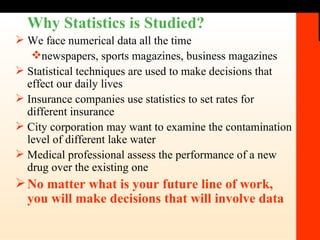
Why Statistics is Studied?  We face numerical data all the time newspapers, sports magazines, business magazines Statistical techniques are used to make decisions that effect our daily lives Insurance companies use statistics to set rates for different insurance City corporation may want to examine the contamination level of different lake water Medical professional assess the performance of a new drug over the existing one No matter what is your future line of work, you will make decisions that will involve data
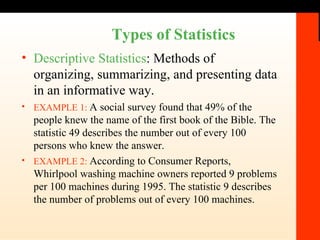
Types of Statistics Descriptive Statistics : Methods of organizing, summarizing, and presenting data in an informative way. EXAMPLE 1:   A social survey found that 49% of the people knew the name of the first book of the Bible. The statistic 49 describes the number out of every 100 persons who knew the answer. EXAMPLE 2:   According to Consumer Reports, Whirlpool washing machine owners reported 9 problems per 100 machines during 1995. The statistic 9 describes the number of problems out of every 100 machines.
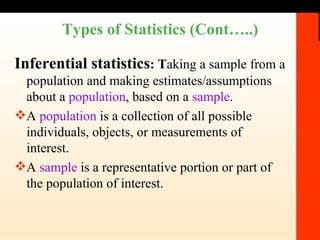
Types of Statistics (Cont…..) Inferential statistics : T aking a sample from a population and making estimates/assumptions about a  population , based on a  sample . A  population   is a collection of all possible individuals, objects, or measurements of interest. A  sample  is a representative portion or part of the population of interest.
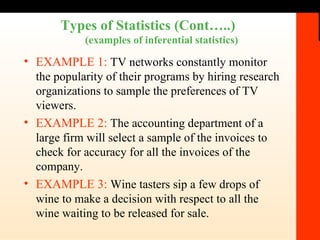
Types of Statistics (Cont…..)   (examples of inferential statistics) EXAMPLE 1:   TV networks constantly monitor the popularity of their programs by hiring research organizations to sample the preferences of TV viewers. EXAMPLE 2:   The accounting department of a large firm will select a sample of the invoices to check for accuracy for all the invoices of the company. EXAMPLE 3:   Wine tasters sip a few drops of wine to make a decision with respect to all the wine waiting to be released for sale.
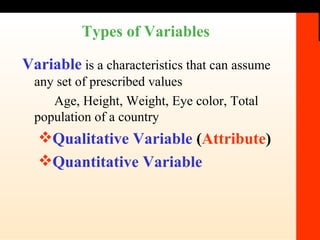
Types of Variables Variable   is a characteristics that can assume any set of prescribed values Age, Height, Weight, Eye color, Total population of a country Qualitative Variable  ( Attribute )  Quantitative Variable
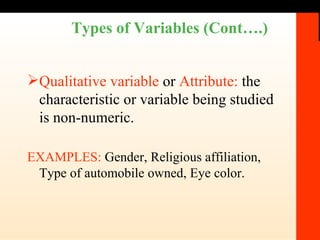
Types of Variables (Cont….) Qualitative variable   or  Attribute:  the characteristic or variable being studied is non-numeric. EXAMPLES:  Gender, Religious affiliation, Type of automobile owned, Eye color.
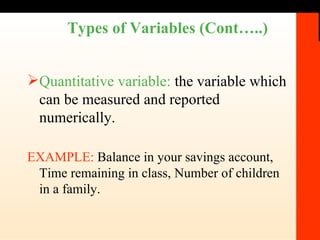
Types of Variables (Cont…..) Quantitative variable:  the variable which can be measured and reported numerically. EXAMPLE:  Balance in your savings account, Time remaining in class, Number of children in a family.
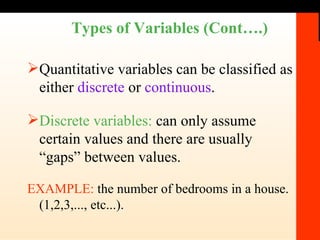
Types of Variables (Cont….) Quantitative variables can be classified as either  discrete  or  continuous . Discrete variables:  can only assume certain values and there are usually “gaps” between values. EXAMPLE:  the number of bedrooms in a house. (1,2,3,..., etc...).
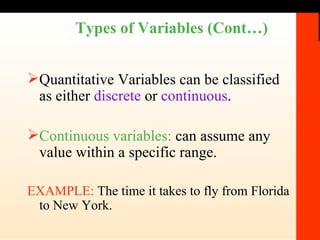
Types of Variables (Cont…) Quantitative Variables can be classified as either  discrete  or  continuous .  Continuous variables:  can assume any value within a specific range. EXAMPLE:  The time it takes to fly from Florida to New York.
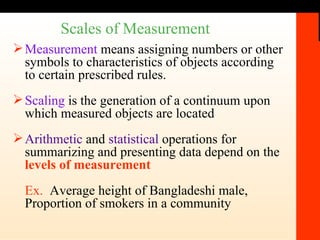
Scales of Measurement Measurement  means assigning numbers or other symbols to characteristics of objects according to certain prescribed rules.  Scaling  is the generation of a continuum upon which measured objects are located Arithmetic  and  statistical  operations for summarizing and presenting data depend on the  levels of measurement Ex.   Average height of Bangladeshi male, Proportion of smokers in a community
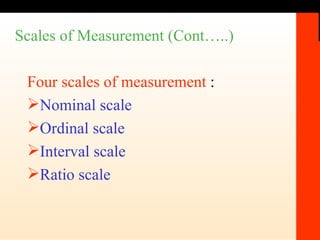
Scales of Measurement (Cont…..) Four scales of measurement  : Nominal scale Ordinal scale Interval scale Ratio scale
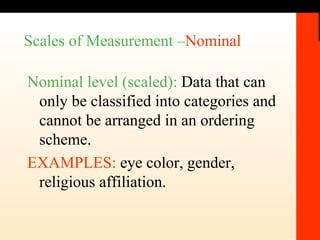
Scales of Measurement – Nominal   Nominal level (scaled):  Data that can only be classified into categories and cannot be arranged in an ordering scheme. EXAMPLES:  eye color, gender, religious affiliation.
Scales of Measurement- Nominal  (Cont…) Categories  must be  mutually exclusive  and  exhaustive Mutually exclusive :  Categories are so defined that each member of the population is correctly allocated to one and only one category Exhaustive :  each person, object, or item must be classified in at least one category i.e. A classification is exhaustive when it provides sufficient categories to accommodated all members of the population
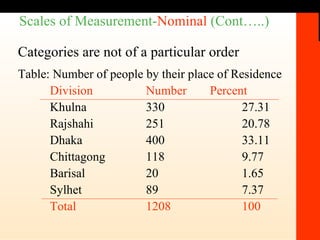
Scales of Measurement- Nominal  (Cont…..) Categories are not of a particular order Table: Number of people by their place of Residence Division  Number  Percent Khulna  330  27.31 Rajshahi  251  20.78 Dhaka  400  33.11 Chittagong  118  9.77 Barisal  20  1.65 Sylhet  89  7.37 Total  1208  100
Scales of Measurement- Ordinal Ordinal level:  involves data that may be arranged in some order, but differences between data values cannot be determined or are meaningless. EXAMPLE:   During a taste test of 4 colas, cola C was ranked number 1, cola B was ranked number 2, cola A was ranked number 3, and cola D was ranked number 4.
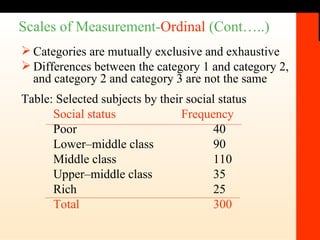
Scales of Measurement- Ordinal  (Cont…..) Categories are mutually exclusive and exhaustive Differences between the category 1 and category 2, and category 2 and category 3 are not the same Table: Selected subjects by their social status Social status Frequency Poor  40 Lower–middle class  90 Middle class  110 Upper–middle class  35 Rich  25 Total 300
Scales of Measurement- Interval Interval level:  similar to the ordinal level, with the additional property that meaningful amounts of differences between data values can be determined. There is no natural zero point. EXAMPLE:  Temperature on the Fahrenheit scale.
Scales of Measurement- Interval  (Cont…..) Includes all the characteristics of ordinal level Differences between the values is a constant size Examples : temperature in Centigrade, calendar year Difference between 96 0 C and 98 0 C is equal to the difference between 100 0 C and 102 0 C 0 0  C does not mean the ’no temperature!’ Cannot say place A (with temperature 100 0 C) is 10 times more warmer than place B (with temperature 10 0 C) No absolute zero, zero is arbitrary
Scales of Measurement- Ratio   Ratio level:  the interval level with an inherent zero starting point.  Differences and ratios are meaningful for this level of measurement. EXAMPLES:  money, heights of NBA players.
Scales of Measurement- Ratio  (Cont…..) The highest level of measurement that includes all the characteristics of the interval level The point 0 indicates the absence of the characteristics. Ratio between two numbers is meaningful Can say company A (with net wealth 100 b) is 10 times more rich than company B (with net wealth 10 b)

Emba502 day 2

  • 1.
    1-1 M. AmirHossain, Ph.D. Professor, Applied Statistics D.U. MBM_509: Quantitative Techniques EMBA_502: Analytical Techniques in Management September 24, 2011
  • 2.
    What is Meantby Statistics? Statistics is the science of collecting, organizing, presenting, analyzing, and interpreting numerical data for the purpose of assisting in making a more effective decision.
  • 3.
    Who Uses Statistics?Statistical techniques are used extensively by marketing, accounting, quality control, consumers, professional sports people, hospital administrators, educators, politicians, physicians, etc...
  • 4.
    Why Statistics isStudied? We face numerical data all the time newspapers, sports magazines, business magazines Statistical techniques are used to make decisions that effect our daily lives Insurance companies use statistics to set rates for different insurance City corporation may want to examine the contamination level of different lake water Medical professional assess the performance of a new drug over the existing one No matter what is your future line of work, you will make decisions that will involve data
  • 5.
    Types of StatisticsDescriptive Statistics : Methods of organizing, summarizing, and presenting data in an informative way. EXAMPLE 1: A social survey found that 49% of the people knew the name of the first book of the Bible. The statistic 49 describes the number out of every 100 persons who knew the answer. EXAMPLE 2: According to Consumer Reports, Whirlpool washing machine owners reported 9 problems per 100 machines during 1995. The statistic 9 describes the number of problems out of every 100 machines.
  • 6.
    Types of Statistics(Cont…..) Inferential statistics : T aking a sample from a population and making estimates/assumptions about a population , based on a sample . A population is a collection of all possible individuals, objects, or measurements of interest. A sample is a representative portion or part of the population of interest.
  • 7.
    Types of Statistics(Cont…..) (examples of inferential statistics) EXAMPLE 1: TV networks constantly monitor the popularity of their programs by hiring research organizations to sample the preferences of TV viewers. EXAMPLE 2: The accounting department of a large firm will select a sample of the invoices to check for accuracy for all the invoices of the company. EXAMPLE 3: Wine tasters sip a few drops of wine to make a decision with respect to all the wine waiting to be released for sale.
  • 8.
    Types of VariablesVariable is a characteristics that can assume any set of prescribed values Age, Height, Weight, Eye color, Total population of a country Qualitative Variable ( Attribute ) Quantitative Variable
  • 9.
    Types of Variables(Cont….) Qualitative variable or Attribute: the characteristic or variable being studied is non-numeric. EXAMPLES: Gender, Religious affiliation, Type of automobile owned, Eye color.
  • 10.
    Types of Variables(Cont…..) Quantitative variable: the variable which can be measured and reported numerically. EXAMPLE: Balance in your savings account, Time remaining in class, Number of children in a family.
  • 11.
    Types of Variables(Cont….) Quantitative variables can be classified as either discrete or continuous . Discrete variables: can only assume certain values and there are usually “gaps” between values. EXAMPLE: the number of bedrooms in a house. (1,2,3,..., etc...).
  • 12.
    Types of Variables(Cont…) Quantitative Variables can be classified as either discrete or continuous . Continuous variables: can assume any value within a specific range. EXAMPLE: The time it takes to fly from Florida to New York.
  • 13.
    Scales of MeasurementMeasurement means assigning numbers or other symbols to characteristics of objects according to certain prescribed rules. Scaling is the generation of a continuum upon which measured objects are located Arithmetic and statistical operations for summarizing and presenting data depend on the levels of measurement Ex. Average height of Bangladeshi male, Proportion of smokers in a community
  • 14.
    Scales of Measurement(Cont…..) Four scales of measurement : Nominal scale Ordinal scale Interval scale Ratio scale
  • 15.
    Scales of Measurement– Nominal Nominal level (scaled): Data that can only be classified into categories and cannot be arranged in an ordering scheme. EXAMPLES: eye color, gender, religious affiliation.
  • 16.
    Scales of Measurement-Nominal (Cont…) Categories must be mutually exclusive and exhaustive Mutually exclusive : Categories are so defined that each member of the population is correctly allocated to one and only one category Exhaustive : each person, object, or item must be classified in at least one category i.e. A classification is exhaustive when it provides sufficient categories to accommodated all members of the population
  • 17.
    Scales of Measurement-Nominal (Cont…..) Categories are not of a particular order Table: Number of people by their place of Residence Division Number Percent Khulna 330 27.31 Rajshahi 251 20.78 Dhaka 400 33.11 Chittagong 118 9.77 Barisal 20 1.65 Sylhet 89 7.37 Total 1208 100
  • 18.
    Scales of Measurement-Ordinal Ordinal level: involves data that may be arranged in some order, but differences between data values cannot be determined or are meaningless. EXAMPLE: During a taste test of 4 colas, cola C was ranked number 1, cola B was ranked number 2, cola A was ranked number 3, and cola D was ranked number 4.
  • 19.
    Scales of Measurement-Ordinal (Cont…..) Categories are mutually exclusive and exhaustive Differences between the category 1 and category 2, and category 2 and category 3 are not the same Table: Selected subjects by their social status Social status Frequency Poor 40 Lower–middle class 90 Middle class 110 Upper–middle class 35 Rich 25 Total 300
  • 20.
    Scales of Measurement-Interval Interval level: similar to the ordinal level, with the additional property that meaningful amounts of differences between data values can be determined. There is no natural zero point. EXAMPLE: Temperature on the Fahrenheit scale.
  • 21.
    Scales of Measurement-Interval (Cont…..) Includes all the characteristics of ordinal level Differences between the values is a constant size Examples : temperature in Centigrade, calendar year Difference between 96 0 C and 98 0 C is equal to the difference between 100 0 C and 102 0 C 0 0 C does not mean the ’no temperature!’ Cannot say place A (with temperature 100 0 C) is 10 times more warmer than place B (with temperature 10 0 C) No absolute zero, zero is arbitrary
  • 22.
    Scales of Measurement-Ratio Ratio level: the interval level with an inherent zero starting point. Differences and ratios are meaningful for this level of measurement. EXAMPLES: money, heights of NBA players.
  • 23.
    Scales of Measurement-Ratio (Cont…..) The highest level of measurement that includes all the characteristics of the interval level The point 0 indicates the absence of the characteristics. Ratio between two numbers is meaningful Can say company A (with net wealth 100 b) is 10 times more rich than company B (with net wealth 10 b)