SIGNS OF INFECTIVE ENDOCARDITIS
Infective endocarditis is a condition characterized by microbial infection of the endothelial surface of the heart, most comm
the heart.
The diagnosis of endocarditis can be difficult but may be made by satisfying certain well- described criteria, including the presence of positive blood
cultures for typical causative microorganisms and evidence of endocardial involvement seen on echocardiography.
The physical signs of endocarditis are numerous and include heart murmurs, which are encountered frequently, and the peripheral signs of endocarditis,
which are much less common. When uncertainty exists, the peripheral signs may be useful to support the diagnosis of endocardi
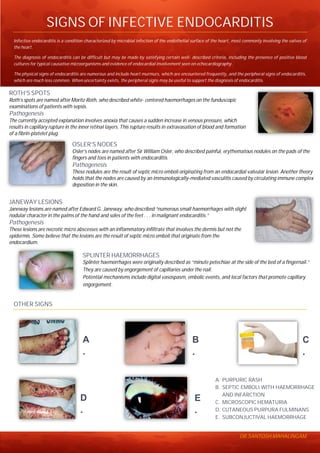
OTHER SIGNS
ROTH’S SPOTS
Roth’s spots are named after Moritz Roth, who described white- centered haemorrhages on the funduscopic
examinations of patients with sepsis.
Pathogenesis
The currently accepted explanation involves anoxia that causes a sudden increase in venous pressure, which
results in capillary rupture in the inner retinal layers. This rupture results in extravasation of blood and formation
of a fibrin-platelet plug.
OSLER’S NODES
Osler’s nodes are named after Sir William Osler, who described painful, erythematous nodules on the pads of the
fingers and toes in patients with endocarditis.
Pathogenesis
These nodules are the result of septic micro emboli originating from an endocardial valvular lesion. Another theory
holds that the nodes are caused by an immunologically-mediated vasculitis caused by circulating immune complex
deposition in the skin.
JANEWAY LESIONS
Janeway lesions are named after Edward G. Janeway, who described “numerous small haemorrhages with slight
nodular character in the palms of the hand and soles of the feet . . . in malignant endocarditis.”
Pathogenesis
These lesions are necrotic micro abscesses with an inflammatory infiltrate that involves the dermis but not the
epidermis. Some believe that the lesions are the result of septic micro emboli that originate from the
endocardium.
SPLINTER HAEMORRHAGES
Splinter haemorrhages were originally described as “minute petechiae at the side of the bed of a fingernail.”
They are caused by engorgement of capillaries under the nail.
Potential mechanisms include digital vasospasm, embolic events, and local factors that promote capillary
engorgement.
A
.
B
.
D
.
E
.
A. PURPURIC RASH
B. SEPTIC EMBOLI WITH HAEMORRHAGE
AND INFARCTION
C. MICROSCOPIC HEMATURIA
D. CUTANEOUS PURPURA FULMINANS
E. SUBCONJUCTIVAL HAEMORRHAGE
ENDOCARDITIS
Infective endocarditis is a condition characterized by microbial infection of the endothelial surface of the heart, most commonly involving the valves of
described criteria, including the presence of positive blood
cultures for typical causative microorganisms and evidence of endocardial involvement seen on echocardiography.
murmurs, which are encountered frequently, and the peripheral signs of endocarditis,
which are much less common. When uncertainty exists, the peripheral signs may be useful to support the diagnosis of endocarditis.
DR.SANTOSH MAHALINGAM
centered haemorrhages on the funduscopic
accepted explanation involves anoxia that causes a sudden increase in venous pressure, which
results in capillary rupture in the inner retinal layers. This rupture results in extravasation of blood and formation
Osler’s nodes are named after Sir William Osler, who described painful, erythematous nodules on the pads of the
endocardial valvular lesion. Another theory
mediated vasculitis caused by circulating immune complex
Janeway lesions are named after Edward G. Janeway, who described “numerous small haemorrhages with slight
abscesses with an inflammatory infiltrate that involves the dermis but not the
riginally described as “minute petechiae at the side of the bed of a fingernail.”
Potential mechanisms include digital vasospasm, embolic events, and local factors that promote capillary
C
.
PURPURIC RASH
SEPTIC EMBOLI WITH HAEMORRHAGE
AND INFARCTION
MICROSCOPIC HEMATURIA
CUTANEOUS PURPURA FULMINANS
SUBCONJUCTIVAL HAEMORRHAGE

Infective endocarditis

  • 1.
    SIGNS OF INFECTIVEENDOCARDITIS Infective endocarditis is a condition characterized by microbial infection of the endothelial surface of the heart, most comm the heart. The diagnosis of endocarditis can be difficult but may be made by satisfying certain well- described criteria, including the presence of positive blood cultures for typical causative microorganisms and evidence of endocardial involvement seen on echocardiography. The physical signs of endocarditis are numerous and include heart murmurs, which are encountered frequently, and the peripheral signs of endocarditis, which are much less common. When uncertainty exists, the peripheral signs may be useful to support the diagnosis of endocardi OTHER SIGNS ROTH’S SPOTS Roth’s spots are named after Moritz Roth, who described white- centered haemorrhages on the funduscopic examinations of patients with sepsis. Pathogenesis The currently accepted explanation involves anoxia that causes a sudden increase in venous pressure, which results in capillary rupture in the inner retinal layers. This rupture results in extravasation of blood and formation of a fibrin-platelet plug. OSLER’S NODES Osler’s nodes are named after Sir William Osler, who described painful, erythematous nodules on the pads of the fingers and toes in patients with endocarditis. Pathogenesis These nodules are the result of septic micro emboli originating from an endocardial valvular lesion. Another theory holds that the nodes are caused by an immunologically-mediated vasculitis caused by circulating immune complex deposition in the skin. JANEWAY LESIONS Janeway lesions are named after Edward G. Janeway, who described “numerous small haemorrhages with slight nodular character in the palms of the hand and soles of the feet . . . in malignant endocarditis.” Pathogenesis These lesions are necrotic micro abscesses with an inflammatory infiltrate that involves the dermis but not the epidermis. Some believe that the lesions are the result of septic micro emboli that originate from the endocardium. SPLINTER HAEMORRHAGES Splinter haemorrhages were originally described as “minute petechiae at the side of the bed of a fingernail.” They are caused by engorgement of capillaries under the nail. Potential mechanisms include digital vasospasm, embolic events, and local factors that promote capillary engorgement. A . B . D . E . A. PURPURIC RASH B. SEPTIC EMBOLI WITH HAEMORRHAGE AND INFARCTION C. MICROSCOPIC HEMATURIA D. CUTANEOUS PURPURA FULMINANS E. SUBCONJUCTIVAL HAEMORRHAGE ENDOCARDITIS Infective endocarditis is a condition characterized by microbial infection of the endothelial surface of the heart, most commonly involving the valves of described criteria, including the presence of positive blood cultures for typical causative microorganisms and evidence of endocardial involvement seen on echocardiography. murmurs, which are encountered frequently, and the peripheral signs of endocarditis, which are much less common. When uncertainty exists, the peripheral signs may be useful to support the diagnosis of endocarditis. DR.SANTOSH MAHALINGAM centered haemorrhages on the funduscopic accepted explanation involves anoxia that causes a sudden increase in venous pressure, which results in capillary rupture in the inner retinal layers. This rupture results in extravasation of blood and formation Osler’s nodes are named after Sir William Osler, who described painful, erythematous nodules on the pads of the endocardial valvular lesion. Another theory mediated vasculitis caused by circulating immune complex Janeway lesions are named after Edward G. Janeway, who described “numerous small haemorrhages with slight abscesses with an inflammatory infiltrate that involves the dermis but not the riginally described as “minute petechiae at the side of the bed of a fingernail.” Potential mechanisms include digital vasospasm, embolic events, and local factors that promote capillary C . PURPURIC RASH SEPTIC EMBOLI WITH HAEMORRHAGE AND INFARCTION MICROSCOPIC HEMATURIA CUTANEOUS PURPURA FULMINANS SUBCONJUCTIVAL HAEMORRHAGE