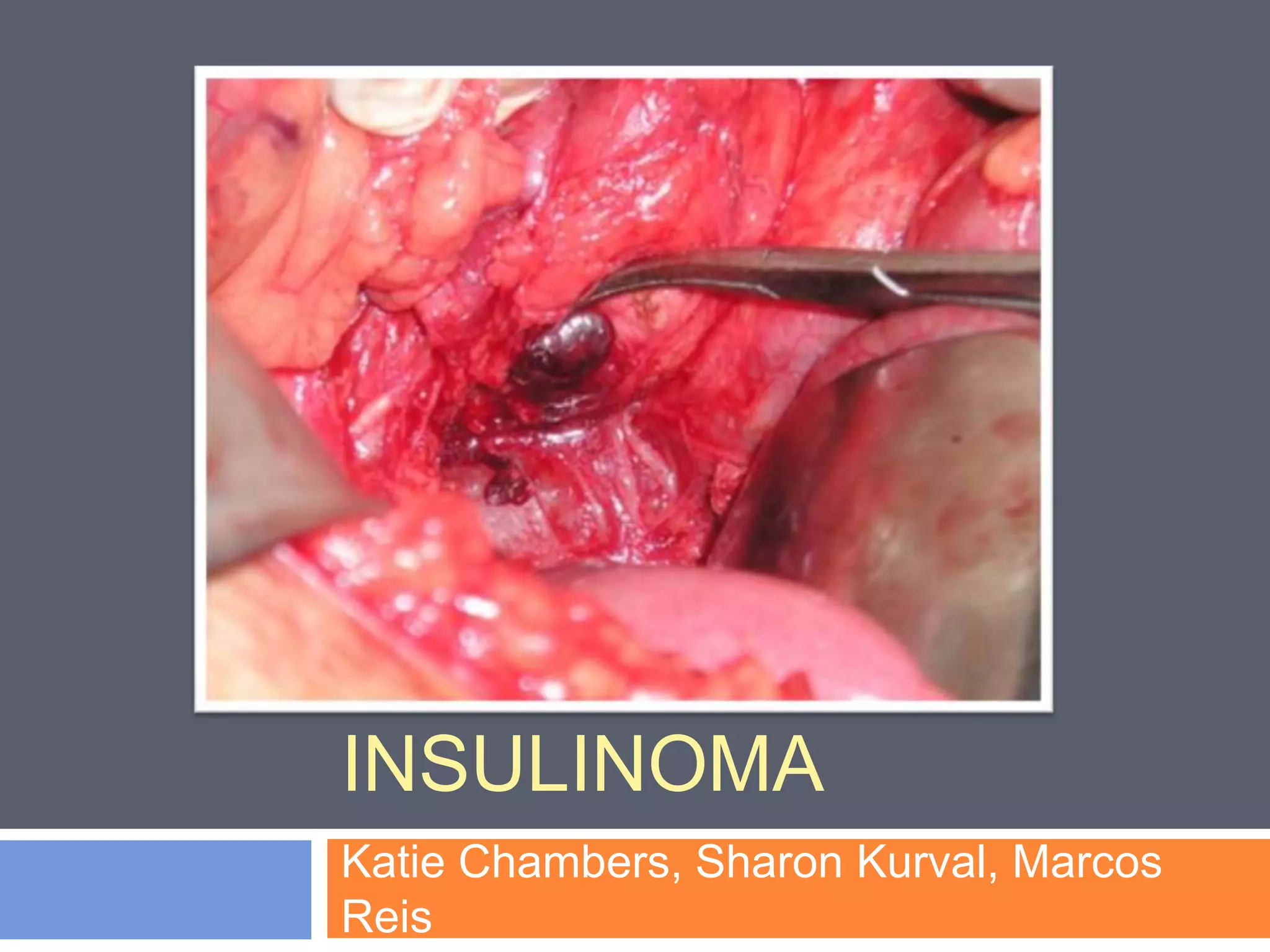
INSULINOMA
Katie Chambers, Sharon Kurval, Marcos
Reis
INSULINOMA
   Insulinomas are the most common tumors
    arising from the pancreatic islets of
    Langerhans
   Although most insulinomas are in the
    pancreas, distinguishing the location of the
    tumors is difficult at diagnosis
   The highest incidence is in people between 40
    and 60 years of age, and women are affected
    slightly more often than men.
SYMPTOMS
   Anxiety
   Weight Gain (patient can become
    excessively obese)
   Behavior Changes
   Clouded Vision
   Confusion
   Convulsions
   Dizziness
   Headache
   Hunger
   Loss of Consciousness
   Rapid Heart Rate
   Sweating
   Tremor
CAUSES
   Insulinoma is a tumor found in the pancreas
    that continues to produce insulin even when
    your blood sugar drops too low
   High blood insulin levels cause low blood
    sugar levels called Hypoglycemia
   Hypogycemia may be mild, leading to
    symptoms such as anxiety and hunger or it
    can be severe, leading to seizures, coma and
    even death
THE PANCREAS
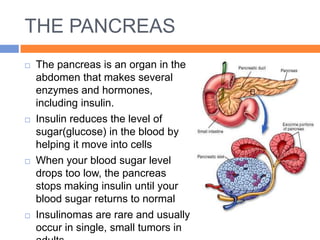
   The pancreas is an organ in the
    abdomen that makes several
    enzymes and hormones,
    including insulin.
   Insulin reduces the level of
    sugar(glucose) in the blood by
    helping it move into cells
   When your blood sugar level
    drops too low, the pancreas
    stops making insulin until your
    blood sugar returns to normal
   Insulinomas are rare and usually
    occur in single, small tumors in
EXAMS AND TESTS
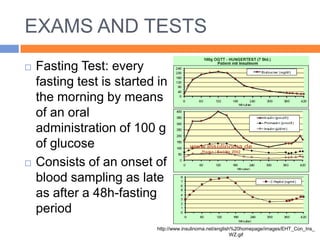
   Fasting Test: every
    fasting test is started in
    the morning by means
    of an oral
    administration of 100 g
    of glucose
   Consists of an onset of
    blood sampling as late
    as after a 48h-fasting
    period
                           http://www.insulinoma.net/english%20homepage/images/EHT_Con_Ins_
                                                            WZ.gif
EXAMS AND TESTS
   After fasting, your blood may be tested for:
       Blood C-peptide level
       Blood glucose level
       Blood insulin level
       Drugs that cause the pancreas to release insulin
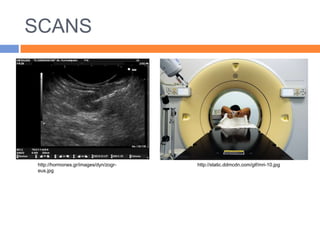
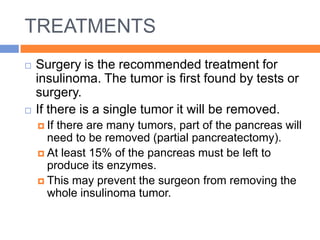
   CT or MRI scan of the abdomen may be done to
    look for a tumor in the pancreas. If the test is
    negative, one of the following tests may be
    performed:
       Endoscopic ultrasound
       Octreotide Scan
       Pancreatic Arteriography
       Pancreatic venous sampling for insulin
SCANS


http://hormones.gr/images/dyn/zogr-   http://static.ddmcdn.com/gif/mri-10.jpg
eus.jpg
TREATMENTS
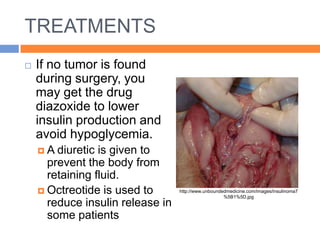
   Surgery is the recommended treatment for
    insulinoma. The tumor is first found by tests or
    surgery.
   If there is a single tumor it will be removed.
     Ifthere are many tumors, part of the pancreas will
      need to be removed (partial pancreatectomy).
     At least 15% of the pancreas must be left to
      produce its enzymes.
     This may prevent the surgeon from removing the
      whole insulinoma tumor.
TREATMENTS
   If no tumor is found
    during surgery, you
    may get the drug
    diazoxide to lower
    insulin production and
    avoid hypoglycemia.
    A  diuretic is given to
      prevent the body from
      retaining fluid.
     Octreotide is used to       http://www.unboundedmedicine.com/images/insulinoma7
                                                     %5B1%5D.jpg
      reduce insulin release in
      some patients
HISTORY
   Historically, the three components of
    insulinoma
     1) symptoms of hypoglycemia
     2) documented plasma glucose of less than 50
      mg/dL at the time of hypoglycemic symptoms
     3) relief of these symptoms with administration of
      glucose has been referred to as Whipple's triad.
WORKS CITED
   The New York Times. (2010). Insulinoma. Retrieved February 21, 2012, from
    http://health.nytimes.com/health/guides/disease/insulinoma/overview.html
   Medline Plus. (2012). Insulinoma. Retrieved February 21, 2012, from
    http://www.nlm.nih.gov/medlineplus/ency/article/000387.htm
   Center for Pancreatic and Bilary Disorders. (2002). Insulinoma. Retrieved February
    21, 2012, from
    http://www.surgery.usc.edu/divisions/tumor/pancreasdiseases/web%20pages/Endocr
    ine%20tumors/pancreatic%20tumors/insulinoma.html
   UpToDate. (2012). Insulinoma. Retrieved February 21, 2012, from
    http://www.uptodate.com/contents/insulinoma
   Insulinoma UK. (2011). What is an insulinoma?. Retrieved February 21, 2012, from
    http://www.insulinoma.co.uk/page_1218566549343.html
   eHow. (2011). How to Diagnose Insulinoma. Retrieved February 22, 2012, from
    http://www.ehow.com/how_2086786_diagnose-insulinoma.html
   Medscape Reference. (2012). Insulinoma Treatment & Management. Retrieved
    February 22, 2012, from http://emedicine.medscape.com/article/283039-overview
   University of Maryland Medical Center. (2010). Insulinoma – Treatment. Retrieved
    February 22, 2012, from http://www.umm.edu/ency/article/000387trt.htm
Insulinoma slideshow

Insulinoma slideshow

  • 1.
  • 2.
    INSULINOMA  Insulinomas are the most common tumors arising from the pancreatic islets of Langerhans  Although most insulinomas are in the pancreas, distinguishing the location of the tumors is difficult at diagnosis  The highest incidence is in people between 40 and 60 years of age, and women are affected slightly more often than men.
  • 3.
    SYMPTOMS  Anxiety  Weight Gain (patient can become excessively obese)  Behavior Changes  Clouded Vision  Confusion  Convulsions  Dizziness  Headache  Hunger  Loss of Consciousness  Rapid Heart Rate  Sweating  Tremor
  • 4.
    CAUSES  Insulinoma is a tumor found in the pancreas that continues to produce insulin even when your blood sugar drops too low  High blood insulin levels cause low blood sugar levels called Hypoglycemia  Hypogycemia may be mild, leading to symptoms such as anxiety and hunger or it can be severe, leading to seizures, coma and even death
  • 5.
    THE PANCREAS  The pancreas is an organ in the abdomen that makes several enzymes and hormones, including insulin.  Insulin reduces the level of sugar(glucose) in the blood by helping it move into cells  When your blood sugar level drops too low, the pancreas stops making insulin until your blood sugar returns to normal  Insulinomas are rare and usually occur in single, small tumors in
  • 6.
    EXAMS AND TESTS  Fasting Test: every fasting test is started in the morning by means of an oral administration of 100 g of glucose  Consists of an onset of blood sampling as late as after a 48h-fasting period http://www.insulinoma.net/english%20homepage/images/EHT_Con_Ins_ WZ.gif
  • 7.
    EXAMS AND TESTS  After fasting, your blood may be tested for:  Blood C-peptide level  Blood glucose level  Blood insulin level  Drugs that cause the pancreas to release insulin  CT or MRI scan of the abdomen may be done to look for a tumor in the pancreas. If the test is negative, one of the following tests may be performed:  Endoscopic ultrasound  Octreotide Scan  Pancreatic Arteriography  Pancreatic venous sampling for insulin
  • 8.
    SCANS http://hormones.gr/images/dyn/zogr- http://static.ddmcdn.com/gif/mri-10.jpg eus.jpg
  • 9.
    TREATMENTS  Surgery is the recommended treatment for insulinoma. The tumor is first found by tests or surgery.  If there is a single tumor it will be removed.  Ifthere are many tumors, part of the pancreas will need to be removed (partial pancreatectomy).  At least 15% of the pancreas must be left to produce its enzymes.  This may prevent the surgeon from removing the whole insulinoma tumor.
  • 10.
    TREATMENTS  If no tumor is found during surgery, you may get the drug diazoxide to lower insulin production and avoid hypoglycemia. A diuretic is given to prevent the body from retaining fluid.  Octreotide is used to http://www.unboundedmedicine.com/images/insulinoma7 %5B1%5D.jpg reduce insulin release in some patients
  • 11.
    HISTORY  Historically, the three components of insulinoma  1) symptoms of hypoglycemia  2) documented plasma glucose of less than 50 mg/dL at the time of hypoglycemic symptoms  3) relief of these symptoms with administration of glucose has been referred to as Whipple's triad.
  • 12.
    WORKS CITED  The New York Times. (2010). Insulinoma. Retrieved February 21, 2012, from http://health.nytimes.com/health/guides/disease/insulinoma/overview.html  Medline Plus. (2012). Insulinoma. Retrieved February 21, 2012, from http://www.nlm.nih.gov/medlineplus/ency/article/000387.htm  Center for Pancreatic and Bilary Disorders. (2002). Insulinoma. Retrieved February 21, 2012, from http://www.surgery.usc.edu/divisions/tumor/pancreasdiseases/web%20pages/Endocr ine%20tumors/pancreatic%20tumors/insulinoma.html  UpToDate. (2012). Insulinoma. Retrieved February 21, 2012, from http://www.uptodate.com/contents/insulinoma  Insulinoma UK. (2011). What is an insulinoma?. Retrieved February 21, 2012, from http://www.insulinoma.co.uk/page_1218566549343.html  eHow. (2011). How to Diagnose Insulinoma. Retrieved February 22, 2012, from http://www.ehow.com/how_2086786_diagnose-insulinoma.html  Medscape Reference. (2012). Insulinoma Treatment & Management. Retrieved February 22, 2012, from http://emedicine.medscape.com/article/283039-overview  University of Maryland Medical Center. (2010). Insulinoma – Treatment. Retrieved February 22, 2012, from http://www.umm.edu/ency/article/000387trt.htm