INFECTION PREVENTION,
STANDARD SAFETY
MEASURES & BIO-MEDICAL
WASTE MANAGEMENT
TOPIC
 Infection prevention and control is the
discipline concerned with preventing
nosocomial or healthcare-associated
infection.
INFECTION PREVENTION AND
CONTROL
 An infection is the entry and
multiplication of an infectious agent in
the tissues of the host infectious agent
may be bacteria viruses, fungus,
spirochete or other microorganisms
capable of producing infection under
favorable circumstances of host, and
the environment.
DEFINITION OF INFECTION
AGENT
 Biological agent: fungi, bacteria, protozoa, viruses, etc.
 Nutrient agent: protein, fat, carbohydrates, vitamins,
minerals and water. Any excess or deficiency of the
nutritive elements may result in nutritional disorders like
PEM, anemia, goiter, obesity, etc.
 Physical agent: exposure to excessive heat, cold, pressure,
radiation, electricity may result in illness.
 Chemical agents
 Mechanical agent
 Social agent
EPIDEMIOLOGY OF INFECTION
Host:
 i. Demographic characteristics: age, sex, race.
 ii. Biological characteristics: genetic factor, blood
group, enzymes, immunological factors etc.
 iii. Socio-economic characteristics: economic status,
social class, religion, education, occupation, marital
status, housing, etc.
 iv. Lifestyle
Cont.
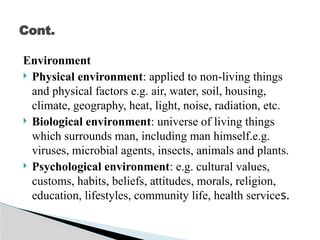
Environment
 Physical environment: applied to non-living things
and physical factors e.g. air, water, soil, housing,
climate, geography, heat, light, noise, radiation, etc.
 Biological environment: universe of living things
which surrounds man, including man himself.e.g.
viruses, microbial agents, insects, animals and plants.
 Psychological environment: e.g. cultural values,
customs, habits, beliefs, attitudes, morals, religion,
education, lifestyles, community life, health services.
Cont.
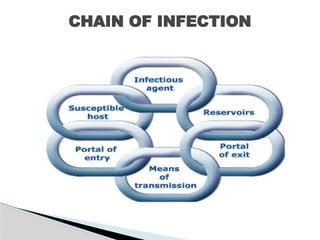
CHAIN OF INFECTION
 STAFF
 CLIENT
 COMMUNITY
WHO IS AT RISK OF
INFECTION?
TIME FRAME OF HEALTH CARE
ASSOCIATED INFECTIONS
 48 hours after hospital admission
 up to 3 days after discharge
 up to 30 days after an operations
HEALTH CARE ASSOCIATED INFECTIONS
 Infection Prevention Practices: As per CDC implementing
good quality of care & following evidence-based infection
prevention measures can prevent up to 70% of HAIs.
 Sepsis is responsible for long term morbidity &
handicapped conditions and an important cause of death.
Prevention of infection is more cost effective than treating
Sepsis
 Break the Chain of Transmission
 Control of Antimicrobial Resistance (AMR
 Protection of Healthcare Workers
IMPORTANCE OF INFECTION
PREVENTION AND CONTROL
 General Urinary Tract Infections (UTIs)
 Catheter-associated Urinary Tract Infections
(CAUTI)
 Central Line-associated Bloodstream Infection
(CLABSI)
 Ventilator-associated Pneumonia (VAP)
 Surgical Site Infections (SSI)
 Skin and Soft Tissue Infections
 Septicemia
 Other sites Infections, e.g., Eye, ENT etc.
COMMON HEALTH CARE ASSOCIATED
INFECTIONS
 Breaking the Chain 1of Infection
 Breaking the Chain 2 of Infection
 Breaking the Chain 3 of Infection
 Breaking the Chain 4 of Infection
 Breaking the Chain 5 of Infection
 Breaking the Chain 6 of Infection
INFECTION PREVENTION
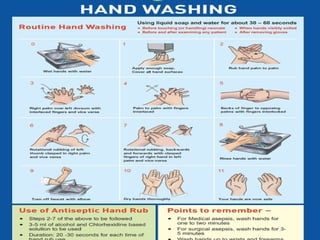
 HAND HYGIENE
 USE OF PERSONAL PROTECTIVE
EQUIPMENT
 APPROPRIATE HANDLING OF PATIENT CARE
EQUIPMENT, INSTRUMENTS AND LINEN
 SAFE HANDLING OF BIO MEDICALAND
HAZARDOUS WASTE
 DISINFECTION, ENVIRONMENT CLEANING
AND SPILL MANAGEMENT
STANDARD SAFETY MEASURES
OR STANDARD PRECAUTION
Additional precautions are needed to control
transmission based infections. These additional
precautions are
 Airborne Precaution
 Droplet Precautions and
 Contact Precautions
ADDITIONAL PRECAUTION
 Healthcare workers who provide direct care to patients and
who work in situations where they may have contact with
blood, body fluids, excretions or secretions
 Support staff including medical aides, cleaners, and laundry
staff in situations where they may have contact with blood,
body fluids, secretions and excretions
 Laboratory staff, who handle patient specimens
 Waste handlers
 Family members who provide care to patients and are in a
situation where they may have contact with blood, body fluids,
secretions and excretions.
INDICATIONS FOR USE OF PPE
 PPE should be chosen according to the risk of exposure.
 Avoid any contact between contaminated (used) PPE and
surfaces, clothing or people outside the patient care area
 Discard the used PPE in appropriate disposal bags, and
dispose off as per BMW Rules
 Do not share personal protective equipment
 Change PPE completely and thoroughly and wash hands
each time one leaves a patient to attend to another patient
or another duty
PRINCIPLES FOR USE OF PPE
Shoe cover
DONNING OF PPE
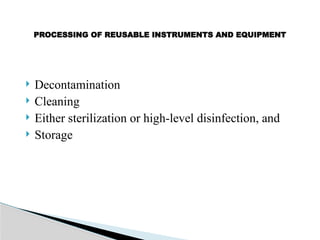
 Decontamination
 Cleaning
 Either sterilization or high-level disinfection, and
 Storage
PROCESSING OF REUSABLE INSTRUMENTS AND EQUIPMENT
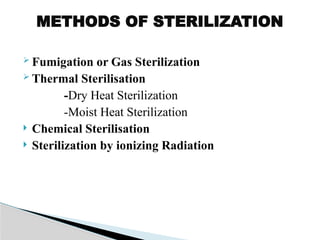
 Fumigation or Gas Sterilization
 Thermal Sterilisation
-Dry Heat Sterilization
-Moist Heat Sterilization
 Chemical Sterilisation
 Sterilization by ionizing Radiation
METHODS OF STERILIZATION
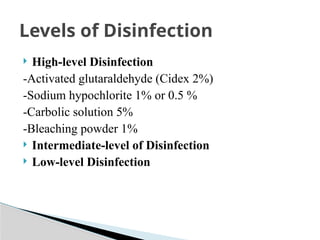
 High-level Disinfection
-Activated glutaraldehyde (Cidex 2%)
-Sodium hypochlorite 1% or 0.5 %
-Carbolic solution 5%
-Bleaching powder 1%
 Intermediate-level of Disinfection
 Low-level Disinfection
Levels of Disinfection
 Medical Superintendent/Medical Officer In-charge- Chairperson
 Nursing in charge/Infection Control Nurse- Convener
 Physician/Microbiologist with knowledge of infection control-
Member Secretary. This person will also be designated as Infection
Control Officer.
 Surgeon
 Blood Bank In-charge
 OT/ICU In-charge
 Lab technician
 Hospital Manager/Quality Manager
 Chief Pharmacist
 Housekeeping In-charge
HOSPITAL INFECTION CONTROL COMMITTEE
 To develop and approve infection control policies and
implement infection control practices in the hospital
 To ensure periodic microbiological surveillance
collection and analysis of data related to HAIs
 Checking the efficacy of the methods of disinfection
and sterilization
 To direct resources to address problems identified
for effective management of infection control
programme
 To ensure availability of appropriate supplies needed
for infection control at the facility
Responsibilities of Infection Control
Committee
 To facilitate and support the training of staff related to
housekeeping and infection control
 To monitor proper segregation and storage of BMW
 To coordinate and monitor waste disposal services provided by
common treatment facility provider
 To ensure periodic medical check-up and immunization of staff
 To develop and implement SOPs on cleanliness and infection
control
 To facilitate development of antibiotic policy for the hospital
 To submit monthly reports to the district and/or state level as
required
Cont.
 Spectrum of antibiotic activity
 Pharmacokinetics/pharmacodynamics of these
medicines
 Adverse effects
 Potential to select resistance
 Analysis of the results of culture sensitivity tests
done on patient samples (this is one of the most
important inputs)
 Cost
 Special needs of individual patient groups
Needs of Antibiotic Policy
 Antibiotic use data is analysed on quarterly basis
based on the hospital records
 Standard treatment guidelines
 Periodic Prescription audits
 Review of surveillance data generated from
antibiograms and prescription auditing
 Education and training for all infection control
activities in collaboration with the hospital infection
control committee.
General principles ofantibiotic
policy
 The bio medical waste as defined by the BMW Rules,
2016 is any waste which is generated during the of
diagnosis, treatment and immunization of human
beings or any research activities pertaining thereto or
in the production or testing of biological or in the
health camps.
DEFINITION OF BIO-MEDICAL
WASTE
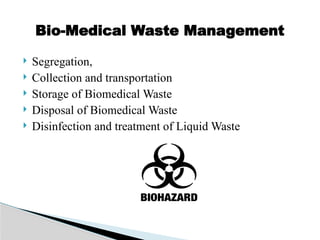
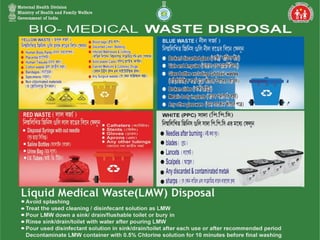
 Segregation,
 Collection and transportation
 Storage of Biomedical Waste
 Disposal of Biomedical Waste
 Disinfection and treatment of Liquid Waste
Bio-Medical Waste Management
ROLE OF NURSE IN INFECTION CONTROL
 Potter P A, Perry AG. Basic Nursing.7th
edition. New Delhi:
Elsevier Publishers:2010.Page no.227-256
 Brar NK, Rawat HC. Text Book of Advance Nursing Practice.1st
edition. Delhi: Jaypee Brothers Medical Publishers(p)Ltd:2015.
Page 507-532
 Baseer S P. A concise textbook of Advance Nursing Practice. 3rd
edition. Bangalore : EMMESS Publishers:2022.Page no 342-358
 Ministry of Health & Family welfare, Govt of India. Guidelines
for implementation of KAYAKALP initiative. 2018. Page 55-122
Bibliography
infection prevention and control PPT.pptx

infection prevention and control PPT.pptx

  • 3.
    INFECTION PREVENTION, STANDARD SAFETY MEASURES& BIO-MEDICAL WASTE MANAGEMENT TOPIC
  • 4.
     Infection preventionand control is the discipline concerned with preventing nosocomial or healthcare-associated infection. INFECTION PREVENTION AND CONTROL
  • 5.
     An infectionis the entry and multiplication of an infectious agent in the tissues of the host infectious agent may be bacteria viruses, fungus, spirochete or other microorganisms capable of producing infection under favorable circumstances of host, and the environment. DEFINITION OF INFECTION
  • 6.
    AGENT  Biological agent:fungi, bacteria, protozoa, viruses, etc.  Nutrient agent: protein, fat, carbohydrates, vitamins, minerals and water. Any excess or deficiency of the nutritive elements may result in nutritional disorders like PEM, anemia, goiter, obesity, etc.  Physical agent: exposure to excessive heat, cold, pressure, radiation, electricity may result in illness.  Chemical agents  Mechanical agent  Social agent EPIDEMIOLOGY OF INFECTION
  • 7.
    Host:  i. Demographiccharacteristics: age, sex, race.  ii. Biological characteristics: genetic factor, blood group, enzymes, immunological factors etc.  iii. Socio-economic characteristics: economic status, social class, religion, education, occupation, marital status, housing, etc.  iv. Lifestyle Cont.
  • 8.
    Environment  Physical environment:applied to non-living things and physical factors e.g. air, water, soil, housing, climate, geography, heat, light, noise, radiation, etc.  Biological environment: universe of living things which surrounds man, including man himself.e.g. viruses, microbial agents, insects, animals and plants.  Psychological environment: e.g. cultural values, customs, habits, beliefs, attitudes, morals, religion, education, lifestyles, community life, health services. Cont.
  • 9.
  • 10.
     STAFF  CLIENT COMMUNITY WHO IS AT RISK OF INFECTION?
  • 11.
    TIME FRAME OFHEALTH CARE ASSOCIATED INFECTIONS  48 hours after hospital admission  up to 3 days after discharge  up to 30 days after an operations HEALTH CARE ASSOCIATED INFECTIONS
  • 12.
     Infection PreventionPractices: As per CDC implementing good quality of care & following evidence-based infection prevention measures can prevent up to 70% of HAIs.  Sepsis is responsible for long term morbidity & handicapped conditions and an important cause of death. Prevention of infection is more cost effective than treating Sepsis  Break the Chain of Transmission  Control of Antimicrobial Resistance (AMR  Protection of Healthcare Workers IMPORTANCE OF INFECTION PREVENTION AND CONTROL
  • 13.
     General UrinaryTract Infections (UTIs)  Catheter-associated Urinary Tract Infections (CAUTI)  Central Line-associated Bloodstream Infection (CLABSI)  Ventilator-associated Pneumonia (VAP)  Surgical Site Infections (SSI)  Skin and Soft Tissue Infections  Septicemia  Other sites Infections, e.g., Eye, ENT etc. COMMON HEALTH CARE ASSOCIATED INFECTIONS
  • 14.
     Breaking theChain 1of Infection  Breaking the Chain 2 of Infection  Breaking the Chain 3 of Infection  Breaking the Chain 4 of Infection  Breaking the Chain 5 of Infection  Breaking the Chain 6 of Infection INFECTION PREVENTION
  • 15.
     HAND HYGIENE USE OF PERSONAL PROTECTIVE EQUIPMENT  APPROPRIATE HANDLING OF PATIENT CARE EQUIPMENT, INSTRUMENTS AND LINEN  SAFE HANDLING OF BIO MEDICALAND HAZARDOUS WASTE  DISINFECTION, ENVIRONMENT CLEANING AND SPILL MANAGEMENT STANDARD SAFETY MEASURES OR STANDARD PRECAUTION
  • 16.
    Additional precautions areneeded to control transmission based infections. These additional precautions are  Airborne Precaution  Droplet Precautions and  Contact Precautions ADDITIONAL PRECAUTION
  • 18.
     Healthcare workerswho provide direct care to patients and who work in situations where they may have contact with blood, body fluids, excretions or secretions  Support staff including medical aides, cleaners, and laundry staff in situations where they may have contact with blood, body fluids, secretions and excretions  Laboratory staff, who handle patient specimens  Waste handlers  Family members who provide care to patients and are in a situation where they may have contact with blood, body fluids, secretions and excretions. INDICATIONS FOR USE OF PPE
  • 19.
     PPE shouldbe chosen according to the risk of exposure.  Avoid any contact between contaminated (used) PPE and surfaces, clothing or people outside the patient care area  Discard the used PPE in appropriate disposal bags, and dispose off as per BMW Rules  Do not share personal protective equipment  Change PPE completely and thoroughly and wash hands each time one leaves a patient to attend to another patient or another duty PRINCIPLES FOR USE OF PPE
  • 20.
  • 21.
     Decontamination  Cleaning Either sterilization or high-level disinfection, and  Storage PROCESSING OF REUSABLE INSTRUMENTS AND EQUIPMENT
  • 22.
     Fumigation orGas Sterilization  Thermal Sterilisation -Dry Heat Sterilization -Moist Heat Sterilization  Chemical Sterilisation  Sterilization by ionizing Radiation METHODS OF STERILIZATION
  • 23.
     High-level Disinfection -Activatedglutaraldehyde (Cidex 2%) -Sodium hypochlorite 1% or 0.5 % -Carbolic solution 5% -Bleaching powder 1%  Intermediate-level of Disinfection  Low-level Disinfection Levels of Disinfection
  • 24.
     Medical Superintendent/MedicalOfficer In-charge- Chairperson  Nursing in charge/Infection Control Nurse- Convener  Physician/Microbiologist with knowledge of infection control- Member Secretary. This person will also be designated as Infection Control Officer.  Surgeon  Blood Bank In-charge  OT/ICU In-charge  Lab technician  Hospital Manager/Quality Manager  Chief Pharmacist  Housekeeping In-charge HOSPITAL INFECTION CONTROL COMMITTEE
  • 25.
     To developand approve infection control policies and implement infection control practices in the hospital  To ensure periodic microbiological surveillance collection and analysis of data related to HAIs  Checking the efficacy of the methods of disinfection and sterilization  To direct resources to address problems identified for effective management of infection control programme  To ensure availability of appropriate supplies needed for infection control at the facility Responsibilities of Infection Control Committee
  • 26.
     To facilitateand support the training of staff related to housekeeping and infection control  To monitor proper segregation and storage of BMW  To coordinate and monitor waste disposal services provided by common treatment facility provider  To ensure periodic medical check-up and immunization of staff  To develop and implement SOPs on cleanliness and infection control  To facilitate development of antibiotic policy for the hospital  To submit monthly reports to the district and/or state level as required Cont.
  • 27.
     Spectrum ofantibiotic activity  Pharmacokinetics/pharmacodynamics of these medicines  Adverse effects  Potential to select resistance  Analysis of the results of culture sensitivity tests done on patient samples (this is one of the most important inputs)  Cost  Special needs of individual patient groups Needs of Antibiotic Policy
  • 28.
     Antibiotic usedata is analysed on quarterly basis based on the hospital records  Standard treatment guidelines  Periodic Prescription audits  Review of surveillance data generated from antibiograms and prescription auditing  Education and training for all infection control activities in collaboration with the hospital infection control committee. General principles ofantibiotic policy
  • 29.
     The biomedical waste as defined by the BMW Rules, 2016 is any waste which is generated during the of diagnosis, treatment and immunization of human beings or any research activities pertaining thereto or in the production or testing of biological or in the health camps. DEFINITION OF BIO-MEDICAL WASTE
  • 30.
     Segregation,  Collectionand transportation  Storage of Biomedical Waste  Disposal of Biomedical Waste  Disinfection and treatment of Liquid Waste Bio-Medical Waste Management
  • 32.
    ROLE OF NURSEIN INFECTION CONTROL
  • 34.
     Potter PA, Perry AG. Basic Nursing.7th edition. New Delhi: Elsevier Publishers:2010.Page no.227-256  Brar NK, Rawat HC. Text Book of Advance Nursing Practice.1st edition. Delhi: Jaypee Brothers Medical Publishers(p)Ltd:2015. Page 507-532  Baseer S P. A concise textbook of Advance Nursing Practice. 3rd edition. Bangalore : EMMESS Publishers:2022.Page no 342-358  Ministry of Health & Family welfare, Govt of India. Guidelines for implementation of KAYAKALP initiative. 2018. Page 55-122 Bibliography