GLASGOW
COMA SCALE
PRESENTED BY
PANKAJ SINGH RANA
NURSE PRACTITIONER
IN CRITICAL CARE
OBJECTIVE
▪ INTRODUCTION
▪ DEFINITION
▪ EYE SCORE
▪ VEERBAL SCORE
▪ MOTOR SCORE
▪ INTERPREATION
▪ SUMMARY
INTRODUCTION
▪ The scale was published in 1974 by Graham
Teasdale and Bryan J. Jennett, professors of neurosurgery at
the University of Glasgow's Institute of Neurological Sciences
at the city's Southern General Hospital.
▪ A patient is assessed against the criteria of the scale, and the
resulting points give a patient score between 3 (indicating
deep unconsciousness) to 15 ( full consciousness).
DEFINITION
▪ The Glasgow coma scale (GCS) is
a neurological scale which aims to give a reliable
way of recording the conscious state of a person.
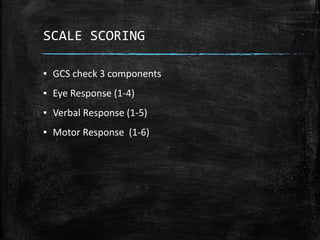
SCALE SCORING
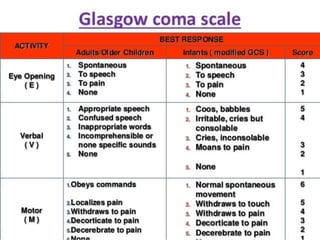
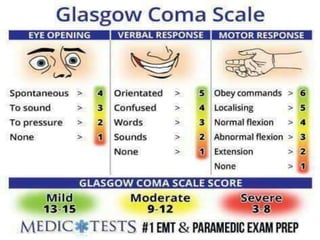
▪ GCS check 3 components
▪ Eye Response (1-4)
▪ Verbal Response (1-5)
▪ Motor Response (1-6)
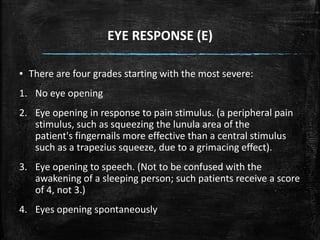
EYE RESPONSE (E)
▪ There are four grades starting with the most severe:
1. No eye opening
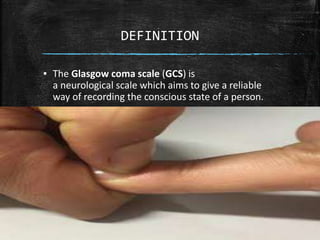
2. Eye opening in response to pain stimulus. (a peripheral pain
stimulus, such as squeezing the lunula area of the
patient's fingernails more effective than a central stimulus
such as a trapezius squeeze, due to a grimacing effect).
3. Eye opening to speech. (Not to be confused with the
awakening of a sleeping person; such patients receive a score
of 4, not 3.)
4. Eyes opening spontaneously
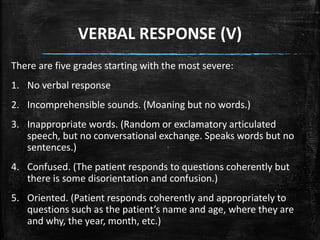
VERBAL RESPONSE (V)
There are five grades starting with the most severe:
1. No verbal response
2. Incomprehensible sounds. (Moaning but no words.)
3. Inappropriate words. (Random or exclamatory articulated
speech, but no conversational exchange. Speaks words but no
sentences.)
4. Confused. (The patient responds to questions coherently but
there is some disorientation and confusion.)
5. Oriented. (Patient responds coherently and appropriately to
questions such as the patient’s name and age, where they are
and why, the year, month, etc.)
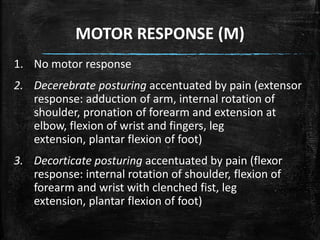
MOTOR RESPONSE (M)
1. No motor response
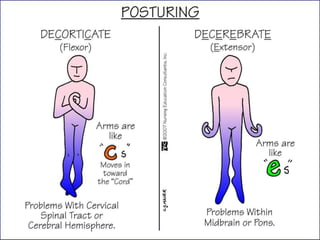
2. Decerebrate posturing accentuated by pain (extensor
response: adduction of arm, internal rotation of
shoulder, pronation of forearm and extension at
elbow, flexion of wrist and fingers, leg
extension, plantar flexion of foot)
3. Decorticate posturing accentuated by pain (flexor
response: internal rotation of shoulder, flexion of
forearm and wrist with clenched fist, leg
extension, plantar flexion of foot)
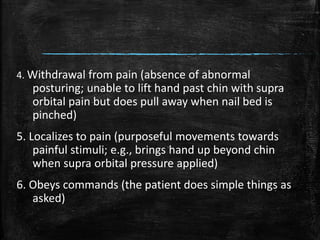
4. Withdrawal from pain (absence of abnormal
posturing; unable to lift hand past chin with supra
orbital pain but does pull away when nail bed is
pinched)
5. Localizes to pain (purposeful movements towards
painful stimuli; e.g., brings hand up beyond chin
when supra orbital pressure applied)
6. Obeys commands (the patient does simple things as
asked)
INTERPRETATION
Generally, brain injury is classified as:
▪ Severe, GCS < 8–9
▪ Moderate, GCS 8 or 9–12 (controversial)
▪ Minor, GCS ≥ 13.
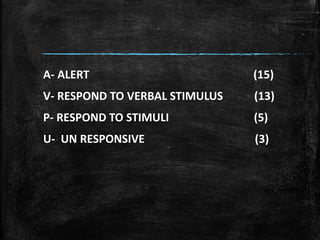
A- ALERT (15)
V- RESPOND TO VERBAL STIMULUS (13)
P- RESPOND TO STIMULI (5)
U- UN RESPONSIVE (3)
LIMITATION
▪ Tracheal intubation and severe facial/eye swelling or damage
make it impossible to test the verbal and eye responses.
▪ In these circumstances, the score is given as 1 with a modifier
attached (e.g. "E1c", where "c" = closed, or "V1t" where t =
tube). Often the 1 is left out, so the scale reads Ec or Vt.
▪ The GCS has limited applicability to children, especially below the
age of 36 months (where the verbal performance of even a
healthy child would be expected to be poor).
Gcs( GLASGOW COMA SCALE)

Gcs( GLASGOW COMA SCALE)

  • 1.
    GLASGOW COMA SCALE PRESENTED BY PANKAJSINGH RANA NURSE PRACTITIONER IN CRITICAL CARE
  • 2.
    OBJECTIVE ▪ INTRODUCTION ▪ DEFINITION ▪EYE SCORE ▪ VEERBAL SCORE ▪ MOTOR SCORE ▪ INTERPREATION ▪ SUMMARY
  • 3.
    INTRODUCTION ▪ The scalewas published in 1974 by Graham Teasdale and Bryan J. Jennett, professors of neurosurgery at the University of Glasgow's Institute of Neurological Sciences at the city's Southern General Hospital. ▪ A patient is assessed against the criteria of the scale, and the resulting points give a patient score between 3 (indicating deep unconsciousness) to 15 ( full consciousness).
  • 4.
    DEFINITION ▪ The Glasgowcoma scale (GCS) is a neurological scale which aims to give a reliable way of recording the conscious state of a person.
  • 5.
    SCALE SCORING ▪ GCScheck 3 components ▪ Eye Response (1-4) ▪ Verbal Response (1-5) ▪ Motor Response (1-6)
  • 7.
    EYE RESPONSE (E) ▪There are four grades starting with the most severe: 1. No eye opening 2. Eye opening in response to pain stimulus. (a peripheral pain stimulus, such as squeezing the lunula area of the patient's fingernails more effective than a central stimulus such as a trapezius squeeze, due to a grimacing effect). 3. Eye opening to speech. (Not to be confused with the awakening of a sleeping person; such patients receive a score of 4, not 3.) 4. Eyes opening spontaneously
  • 8.
    VERBAL RESPONSE (V) Thereare five grades starting with the most severe: 1. No verbal response 2. Incomprehensible sounds. (Moaning but no words.) 3. Inappropriate words. (Random or exclamatory articulated speech, but no conversational exchange. Speaks words but no sentences.) 4. Confused. (The patient responds to questions coherently but there is some disorientation and confusion.) 5. Oriented. (Patient responds coherently and appropriately to questions such as the patient’s name and age, where they are and why, the year, month, etc.)
  • 9.
    MOTOR RESPONSE (M) 1.No motor response 2. Decerebrate posturing accentuated by pain (extensor response: adduction of arm, internal rotation of shoulder, pronation of forearm and extension at elbow, flexion of wrist and fingers, leg extension, plantar flexion of foot) 3. Decorticate posturing accentuated by pain (flexor response: internal rotation of shoulder, flexion of forearm and wrist with clenched fist, leg extension, plantar flexion of foot)
  • 11.
    4. Withdrawal frompain (absence of abnormal posturing; unable to lift hand past chin with supra orbital pain but does pull away when nail bed is pinched) 5. Localizes to pain (purposeful movements towards painful stimuli; e.g., brings hand up beyond chin when supra orbital pressure applied) 6. Obeys commands (the patient does simple things as asked)
  • 13.
    INTERPRETATION Generally, brain injuryis classified as: ▪ Severe, GCS < 8–9 ▪ Moderate, GCS 8 or 9–12 (controversial) ▪ Minor, GCS ≥ 13.
  • 14.
    A- ALERT (15) V-RESPOND TO VERBAL STIMULUS (13) P- RESPOND TO STIMULI (5) U- UN RESPONSIVE (3)
  • 15.
    LIMITATION ▪ Tracheal intubationand severe facial/eye swelling or damage make it impossible to test the verbal and eye responses. ▪ In these circumstances, the score is given as 1 with a modifier attached (e.g. "E1c", where "c" = closed, or "V1t" where t = tube). Often the 1 is left out, so the scale reads Ec or Vt. ▪ The GCS has limited applicability to children, especially below the age of 36 months (where the verbal performance of even a healthy child would be expected to be poor).