YASHWANT RAMAWAT
RAK COLLEGE OF NURSING
NEW DELHI
It is a more comprehensive term
that is defined the use of
information technologies with
information management concept
and methods to support the
delivery of health care. It includes
the medical , nursing , dental, and
pharmacy informatics as well as all
other health care deciplines.
American nurses association has
defined it as ‘ the development
and evaluation of applications,
tools, processes, and structures
which assist nurses with the
management of data in taking
care of patients or supporting
the practice of nursing’.
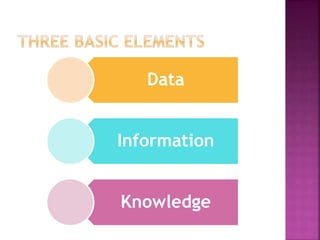
Data
Information
Knowledge
Data: it is defined as raw and
unstructured facts.
Information : it consists of data that
have been given form and have been
interpreted.
Knowledge : it takes the process one
step further because it is synthesis of
data and information.
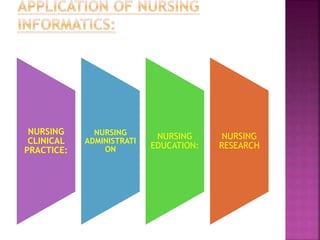
NURSING
CLINICAL
PRACTICE:
NURSING
ADMINISTRATI
ON
NURSING
EDUCATION:
NURSING
RESEARCH
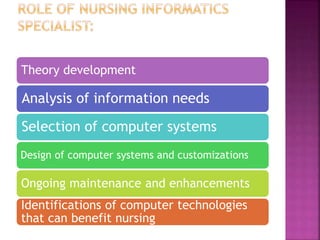
Theory development
Analysis of information needs
Selection of computer systems
Design of computer systems and customizations
Ongoing maintenance and enhancements
Identifications of computer technologies
that can benefit nursing
 Technology- is the collection of
techniques, skills, methods and processes
used in the production of goods or services or
in the accomplishment of objectives, such as
scientific investigation. Technology can be
the knowledge of techniques, processes, etc.
or it can be embedded in machines,
computers, devices and factories, which can
be operated by individuals without detailed
knowledge of the workings of such things.
 There are a number of activities within clinical
research that CRI supports, including:
 more efficient and effective data collection and
acquisition
 improved recruitment into clinical trials
 optimal protocol design and efficient
management
 patient recruitment and management
 adverse event reporting
 regulatory compliance
 data storage, transfer, processing and analysis
 repositories of data from completed clinical
trials (for secondary analyses)
 Nursing Informatics is the "science and
practice (that) integrates nursing, its
information and knowledge, with
management of information and
communication technologies to promote the
health of people, families, and communities
worldwide." (IMIA Special Interest Group on
Nursing Informatics 2009). The application of
nursing informatics knowledge is empowering
for all healthcare practitioners in achieving
patient centered care.
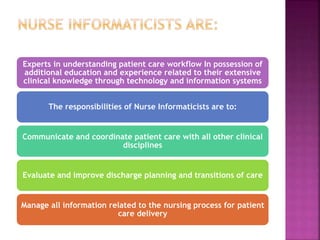
Experts in understanding patient care workflow In possession of
additional education and experience related to their extensive
clinical knowledge through technology and information systems
The responsibilities of Nurse Informaticists are to:
Communicate and coordinate patient care with all other clinical
disciplines
Evaluate and improve discharge planning and transitions of care
Manage all information related to the nursing process for patient
care delivery
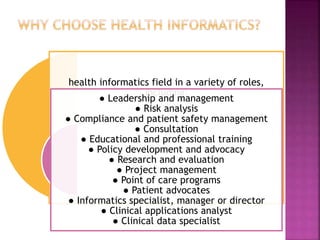
health informatics field in a variety of roles,
including:
● Leadership and management
● Risk analysis
● Compliance and patient safety management
● Consultation
● Educational and professional training
● Policy development and advocacy
● Research and evaluation
● Project management
● Point of care programs
● Patient advocates
● Informatics specialist, manager or director
● Clinical applications analyst
● Clinical data specialist
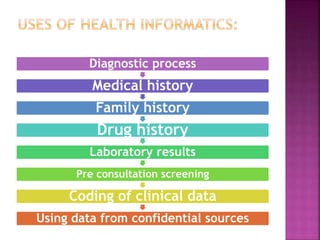
Diagnostic process
Medical history
Family history
Drug history
Laboratory results
Pre consultation screening
Coding of clinical data
Using data from confidential sources
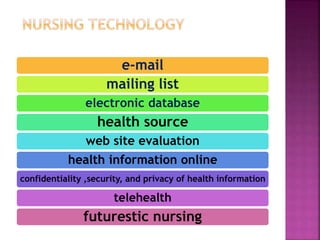
e-mail
mailing list
electronic database
health source
web site evaluation
health information online
confidentiality ,security, and privacy of health information
telehealth
futurestic nursing
 Email is a system for sending and
receiving a digital message over a
computer network, between two
personal computers. An email
message contains two sections, the
header and the body of the email.
The header contains the sender’s
address, the receiver’s address, the
subject heading, and attachments, if
included. The body of the email
contains the main message and the
signature block.
 appointment schedules (booking,
cancelling, and automated
reminders),
 billing questions,
 health questions for the nurses,
 prescription refills,
 referrals or non-urgent consults,
 test results, sick note renewals,
 preventative health care reminders,
counseling, and education
 A mailing list is simply a list of e-mail addresses
of people that are interested in the same
subject, are members of the same work group,
or who are taking class together.
 When a member of the list sends a note to the
group's special address, the e-mail is broadcast
to all of the members of the list.
 The key advantage of a mailing list over a things
such as web-based discussion is that as new
message becomes available they are
immediately delivered to the participants'
mailboxes.
 A mailing list sometime can also include
information such as phone number, postal
address, fax number and more.
 An increasing number of database are
available over the internet and can be
accessed through local libraries or by
subscripltion from a vendor which provide
access to online databases and e-journals.
 Scholarly journal articles about nursing and
allied health. Includes nursing interventions,
management, education, theory, and history.
Also includes allied health topics such as
physical and occupational therapy.
 CINAHL with Full Text
(Cumulative Index to Nursing
& Allied Health Literature)
indexes over 950 English-
language nursing and allied
health journals and
publications of the American
Nurses' Association and the
National League for Nursing.
Includes full-text for more
than 580 journals.
 Subjects include:
 Aging
 AIDS
 Cancer
 Diseases
 Healthcare
 Medicine
 Nursing
 Occupational Therapy
 Physical Therapy
 Public Health
 Rehabilitation
 Formerly Medscape Reference has
comprehensive clinical overviews of over 10,
000 conditions, procedures and drugs. Also
contains images and interactive clinical
tools. Access to MedScape Reference requires
creating a free account. Formerly eMedicine.
Please use this newly combined
eMedicine/MedScape Reference. Medscape
Reference has comprehensive clinical
overviews of over 10, 000 conditions,
procedures and drugs. Also contains images
and interactive clinical tools.
 Scholarly articles in psychology, plus
medicine, psychiatry, education, social work,
criminology, social science, business, &
organizational behavior.
 Covers the academic, research and practice
literature -- including journal articles,
dissertations, book chapters, books,
technical reports -- from over 45 countries in
more than 30 languages. From the American
Psychological Association.
Subjects include:
Business (advertising & marketing)
Communication Sciences
Education
Medicine
Psychiatry
Psychology
Sociology
 Nursing/Academic Edition provides
researchers, allied health professionals,
nurses and medical educators with access to
full-text scholarly journals focusing on many
medical disciplines.
 Coverage of nursing and allied health is
particularly strong, including full text from
for more than 355 journals, of which 287 are
peer-reviewed, as well as abstracting and
indexing for more than 830 journals.
 The Education Resources Information
Center (ERIC) is an online digital library of
education research and information.
 ERIC is sponsored by the Institute of
Education Sciences of the United States
Department of Education.
 The mission of ERIC is to provide a
comprehensive, easy-to-use, searchable,
Internet-based bibliographic and full-text
database of education research and
information for educators, researchers, and
the general public
 ERIC provides access to 1.5 million bibliographic
records (citations, abstracts, and other pertinent
data) of journal articles and other education-related
materials, with hundreds of new records added every
week.
 The ERIC Collection, begun in 1966, contains records
for a variety of publication types, including:
 journal articles
 books
 research syntheses
 conference papers
 technical reports
 dissertations
 policy papers, and
 other education-related materials
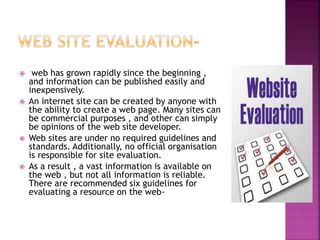
 web has grown rapidly since the beginning ,
and information can be published easily and
inexpensively.
 An internet site can be created by anyone with
the ability to create a web page. Many sites can
be commercial purposes , and other can simply
be opinions of the web site developer.
 Web sites are under no required guidelines and
standards. Additionally, no official organisation
is responsible for site evaluation.
 As a result , a vast information is available on
the web , but not all information is reliable.
There are recommended six guidelines for
evaluating a resource on the web-
 1. AUTHORITY
 Authority reveals that the person, institution or
agency responsible for a site has the
qualifications and knowledge to do so.
Evaluating a web site for authority:
 Authorship: It should be clear who developed the
site.
 Contact information
 Credentials: the author should state
qualifications, credentials, or personal
background .
 Check to see if the site supported by an
organization or a commercial body
 The purpose of the information presented in the
site should be clear. Some sites are meant to
inform, persuade, state an opinion, entertain, or
parody something or someone. Evaluating a web
site for purpose:
 Does the content support the purpose of the
site?
 Is the information geared to a specific audience
(students, scholars, general reader)?
 Is the site organized and focused?
 Are the outside links appropriate for the site?
 Does the site evaluate the links?
 Check the domain of the site. The URL may
indicate its purpose.
 It is difficult to assess the extent of coverage since
depth in a site, through the use of links, can be
infinite. One author may claim comprehensive
coverage of a topic while another may cover just one
aspect of a topic. Evaluating a web site for coverage:
 Does the site claim to be selective or comprehensive?
 Are the topics explored in depth?
 Compare the value of the site’s information
compared to other similar sites.
 Do the links go to outside sites rather than its own?
 Does the site provide information with no relevant
outside links?
 Currency of the site refers to: 1) how current the
information presented is, and 2) how often the site is
updated or maintained. It is important to know when a site
was created, when it was last updated, and if all of the
links are current. Evaluating a web site for currency
involves finding the date information was:
 first written
 placed on the web
 last revised
 Then ask if:
 Links are up-to-date
 Links provided should be reliable. Dead links or references
to sites that have moved are not useful.
 Information provided so trend related that its usefulness is
limited to a certain time period?
 the site been under construction for some time?
 Objectivity of the site should be clear. Beware of
sites that contain bias or do not admit its bias
freely. Objective sites present information with a
minimum of bias. Evaluating a web site for
objectivity:
 Is the information presented with a particular
bias?
 Does the information try to sway the audience?
 Does site advertising conflict with the content?
 Is the site trying to explain, inform, persuade, or
sell something?
 There are few standards to verify the accuracy of
information on the web. It is the responsibility of the
reader to assess the information presented.
Evaluating a web site for accuracy:
 Reliability: Is the author affiliated with a known,
respectable institution?
 References: do statistics and other factual
information receive proper references as to their
origin?
 Does the reading you have already done on the
subject make the information seem accurate?
 Is the information comparable to other sites on the
same topic?
 Does the text follow basic rules of grammar, spelling
and composition?
 Is a bibliography or reference list included?
 There are thousands of medical websites.
Some provide reliable health information.
Some do not. Some of the medical news is
current. Some of it is not. Choosing which
websites to trust is an important part of
using the Internet.
 How Do I Find Reliable Health Information
Online?
 As you search online, you are likely to find
websites for many health agencies and
organizations that are not well-known. By
answering the following questions you should
be able to find more information about these
websites. A lot of these details might be
found under the heading “About Us.”
 Who sponsors/hosts the website? Is that
information easy to find?
 Websites cost money. Is the source of funding
(sponsor) clear? Sometimes the website address
is helpful. For example:
 .gov identifies a india government agency
 .edu identifies an educational institution, like a
school, college, or university
 .org usually identifies nonprofit organizations
(such as professional groups; scientific, medical,
or research societies; advocacy groups)
 .com identifies commercial websites (such as
businesses, pharmaceutical companies, and
sometimes hospitals)
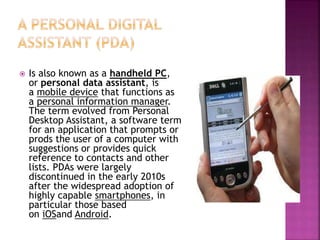
 Is also known as a handheld PC,
or personal data assistant, is
a mobile device that functions as
a personal information manager.
The term evolved from Personal
Desktop Assistant, a software term
for an application that prompts or
prods the user of a computer with
suggestions or provides quick
reference to contacts and other
lists. PDAs were largely
discontinued in the early 2010s
after the widespread adoption of
highly capable smartphones, in
particular those based
on iOSand Android.
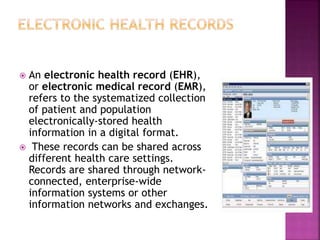
 An electronic health record (EHR),
or electronic medical record (EMR),
refers to the systematized collection
of patient and population
electronically-stored health
information in a digital format.
 These records can be shared across
different health care settings.
Records are shared through network-
connected, enterprise-wide
information systems or other
information networks and exchanges.
 EHRs may include a range of data:
 demographics,
 medical history,
 medication and allergies,
 immunization status,
 laboratory test results,
 radiology images,
 vital signs,
 personal statistics like age and weight,
 and billing information.
 Electronic health records contain significantly
fewer errors than paper records, according to
experts.
 Communication between physicians can be
greatly improved with the use of EHR, allowing
each party full access to a patient’s medical
history rather than a snapshot-type overview
from a current visit. This access allows for a
more in-depth evaluation, and enables doctors
to reach an accurate diagnosis more quickly.
 In addition, electronic health can records make
it easier for doctors to follow up with patients
and track continuing care, both under their
supervision and that of the patient’s other
doctors.
 At the very least, electronic
health records can save time
during a doctor’s office visit.
And in case of emergency,
these records can provide
critical, life-saving
information to emergency
care providers.
 When a patient is under the care of
multiple doctors:
 tracking his or her history, including
allergies, blood type, current
medications, past procedures and other
relevant information, can be problematic
when relying on paper charts.
 The use of electronic health records
allows multiple care providers, regardless
of location, to simultaneously access a
patient’s record from any computer.
 The electronic record can provide up-to-the-
minute information on the patient’s full history,
including current test results and the
recommendations of other physicians, allowing
more efficient collaboration on multiple facets
of a patient’s care.
 nurses can quickly transfer patient data to other
departments or providers, while also reducing
errors, which yield improved results
management. Both patients and employees often
respond positively to these process
improvements, as it can help keep a facility’s
schedule on track.
 less paperwork and fewer storage issues
 increased quality of care
 Financial Incentives
 Increased Efficiency and Productivity
 Better Patient Care
 The challenge of this responsibility has also
increased due to the constantly changing
legislative and regulatory
environment.Regulations have impacted privacy
and security:
 The Health Insurance Portability and
Accountability Act of 1996 (HIPAA)
 The American Recovery and Reinvestment Act of
2009 (ARRA)
 Modifications to the HIPAA Privacy, Security, and
Enforcement Rules the Health Information
Technology for Economic and Clinical Health Act;
Final Rule
 Established pursuant to the broader Health Insurance
Portability and Accountability Act of 1996 (HIPAA), as
described by the U.S. Department of Health and
Human Services (HHS), the Privacy Rule, “…strikes a
balance that permits important uses of information,
while protecting the privacy of people who seek care
and healing”.
 Individuals are provided some elements of control,
such as the right to access their own health
information in most cases and the right to request
amendment of inaccurate health information
(HHSa). However, in that attempt to strike a
balance, the Rule provides numerous exceptions to
use and disclosure of protected health information
without patient authorization, including for
treatment, payment, health organization operations
and for certain public health activities
 Telehealth is the delivery of health-related services
and information via telecommunications
technologies. Telehealth could be as simple as two
health professionals discussing a case over the
telephone or as sophisticated as doing robotic
surgery between facilities at different ends of the
globe.
 Telehealth is an expansion of telemedicine, and
unlike telemedicine (which more narrowly focuses on
the curative aspect) it encompasses preventative,
promotive andcurative aspects. Originally used to
describe administrative or educational functions
related to telemedicine, today telehealth stresses
myriad technology solutions.
Clinical uses
 Transmission of medical images for diagnosis (often
referred to as store and forward telehealth)
 Teleconference between patient and healthcare
provider for assessments and history taking
 Groups or individuals exchanging health services or
education live via videoconference (real-time
telehealth)
 Transmission of medical data for diagnosis or disease
management (sometimes referred to as remote
monitoring)
 Advice on prevention of diseases and promotion of
good health by patient monitoring and followup.
 Health advice by telephone in emergency cases
(referred to as teletriage)
 Distance education including continuing medical
education, grand rounds, and patient education
 administrative uses including meetings among
telehealth networks, supervision, and
presentations
 research on telehealth
 online information and health data management
 healthcare system integration
 asset identification, listing, and patient to asset
matching, and movement
 overall healthcare system management
 patient movement and remote admission
 Examples of real-time clinical telehealth
include:
 Tele-audiology
 Telecardiology
 Teledentistry
 Telebehavioral Health—includes telepsychiatry
 Telehomecare
 Teleneurology
 Telenursing
 Teleradiology
 Telerehabilitation
 trends in futuristic nursing
Service(practice) education
 Practice (nursing care) Research Administration
 Clinical nurse specialist {C.N.S}
 Nurse practitioner {N.P} academic
administration
Adult nurse practitioner
Family nurse practitioner Master’s education
Acute care nurse practitioner
Doctoral programs in nursing
Geriatric nurse practitioner
Bachelor of Science in management/
Pediatric nurse practitioner health care.
 Women’s health nurse practitioner Certificate in
Forensic Nursing
 Certificate in legal nurse consulting
Certified nurse midwife (C.N.M.)
MSN/ Masters of business
Certified registered nurse anesthetist (C.R.N.A.)
administration
 Other areas for practice in service. Master’s of
science in nursing/
Master’s of health administration
Mobile nursing
MSN/ Health care Education
 Space nursing Certified nurse practitioner
 Licensed practical nurse
 Systems and software designed to reduce the
amount of time nurses must spend on tasks such
as tracking down equipment.
 locating and collaborating with other staff
members and updating patient charts.
 technology serves to improve accuracy and
patient safety by reducing medical errors.
 preventing unauthorized people from entering a
facility or accessing sensitive patient records.
 to improved accuracy, efficiency and safety.
 technology also allows nurses to spend more
time on direct patient care.

Health informatics

  • 1.
    YASHWANT RAMAWAT RAK COLLEGEOF NURSING NEW DELHI
  • 2.
    It is amore comprehensive term that is defined the use of information technologies with information management concept and methods to support the delivery of health care. It includes the medical , nursing , dental, and pharmacy informatics as well as all other health care deciplines.
  • 3.
    American nurses associationhas defined it as ‘ the development and evaluation of applications, tools, processes, and structures which assist nurses with the management of data in taking care of patients or supporting the practice of nursing’.
  • 4.
  • 5.
    Data: it isdefined as raw and unstructured facts. Information : it consists of data that have been given form and have been interpreted. Knowledge : it takes the process one step further because it is synthesis of data and information.
  • 6.
  • 7.
    Theory development Analysis ofinformation needs Selection of computer systems Design of computer systems and customizations Ongoing maintenance and enhancements Identifications of computer technologies that can benefit nursing
  • 8.
     Technology- isthe collection of techniques, skills, methods and processes used in the production of goods or services or in the accomplishment of objectives, such as scientific investigation. Technology can be the knowledge of techniques, processes, etc. or it can be embedded in machines, computers, devices and factories, which can be operated by individuals without detailed knowledge of the workings of such things.
  • 9.
     There area number of activities within clinical research that CRI supports, including:  more efficient and effective data collection and acquisition  improved recruitment into clinical trials  optimal protocol design and efficient management  patient recruitment and management  adverse event reporting  regulatory compliance  data storage, transfer, processing and analysis  repositories of data from completed clinical trials (for secondary analyses)
  • 10.
     Nursing Informaticsis the "science and practice (that) integrates nursing, its information and knowledge, with management of information and communication technologies to promote the health of people, families, and communities worldwide." (IMIA Special Interest Group on Nursing Informatics 2009). The application of nursing informatics knowledge is empowering for all healthcare practitioners in achieving patient centered care.
  • 11.
    Experts in understandingpatient care workflow In possession of additional education and experience related to their extensive clinical knowledge through technology and information systems The responsibilities of Nurse Informaticists are to: Communicate and coordinate patient care with all other clinical disciplines Evaluate and improve discharge planning and transitions of care Manage all information related to the nursing process for patient care delivery
  • 12.
    health informatics fieldin a variety of roles, including: ● Leadership and management ● Risk analysis ● Compliance and patient safety management ● Consultation ● Educational and professional training ● Policy development and advocacy ● Research and evaluation ● Project management ● Point of care programs ● Patient advocates ● Informatics specialist, manager or director ● Clinical applications analyst ● Clinical data specialist
  • 13.
    Diagnostic process Medical history Familyhistory Drug history Laboratory results Pre consultation screening Coding of clinical data Using data from confidential sources
  • 14.
    e-mail mailing list electronic database healthsource web site evaluation health information online confidentiality ,security, and privacy of health information telehealth futurestic nursing
  • 15.
     Email isa system for sending and receiving a digital message over a computer network, between two personal computers. An email message contains two sections, the header and the body of the email. The header contains the sender’s address, the receiver’s address, the subject heading, and attachments, if included. The body of the email contains the main message and the signature block.
  • 16.
     appointment schedules(booking, cancelling, and automated reminders),  billing questions,  health questions for the nurses,  prescription refills,  referrals or non-urgent consults,  test results, sick note renewals,  preventative health care reminders, counseling, and education
  • 17.
     A mailinglist is simply a list of e-mail addresses of people that are interested in the same subject, are members of the same work group, or who are taking class together.  When a member of the list sends a note to the group's special address, the e-mail is broadcast to all of the members of the list.  The key advantage of a mailing list over a things such as web-based discussion is that as new message becomes available they are immediately delivered to the participants' mailboxes.  A mailing list sometime can also include information such as phone number, postal address, fax number and more.
  • 18.
     An increasingnumber of database are available over the internet and can be accessed through local libraries or by subscripltion from a vendor which provide access to online databases and e-journals.
  • 19.
     Scholarly journalarticles about nursing and allied health. Includes nursing interventions, management, education, theory, and history. Also includes allied health topics such as physical and occupational therapy.
  • 20.
     CINAHL withFull Text (Cumulative Index to Nursing & Allied Health Literature) indexes over 950 English- language nursing and allied health journals and publications of the American Nurses' Association and the National League for Nursing. Includes full-text for more than 580 journals.
  • 21.
     Subjects include: Aging  AIDS  Cancer  Diseases  Healthcare  Medicine  Nursing  Occupational Therapy  Physical Therapy  Public Health  Rehabilitation
  • 22.
     Formerly MedscapeReference has comprehensive clinical overviews of over 10, 000 conditions, procedures and drugs. Also contains images and interactive clinical tools. Access to MedScape Reference requires creating a free account. Formerly eMedicine. Please use this newly combined eMedicine/MedScape Reference. Medscape Reference has comprehensive clinical overviews of over 10, 000 conditions, procedures and drugs. Also contains images and interactive clinical tools.
  • 23.
     Scholarly articlesin psychology, plus medicine, psychiatry, education, social work, criminology, social science, business, & organizational behavior.  Covers the academic, research and practice literature -- including journal articles, dissertations, book chapters, books, technical reports -- from over 45 countries in more than 30 languages. From the American Psychological Association.
  • 24.
    Subjects include: Business (advertising& marketing) Communication Sciences Education Medicine Psychiatry Psychology Sociology
  • 25.
     Nursing/Academic Editionprovides researchers, allied health professionals, nurses and medical educators with access to full-text scholarly journals focusing on many medical disciplines.  Coverage of nursing and allied health is particularly strong, including full text from for more than 355 journals, of which 287 are peer-reviewed, as well as abstracting and indexing for more than 830 journals.
  • 26.
     The EducationResources Information Center (ERIC) is an online digital library of education research and information.  ERIC is sponsored by the Institute of Education Sciences of the United States Department of Education.  The mission of ERIC is to provide a comprehensive, easy-to-use, searchable, Internet-based bibliographic and full-text database of education research and information for educators, researchers, and the general public
  • 27.
     ERIC providesaccess to 1.5 million bibliographic records (citations, abstracts, and other pertinent data) of journal articles and other education-related materials, with hundreds of new records added every week.  The ERIC Collection, begun in 1966, contains records for a variety of publication types, including:  journal articles  books  research syntheses  conference papers  technical reports  dissertations  policy papers, and  other education-related materials
  • 28.
     web hasgrown rapidly since the beginning , and information can be published easily and inexpensively.  An internet site can be created by anyone with the ability to create a web page. Many sites can be commercial purposes , and other can simply be opinions of the web site developer.  Web sites are under no required guidelines and standards. Additionally, no official organisation is responsible for site evaluation.  As a result , a vast information is available on the web , but not all information is reliable. There are recommended six guidelines for evaluating a resource on the web-
  • 29.
     1. AUTHORITY Authority reveals that the person, institution or agency responsible for a site has the qualifications and knowledge to do so. Evaluating a web site for authority:  Authorship: It should be clear who developed the site.  Contact information  Credentials: the author should state qualifications, credentials, or personal background .  Check to see if the site supported by an organization or a commercial body
  • 30.
     The purposeof the information presented in the site should be clear. Some sites are meant to inform, persuade, state an opinion, entertain, or parody something or someone. Evaluating a web site for purpose:  Does the content support the purpose of the site?  Is the information geared to a specific audience (students, scholars, general reader)?  Is the site organized and focused?  Are the outside links appropriate for the site?  Does the site evaluate the links?  Check the domain of the site. The URL may indicate its purpose.
  • 31.
     It isdifficult to assess the extent of coverage since depth in a site, through the use of links, can be infinite. One author may claim comprehensive coverage of a topic while another may cover just one aspect of a topic. Evaluating a web site for coverage:  Does the site claim to be selective or comprehensive?  Are the topics explored in depth?  Compare the value of the site’s information compared to other similar sites.  Do the links go to outside sites rather than its own?  Does the site provide information with no relevant outside links?
  • 32.
     Currency ofthe site refers to: 1) how current the information presented is, and 2) how often the site is updated or maintained. It is important to know when a site was created, when it was last updated, and if all of the links are current. Evaluating a web site for currency involves finding the date information was:  first written  placed on the web  last revised  Then ask if:  Links are up-to-date  Links provided should be reliable. Dead links or references to sites that have moved are not useful.  Information provided so trend related that its usefulness is limited to a certain time period?  the site been under construction for some time?
  • 33.
     Objectivity ofthe site should be clear. Beware of sites that contain bias or do not admit its bias freely. Objective sites present information with a minimum of bias. Evaluating a web site for objectivity:  Is the information presented with a particular bias?  Does the information try to sway the audience?  Does site advertising conflict with the content?  Is the site trying to explain, inform, persuade, or sell something?
  • 34.
     There arefew standards to verify the accuracy of information on the web. It is the responsibility of the reader to assess the information presented. Evaluating a web site for accuracy:  Reliability: Is the author affiliated with a known, respectable institution?  References: do statistics and other factual information receive proper references as to their origin?  Does the reading you have already done on the subject make the information seem accurate?  Is the information comparable to other sites on the same topic?  Does the text follow basic rules of grammar, spelling and composition?  Is a bibliography or reference list included?
  • 35.
     There arethousands of medical websites. Some provide reliable health information. Some do not. Some of the medical news is current. Some of it is not. Choosing which websites to trust is an important part of using the Internet.  How Do I Find Reliable Health Information Online?
  • 36.
     As yousearch online, you are likely to find websites for many health agencies and organizations that are not well-known. By answering the following questions you should be able to find more information about these websites. A lot of these details might be found under the heading “About Us.”  Who sponsors/hosts the website? Is that information easy to find?
  • 37.
     Websites costmoney. Is the source of funding (sponsor) clear? Sometimes the website address is helpful. For example:  .gov identifies a india government agency  .edu identifies an educational institution, like a school, college, or university  .org usually identifies nonprofit organizations (such as professional groups; scientific, medical, or research societies; advocacy groups)  .com identifies commercial websites (such as businesses, pharmaceutical companies, and sometimes hospitals)
  • 38.
     Is alsoknown as a handheld PC, or personal data assistant, is a mobile device that functions as a personal information manager. The term evolved from Personal Desktop Assistant, a software term for an application that prompts or prods the user of a computer with suggestions or provides quick reference to contacts and other lists. PDAs were largely discontinued in the early 2010s after the widespread adoption of highly capable smartphones, in particular those based on iOSand Android.
  • 39.
     An electronichealth record (EHR), or electronic medical record (EMR), refers to the systematized collection of patient and population electronically-stored health information in a digital format.  These records can be shared across different health care settings. Records are shared through network- connected, enterprise-wide information systems or other information networks and exchanges.
  • 40.
     EHRs mayinclude a range of data:  demographics,  medical history,  medication and allergies,  immunization status,  laboratory test results,  radiology images,  vital signs,  personal statistics like age and weight,  and billing information.
  • 41.
     Electronic healthrecords contain significantly fewer errors than paper records, according to experts.  Communication between physicians can be greatly improved with the use of EHR, allowing each party full access to a patient’s medical history rather than a snapshot-type overview from a current visit. This access allows for a more in-depth evaluation, and enables doctors to reach an accurate diagnosis more quickly.  In addition, electronic health can records make it easier for doctors to follow up with patients and track continuing care, both under their supervision and that of the patient’s other doctors.
  • 42.
     At thevery least, electronic health records can save time during a doctor’s office visit. And in case of emergency, these records can provide critical, life-saving information to emergency care providers.
  • 43.
     When apatient is under the care of multiple doctors:  tracking his or her history, including allergies, blood type, current medications, past procedures and other relevant information, can be problematic when relying on paper charts.  The use of electronic health records allows multiple care providers, regardless of location, to simultaneously access a patient’s record from any computer.
  • 44.
     The electronicrecord can provide up-to-the- minute information on the patient’s full history, including current test results and the recommendations of other physicians, allowing more efficient collaboration on multiple facets of a patient’s care.  nurses can quickly transfer patient data to other departments or providers, while also reducing errors, which yield improved results management. Both patients and employees often respond positively to these process improvements, as it can help keep a facility’s schedule on track.
  • 45.
     less paperworkand fewer storage issues  increased quality of care  Financial Incentives  Increased Efficiency and Productivity  Better Patient Care
  • 46.
     The challengeof this responsibility has also increased due to the constantly changing legislative and regulatory environment.Regulations have impacted privacy and security:  The Health Insurance Portability and Accountability Act of 1996 (HIPAA)  The American Recovery and Reinvestment Act of 2009 (ARRA)  Modifications to the HIPAA Privacy, Security, and Enforcement Rules the Health Information Technology for Economic and Clinical Health Act; Final Rule
  • 47.
     Established pursuantto the broader Health Insurance Portability and Accountability Act of 1996 (HIPAA), as described by the U.S. Department of Health and Human Services (HHS), the Privacy Rule, “…strikes a balance that permits important uses of information, while protecting the privacy of people who seek care and healing”.  Individuals are provided some elements of control, such as the right to access their own health information in most cases and the right to request amendment of inaccurate health information (HHSa). However, in that attempt to strike a balance, the Rule provides numerous exceptions to use and disclosure of protected health information without patient authorization, including for treatment, payment, health organization operations and for certain public health activities
  • 48.
     Telehealth isthe delivery of health-related services and information via telecommunications technologies. Telehealth could be as simple as two health professionals discussing a case over the telephone or as sophisticated as doing robotic surgery between facilities at different ends of the globe.  Telehealth is an expansion of telemedicine, and unlike telemedicine (which more narrowly focuses on the curative aspect) it encompasses preventative, promotive andcurative aspects. Originally used to describe administrative or educational functions related to telemedicine, today telehealth stresses myriad technology solutions.
  • 49.
    Clinical uses  Transmissionof medical images for diagnosis (often referred to as store and forward telehealth)  Teleconference between patient and healthcare provider for assessments and history taking  Groups or individuals exchanging health services or education live via videoconference (real-time telehealth)  Transmission of medical data for diagnosis or disease management (sometimes referred to as remote monitoring)  Advice on prevention of diseases and promotion of good health by patient monitoring and followup.  Health advice by telephone in emergency cases (referred to as teletriage)
  • 50.
     Distance educationincluding continuing medical education, grand rounds, and patient education  administrative uses including meetings among telehealth networks, supervision, and presentations  research on telehealth  online information and health data management  healthcare system integration  asset identification, listing, and patient to asset matching, and movement  overall healthcare system management  patient movement and remote admission
  • 51.
     Examples ofreal-time clinical telehealth include:  Tele-audiology  Telecardiology  Teledentistry  Telebehavioral Health—includes telepsychiatry  Telehomecare  Teleneurology  Telenursing  Teleradiology  Telerehabilitation
  • 52.
     trends infuturistic nursing Service(practice) education  Practice (nursing care) Research Administration  Clinical nurse specialist {C.N.S}  Nurse practitioner {N.P} academic administration Adult nurse practitioner Family nurse practitioner Master’s education Acute care nurse practitioner Doctoral programs in nursing Geriatric nurse practitioner Bachelor of Science in management/ Pediatric nurse practitioner health care.
  • 53.
     Women’s healthnurse practitioner Certificate in Forensic Nursing  Certificate in legal nurse consulting Certified nurse midwife (C.N.M.) MSN/ Masters of business Certified registered nurse anesthetist (C.R.N.A.) administration  Other areas for practice in service. Master’s of science in nursing/ Master’s of health administration Mobile nursing MSN/ Health care Education  Space nursing Certified nurse practitioner  Licensed practical nurse
  • 54.
     Systems andsoftware designed to reduce the amount of time nurses must spend on tasks such as tracking down equipment.  locating and collaborating with other staff members and updating patient charts.  technology serves to improve accuracy and patient safety by reducing medical errors.  preventing unauthorized people from entering a facility or accessing sensitive patient records.  to improved accuracy, efficiency and safety.  technology also allows nurses to spend more time on direct patient care.