Taadiya [infection]
1
Md Tanwir Alam, MD
Assistant Professor,
Govt. Tibbi College & Hospital (GTCH), Patnatanveernium@gmail.com24/11/16
Infection
◆ Infection is the entry and development or
multiplication of an infectious agent in the body
of man or animals. An infection does not always
cause illness.
◆ There are several levels of infection (Gradients of infection):
▪ Colonization (S. aureus in skin and normal nasopharynx)
▪ Subclinical or inapparent infection (polio)
▪ Latent infection (virus of herpes simplex)
▪ Manifest or clinical infection
24/11/16 2tanveernium@gmail.com
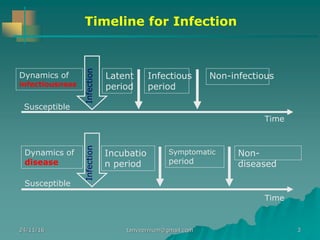
Susceptible
Susceptible
Dynamics of
infectiousness
Dynamics of
disease
Incubatio
n period
Symptomatic
period
Non-
diseased
Latent
period
Infectious
period
Non-infectious
Time
Time
Timeline for Infection
24/11/16 3tanveernium@gmail.com
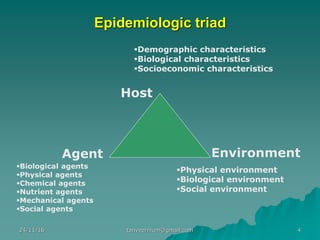
Epidemiologic triad
Host
Agent Environment
▪Biological agents
▪Physical agents
▪Chemical agents
▪Nutrient agents
▪Mechanical agents
▪Social agents
▪Physical environment
▪Biological environment
▪Social environment
▪Demographic characteristics
▪Biological characteristics
▪Socioeconomic characteristics
24/11/16 4tanveernium@gmail.com
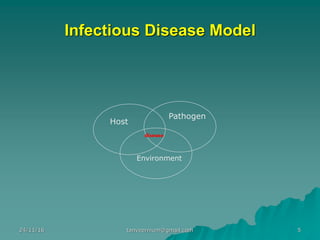
Infectious Disease Model
Host
Pathogen
Environment
disease
24/11/16 5tanveernium@gmail.com
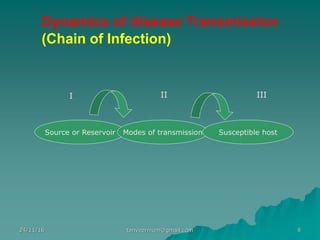
Dynamics of disease Transmission
(Chain of Infection)
Source or Reservoir Modes of transmission Susceptible host
I II III
24/11/16 6tanveernium@gmail.com
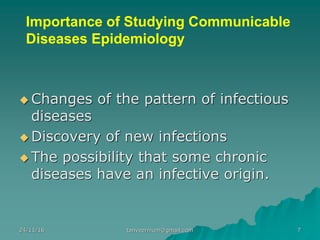
Importance of Studying Communicable
Diseases Epidemiology
◆ Changes of the pattern of infectious
diseases
◆ Discovery of new infections
◆ The possibility that some chronic
diseases have an infective origin.
24/11/16 7tanveernium@gmail.com
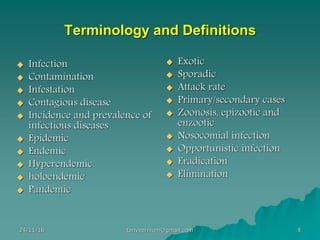
Terminology and Definitions
◆ Infection
◆ Contamination
◆ Infestation
◆ Contagious disease
◆ Incidence and prevalence of
infectious diseases
◆ Epidemic
◆ Endemic
◆ Hyperendemic
◆ holoendemic
◆ Pandemic
◆ Exotic
◆ Sporadic
◆ Attack rate
◆ Primary/secondary cases
◆ Zoonosis, epizootic and
enzootic
◆ Nosocomial infection
◆ Opportunistic infection
◆ Eradication
◆ Elimination
24/11/16 8tanveernium@gmail.com
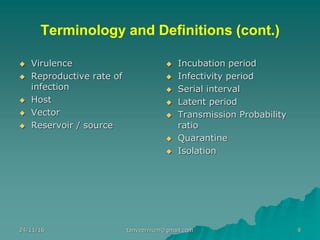
Terminology and Definitions (cont.)
◆ Virulence
◆ Reproductive rate of
infection
◆ Host
◆ Vector
◆ Reservoir / source
◆ Incubation period
◆ Infectivity period
◆ Serial interval
◆ Latent period
◆ Transmission Probability
ratio
◆ Quarantine
◆ Isolation
24/11/16 9tanveernium@gmail.com
Some key terms to describe individuals
Susceptible: uninfected, but able to become infected if
exposed
Infectious: infected and able to transmit the infection to
other susceptible individuals
Immune: possessing cell-mediated or humoral antibody
protection against an infection
Diseased/clinical infection: implies the presence of clinical
signs of pathology (not synonymous with infected)
Latent infection / subclinical infection: implies presence
of infectious agent but absence of clinical disease
Carrier: implies a protracted infected state with shedding of
the infectious agent. Carriers may be diseased, recovering,
or healthy.
24/11/16 10tanveernium@gmail.com
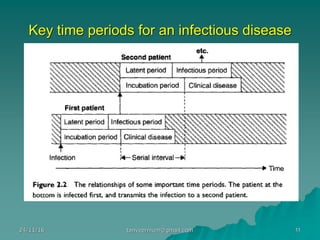
Key time periods for an infectious disease
24/11/16 11tanveernium@gmail.com
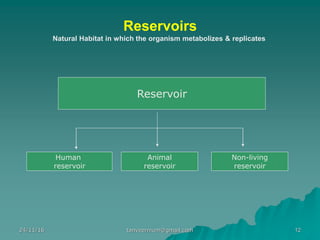
Reservoirs
Natural Habitat in which the organism metabolizes & replicates
Reservoir
Human
reservoir
Animal
reservoir
Non-living
reservoir
24/11/16 12tanveernium@gmail.com
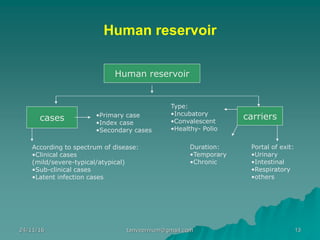
Human reservoir
Human reservoir
cases carriers
According to spectrum of disease:
•Clinical cases
(mild/severe-typical/atypical)
•Sub-clinical cases
•Latent infection cases
•Primary case
•Index case
•Secondary cases
Type:
•Incubatory
•Convalescent
•Healthy- Polio
Duration:
•Temporary
•Chronic
Portal of exit:
•Urinary
•Intestinal
•Respiratory
•others
24/11/16 13tanveernium@gmail.com
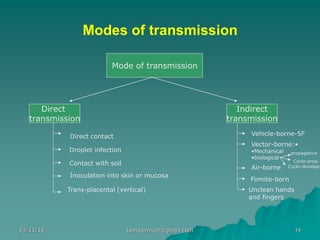
Modes of transmission
Mode of transmission
Direct
transmission
Indirect
transmission
Direct contact
Droplet infection
Contact with soil
Inoculation into skin or mucosa
Trans-placental (vertical)
Vehicle-borne-5F
•Vector-borne:
•Mechanical
•biological
Air-borne
Fomite-born
Unclean hands
and fingers
propagative
Cyclo-prop.
Cyclo-develop.
24/11/16 14tanveernium@gmail.com
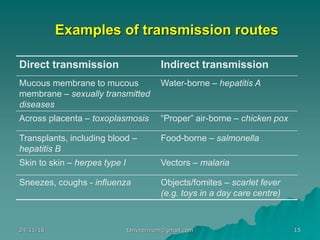
Examples of transmission routes
Direct transmission Indirect transmission
Mucous membrane to mucous
membrane – sexually transmitted
diseases
Water-borne – hepatitis A
Across placenta – toxoplasmosis “Proper” air-borne – chicken pox
Transplants, including blood –
hepatitis B
Food-borne – salmonella
Skin to skin – herpes type I Vectors – malaria
Sneezes, coughs - influenza Objects/fomites – scarlet fever
(e.g. toys in a day care centre)
24/11/16 15tanveernium@gmail.com
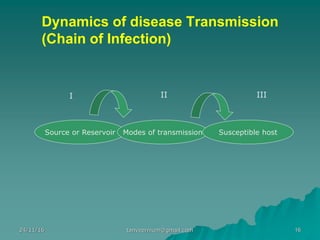
Dynamics of disease Transmission
(Chain of Infection)
Source or Reservoir Modes of transmission Susceptible host
I II III
24/11/16 16tanveernium@gmail.com
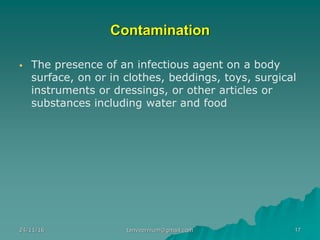
Contamination
▪ The presence of an infectious agent on a body
surface, on or in clothes, beddings, toys, surgical
instruments or dressings, or other articles or
substances including water and food
24/11/16 17tanveernium@gmail.com
Infestation
◆ It is the lodgment, development and reproduction
of arthropods on the surface of the body or in the
clothing, e.g. lice, itch mite. This term could be
also used to describe the invasion of the gut by
parasitic worms, e.g. ascariasis.
24/11/16 18tanveernium@gmail.com
Contagious disease
◆ A contagious disease is the one that is
transmitted through contact. Examples
include scabies, trachoma, STD and
leprosy.
24/11/16 19tanveernium@gmail.com
Host
▪ A person or an animal that affords subsistence or
lodgement to an infectious agent under natural
conditions. Types include: an obligate host,
definitive (primary) host, intermediate host and a
transport host.
24/11/16 20tanveernium@gmail.com
Vector of infection
▪ An insect or any living carrier that
transports an infectious agent from an
infected individual or its wastes to a
susceptible individual or its food or
immediate surroundings. Both biological
and mechanical transmissions are
encountered.
24/11/16 21tanveernium@gmail.com
Reservoir
▪ Any person, animal, arthropod, plant, soil, or
substance, or a combination of these, in which an
infectious agent normally lives and multiplies, on
which it depends primarily for survival, and
where it reproduces itself in such a manner that
it can be transmitted to a susceptible host. It is
the natural habitat of the infectious agent.
24/11/16 22tanveernium@gmail.com
Incidence and prevalence of infectious
diseases
◆ Incidence of an infectious disease: number of
new cases in a given time period expressed as
percent infected per year (cumulative incidence)
or number per person time of observation
(incidence density).
◆ Prevalence of an infectious disease: number of
cases at a given time expressed as a percent at a
given time. Prevalence is a product of incidence x
duration of disease, and is of little interest if an
infectious disease is of short duration (i.e.
measles), but may be of interest if an infectious
disease is of long duration (i.e. chronic hepatitis
B).
24/11/16 23tanveernium@gmail.com
Epidemic
◆ “The unusual occurrence in a
community of disease, specific health
related behavior, or other health
related events clearly in excess of
expected occurrence”
◆ (epi= upon; demos= people)
◆ Epidemics can occur upon endemic
states too.
24/11/16 24tanveernium@gmail.com
Endemic
◆ It refers to the constant presence of
a disease or infectious agent within a
given geographic area or population
group. It is the usual or expected
frequency of disease within a
population.
◆ (En = in; demos = people)
24/11/16 25tanveernium@gmail.com
Hyperendemic and holoendemic
◆ The term “hyperendemic” expresses that
the disease is constantly present at high
incidence and/or prevalence rate and
affects all age groups equally.
◆ The term “holoendemic” expresses a high
level of infection beginning early in life
and affecting most of the child population,
leading to a state of equilibrium such that
the adult population shows evidence of the
disease much less commonly than do the
children (e.g. malaria)
24/11/16 26tanveernium@gmail.com
Pandemic and Exotic
◆ An epidemic usually affecting a large
proportion of the population, occuring
over a wide geographic area such as a
section of a nation, the entire nation, a
continent or the world, e.g. Influenza
pandemics.
◆ Exotic diseases are those which are
imported into a country in which they do
not otherwise occur, as for example,
rabies in the UK.
24/11/16 27tanveernium@gmail.com
Sporadic
◆ The word sporadic means “scattered
about”. The cases occur irregularly,
haphazardly from time to time, and
generally infrequently. The cases are few
and separated widely in time and place
that they show no or little connection with
each other, nor a recognizable common
source of infection e.g. polio,
meningococcal meningitis, tetanus….
◆ However, a sporadic disease could be the
starting point of an epidemic when the
conditions are favorable for its spread.
24/11/16 28tanveernium@gmail.com
Attack rates and primary/secondary cases
◆ Attack rate: proportion of non-immune
exposed individuals who become clinically
ill.
◆ Primary (index)/secondary cases: The
person who comes into and infects a
population is the primary case. Those who
subsequently contract the infection are
secondary cases. Further spread is
described as "waves" or "generations".
24/11/16 29tanveernium@gmail.com
Zoonosis, epizootic and enzootic
◆ Zoonosis is an infection that is transmissible
under natural conditions from vertebrate animals
to man, e.g. rabies, plague, bovine
tuberculosis…..
◆ An epizotic is an outbreak (epidemic) of disease
in an animal population, e.g. rift valley fever.
◆ An Enzotic is an endemic occurring in animals,
e.g. bovine TB.
24/11/16 30tanveernium@gmail.com
Nosocomial infections
▪ Nosocomial (hospital acquired) infection is
an infection originating in a patient while
in a hospital or another health care
facility. It has to be a new disorder
unrelated to the patient’s primary
condition. Examples include infection of
surgical wounds, hepatitis B and urinary
tract infections.
24/11/16 31tanveernium@gmail.com
Opportunistic infection
◆ This is infection by organisms that
take the opportunity provided by a
defect in host defense (e.g.
immunity) to infect the host and thus
cause disease. For example,
opportunistic infections are very
common in AIDS. Organisms include
Herpes simplex, cytomegalovirus,
◆ M. tuberculosis….
24/11/16 32tanveernium@gmail.com
Eradication and Elimination
◆ Termination of all transmission of infection by the
extermination of the infectious agent through
surveillance and containment. Eradication is an
absolute process, an “all or none” phenomenon,
restricted to termination of infection from the
whole world.
◆ The term elimination is sometimes used to
describe eradication of a disease from a large
geographic region. Disease which are amenable
to elimination in the meantime are polio, measles
and diphtheria.
24/11/16 33tanveernium@gmail.com
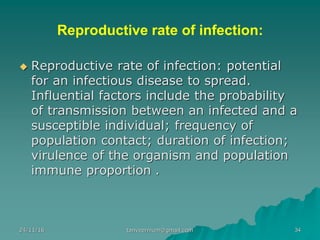
Reproductive rate of infection:
◆ Reproductive rate of infection: potential
for an infectious disease to spread.
Influential factors include the probability
of transmission between an infected and a
susceptible individual; frequency of
population contact; duration of infection;
virulence of the organism and population
immune proportion .
24/11/16 34tanveernium@gmail.com
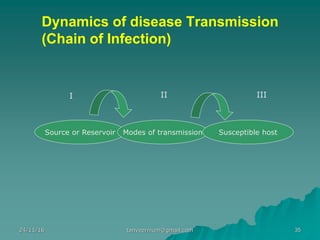
Dynamics of disease Transmission
(Chain of Infection)
Source or Reservoir Modes of transmission Susceptible host
I II III
24/11/16 35tanveernium@gmail.com
(I): Source or Reservoir
▪ The starting point for the occurrence of a
communicable disease is the existence of a
reservoir or source of infection.
▪ The source of infection is defined as “the person,
animal, object or substance from which an
infectious agent passes or is disseminated to the
host (immediate source). The reservoir is “any
person, animal, arthropod, plant, soil, or
substance, or a combination of these, in which an
infectious agent normally lives and multiplies, on
which it depends primarily for survival, and
where it reproduces itself in such a manner that
it can be transmitted to a susceptible host. It is
the natural habitat of the infectious agent.”
24/11/16 36tanveernium@gmail.com
Cases
◆ A case is defined as “a person in the
population or study group identified
as having the particular disease,
health disorder, or condition under
investigation”
24/11/16 37tanveernium@gmail.com
Carriers
▪ It occurs either due to inadequate treatment or immune
response, the disease agent is not completely eliminated,
leading to a carrier state.
▪ It is “an infected person or animal that harbors a specific
infectious agent in the absence of discernible (visible)
clinical disease and serves as a potential source of
infection to others.
▪ Three elements have to occur to form a carrier state:
1. The presence in the body of the disease agent.
2. The absence of recognizable symptoms and signs of
disease.
3. The shedding of disease agent in the discharge or
excretions.
24/11/16 38tanveernium@gmail.com
Animal reservoirs
◆ Zoonosis is an infection that is transmissible
under natural conditions from vertebrate animals
to man, e.g. rabies, plague, bovine
tuberculosis…..
◆ There are over a 100 zoonotic diseases that can
be conveyed from animal to man.
24/11/16 39tanveernium@gmail.com
Reservoir in non-living things
◆ Soil and inanimate matter can also
act as reservoir of infection.
◆ For example, soil may harbor agents
that causes tetanus, anthrax and
coccidiodomycosis.
24/11/16 40tanveernium@gmail.com
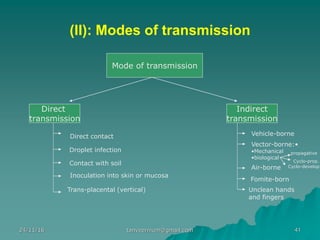
(II): Modes of transmission
Mode of transmission
Direct
transmission
Indirect
transmission
Direct contact
Droplet infection
Contact with soil
Inoculation into skin or mucosa
Trans-placental (vertical)
Vehicle-borne
•Vector-borne:
•Mechanical
•biological
Air-borne
Fomite-born
Unclean hands
and fingers
propagative
Cyclo-prop.
Cyclo-develop.
24/11/16 41tanveernium@gmail.com
(III): Susceptible host
▪ An infectious agent seeks a susceptible host
aiming “successful parasitism”.
▪ Four stages are required for successful
parasitism:
1. Portal of entry
2. Site of election inside the body
3. Portal of exit
4. Survival in external environment
24/11/16 42tanveernium@gmail.com
Virulence and Case Fatality Rate
◆ Virulence: is the degree of pathogenicity; the
disease evoking power of a micro-organism in a
given host. Numerically expressed as the ratio of
the number of cases of overt infection to the total
number infected, as determined by
immunoassay. When death is the only criterion of
severity, this is the case fatality rate.
◆ Case fatality rate for infectious diseases: is
the proportion of infected individuals who die of
the infection. This is a function of the severity of
the infection and is heavily influenced by how
many mild cases are not diagnosed.
24/11/16 43tanveernium@gmail.com
Serial interval and Infectious period
▪ Serial interval: (the gap in time between the
onset of the primary and the secondary cases)
the interval between receipt of infection and
maximal infectivity of the host (also called
generation time).
▪
▪ Infectious (communicable) period: length of time
a person can transmit disease (sheds the
infectious agent).
24/11/16 44tanveernium@gmail.com
Incubation and Latent periods
▪ Incubation period: time from exposure to
development of disease. In other words,
the time interval between invasion by an
infectious agent and the appearance of the
first sign or symptom of the disease in
question.
▪ Latent period: the period between
exposure and the onset of infectiousness
(this may be shorter or longer than the
incubation period).
24/11/16 45tanveernium@gmail.com
Transmission Probability Ratio (TPR)
TPR is a measure of risk transmission
from infected to susceptible individuals
during a contact.
TPR of differing types of contacts,
infectious agents, infection routes and
strains can be calculated.
There are 4 types of transmission
probabilities.
24/11/16 46tanveernium@gmail.com
TPR (cont.)
Transmission probabilities:
◆ p00: tp from unvaccinated infective to
unvaccinated susceptible
◆ p01: tp from vaccinated infective to
unvaccinated susceptible
◆ p10: tp from unvaccinated infective to
vaccinated susceptible
◆ p11: tp from vaccinated infective to
vaccinated susceptible
24/11/16 47tanveernium@gmail.com
TPR (cont.)
◆ To estimate the effect of a vaccine in
reducing susceptibility, compare the ratio
of p10 to p00.
◆ To estimate the effect of a vaccine in
reducing infectiousness, compare the ratio
of p01 to p00.
◆ To estimate the combined effect of a
vaccine, compare the ratio of p11 to p00.
24/11/16 48tanveernium@gmail.com
Quarantine
◆The limitation of freedom of movement of
such well persons or domestic animals
exposed to communicable diseases for a
period of time bot longer than the longest
usual incubation period of the diseases in
such a manner as to prevent effective
contact with those not so exposed
24/11/16 tanveernium@gmail.com 49
Isolation
◆Separation for the period of
communicability of infected persons or
animals from others in such places and
under such conditions, as to prevent or
limit the direct or indirect transmission of
the infectious agent from those infected to
those who are susceptible or who may
spread the agent to the others.
24/11/16 tanveernium@gmail.com 50
THANK YOU
THANK YOU
24/11/16 51tanveernium@gmail.com

Infection

  • 1.
    Taadiya [infection] 1 Md TanwirAlam, MD Assistant Professor, Govt. Tibbi College & Hospital (GTCH), Patnatanveernium@gmail.com24/11/16
  • 2.
    Infection ◆ Infection isthe entry and development or multiplication of an infectious agent in the body of man or animals. An infection does not always cause illness. ◆ There are several levels of infection (Gradients of infection): ▪ Colonization (S. aureus in skin and normal nasopharynx) ▪ Subclinical or inapparent infection (polio) ▪ Latent infection (virus of herpes simplex) ▪ Manifest or clinical infection 24/11/16 2tanveernium@gmail.com
  • 3.
    Susceptible Susceptible Dynamics of infectiousness Dynamics of disease Incubatio nperiod Symptomatic period Non- diseased Latent period Infectious period Non-infectious Time Time Timeline for Infection 24/11/16 3tanveernium@gmail.com
  • 4.
    Epidemiologic triad Host Agent Environment ▪Biologicalagents ▪Physical agents ▪Chemical agents ▪Nutrient agents ▪Mechanical agents ▪Social agents ▪Physical environment ▪Biological environment ▪Social environment ▪Demographic characteristics ▪Biological characteristics ▪Socioeconomic characteristics 24/11/16 4tanveernium@gmail.com
  • 5.
  • 6.
    Dynamics of diseaseTransmission (Chain of Infection) Source or Reservoir Modes of transmission Susceptible host I II III 24/11/16 6tanveernium@gmail.com
  • 7.
    Importance of StudyingCommunicable Diseases Epidemiology ◆ Changes of the pattern of infectious diseases ◆ Discovery of new infections ◆ The possibility that some chronic diseases have an infective origin. 24/11/16 7tanveernium@gmail.com
  • 8.
    Terminology and Definitions ◆Infection ◆ Contamination ◆ Infestation ◆ Contagious disease ◆ Incidence and prevalence of infectious diseases ◆ Epidemic ◆ Endemic ◆ Hyperendemic ◆ holoendemic ◆ Pandemic ◆ Exotic ◆ Sporadic ◆ Attack rate ◆ Primary/secondary cases ◆ Zoonosis, epizootic and enzootic ◆ Nosocomial infection ◆ Opportunistic infection ◆ Eradication ◆ Elimination 24/11/16 8tanveernium@gmail.com
  • 9.
    Terminology and Definitions(cont.) ◆ Virulence ◆ Reproductive rate of infection ◆ Host ◆ Vector ◆ Reservoir / source ◆ Incubation period ◆ Infectivity period ◆ Serial interval ◆ Latent period ◆ Transmission Probability ratio ◆ Quarantine ◆ Isolation 24/11/16 9tanveernium@gmail.com
  • 10.
    Some key termsto describe individuals Susceptible: uninfected, but able to become infected if exposed Infectious: infected and able to transmit the infection to other susceptible individuals Immune: possessing cell-mediated or humoral antibody protection against an infection Diseased/clinical infection: implies the presence of clinical signs of pathology (not synonymous with infected) Latent infection / subclinical infection: implies presence of infectious agent but absence of clinical disease Carrier: implies a protracted infected state with shedding of the infectious agent. Carriers may be diseased, recovering, or healthy. 24/11/16 10tanveernium@gmail.com
  • 11.
    Key time periodsfor an infectious disease 24/11/16 11tanveernium@gmail.com
  • 12.
    Reservoirs Natural Habitat inwhich the organism metabolizes & replicates Reservoir Human reservoir Animal reservoir Non-living reservoir 24/11/16 12tanveernium@gmail.com
  • 13.
    Human reservoir Human reservoir casescarriers According to spectrum of disease: •Clinical cases (mild/severe-typical/atypical) •Sub-clinical cases •Latent infection cases •Primary case •Index case •Secondary cases Type: •Incubatory •Convalescent •Healthy- Polio Duration: •Temporary •Chronic Portal of exit: •Urinary •Intestinal •Respiratory •others 24/11/16 13tanveernium@gmail.com
  • 14.
    Modes of transmission Modeof transmission Direct transmission Indirect transmission Direct contact Droplet infection Contact with soil Inoculation into skin or mucosa Trans-placental (vertical) Vehicle-borne-5F •Vector-borne: •Mechanical •biological Air-borne Fomite-born Unclean hands and fingers propagative Cyclo-prop. Cyclo-develop. 24/11/16 14tanveernium@gmail.com
  • 15.
    Examples of transmissionroutes Direct transmission Indirect transmission Mucous membrane to mucous membrane – sexually transmitted diseases Water-borne – hepatitis A Across placenta – toxoplasmosis “Proper” air-borne – chicken pox Transplants, including blood – hepatitis B Food-borne – salmonella Skin to skin – herpes type I Vectors – malaria Sneezes, coughs - influenza Objects/fomites – scarlet fever (e.g. toys in a day care centre) 24/11/16 15tanveernium@gmail.com
  • 16.
    Dynamics of diseaseTransmission (Chain of Infection) Source or Reservoir Modes of transmission Susceptible host I II III 24/11/16 16tanveernium@gmail.com
  • 17.
    Contamination ▪ The presenceof an infectious agent on a body surface, on or in clothes, beddings, toys, surgical instruments or dressings, or other articles or substances including water and food 24/11/16 17tanveernium@gmail.com
  • 18.
    Infestation ◆ It isthe lodgment, development and reproduction of arthropods on the surface of the body or in the clothing, e.g. lice, itch mite. This term could be also used to describe the invasion of the gut by parasitic worms, e.g. ascariasis. 24/11/16 18tanveernium@gmail.com
  • 19.
    Contagious disease ◆ Acontagious disease is the one that is transmitted through contact. Examples include scabies, trachoma, STD and leprosy. 24/11/16 19tanveernium@gmail.com
  • 20.
    Host ▪ A personor an animal that affords subsistence or lodgement to an infectious agent under natural conditions. Types include: an obligate host, definitive (primary) host, intermediate host and a transport host. 24/11/16 20tanveernium@gmail.com
  • 21.
    Vector of infection ▪An insect or any living carrier that transports an infectious agent from an infected individual or its wastes to a susceptible individual or its food or immediate surroundings. Both biological and mechanical transmissions are encountered. 24/11/16 21tanveernium@gmail.com
  • 22.
    Reservoir ▪ Any person,animal, arthropod, plant, soil, or substance, or a combination of these, in which an infectious agent normally lives and multiplies, on which it depends primarily for survival, and where it reproduces itself in such a manner that it can be transmitted to a susceptible host. It is the natural habitat of the infectious agent. 24/11/16 22tanveernium@gmail.com
  • 23.
    Incidence and prevalenceof infectious diseases ◆ Incidence of an infectious disease: number of new cases in a given time period expressed as percent infected per year (cumulative incidence) or number per person time of observation (incidence density). ◆ Prevalence of an infectious disease: number of cases at a given time expressed as a percent at a given time. Prevalence is a product of incidence x duration of disease, and is of little interest if an infectious disease is of short duration (i.e. measles), but may be of interest if an infectious disease is of long duration (i.e. chronic hepatitis B). 24/11/16 23tanveernium@gmail.com
  • 24.
    Epidemic ◆ “The unusualoccurrence in a community of disease, specific health related behavior, or other health related events clearly in excess of expected occurrence” ◆ (epi= upon; demos= people) ◆ Epidemics can occur upon endemic states too. 24/11/16 24tanveernium@gmail.com
  • 25.
    Endemic ◆ It refersto the constant presence of a disease or infectious agent within a given geographic area or population group. It is the usual or expected frequency of disease within a population. ◆ (En = in; demos = people) 24/11/16 25tanveernium@gmail.com
  • 26.
    Hyperendemic and holoendemic ◆The term “hyperendemic” expresses that the disease is constantly present at high incidence and/or prevalence rate and affects all age groups equally. ◆ The term “holoendemic” expresses a high level of infection beginning early in life and affecting most of the child population, leading to a state of equilibrium such that the adult population shows evidence of the disease much less commonly than do the children (e.g. malaria) 24/11/16 26tanveernium@gmail.com
  • 27.
    Pandemic and Exotic ◆An epidemic usually affecting a large proportion of the population, occuring over a wide geographic area such as a section of a nation, the entire nation, a continent or the world, e.g. Influenza pandemics. ◆ Exotic diseases are those which are imported into a country in which they do not otherwise occur, as for example, rabies in the UK. 24/11/16 27tanveernium@gmail.com
  • 28.
    Sporadic ◆ The wordsporadic means “scattered about”. The cases occur irregularly, haphazardly from time to time, and generally infrequently. The cases are few and separated widely in time and place that they show no or little connection with each other, nor a recognizable common source of infection e.g. polio, meningococcal meningitis, tetanus…. ◆ However, a sporadic disease could be the starting point of an epidemic when the conditions are favorable for its spread. 24/11/16 28tanveernium@gmail.com
  • 29.
    Attack rates andprimary/secondary cases ◆ Attack rate: proportion of non-immune exposed individuals who become clinically ill. ◆ Primary (index)/secondary cases: The person who comes into and infects a population is the primary case. Those who subsequently contract the infection are secondary cases. Further spread is described as "waves" or "generations". 24/11/16 29tanveernium@gmail.com
  • 30.
    Zoonosis, epizootic andenzootic ◆ Zoonosis is an infection that is transmissible under natural conditions from vertebrate animals to man, e.g. rabies, plague, bovine tuberculosis….. ◆ An epizotic is an outbreak (epidemic) of disease in an animal population, e.g. rift valley fever. ◆ An Enzotic is an endemic occurring in animals, e.g. bovine TB. 24/11/16 30tanveernium@gmail.com
  • 31.
    Nosocomial infections ▪ Nosocomial(hospital acquired) infection is an infection originating in a patient while in a hospital or another health care facility. It has to be a new disorder unrelated to the patient’s primary condition. Examples include infection of surgical wounds, hepatitis B and urinary tract infections. 24/11/16 31tanveernium@gmail.com
  • 32.
    Opportunistic infection ◆ Thisis infection by organisms that take the opportunity provided by a defect in host defense (e.g. immunity) to infect the host and thus cause disease. For example, opportunistic infections are very common in AIDS. Organisms include Herpes simplex, cytomegalovirus, ◆ M. tuberculosis…. 24/11/16 32tanveernium@gmail.com
  • 33.
    Eradication and Elimination ◆Termination of all transmission of infection by the extermination of the infectious agent through surveillance and containment. Eradication is an absolute process, an “all or none” phenomenon, restricted to termination of infection from the whole world. ◆ The term elimination is sometimes used to describe eradication of a disease from a large geographic region. Disease which are amenable to elimination in the meantime are polio, measles and diphtheria. 24/11/16 33tanveernium@gmail.com
  • 34.
    Reproductive rate ofinfection: ◆ Reproductive rate of infection: potential for an infectious disease to spread. Influential factors include the probability of transmission between an infected and a susceptible individual; frequency of population contact; duration of infection; virulence of the organism and population immune proportion . 24/11/16 34tanveernium@gmail.com
  • 35.
    Dynamics of diseaseTransmission (Chain of Infection) Source or Reservoir Modes of transmission Susceptible host I II III 24/11/16 35tanveernium@gmail.com
  • 36.
    (I): Source orReservoir ▪ The starting point for the occurrence of a communicable disease is the existence of a reservoir or source of infection. ▪ The source of infection is defined as “the person, animal, object or substance from which an infectious agent passes or is disseminated to the host (immediate source). The reservoir is “any person, animal, arthropod, plant, soil, or substance, or a combination of these, in which an infectious agent normally lives and multiplies, on which it depends primarily for survival, and where it reproduces itself in such a manner that it can be transmitted to a susceptible host. It is the natural habitat of the infectious agent.” 24/11/16 36tanveernium@gmail.com
  • 37.
    Cases ◆ A caseis defined as “a person in the population or study group identified as having the particular disease, health disorder, or condition under investigation” 24/11/16 37tanveernium@gmail.com
  • 38.
    Carriers ▪ It occurseither due to inadequate treatment or immune response, the disease agent is not completely eliminated, leading to a carrier state. ▪ It is “an infected person or animal that harbors a specific infectious agent in the absence of discernible (visible) clinical disease and serves as a potential source of infection to others. ▪ Three elements have to occur to form a carrier state: 1. The presence in the body of the disease agent. 2. The absence of recognizable symptoms and signs of disease. 3. The shedding of disease agent in the discharge or excretions. 24/11/16 38tanveernium@gmail.com
  • 39.
    Animal reservoirs ◆ Zoonosisis an infection that is transmissible under natural conditions from vertebrate animals to man, e.g. rabies, plague, bovine tuberculosis….. ◆ There are over a 100 zoonotic diseases that can be conveyed from animal to man. 24/11/16 39tanveernium@gmail.com
  • 40.
    Reservoir in non-livingthings ◆ Soil and inanimate matter can also act as reservoir of infection. ◆ For example, soil may harbor agents that causes tetanus, anthrax and coccidiodomycosis. 24/11/16 40tanveernium@gmail.com
  • 41.
    (II): Modes oftransmission Mode of transmission Direct transmission Indirect transmission Direct contact Droplet infection Contact with soil Inoculation into skin or mucosa Trans-placental (vertical) Vehicle-borne •Vector-borne: •Mechanical •biological Air-borne Fomite-born Unclean hands and fingers propagative Cyclo-prop. Cyclo-develop. 24/11/16 41tanveernium@gmail.com
  • 42.
    (III): Susceptible host ▪An infectious agent seeks a susceptible host aiming “successful parasitism”. ▪ Four stages are required for successful parasitism: 1. Portal of entry 2. Site of election inside the body 3. Portal of exit 4. Survival in external environment 24/11/16 42tanveernium@gmail.com
  • 43.
    Virulence and CaseFatality Rate ◆ Virulence: is the degree of pathogenicity; the disease evoking power of a micro-organism in a given host. Numerically expressed as the ratio of the number of cases of overt infection to the total number infected, as determined by immunoassay. When death is the only criterion of severity, this is the case fatality rate. ◆ Case fatality rate for infectious diseases: is the proportion of infected individuals who die of the infection. This is a function of the severity of the infection and is heavily influenced by how many mild cases are not diagnosed. 24/11/16 43tanveernium@gmail.com
  • 44.
    Serial interval andInfectious period ▪ Serial interval: (the gap in time between the onset of the primary and the secondary cases) the interval between receipt of infection and maximal infectivity of the host (also called generation time). ▪ ▪ Infectious (communicable) period: length of time a person can transmit disease (sheds the infectious agent). 24/11/16 44tanveernium@gmail.com
  • 45.
    Incubation and Latentperiods ▪ Incubation period: time from exposure to development of disease. In other words, the time interval between invasion by an infectious agent and the appearance of the first sign or symptom of the disease in question. ▪ Latent period: the period between exposure and the onset of infectiousness (this may be shorter or longer than the incubation period). 24/11/16 45tanveernium@gmail.com
  • 46.
    Transmission Probability Ratio(TPR) TPR is a measure of risk transmission from infected to susceptible individuals during a contact. TPR of differing types of contacts, infectious agents, infection routes and strains can be calculated. There are 4 types of transmission probabilities. 24/11/16 46tanveernium@gmail.com
  • 47.
    TPR (cont.) Transmission probabilities: ◆p00: tp from unvaccinated infective to unvaccinated susceptible ◆ p01: tp from vaccinated infective to unvaccinated susceptible ◆ p10: tp from unvaccinated infective to vaccinated susceptible ◆ p11: tp from vaccinated infective to vaccinated susceptible 24/11/16 47tanveernium@gmail.com
  • 48.
    TPR (cont.) ◆ Toestimate the effect of a vaccine in reducing susceptibility, compare the ratio of p10 to p00. ◆ To estimate the effect of a vaccine in reducing infectiousness, compare the ratio of p01 to p00. ◆ To estimate the combined effect of a vaccine, compare the ratio of p11 to p00. 24/11/16 48tanveernium@gmail.com
  • 49.
    Quarantine ◆The limitation offreedom of movement of such well persons or domestic animals exposed to communicable diseases for a period of time bot longer than the longest usual incubation period of the diseases in such a manner as to prevent effective contact with those not so exposed 24/11/16 tanveernium@gmail.com 49
  • 50.
    Isolation ◆Separation for theperiod of communicability of infected persons or animals from others in such places and under such conditions, as to prevent or limit the direct or indirect transmission of the infectious agent from those infected to those who are susceptible or who may spread the agent to the others. 24/11/16 tanveernium@gmail.com 50
  • 51.
    THANK YOU THANK YOU 24/11/1651tanveernium@gmail.com