• Instructor:
  Mr. Tawfik Aljobory
• Required: Text editor (e.g. Notepad)
• Textbook: HTML, XHTML, and CSS
  Bible, Brian Pfaffenberger, Steven M.
  Schafer,Charles White, Bill Karow,2004


                                           1
What Is the World Wide Web?
is a network of computers able to exchange
text, graphics, and multimedia information
via the Internet.
•The Web is a collection of files organized as a huge
hypertext .
•Many of these files produce documents called Web pages
•Web site - location on a computer somewhere on the
 Internet that stores a collection of Web pages
    http://www.yahoo.com
                                                    2
3
4
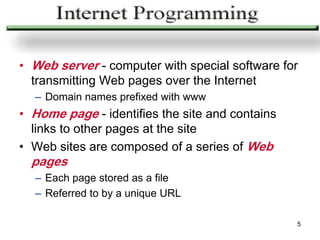
• Web server - computer with special software for
  transmitting Web pages over the Internet
  – Domain names prefixed with www
• Home page - identifies the site and contains
  links to other pages at the site
• Web sites are composed of a series of Web
  pages
  – Each page stored as a file
  – Referred to by a unique URL

                                                 5
What is the Web?
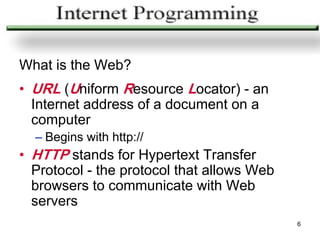
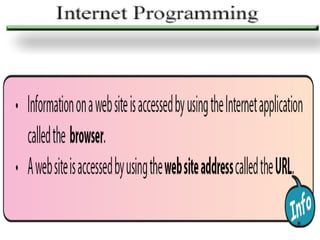
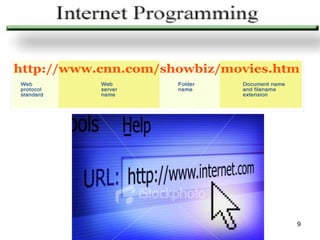
• URL (Uniform Resource Locator) - an
  Internet address of a document on a
  computer
  – Begins with http://
• HTTP stands for Hypertext Transfer
  Protocol - the protocol that allows Web
  browsers to communicate with Web
  servers
                                            6
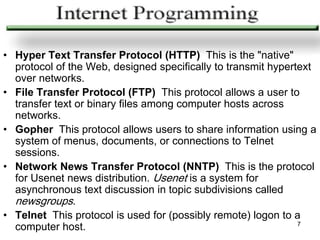
• Hyper Text Transfer Protocol (HTTP) This is the "native"
  protocol of the Web, designed specifically to transmit hypertext
  over networks.
• File Transfer Protocol (FTP) This protocol allows a user to
  transfer text or binary files among computer hosts across
  networks.
• Gopher This protocol allows users to share information using a
  system of menus, documents, or connections to Telnet
  sessions.
• Network News Transfer Protocol (NNTP) This is the protocol
  for Usenet news distribution. Usenet is a system for
  asynchronous text discussion in topic subdivisions called
  newsgroups.
• Telnet This protocol is used for (possibly remote) logon to a
                                                               7
  computer host.
8
9
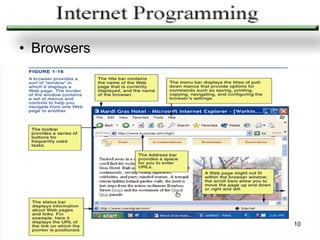
• Browsers


             10
• What is a browser?
• Web browsers provide Internet users with
  all-purpose client software for accessing
  many types of servers
  – Internet Explorer
  – Netscape
  – Opera
  – Chrome
  – Firefox
                                          11
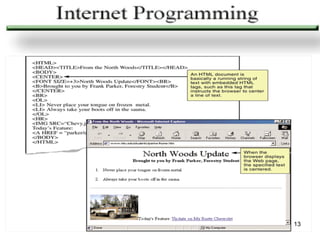
Exactly what does a browser do?
  A browser fetches and displays Web
  pages
• The server sends your computer data
  that’s stored
• The data consists of information that you
  want to see and HTML tags, codes that
  tell your browser how to display it

                                              12
13
How Does the Web Work?
• The computers that make all these Web
  pages available are called Web servers.


  On any computer that’s connected to the
• Web, you can run an application called a
  Web browser. Technically, a Web browser
  is called a Web client
                                            14
• They all speak a common “language,” called
  HyperText Transfer Protocol (HTTP).

• HTTP It’s a set of rules or
• procedures, called protocols, that enables
  computers to exchange information over
the Web.) Regardless of where these computers
  reside—China, Norway, or Texas—they can
  communicate with each other through HTTP.
                                                15
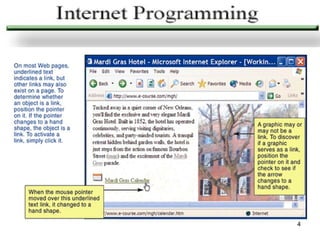
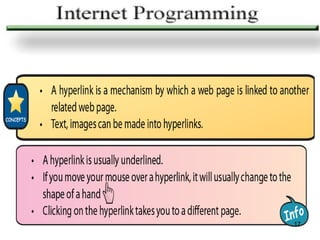
• Most Web pages contain hyperlinks,
  which are specially formatted words or
phrases that enable you to access another
  page on the Web.
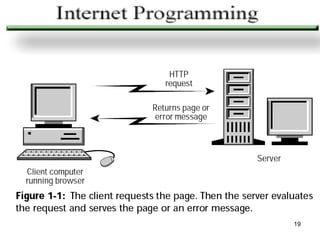
• When you click the hyperlink, your
  computer sends a message called an
  HTTP request. This message says, in
  effect, “Please send me the Web page that
  I want.”
                                          16
17
• If the page isn’t found, you see an
• error message, which probably includes
  the HTTP code for this error: 404, “Not
• Found.”


                                            18
19
• What Is Hypertext?
Hypertext is a type of text that contains
  hyperlinks
which enable the reader to jump from one
  hypertext page to another.


                                            20
• Where Does HTML Fit In?
Hyper Text Markup Language (HTML) enables
  you to mark up text so that it can
function as hypertext on the Web.It is
  Computer Language understood by internet
  browser
HTML consists of its own set of symbols that
  tell Web browsers how to display the page.
  These symbols, called elements, include the
  ones needed to create hyperlinks.         21
Standard Generalized Markup Language
  (SGML), an international standard for
  marking up text for presentation on a
  variety of physical devices.
  The basic idea of SGML is that the
document’s structure should be separated
  from its presentation:


                                           22

Inet prog

  • 1.
    • Instructor: Mr. Tawfik Aljobory • Required: Text editor (e.g. Notepad) • Textbook: HTML, XHTML, and CSS Bible, Brian Pfaffenberger, Steven M. Schafer,Charles White, Bill Karow,2004 1
  • 2.
    What Is theWorld Wide Web? is a network of computers able to exchange text, graphics, and multimedia information via the Internet. •The Web is a collection of files organized as a huge hypertext . •Many of these files produce documents called Web pages •Web site - location on a computer somewhere on the Internet that stores a collection of Web pages http://www.yahoo.com 2
  • 3.
  • 4.
  • 5.
    • Web server- computer with special software for transmitting Web pages over the Internet – Domain names prefixed with www • Home page - identifies the site and contains links to other pages at the site • Web sites are composed of a series of Web pages – Each page stored as a file – Referred to by a unique URL 5
  • 6.
    What is theWeb? • URL (Uniform Resource Locator) - an Internet address of a document on a computer – Begins with http:// • HTTP stands for Hypertext Transfer Protocol - the protocol that allows Web browsers to communicate with Web servers 6
  • 7.
    • Hyper TextTransfer Protocol (HTTP) This is the "native" protocol of the Web, designed specifically to transmit hypertext over networks. • File Transfer Protocol (FTP) This protocol allows a user to transfer text or binary files among computer hosts across networks. • Gopher This protocol allows users to share information using a system of menus, documents, or connections to Telnet sessions. • Network News Transfer Protocol (NNTP) This is the protocol for Usenet news distribution. Usenet is a system for asynchronous text discussion in topic subdivisions called newsgroups. • Telnet This protocol is used for (possibly remote) logon to a 7 computer host.
  • 8.
  • 9.
  • 10.
  • 11.
    • What isa browser? • Web browsers provide Internet users with all-purpose client software for accessing many types of servers – Internet Explorer – Netscape – Opera – Chrome – Firefox 11
  • 12.
    Exactly what doesa browser do? A browser fetches and displays Web pages • The server sends your computer data that’s stored • The data consists of information that you want to see and HTML tags, codes that tell your browser how to display it 12
  • 13.
  • 14.
    How Does theWeb Work? • The computers that make all these Web pages available are called Web servers. On any computer that’s connected to the • Web, you can run an application called a Web browser. Technically, a Web browser is called a Web client 14
  • 15.
    • They allspeak a common “language,” called HyperText Transfer Protocol (HTTP). • HTTP It’s a set of rules or • procedures, called protocols, that enables computers to exchange information over the Web.) Regardless of where these computers reside—China, Norway, or Texas—they can communicate with each other through HTTP. 15
  • 16.
    • Most Webpages contain hyperlinks, which are specially formatted words or phrases that enable you to access another page on the Web. • When you click the hyperlink, your computer sends a message called an HTTP request. This message says, in effect, “Please send me the Web page that I want.” 16
  • 17.
  • 18.
    • If thepage isn’t found, you see an • error message, which probably includes the HTTP code for this error: 404, “Not • Found.” 18
  • 19.
  • 20.
    • What IsHypertext? Hypertext is a type of text that contains hyperlinks which enable the reader to jump from one hypertext page to another. 20
  • 21.
    • Where DoesHTML Fit In? Hyper Text Markup Language (HTML) enables you to mark up text so that it can function as hypertext on the Web.It is Computer Language understood by internet browser HTML consists of its own set of symbols that tell Web browsers how to display the page. These symbols, called elements, include the ones needed to create hyperlinks. 21
  • 22.
    Standard Generalized MarkupLanguage (SGML), an international standard for marking up text for presentation on a variety of physical devices. The basic idea of SGML is that the document’s structure should be separated from its presentation: 22