Message Passing Interface (MPI) 1
Amit Majumdar
CS 505, Spring 2002
2
Lecture Overview
• Advantages of Message Passing
• Background on MPI
• “Hello, world” in MPI
• Key Concepts in MPI
• Basic Communications in MPI
• Simple send and receive program
3
Advantages of Message Passing
• Universality : MP model fits well on separate processors
connected by fast/slow network. Matches the hardware of
most of today’s parallel supercomputers as well as network
of workstations (NOW)
• Expressivity : MP has been found to be a useful and
complete model in which to express parallel algorithms. It
provides the control missing from data parallel or compiler
based models
• Ease of debugging : Debugging of parallel programs remain
a challenging research area. Debugging is easier for MPI
paradigm than shared memory paradigm (even if it is hard
to believe)
4
Advantages of Message Passing
• Performance:
– This is the most compelling reason why MP will remain a
permanent part of parallel computing environment
– As modern CPUs become faster, management of their
caches and the memory hierarchy is the key to getting most
out of them
– MP allows a way for the programmer to explicitly associate
specific data with processes and allows the compiler and
cache management hardware to function fully
– Memory bound applications can exhibit superlinear speedup
when run on multiple PEs compare to single PE of MP
machines
5
Background on MPI
• MPI - Message Passing Interface
– Library standard defined by committee of vendors,
implementers, and parallel programmer
– Used to create parallel SPMD programs based on
message passing
• Available on almost all parallel machines in C and
Fortran
• About 125 routines including advanced routines
• 6 basic routines
6
MPI Implementations
• Most parallel machine vendors have optimized
versions
• Others:
– http://www-unix.mcs.anl.gov/mpi/mpich/
– GLOBUS:
– http://www3.niu.edu/mpi/
– http://www.globus.org
7
Key Concepts of MPI
• Used to create parallel SPMD programs based on
message passing
• Normally the same program is running on several
different nodes
• Nodes communicate using message passing
8
Include files
• The MPI include file
– C: mpi.h
– Fortran: mpif.h (a f90 module is a good place for
this)
• Defines many constants used within MPI
programs
• In C defines the interfaces for the functions
• Compilers know where to find the include files
9
Communicators
• Communicators
– A parameter for most MPI calls
– A collection of processors working on some part of
a parallel job
– MPI_COMM_WORLD is defined in the MPI
include file as all of the processors in your job
– Can create subsets of MPI_COMM_WORLD
– Processors within a communicator are assigned
numbers 0 to n-1
10
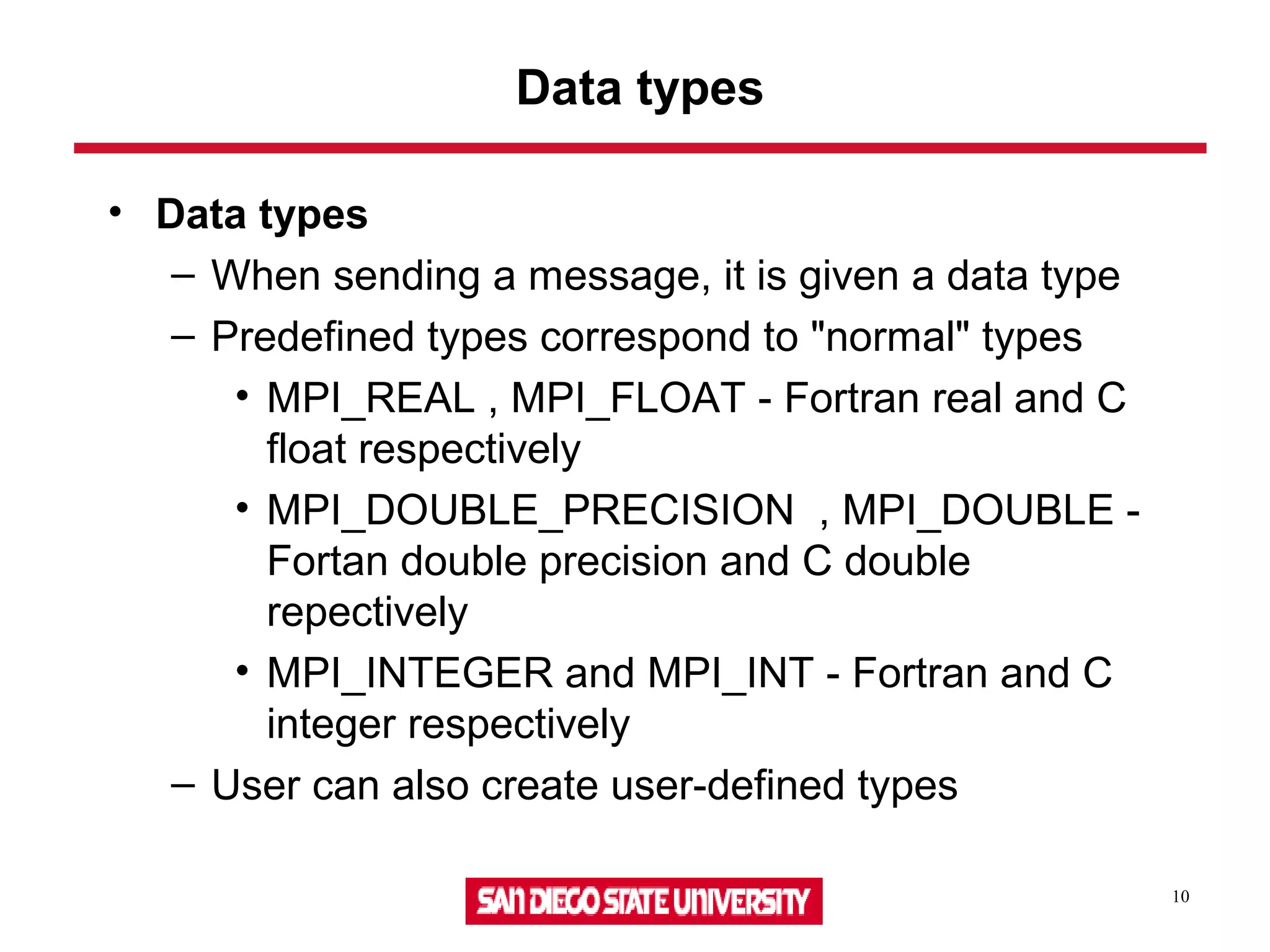
Data types
• Data types
– When sending a message, it is given a data type
– Predefined types correspond to "normal" types
• MPI_REAL , MPI_FLOAT - Fortran real and C
float respectively
• MPI_DOUBLE_PRECISION , MPI_DOUBLE -
Fortan double precision and C double
repectively
• MPI_INTEGER and MPI_INT - Fortran and C
integer respectively
– User can also create user-defined types
11
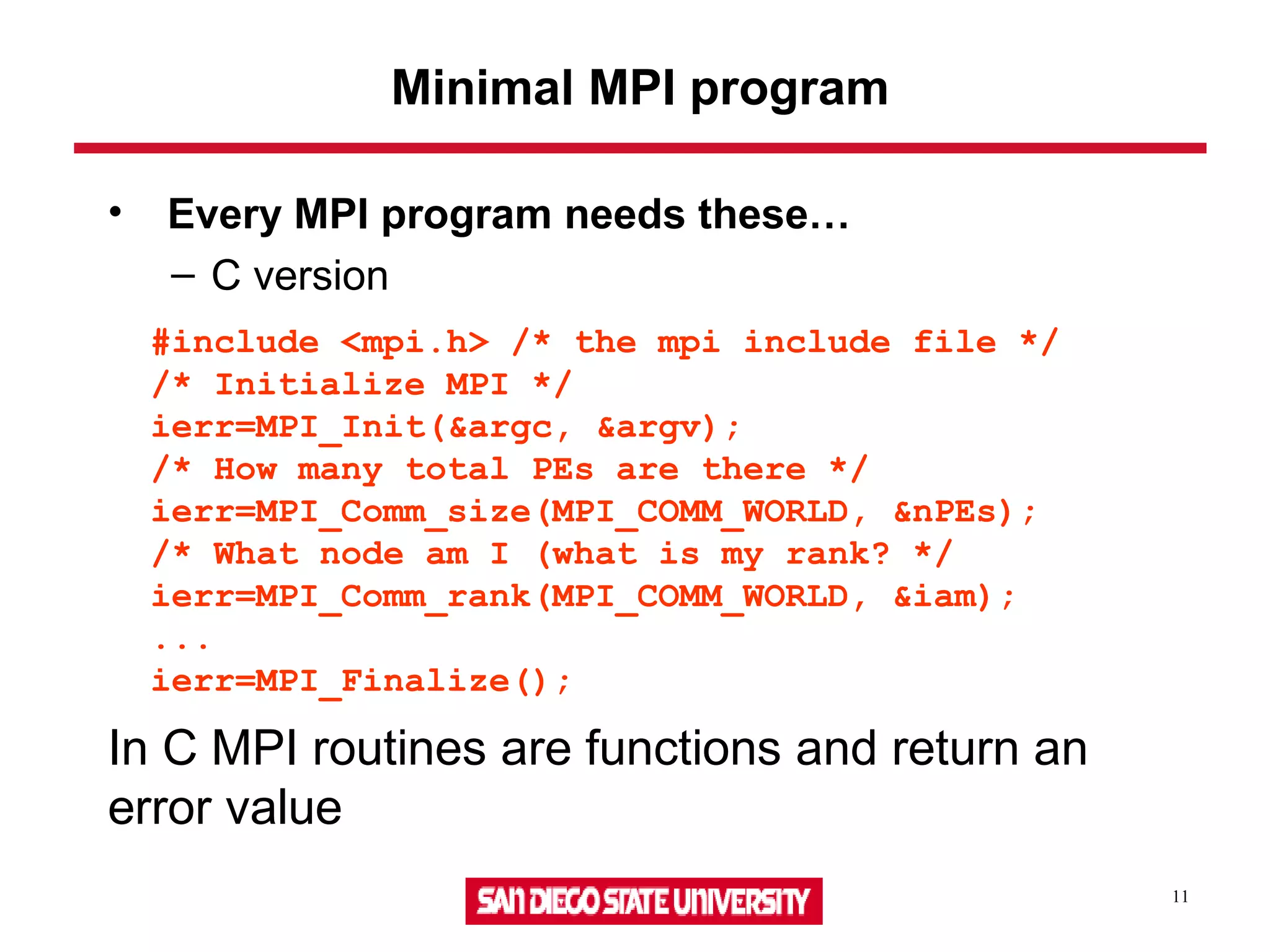
Minimal MPI program
• Every MPI program needs these…
– C version
#include <mpi.h> /* the mpi include file */
/* Initialize MPI */
ierr=MPI_Init(&argc, &argv);
/* How many total PEs are there */
ierr=MPI_Comm_size(MPI_COMM_WORLD, &nPEs);
/* What node am I (what is my rank? */
ierr=MPI_Comm_rank(MPI_COMM_WORLD, &iam);
...
ierr=MPI_Finalize();
In C MPI routines are functions and return an
error value
12
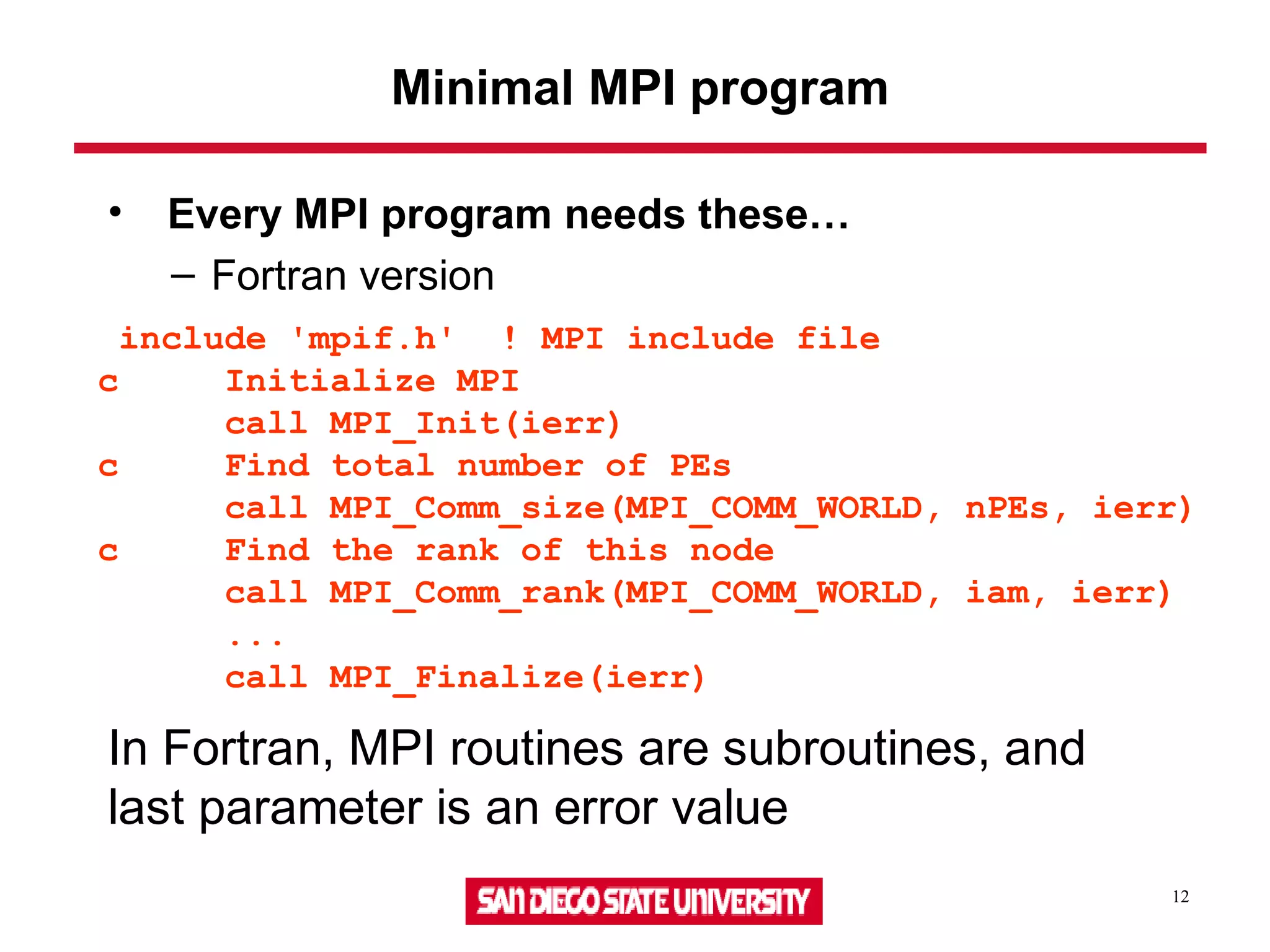
Minimal MPI program
• Every MPI program needs these…
– Fortran version
include 'mpif.h' ! MPI include file
c Initialize MPI
call MPI_Init(ierr)
c Find total number of PEs
call MPI_Comm_size(MPI_COMM_WORLD, nPEs, ierr)
c Find the rank of this node
call MPI_Comm_rank(MPI_COMM_WORLD, iam, ierr)
...
call MPI_Finalize(ierr)
In Fortran, MPI routines are subroutines, and
last parameter is an error value
13
MPI “Hello, World”
• A parallel hello world program
– Initialize MPI
– Have each node print out its node number
– Quit MPI
14
#include <stdio.h>
#include <math.h>
#include <mpi.h>
int main(argc, argv)
int argc;
char *argv[ ];
{
int myid, numprocs;
MPI_Init (&argc, &argv) ;
MPI_Comm_size(MPI_COMM_WORLD, &numprocs) ;
MPI_Comm_rank(MPI_COMM_WORLD, &myid) ;
printf(“Hello from %dn”, myid) ;
printf(“Numprocs is %dn”, numprocs) ;
MPI_Finalize():
}
C/MPI version of “Hello, World”
15
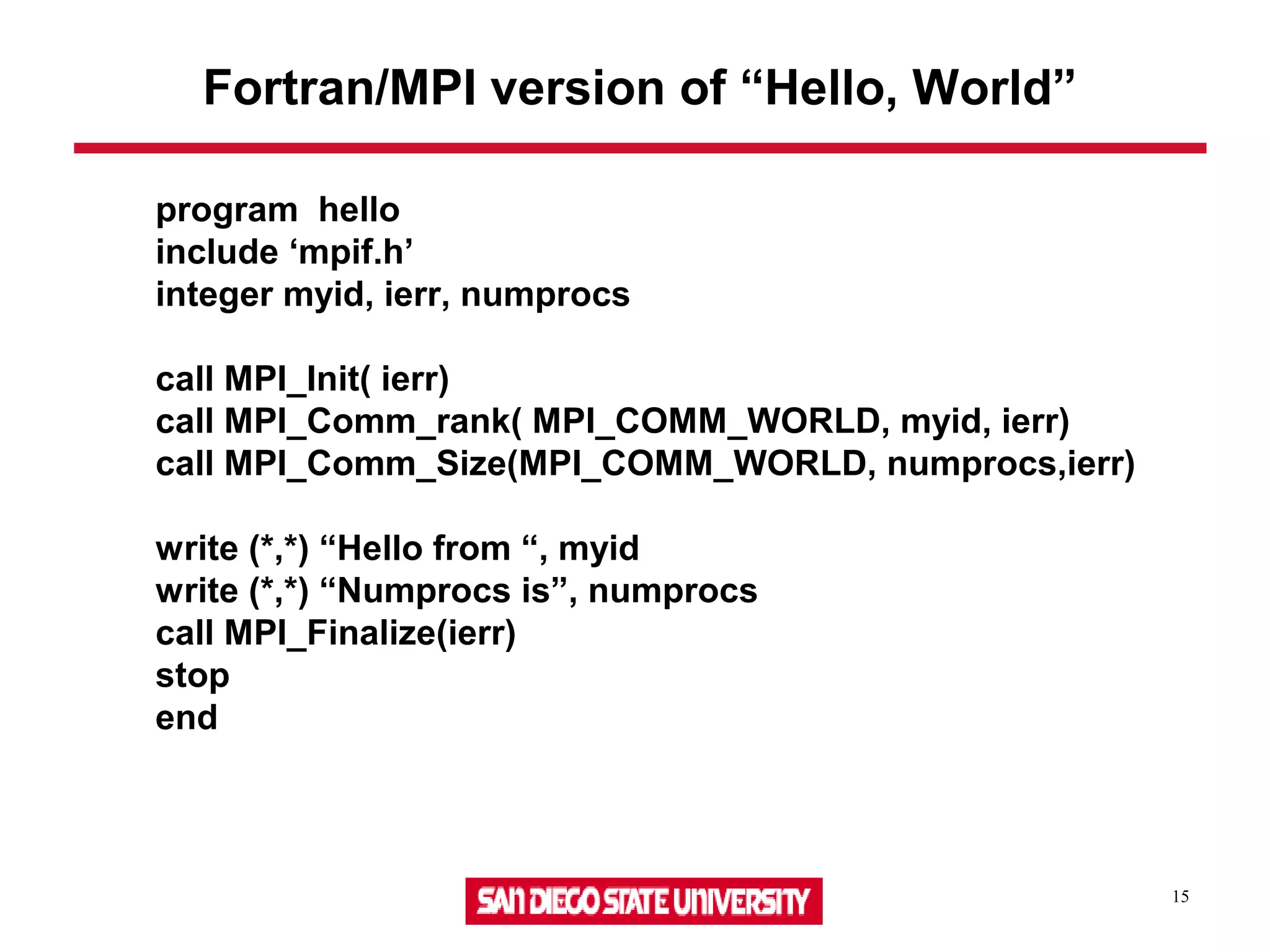
program hello
include ‘mpif.h’
integer myid, ierr, numprocs
call MPI_Init( ierr)
call MPI_Comm_rank( MPI_COMM_WORLD, myid, ierr)
call MPI_Comm_Size(MPI_COMM_WORLD, numprocs,ierr)
write (*,*) “Hello from “, myid
write (*,*) “Numprocs is”, numprocs
call MPI_Finalize(ierr)
stop
end
Fortran/MPI version of “Hello, World”
16
Basic Communications in MPI
• Data values are transferred from one processor
to another
– One process sends the data
– Another receives the data
• Synchronous
– Call does not return until the message is sent or
received
• Asynchronous
– Call indicates a start of send or receive operation,
and another call is made to determine if call has
finished
17
Synchronous Send
• MPI_Send: Sends data to another processor
• Use MPI_Receive to "get" the data
• C
– MPI_Send(&buffer,count,datatype,
destination,tag,communicator);
• Fortran
– Call MPI_Send(buffer, count, datatype,destination,
tag, communicator, ierr)
• Call blocks until message on the way
18
MPI_Send
• Buffer: The data
• Count : Length of source array (in elements, 1 for
scalars)
• Datatype : Type of data, for example
MPI_DOUBLE_PRECISION (fortran) ,
MPI_INT ( C ), etc
• Destination : Processor number of destination
processor in communicator
• Tag : Message type (arbitrary integer)
• Communicator : Your set of processors
• Ierr : Error return (Fortran only)
19
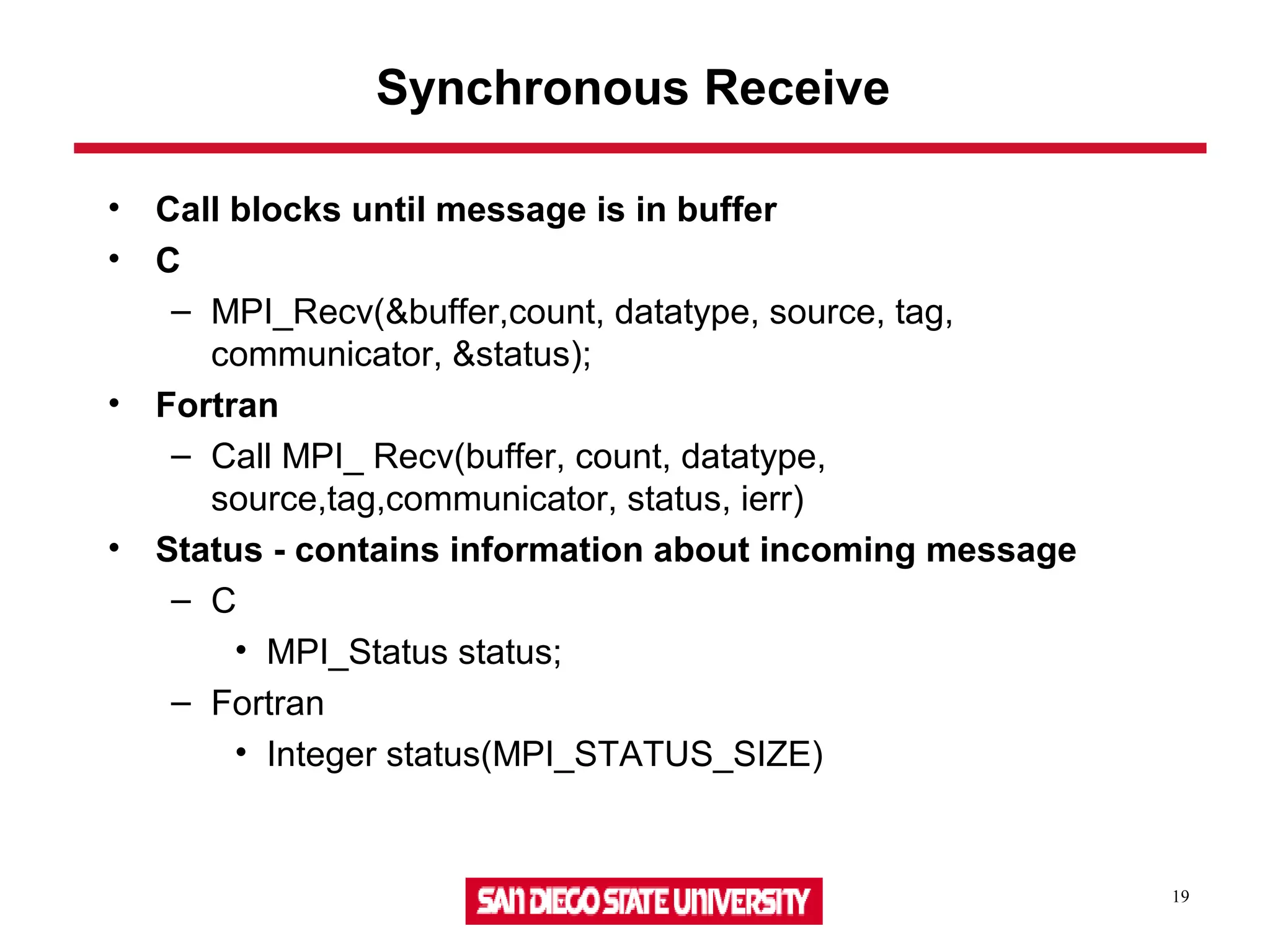
Synchronous Receive
• Call blocks until message is in buffer
• C
– MPI_Recv(&buffer,count, datatype, source, tag,
communicator, &status);
• Fortran
– Call MPI_ Recv(buffer, count, datatype,
source,tag,communicator, status, ierr)
• Status - contains information about incoming message
– C
• MPI_Status status;
– Fortran
• Integer status(MPI_STATUS_SIZE)
20
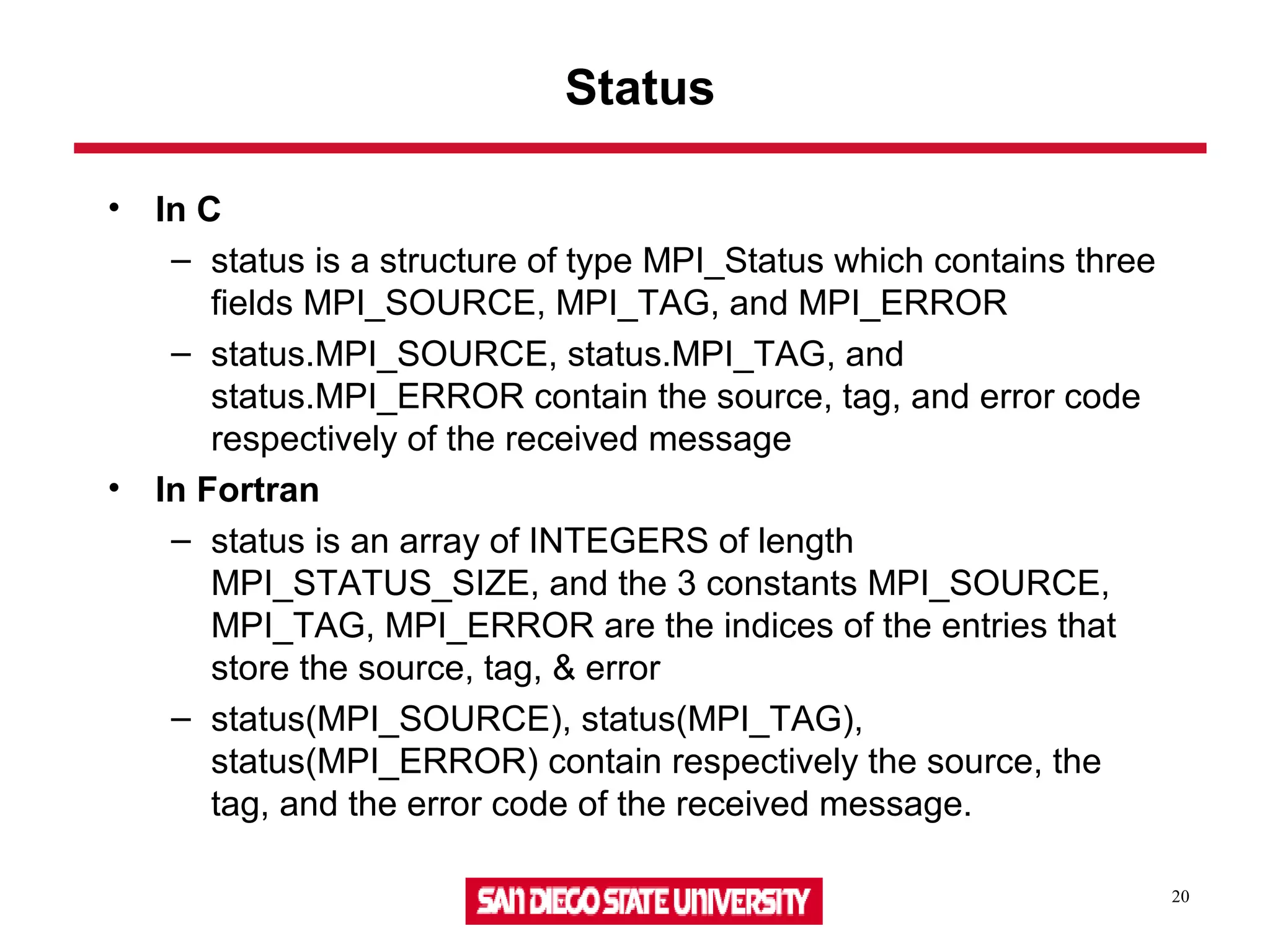
Status
• In C
– status is a structure of type MPI_Status which contains three
fields MPI_SOURCE, MPI_TAG, and MPI_ERROR
– status.MPI_SOURCE, status.MPI_TAG, and
status.MPI_ERROR contain the source, tag, and error code
respectively of the received message
• In Fortran
– status is an array of INTEGERS of length
MPI_STATUS_SIZE, and the 3 constants MPI_SOURCE,
MPI_TAG, MPI_ERROR are the indices of the entries that
store the source, tag, & error
– status(MPI_SOURCE), status(MPI_TAG),
status(MPI_ERROR) contain respectively the source, the
tag, and the error code of the received message.
21
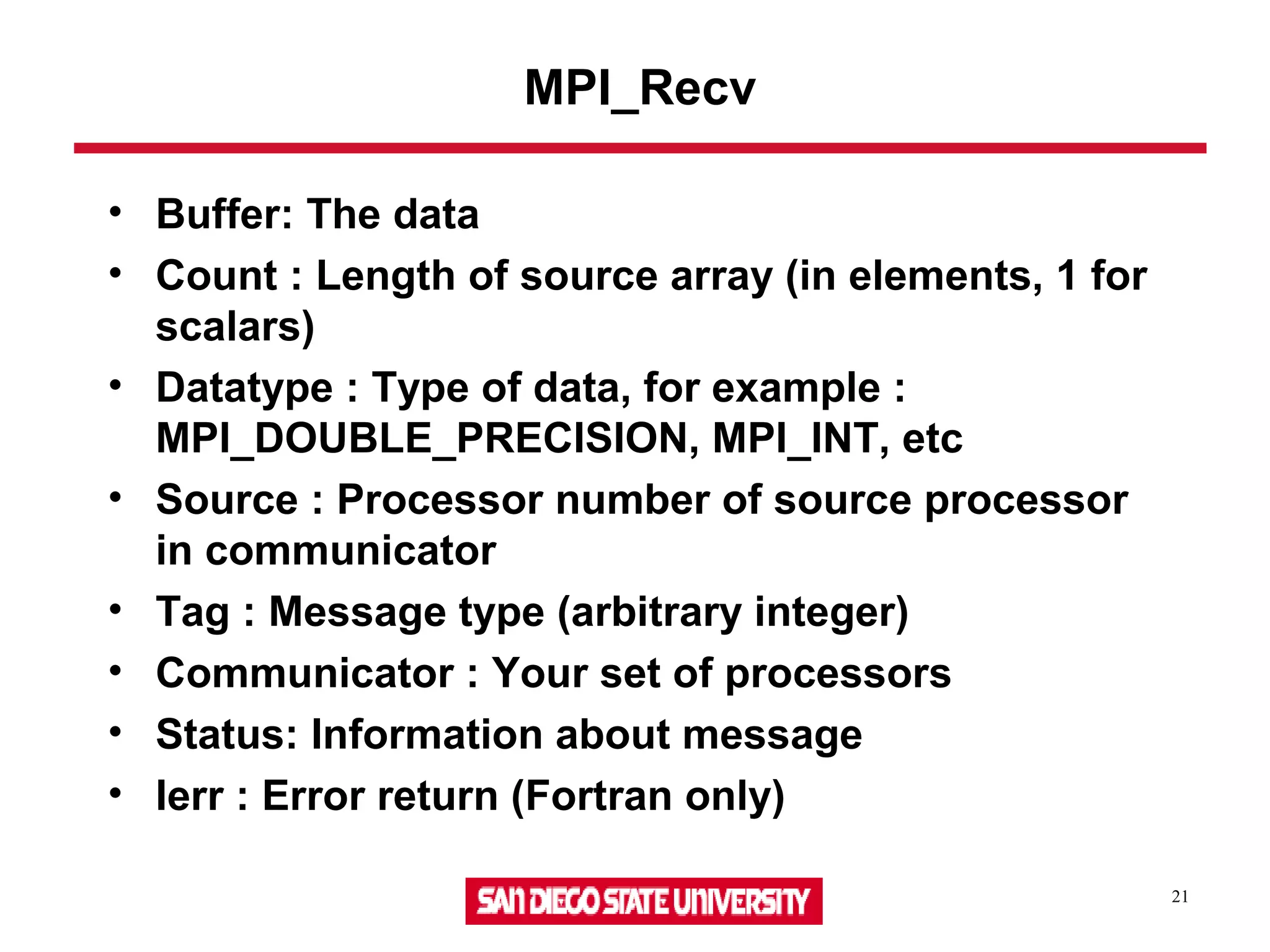
MPI_Recv
• Buffer: The data
• Count : Length of source array (in elements, 1 for
scalars)
• Datatype : Type of data, for example :
MPI_DOUBLE_PRECISION, MPI_INT, etc
• Source : Processor number of source processor
in communicator
• Tag : Message type (arbitrary integer)
• Communicator : Your set of processors
• Status: Information about message
• Ierr : Error return (Fortran only)
22
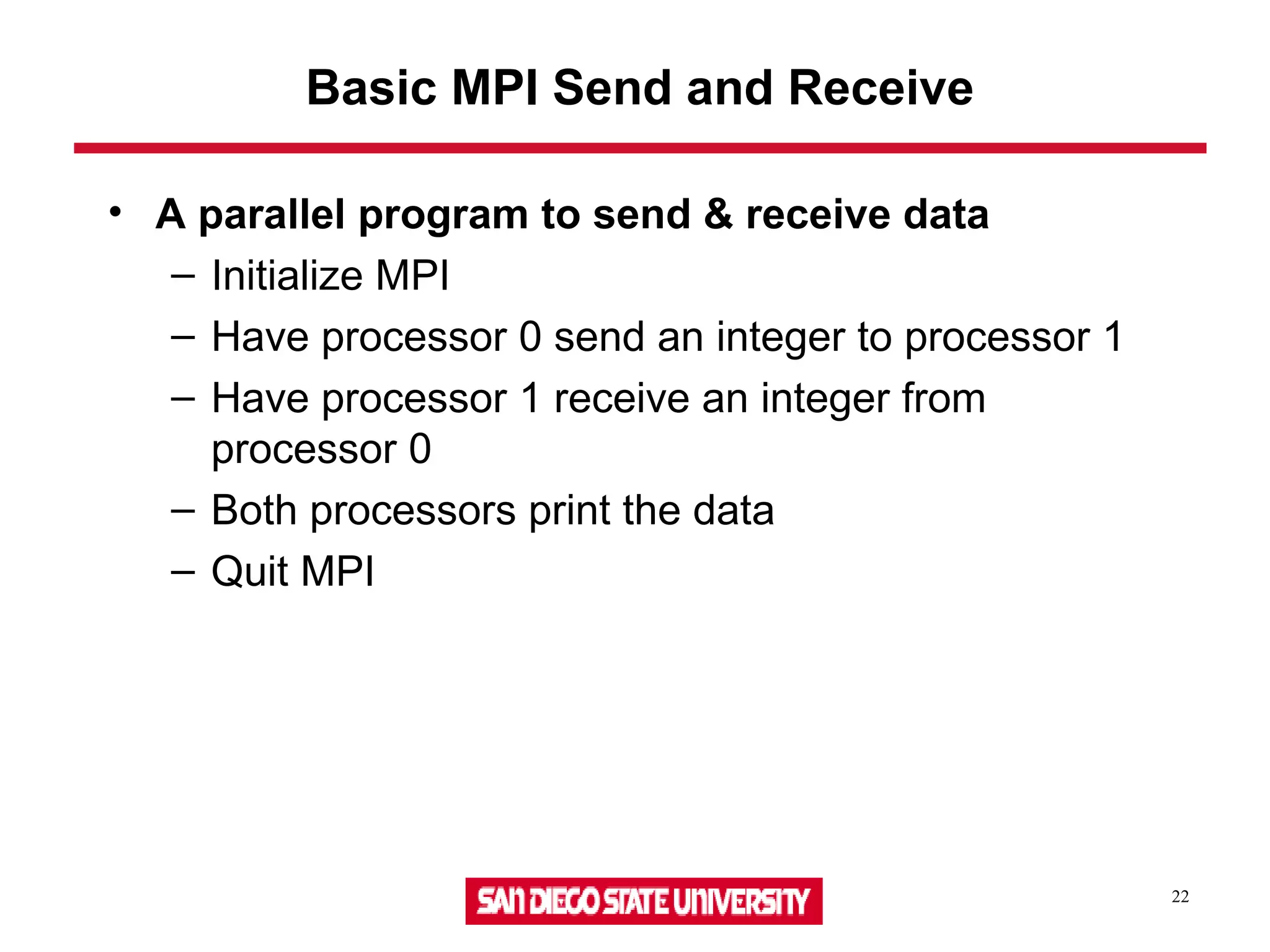
Basic MPI Send and Receive
• A parallel program to send & receive data
– Initialize MPI
– Have processor 0 send an integer to processor 1
– Have processor 1 receive an integer from
processor 0
– Both processors print the data
– Quit MPI
23
Simple Send & Receive Program
#include <stdio.h>
#include "mpi.h"
#include <math.h>
/************************************************************
This is a simple send/receive program in MPI
************************************************************/
int main(argc,argv)
int argc;
char *argv[];
{
int myid, numprocs;
int tag,source,destination,count;
int buffer;
MPI_Status status;
MPI_Init(&argc,&argv);
MPI_Comm_size(MPI_COMM_WORLD,&numprocs);
MPI_Comm_rank(MPI_COMM_WORLD,&myid);
24
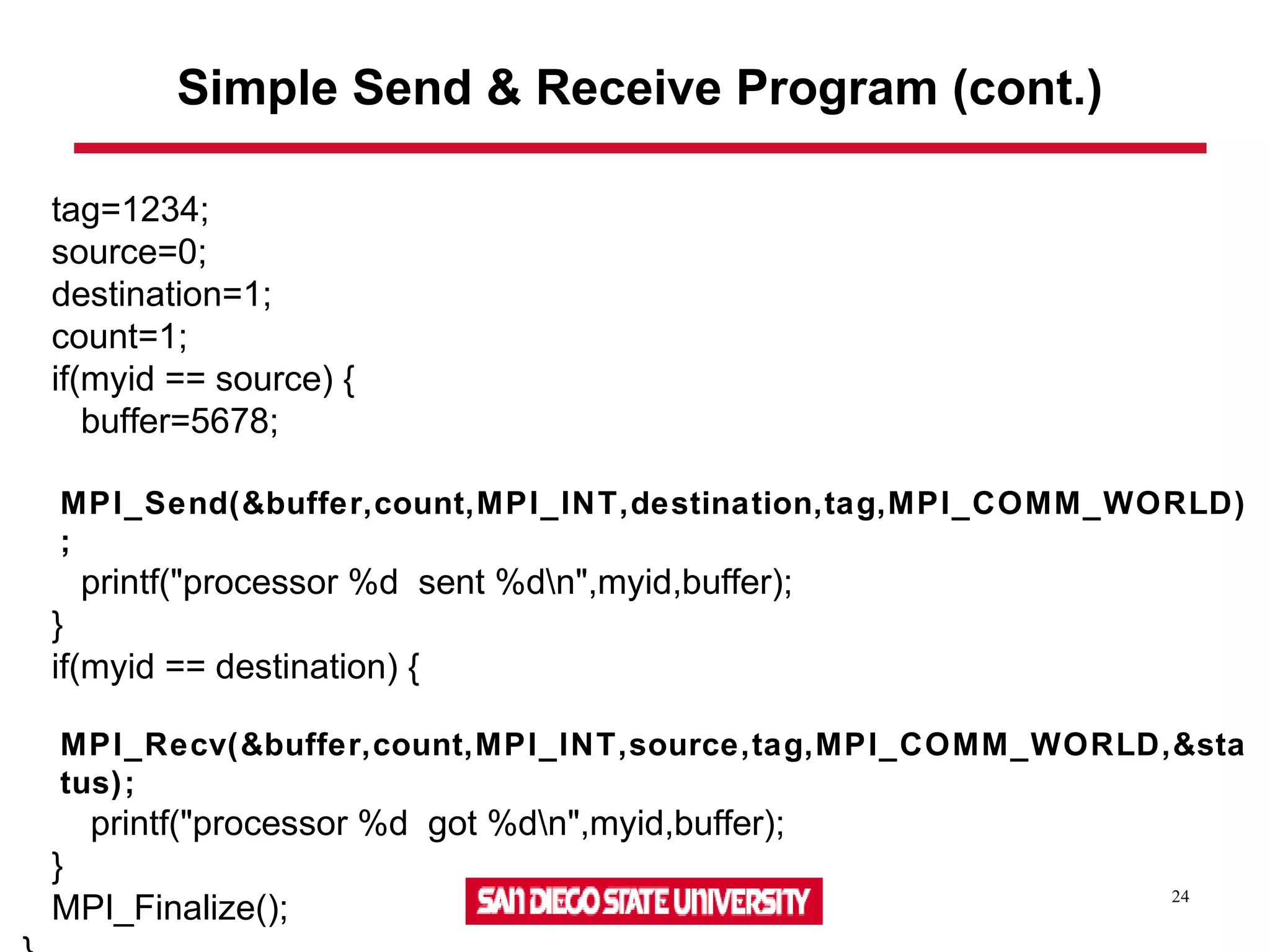
Simple Send & Receive Program (cont.)
tag=1234;
source=0;
destination=1;
count=1;
if(myid == source) {
buffer=5678;
MPI_Send(&buffer,count,MPI_INT,destination,tag,MPI_COMM_WORLD)
;
printf("processor %d sent %dn",myid,buffer);
}
if(myid == destination) {
MPI_Recv(&buffer,count,MPI_INT,source,tag,MPI_COMM_WORLD,&sta
tus);
printf("processor %d got %dn",myid,buffer);
}
MPI_Finalize();
25
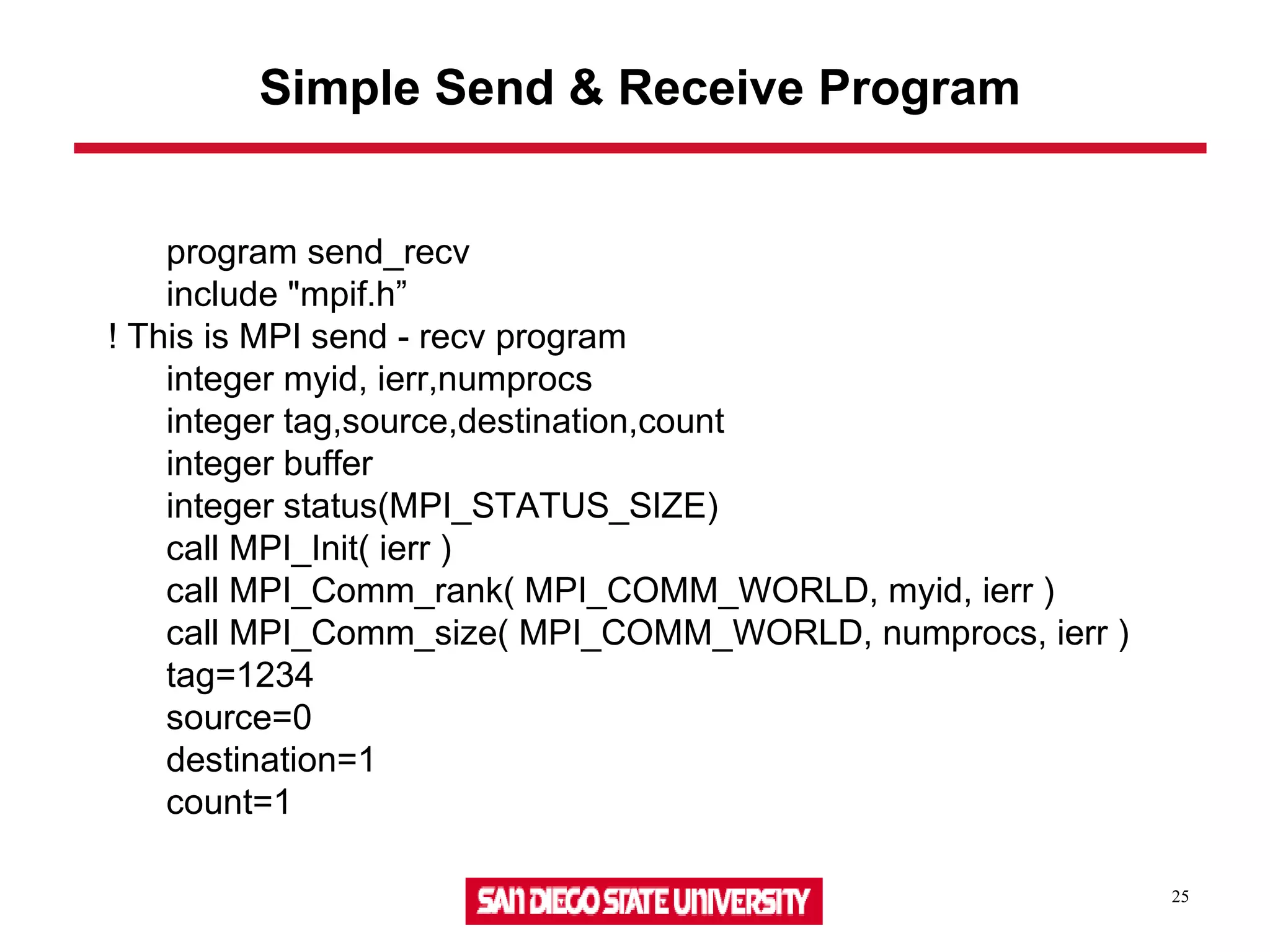
Simple Send & Receive Program
program send_recv
include "mpif.h”
! This is MPI send - recv program
integer myid, ierr,numprocs
integer tag,source,destination,count
integer buffer
integer status(MPI_STATUS_SIZE)
call MPI_Init( ierr )
call MPI_Comm_rank( MPI_COMM_WORLD, myid, ierr )
call MPI_Comm_size( MPI_COMM_WORLD, numprocs, ierr )
tag=1234
source=0
destination=1
count=1
26
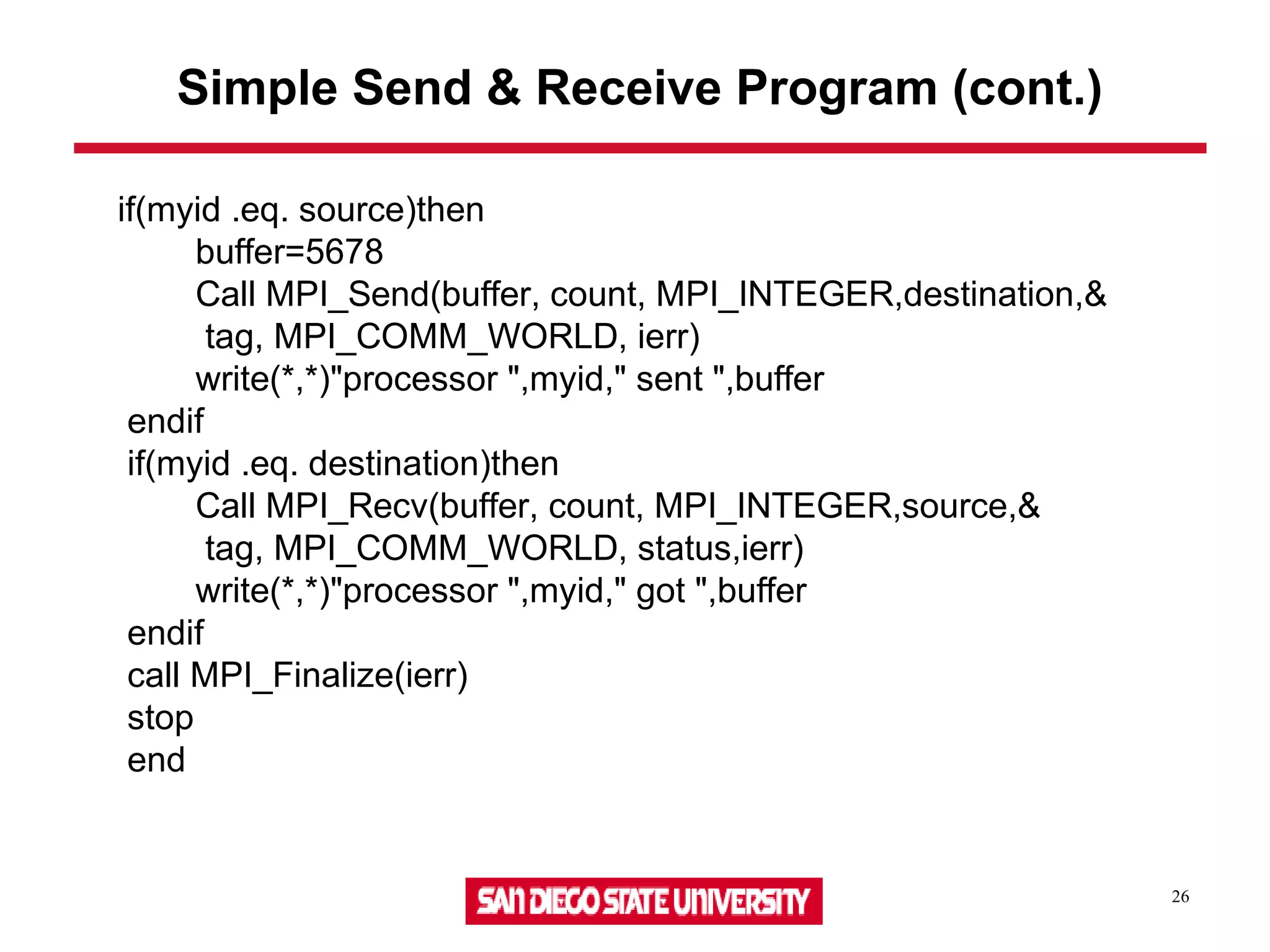
Simple Send & Receive Program (cont.)
if(myid .eq. source)then
buffer=5678
Call MPI_Send(buffer, count, MPI_INTEGER,destination,&
tag, MPI_COMM_WORLD, ierr)
write(*,*)"processor ",myid," sent ",buffer
endif
if(myid .eq. destination)then
Call MPI_Recv(buffer, count, MPI_INTEGER,source,&
tag, MPI_COMM_WORLD, status,ierr)
write(*,*)"processor ",myid," got ",buffer
endif
call MPI_Finalize(ierr)
stop
end
27
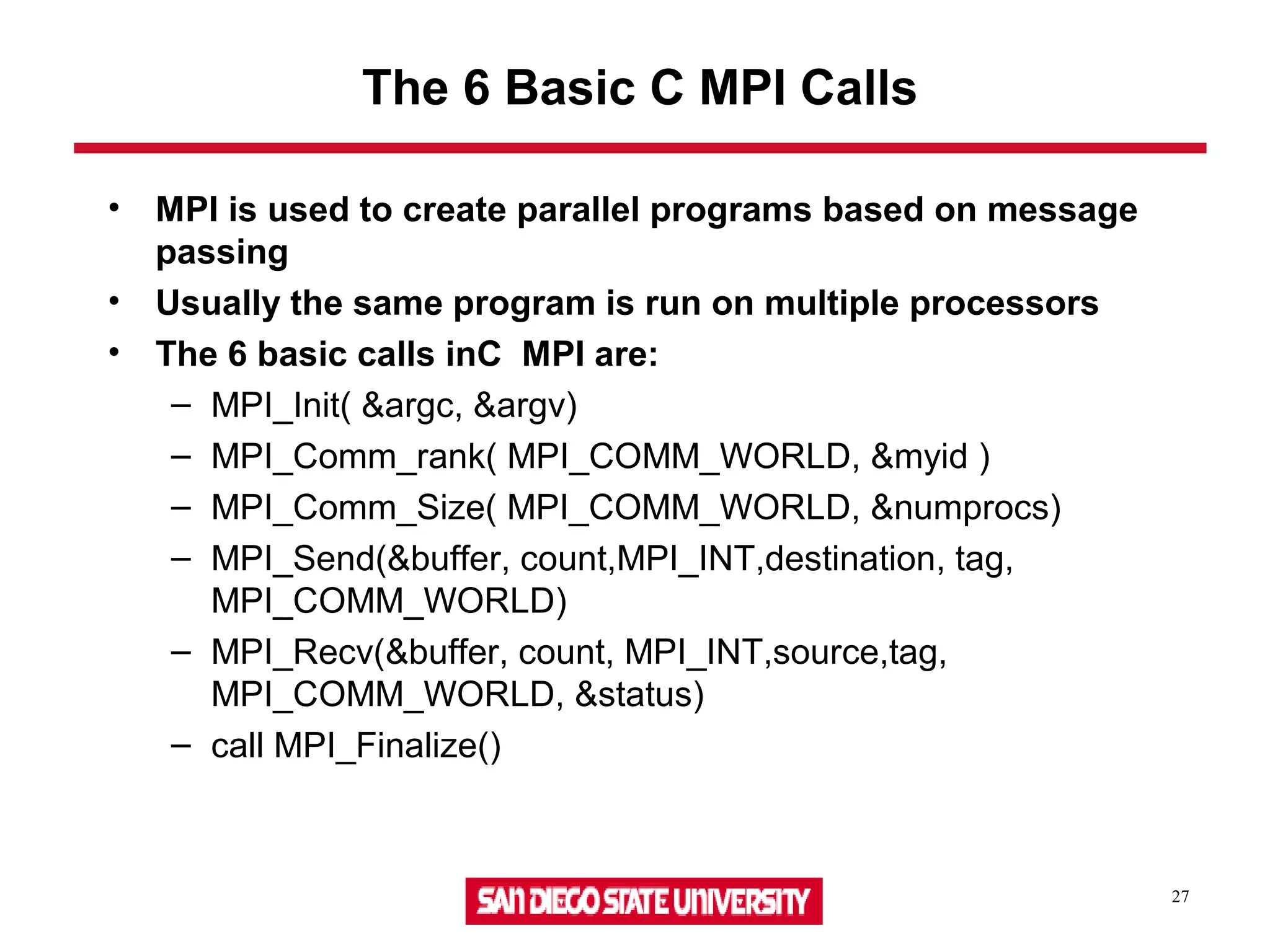
The 6 Basic C MPI Calls
• MPI is used to create parallel programs based on message
passing
• Usually the same program is run on multiple processors
• The 6 basic calls inC MPI are:
– MPI_Init( &argc, &argv)
– MPI_Comm_rank( MPI_COMM_WORLD, &myid )
– MPI_Comm_Size( MPI_COMM_WORLD, &numprocs)
– MPI_Send(&buffer, count,MPI_INT,destination, tag,
MPI_COMM_WORLD)
– MPI_Recv(&buffer, count, MPI_INT,source,tag,
MPI_COMM_WORLD, &status)
– call MPI_Finalize()
28
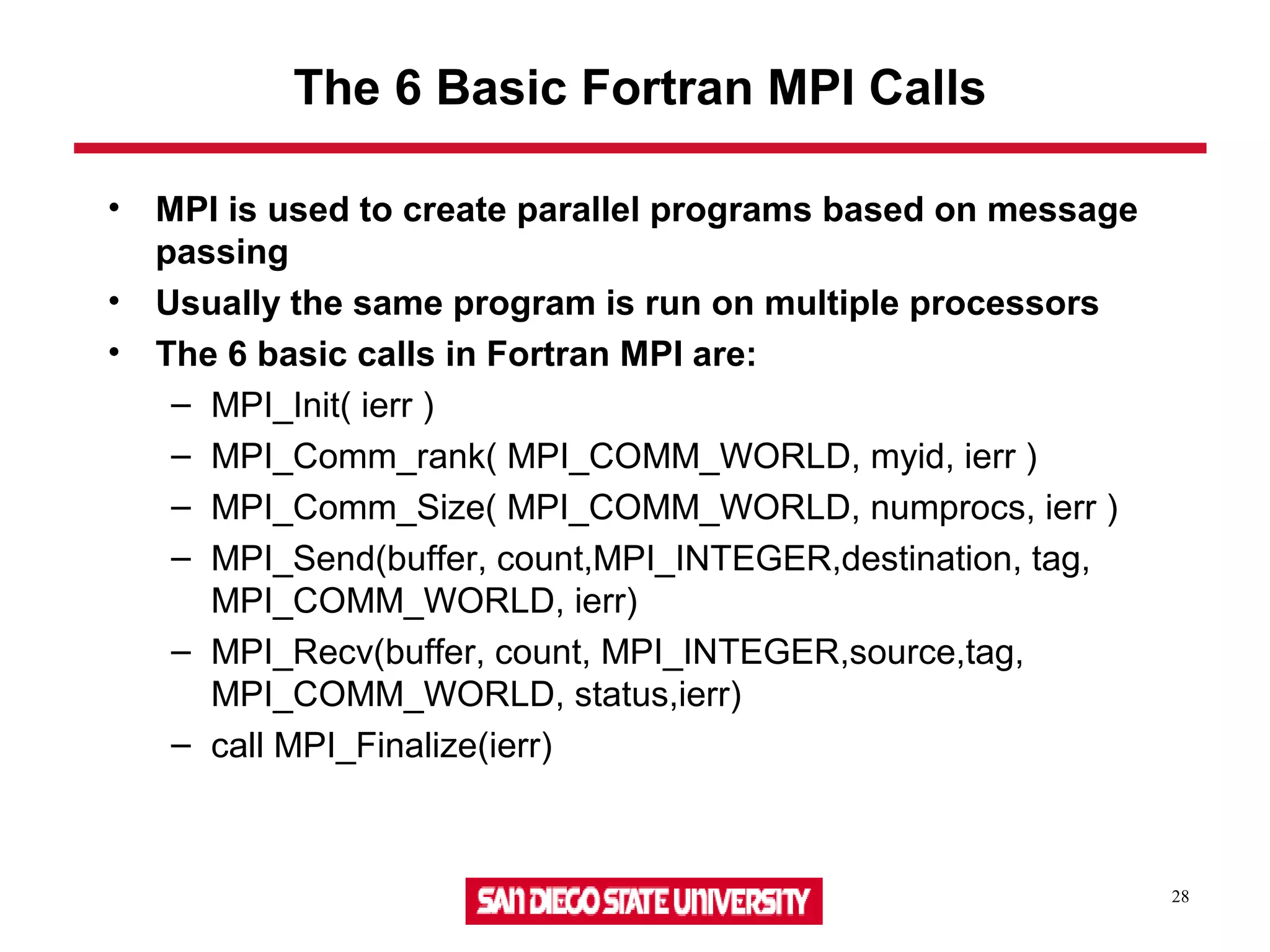
The 6 Basic Fortran MPI Calls
• MPI is used to create parallel programs based on message
passing
• Usually the same program is run on multiple processors
• The 6 basic calls in Fortran MPI are:
– MPI_Init( ierr )
– MPI_Comm_rank( MPI_COMM_WORLD, myid, ierr )
– MPI_Comm_Size( MPI_COMM_WORLD, numprocs, ierr )
– MPI_Send(buffer, count,MPI_INTEGER,destination, tag,
MPI_COMM_WORLD, ierr)
– MPI_Recv(buffer, count, MPI_INTEGER,source,tag,
MPI_COMM_WORLD, status,ierr)
– call MPI_Finalize(ierr)

Lecture9

  • 1.
    Message Passing Interface(MPI) 1 Amit Majumdar CS 505, Spring 2002
  • 2.
    2 Lecture Overview • Advantagesof Message Passing • Background on MPI • “Hello, world” in MPI • Key Concepts in MPI • Basic Communications in MPI • Simple send and receive program
  • 3.
    3 Advantages of MessagePassing • Universality : MP model fits well on separate processors connected by fast/slow network. Matches the hardware of most of today’s parallel supercomputers as well as network of workstations (NOW) • Expressivity : MP has been found to be a useful and complete model in which to express parallel algorithms. It provides the control missing from data parallel or compiler based models • Ease of debugging : Debugging of parallel programs remain a challenging research area. Debugging is easier for MPI paradigm than shared memory paradigm (even if it is hard to believe)
  • 4.
    4 Advantages of MessagePassing • Performance: – This is the most compelling reason why MP will remain a permanent part of parallel computing environment – As modern CPUs become faster, management of their caches and the memory hierarchy is the key to getting most out of them – MP allows a way for the programmer to explicitly associate specific data with processes and allows the compiler and cache management hardware to function fully – Memory bound applications can exhibit superlinear speedup when run on multiple PEs compare to single PE of MP machines
  • 5.
    5 Background on MPI •MPI - Message Passing Interface – Library standard defined by committee of vendors, implementers, and parallel programmer – Used to create parallel SPMD programs based on message passing • Available on almost all parallel machines in C and Fortran • About 125 routines including advanced routines • 6 basic routines
  • 6.
    6 MPI Implementations • Mostparallel machine vendors have optimized versions • Others: – http://www-unix.mcs.anl.gov/mpi/mpich/ – GLOBUS: – http://www3.niu.edu/mpi/ – http://www.globus.org
  • 7.
    7 Key Concepts ofMPI • Used to create parallel SPMD programs based on message passing • Normally the same program is running on several different nodes • Nodes communicate using message passing
  • 8.
    8 Include files • TheMPI include file – C: mpi.h – Fortran: mpif.h (a f90 module is a good place for this) • Defines many constants used within MPI programs • In C defines the interfaces for the functions • Compilers know where to find the include files
  • 9.
    9 Communicators • Communicators – Aparameter for most MPI calls – A collection of processors working on some part of a parallel job – MPI_COMM_WORLD is defined in the MPI include file as all of the processors in your job – Can create subsets of MPI_COMM_WORLD – Processors within a communicator are assigned numbers 0 to n-1
  • 10.
    10 Data types • Datatypes – When sending a message, it is given a data type – Predefined types correspond to "normal" types • MPI_REAL , MPI_FLOAT - Fortran real and C float respectively • MPI_DOUBLE_PRECISION , MPI_DOUBLE - Fortan double precision and C double repectively • MPI_INTEGER and MPI_INT - Fortran and C integer respectively – User can also create user-defined types
  • 11.
    11 Minimal MPI program •Every MPI program needs these… – C version #include <mpi.h> /* the mpi include file */ /* Initialize MPI */ ierr=MPI_Init(&argc, &argv); /* How many total PEs are there */ ierr=MPI_Comm_size(MPI_COMM_WORLD, &nPEs); /* What node am I (what is my rank? */ ierr=MPI_Comm_rank(MPI_COMM_WORLD, &iam); ... ierr=MPI_Finalize(); In C MPI routines are functions and return an error value
  • 12.
    12 Minimal MPI program •Every MPI program needs these… – Fortran version include 'mpif.h' ! MPI include file c Initialize MPI call MPI_Init(ierr) c Find total number of PEs call MPI_Comm_size(MPI_COMM_WORLD, nPEs, ierr) c Find the rank of this node call MPI_Comm_rank(MPI_COMM_WORLD, iam, ierr) ... call MPI_Finalize(ierr) In Fortran, MPI routines are subroutines, and last parameter is an error value
  • 13.
    13 MPI “Hello, World” •A parallel hello world program – Initialize MPI – Have each node print out its node number – Quit MPI
  • 14.
    14 #include <stdio.h> #include <math.h> #include<mpi.h> int main(argc, argv) int argc; char *argv[ ]; { int myid, numprocs; MPI_Init (&argc, &argv) ; MPI_Comm_size(MPI_COMM_WORLD, &numprocs) ; MPI_Comm_rank(MPI_COMM_WORLD, &myid) ; printf(“Hello from %dn”, myid) ; printf(“Numprocs is %dn”, numprocs) ; MPI_Finalize(): } C/MPI version of “Hello, World”
  • 15.
    15 program hello include ‘mpif.h’ integermyid, ierr, numprocs call MPI_Init( ierr) call MPI_Comm_rank( MPI_COMM_WORLD, myid, ierr) call MPI_Comm_Size(MPI_COMM_WORLD, numprocs,ierr) write (*,*) “Hello from “, myid write (*,*) “Numprocs is”, numprocs call MPI_Finalize(ierr) stop end Fortran/MPI version of “Hello, World”
  • 16.
    16 Basic Communications inMPI • Data values are transferred from one processor to another – One process sends the data – Another receives the data • Synchronous – Call does not return until the message is sent or received • Asynchronous – Call indicates a start of send or receive operation, and another call is made to determine if call has finished
  • 17.
    17 Synchronous Send • MPI_Send:Sends data to another processor • Use MPI_Receive to "get" the data • C – MPI_Send(&buffer,count,datatype, destination,tag,communicator); • Fortran – Call MPI_Send(buffer, count, datatype,destination, tag, communicator, ierr) • Call blocks until message on the way
  • 18.
    18 MPI_Send • Buffer: Thedata • Count : Length of source array (in elements, 1 for scalars) • Datatype : Type of data, for example MPI_DOUBLE_PRECISION (fortran) , MPI_INT ( C ), etc • Destination : Processor number of destination processor in communicator • Tag : Message type (arbitrary integer) • Communicator : Your set of processors • Ierr : Error return (Fortran only)
  • 19.
    19 Synchronous Receive • Callblocks until message is in buffer • C – MPI_Recv(&buffer,count, datatype, source, tag, communicator, &status); • Fortran – Call MPI_ Recv(buffer, count, datatype, source,tag,communicator, status, ierr) • Status - contains information about incoming message – C • MPI_Status status; – Fortran • Integer status(MPI_STATUS_SIZE)
  • 20.
    20 Status • In C –status is a structure of type MPI_Status which contains three fields MPI_SOURCE, MPI_TAG, and MPI_ERROR – status.MPI_SOURCE, status.MPI_TAG, and status.MPI_ERROR contain the source, tag, and error code respectively of the received message • In Fortran – status is an array of INTEGERS of length MPI_STATUS_SIZE, and the 3 constants MPI_SOURCE, MPI_TAG, MPI_ERROR are the indices of the entries that store the source, tag, & error – status(MPI_SOURCE), status(MPI_TAG), status(MPI_ERROR) contain respectively the source, the tag, and the error code of the received message.
  • 21.
    21 MPI_Recv • Buffer: Thedata • Count : Length of source array (in elements, 1 for scalars) • Datatype : Type of data, for example : MPI_DOUBLE_PRECISION, MPI_INT, etc • Source : Processor number of source processor in communicator • Tag : Message type (arbitrary integer) • Communicator : Your set of processors • Status: Information about message • Ierr : Error return (Fortran only)
  • 22.
    22 Basic MPI Sendand Receive • A parallel program to send & receive data – Initialize MPI – Have processor 0 send an integer to processor 1 – Have processor 1 receive an integer from processor 0 – Both processors print the data – Quit MPI
  • 23.
    23 Simple Send &Receive Program #include <stdio.h> #include "mpi.h" #include <math.h> /************************************************************ This is a simple send/receive program in MPI ************************************************************/ int main(argc,argv) int argc; char *argv[]; { int myid, numprocs; int tag,source,destination,count; int buffer; MPI_Status status; MPI_Init(&argc,&argv); MPI_Comm_size(MPI_COMM_WORLD,&numprocs); MPI_Comm_rank(MPI_COMM_WORLD,&myid);
  • 24.
    24 Simple Send &Receive Program (cont.) tag=1234; source=0; destination=1; count=1; if(myid == source) { buffer=5678; MPI_Send(&buffer,count,MPI_INT,destination,tag,MPI_COMM_WORLD) ; printf("processor %d sent %dn",myid,buffer); } if(myid == destination) { MPI_Recv(&buffer,count,MPI_INT,source,tag,MPI_COMM_WORLD,&sta tus); printf("processor %d got %dn",myid,buffer); } MPI_Finalize();
  • 25.
    25 Simple Send &Receive Program program send_recv include "mpif.h” ! This is MPI send - recv program integer myid, ierr,numprocs integer tag,source,destination,count integer buffer integer status(MPI_STATUS_SIZE) call MPI_Init( ierr ) call MPI_Comm_rank( MPI_COMM_WORLD, myid, ierr ) call MPI_Comm_size( MPI_COMM_WORLD, numprocs, ierr ) tag=1234 source=0 destination=1 count=1
  • 26.
    26 Simple Send &Receive Program (cont.) if(myid .eq. source)then buffer=5678 Call MPI_Send(buffer, count, MPI_INTEGER,destination,& tag, MPI_COMM_WORLD, ierr) write(*,*)"processor ",myid," sent ",buffer endif if(myid .eq. destination)then Call MPI_Recv(buffer, count, MPI_INTEGER,source,& tag, MPI_COMM_WORLD, status,ierr) write(*,*)"processor ",myid," got ",buffer endif call MPI_Finalize(ierr) stop end
  • 27.
    27 The 6 BasicC MPI Calls • MPI is used to create parallel programs based on message passing • Usually the same program is run on multiple processors • The 6 basic calls inC MPI are: – MPI_Init( &argc, &argv) – MPI_Comm_rank( MPI_COMM_WORLD, &myid ) – MPI_Comm_Size( MPI_COMM_WORLD, &numprocs) – MPI_Send(&buffer, count,MPI_INT,destination, tag, MPI_COMM_WORLD) – MPI_Recv(&buffer, count, MPI_INT,source,tag, MPI_COMM_WORLD, &status) – call MPI_Finalize()
  • 28.
    28 The 6 BasicFortran MPI Calls • MPI is used to create parallel programs based on message passing • Usually the same program is run on multiple processors • The 6 basic calls in Fortran MPI are: – MPI_Init( ierr ) – MPI_Comm_rank( MPI_COMM_WORLD, myid, ierr ) – MPI_Comm_Size( MPI_COMM_WORLD, numprocs, ierr ) – MPI_Send(buffer, count,MPI_INTEGER,destination, tag, MPI_COMM_WORLD, ierr) – MPI_Recv(buffer, count, MPI_INTEGER,source,tag, MPI_COMM_WORLD, status,ierr) – call MPI_Finalize(ierr)