PRESENTATION
ON
WHY INDUSTRIAL
REVOLUTION STARTED IN
BRITIAN
PREPARED BY
BIBHUSHAN KC
INDUSTRIAL REVOLUTION AND
INDUSTRIALIZATION
 Industrialization: The process in which a
society transforms itself from a primarily
agricultural society into one based on the
manufacturing of goods and services
 Industrial Revolution: A period of major
industrialization that took place during the
late 1700s and early 1800s.
NATURAL RESOURCES
Rich in natural resources
Large number of harbors and rivers that could
be used for shipping
Huge supplies of iron and coal---raw materials
for the building of machines and fueling the
new machines
The damp climate was good for textile
production, because it helped to keep the
fibers in the material soft and easy to work
with.
THE AGRICULTURAL REVOLUTION
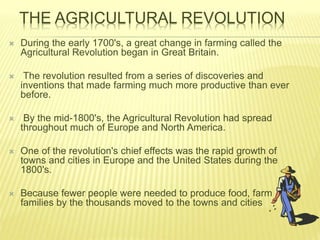
 During the early 1700's, a great change in farming called the
Agricultural Revolution began in Great Britain.
 The revolution resulted from a series of discoveries and
inventions that made farming much more productive than ever
before.
 By the mid-1800's, the Agricultural Revolution had spread
throughout much of Europe and North America.
 One of the revolution's chief effects was the rapid growth of
towns and cities in Europe and the United States during the
1800's.
 Because fewer people were needed to produce food, farm
families by the thousands moved to the towns and cities
COLONIES AND MARKETS
 England had more colonies than any other
nation
 Its colonies gave England access to
enormous markets and vast amounts of raw
materials
 Britain purchased and imported raw materials
from their colonies.
 From these raw materials, British companies
produced manufactured goods which they
sold back to the colonies and to Europe.
SOCIAL FACTORS
 Most people moved to the cities instead of living in
rural areas.
 By the mid 1800s, 70% to 80% of Britain’s
population lived in urban areas.
 British society was organized in a less rigid and
hierarchical manner than France or Germany who
held on to feudalism.
 British society was fairly egalitarian.
 The most significant social class in Britain was the
middle class that was comprised of merchants and
artisans.
OPENNESS TO NEW IDEAS
 Development of entrepreneurship
 Ambitious upper and middle class people
willing to invest in new inventions and
industries
 Not afraid to take risks to make a profit
SCIENTIFIC INVENTIONS
 British people were interested in science and
technology which led to Scientific Revolution
a)John Kay---flying shuttle
b)James Hargreaves---spinning jenny
c)Richard Arkwright---water frame
d)Samuel Crompton---spinning mule
e)Edmund Cartwright---power loom
(all of these led to the development of textile
factories)
f)James Watt---steam engine
g)Henry Bessemer---inexpensive way to make
steel
h)Thomas Telford & John Mc Adam---paving roads
i)Richard Trevithick---steam locomotive
NO CIVIL WAR/POLITICAL STABILITY
 Britain fought many wars during the 1700s, but
never on British soil.
 So they never had to rebuild farms or towns due to
war damages.
 British citizens did not have to worry about the
threat of war destroying their property and had more
time to consider ways to improve the quality of their
lives.
 There were no internal trade barriers within Britain
unlike most European countries.
Why industrial revolution started in britian

Why industrial revolution started in britian

  • 1.
    PRESENTATION ON WHY INDUSTRIAL REVOLUTION STARTEDIN BRITIAN PREPARED BY BIBHUSHAN KC
  • 2.
    INDUSTRIAL REVOLUTION AND INDUSTRIALIZATION Industrialization: The process in which a society transforms itself from a primarily agricultural society into one based on the manufacturing of goods and services  Industrial Revolution: A period of major industrialization that took place during the late 1700s and early 1800s.
  • 3.
    NATURAL RESOURCES Rich innatural resources Large number of harbors and rivers that could be used for shipping Huge supplies of iron and coal---raw materials for the building of machines and fueling the new machines The damp climate was good for textile production, because it helped to keep the fibers in the material soft and easy to work with.
  • 4.
    THE AGRICULTURAL REVOLUTION During the early 1700's, a great change in farming called the Agricultural Revolution began in Great Britain.  The revolution resulted from a series of discoveries and inventions that made farming much more productive than ever before.  By the mid-1800's, the Agricultural Revolution had spread throughout much of Europe and North America.  One of the revolution's chief effects was the rapid growth of towns and cities in Europe and the United States during the 1800's.  Because fewer people were needed to produce food, farm families by the thousands moved to the towns and cities
  • 5.
    COLONIES AND MARKETS England had more colonies than any other nation  Its colonies gave England access to enormous markets and vast amounts of raw materials  Britain purchased and imported raw materials from their colonies.  From these raw materials, British companies produced manufactured goods which they sold back to the colonies and to Europe.
  • 6.
    SOCIAL FACTORS  Mostpeople moved to the cities instead of living in rural areas.  By the mid 1800s, 70% to 80% of Britain’s population lived in urban areas.  British society was organized in a less rigid and hierarchical manner than France or Germany who held on to feudalism.  British society was fairly egalitarian.  The most significant social class in Britain was the middle class that was comprised of merchants and artisans.
  • 7.
    OPENNESS TO NEWIDEAS  Development of entrepreneurship  Ambitious upper and middle class people willing to invest in new inventions and industries  Not afraid to take risks to make a profit
  • 8.
    SCIENTIFIC INVENTIONS  Britishpeople were interested in science and technology which led to Scientific Revolution a)John Kay---flying shuttle b)James Hargreaves---spinning jenny c)Richard Arkwright---water frame d)Samuel Crompton---spinning mule e)Edmund Cartwright---power loom (all of these led to the development of textile factories) f)James Watt---steam engine g)Henry Bessemer---inexpensive way to make steel h)Thomas Telford & John Mc Adam---paving roads i)Richard Trevithick---steam locomotive
  • 9.
    NO CIVIL WAR/POLITICALSTABILITY  Britain fought many wars during the 1700s, but never on British soil.  So they never had to rebuild farms or towns due to war damages.  British citizens did not have to worry about the threat of war destroying their property and had more time to consider ways to improve the quality of their lives.  There were no internal trade barriers within Britain unlike most European countries.

Editor's Notes

  • #3 It is the period of increased output of goods made by machines and new inventions; a series of dramatic changes in the way work was done