INDUS
   VALLEY
CIVILIZATION
• The Indus valley civilization (IVC) was a bronze
  age civilization located in the western
  region of south Asia .
• The civilization was spread over some
  1,260,000 km, making it the largest ancient
  civilization.
• The Indus valley is one of the world's earliest
  urban civilizations,
• At its peak, the Indus civilization may have had
  a population of well over five million.
  Inhabitants of the ancient Indus river valley
  developed new techniques in handicraft and
  metallurgy .
• the civilization is noted for its cities built of
  brick, roadside drainage system, and
  multistoried houses.
The Indus Valley
Civilization is also known
as the Harappan
Civilization, as the first of
its cities to be unearthed
was located at
Harappa, excavated in the
1920s in what was at the
time the Punjab province
of British India (now in
Pakistan).
 Excavation of
 Harappan sites has been
 ongoing since 1920, with
 important break
 through occurring as
 recently as 1999.
 There were earlier and
 later cultures, often
 called Early Harappan
 and Late Harappan, in
 the same area of the
 Harappan Civilization.
The Harappan
 civilization is
 sometimes called
 the Mature Harappan
 culture to distinguish
 it from these cultures.
Up to 1999, about 1,056
 cities and settlements
 have been found, of
 which 96 sites have
 been excavated mainly
 in the general region
 of the Indus river and
 its tributaries.
Among the settlements were the
 major urban centers
 of Harappa, Mohenjo-Daro
 (UNESCO World Heritage
 Site), Ganweriwala, Dholavira, an
 d Rakhigarhi.
The Harappan language is not
 directly attested and its affiliation
 is uncertain since the Indus script
 is still deciphered. A relationship
 with the Dravidian or Elamo-
 Dravidian language family is
 favored by most accounts.
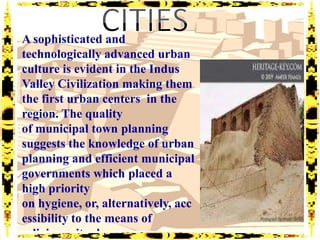
A sophisticated and
technologically advanced urban
culture is evident in the Indus
Valley Civilization making them
the first urban centers in the
region. The quality
of municipal town planning
suggests the knowledge of urban
planning and efficient municipal
governments which placed a
high priority
on hygiene, or, alternatively, acc
essibility to the means of
religious ritual.
From a room that appears to have been set
aside for bathing, waste water was directed
to covered drains, which lined the major
streets. Houses opened only to
inner courtyards and smaller lanes. The
house-building in some villages in the
region still resembles in some respects the
house-building of the Harappan.
The ancient Indus systems of sewerage and
drainage that were developed and used in
cities throughout the Indus region were far
more advanced than any found in
contemporary urban sites in the Middle
East and even more efficient than those in
many areas of Pakistan and India today.
Archaeological records provide no
immediate answers for a center of power
or for depictions of people in power in
Harappan society. But, there are
indications of complex decisions being
taken and implemented. For instance, the
extraordinary uniformity of Harappan
artifacts as evident in
pottery, seals, weights and bricks. These
are the major assumptions:
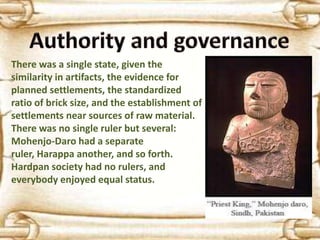
There was a single state, given the
similarity in artifacts, the evidence for
planned settlements, the standardized
ratio of brick size, and the establishment of
settlements near sources of raw material.
There was no single ruler but several:
Mohenjo-Daro had a separate
ruler, Harappa another, and so forth.
Hardpan society had no rulers, and
everybody enjoyed equal status.
Various sculptures, seals, pottery, gold jewelry, and
anatomically detailed figurines in terracotta, bronze,
and steatite have been found at excavation sites.
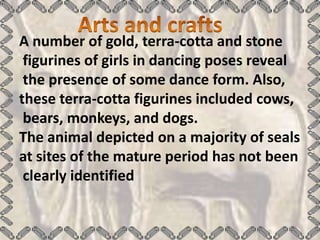
A number of gold, terra-cotta and stone figurines of
girls in dancing poses reveal the presence of
some dance form. Also, these terra-cotta figurines
included cows, bears, monkeys, and dogs. The animal
depicted on a majority of seals at sites of the mature
period has not been clearly identified.
Various sculptures, seals, pottery,
 gold jewelry, and anatomically
detailed figurines in terracotta,
 bronze, and steatite have been found at excavation
sites.
A number of gold, terra-cotta and stone
 figurines of girls in dancing poses reveal
 the presence of some dance form. Also,
these terra-cotta figurines included cows,
 bears, monkeys, and dogs.
The animal depicted on a majority of seals
at sites of the mature period has not been
 clearly identified
Sir John Marshall is known to have reacted with
surprise when he saw the famous Indus bronze
statuette of a slender-limbed dancing girl in Mohenjo-
Daro:Many crafts "such as shell
working, ceramics, and agate and glazed steatite bead
making" were used in the making of
necklaces, bangles, and other ornaments from all
phases of Harappan sites and some of these crafts are
still practiced in the subcontinent today. Some make-
up and toiletry items (a special kind of combs
(kakai), the use of collyrium
and a special three-in-one toiletry
gadget) that were found in Harappan
contexts still have similar counterparts
in modern India.] Terracotta female
 figurines were found (ca. 2800-2600 BCE)
 which had red color applied to the
 "manga" (line of partition of the hair).
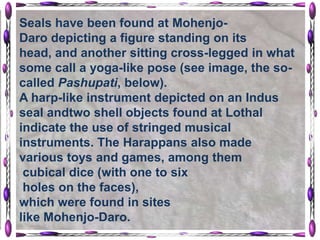
Seals have been found at Mohenjo-
Daro depicting a figure standing on its
head, and another sitting cross-legged in what
some call a yoga-like pose (see image, the so-
called Pashupati, below).
A harp-like instrument depicted on an Indus
seal andtwo shell objects found at Lothal
indicate the use of stringed musical
instruments. The Harappans also made
various toys and games, among them
 cubical dice (with one to six
 holes on the faces),
which were found in sites
like Mohenjo-Daro.
The Indus civilization's economy appears to have
depended significantly on trade, which was
facilitated by major advances in transport
technology. The IVC may have been the first
civilization to use wheeled transport. These advances
may have included bullock carts that are identical to
those seen throughout South Asia today, as well as
boats. Most of these boats were probably small, flat-
bottomed craft, perhaps driven by sail, similar to
those one can see on the Indus River today;
During 4300–3200 BCE of
the chalcolithic period (copper age), the Indus
Valley Civilization area shows ceramic
similarities with southern Turkmenistan and
northern Iran which suggest considerable
mobility and trade. During the Early Harappan
period (about 3200–2600 BCE), similarities in
pottery, seals, figurines, ornaments, etc.
document intensive caravan trade with Central
Asia and the Iranian plateau.
Some Indus valley seals
show swastikas, which are found in other
religions (worldwide), especially in Indian
religions such as Hinduism, Buddhism, and
Jainism. The earliest evidence for elements
of Hinduism are alleged to have been presen
before and during the early
Harappan period. Phallic symbols interprete
as the much later Hindu Shiva lingam have
been found in the Harappan remains.
Many Indus valley seals show animals. One motif
shows a horned figure seated in a posture
reminiscent of the Lotus position and surrounded by
animals was named by early excavators Pashupati
(lord of cattle), an epithet of the
later Hindu gods Shiva and Rudra.
the Harappan people worshipped a Mother goddess
symbolizing fertility, a common practice among
rural Hindus even today. However, this view has
been disputed by S. Clark who sees it as an
inadequate explanation of the function and
construction of many of the figurines.
Around 1800 BCE, signs of a gradual decline began to
emerge, and by around 1700 BCE, most of the cities
were abandoned. In 1953, Sir Mortimer
Wheeler proposed that the decline of the Indus
Civilization was caused by the invasion of an Indo-
European tribe from Central Asia called the "Aryans".
As evidence, he cited a group of 37 skeletons found in
various parts of Mohenjo-Daro, and passages in the
Vedas referring to battles and forts. However, scholars
soon started to reject Wheeler's theory, since the
skeletons belonged to a period after the city's
abandonment and none were found near the citadel.
A possible natural reason for the IVC's decline is
connected with climate change that is also signaled
for the neighboring areas of the Middle East: The
Indus valley climate grew significantly cooler and drier
from about 1800 BCE, linked to a general weakening
of the monsoon at that time. Alternatively, a crucial
factor may have been the disappearance of
substantial portions of the Ghaggar Hakra
river system. A tectonic event may have diverted the
system's sources toward the Ganges Plain
Harappan civi
Harappan civi

Harappan civi

  • 3.
    INDUS VALLEY CIVILIZATION
  • 4.
    • The Indusvalley civilization (IVC) was a bronze age civilization located in the western region of south Asia . • The civilization was spread over some 1,260,000 km, making it the largest ancient civilization. • The Indus valley is one of the world's earliest urban civilizations, • At its peak, the Indus civilization may have had a population of well over five million. Inhabitants of the ancient Indus river valley developed new techniques in handicraft and metallurgy . • the civilization is noted for its cities built of brick, roadside drainage system, and multistoried houses.
  • 6.
    The Indus Valley Civilizationis also known as the Harappan Civilization, as the first of its cities to be unearthed was located at Harappa, excavated in the 1920s in what was at the time the Punjab province of British India (now in Pakistan).
  • 7.
     Excavation of Harappan sites has been ongoing since 1920, with important break through occurring as recently as 1999.  There were earlier and later cultures, often called Early Harappan and Late Harappan, in the same area of the Harappan Civilization.
  • 8.
    The Harappan civilizationis sometimes called the Mature Harappan culture to distinguish it from these cultures. Up to 1999, about 1,056 cities and settlements have been found, of which 96 sites have been excavated mainly in the general region of the Indus river and its tributaries.
  • 9.
    Among the settlementswere the major urban centers of Harappa, Mohenjo-Daro (UNESCO World Heritage Site), Ganweriwala, Dholavira, an d Rakhigarhi. The Harappan language is not directly attested and its affiliation is uncertain since the Indus script is still deciphered. A relationship with the Dravidian or Elamo- Dravidian language family is favored by most accounts.
  • 10.
    A sophisticated and technologicallyadvanced urban culture is evident in the Indus Valley Civilization making them the first urban centers in the region. The quality of municipal town planning suggests the knowledge of urban planning and efficient municipal governments which placed a high priority on hygiene, or, alternatively, acc essibility to the means of religious ritual.
  • 11.
    From a roomthat appears to have been set aside for bathing, waste water was directed to covered drains, which lined the major streets. Houses opened only to inner courtyards and smaller lanes. The house-building in some villages in the region still resembles in some respects the house-building of the Harappan. The ancient Indus systems of sewerage and drainage that were developed and used in cities throughout the Indus region were far more advanced than any found in contemporary urban sites in the Middle East and even more efficient than those in many areas of Pakistan and India today.
  • 12.
    Archaeological records provideno immediate answers for a center of power or for depictions of people in power in Harappan society. But, there are indications of complex decisions being taken and implemented. For instance, the extraordinary uniformity of Harappan artifacts as evident in pottery, seals, weights and bricks. These are the major assumptions:
  • 13.
    There was asingle state, given the similarity in artifacts, the evidence for planned settlements, the standardized ratio of brick size, and the establishment of settlements near sources of raw material. There was no single ruler but several: Mohenjo-Daro had a separate ruler, Harappa another, and so forth. Hardpan society had no rulers, and everybody enjoyed equal status.
  • 16.
    Various sculptures, seals,pottery, gold jewelry, and anatomically detailed figurines in terracotta, bronze, and steatite have been found at excavation sites. A number of gold, terra-cotta and stone figurines of girls in dancing poses reveal the presence of some dance form. Also, these terra-cotta figurines included cows, bears, monkeys, and dogs. The animal depicted on a majority of seals at sites of the mature period has not been clearly identified. Various sculptures, seals, pottery, gold jewelry, and anatomically detailed figurines in terracotta, bronze, and steatite have been found at excavation sites.
  • 17.
    A number ofgold, terra-cotta and stone figurines of girls in dancing poses reveal the presence of some dance form. Also, these terra-cotta figurines included cows, bears, monkeys, and dogs. The animal depicted on a majority of seals at sites of the mature period has not been clearly identified
  • 18.
    Sir John Marshallis known to have reacted with surprise when he saw the famous Indus bronze statuette of a slender-limbed dancing girl in Mohenjo- Daro:Many crafts "such as shell working, ceramics, and agate and glazed steatite bead making" were used in the making of necklaces, bangles, and other ornaments from all phases of Harappan sites and some of these crafts are still practiced in the subcontinent today. Some make- up and toiletry items (a special kind of combs (kakai), the use of collyrium and a special three-in-one toiletry gadget) that were found in Harappan contexts still have similar counterparts in modern India.] Terracotta female figurines were found (ca. 2800-2600 BCE) which had red color applied to the "manga" (line of partition of the hair).
  • 19.
    Seals have beenfound at Mohenjo- Daro depicting a figure standing on its head, and another sitting cross-legged in what some call a yoga-like pose (see image, the so- called Pashupati, below). A harp-like instrument depicted on an Indus seal andtwo shell objects found at Lothal indicate the use of stringed musical instruments. The Harappans also made various toys and games, among them cubical dice (with one to six holes on the faces), which were found in sites like Mohenjo-Daro.
  • 20.
    The Indus civilization'seconomy appears to have depended significantly on trade, which was facilitated by major advances in transport technology. The IVC may have been the first civilization to use wheeled transport. These advances may have included bullock carts that are identical to those seen throughout South Asia today, as well as boats. Most of these boats were probably small, flat- bottomed craft, perhaps driven by sail, similar to those one can see on the Indus River today;
  • 21.
    During 4300–3200 BCEof the chalcolithic period (copper age), the Indus Valley Civilization area shows ceramic similarities with southern Turkmenistan and northern Iran which suggest considerable mobility and trade. During the Early Harappan period (about 3200–2600 BCE), similarities in pottery, seals, figurines, ornaments, etc. document intensive caravan trade with Central Asia and the Iranian plateau.
  • 22.
    Some Indus valleyseals show swastikas, which are found in other religions (worldwide), especially in Indian religions such as Hinduism, Buddhism, and Jainism. The earliest evidence for elements of Hinduism are alleged to have been presen before and during the early Harappan period. Phallic symbols interprete as the much later Hindu Shiva lingam have been found in the Harappan remains.
  • 23.
    Many Indus valleyseals show animals. One motif shows a horned figure seated in a posture reminiscent of the Lotus position and surrounded by animals was named by early excavators Pashupati (lord of cattle), an epithet of the later Hindu gods Shiva and Rudra. the Harappan people worshipped a Mother goddess symbolizing fertility, a common practice among rural Hindus even today. However, this view has been disputed by S. Clark who sees it as an inadequate explanation of the function and construction of many of the figurines.
  • 24.
    Around 1800 BCE,signs of a gradual decline began to emerge, and by around 1700 BCE, most of the cities were abandoned. In 1953, Sir Mortimer Wheeler proposed that the decline of the Indus Civilization was caused by the invasion of an Indo- European tribe from Central Asia called the "Aryans". As evidence, he cited a group of 37 skeletons found in various parts of Mohenjo-Daro, and passages in the Vedas referring to battles and forts. However, scholars soon started to reject Wheeler's theory, since the skeletons belonged to a period after the city's abandonment and none were found near the citadel.
  • 25.
    A possible naturalreason for the IVC's decline is connected with climate change that is also signaled for the neighboring areas of the Middle East: The Indus valley climate grew significantly cooler and drier from about 1800 BCE, linked to a general weakening of the monsoon at that time. Alternatively, a crucial factor may have been the disappearance of substantial portions of the Ghaggar Hakra river system. A tectonic event may have diverted the system's sources toward the Ganges Plain