Gov. HOLKAR SCIENCE COLLEGE
INDORE (M.P.)
CHEMISTRY SEMINAR
SESSION 2024-25
TOPIC: HIGHER BORANE
SUBMITTED TO: DR. NILIMA PRADHAN
SUBMITTED BY: KHUSHBOO MATRIYA
MSC.2ND SEMESTER
Higher Borane:
Table of content:
 Introduction
 Types of bonds in higher borane
 Structure and bonding in higher borane
 Classification of Higher borane
 Synthesis
Introduction:
 The hydrides of boron are known as Borane.
 Boranes are colourless and diamagnetic.
 Boranes are generally represented by two general formula:
o Bn Hn+4 :
These borane are quite stable and have high melting point, where n= 2,5,6,8,10
o Bn Hn+6 : These borane are less stable and have low melting point,
where n= 4,5,6,9,10
Ex: B6H10 (Hexaborane-10)
Types of bonds in Higher borane:
 Higher borane have majorly four types of bond:
 Terminal B-H bond ( 2centre– 2 electron):This is normal covalent bond formed
by overlapping of singly filled sp3 hybrid orbital of boron atom and singly filled
1s- orbital of hydrogen atom.
 Direct B-B bond (2centre- 2electron):This is a normal covalent bond formed by
overlapping of singly filled sp3 hybrid of two boron atoms.
 Bridging or open B-H bond (3 centre- 2electron): This type of bond formed by
overlapping of two sp3 hybrid orbitals of two boron atoms (one singly filled
and other empty) and 1s- orbital of hydrogen atom.
 Triply bridge or closed B-B-B Bond (3centre- 2electron): This type of bond
formed by overlapping os 3-sp3 hybrid orbital of 3-boron atoms. Out of these
1-sp3 hybrid orbitals empty.
Structure and bonding in higher borane:
 Structure of Diborane: (B2H6- Diborane-6),The diborane is an electron
deficient compound i.e. there are not enough valence electorns to form
the expected number of covalent bonds.
 In the structure of hydrogen atom form a bridge between two boron
atoms while the terminal hydrogen atom form normal covalent bonds with
boron atoms.
 In this figure we have:
4 terminal hydrogen atom are known as terminal hydrogens (Ht).
And two other hydrogen atoms are known as bridging hygrogen (Hb).
The two boron atoms and 4 terminal hydrogen atom lie on the same plane
while two bridging hydrogen atom lie on a perpendicular to this
plane.
Types of bond in Diborane structure:
1) Terminal bond (B-H) : 4
2) Bridging bond (B-H-B): 2
CLASSIFICATION OF BORANES:
The boranes are mainly classified as:
1) Closo-BnHn+2 :(closo-Greek for cage), Closo pertains to the
symmetrical symmetrical form that is a closed polyhedral.
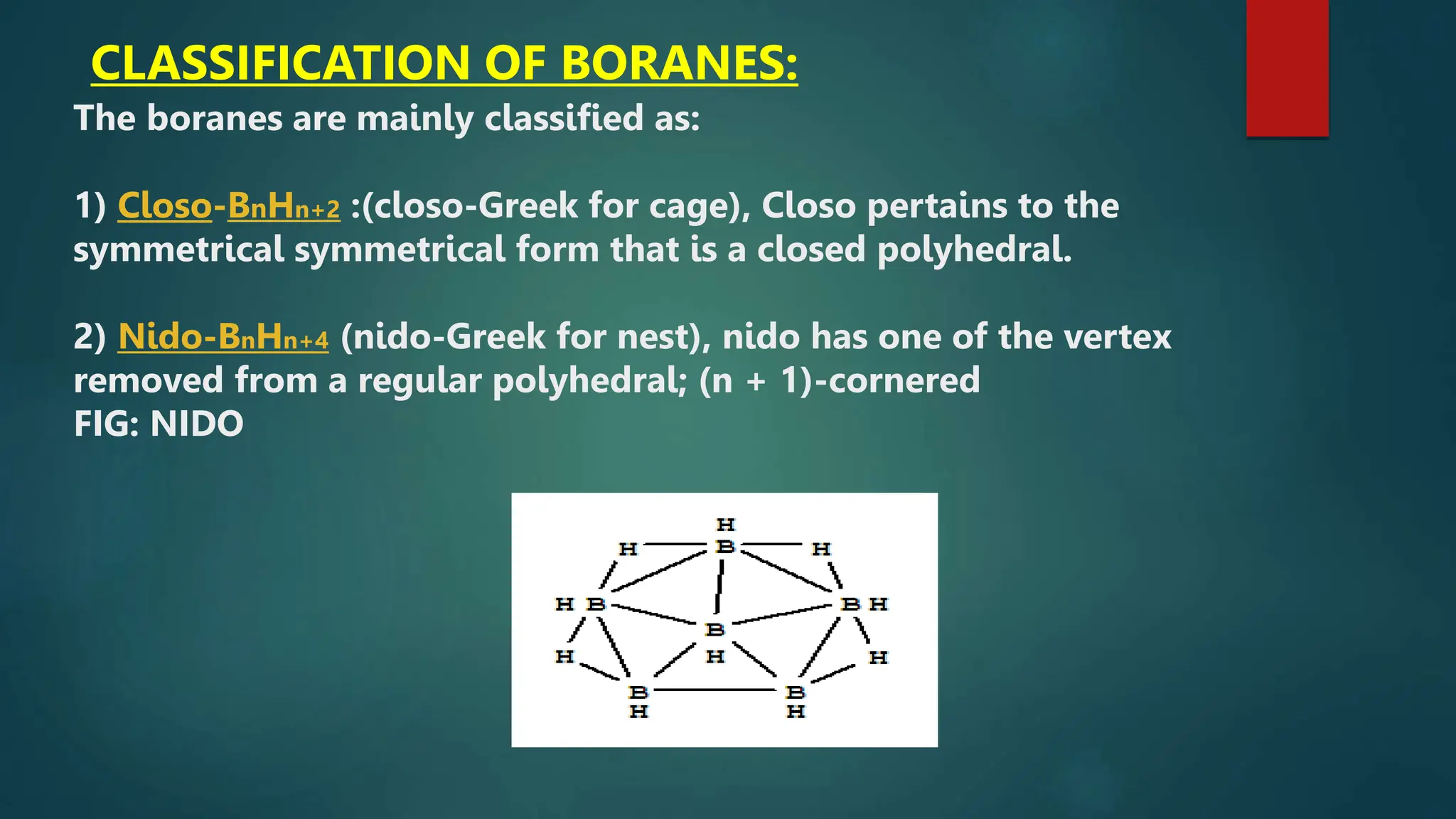
2) Nido-BnHn+4 (nido-Greek for nest), nido has one of the vertex
removed from a regular polyhedral; (n + 1)-cornered
FIG: NIDO
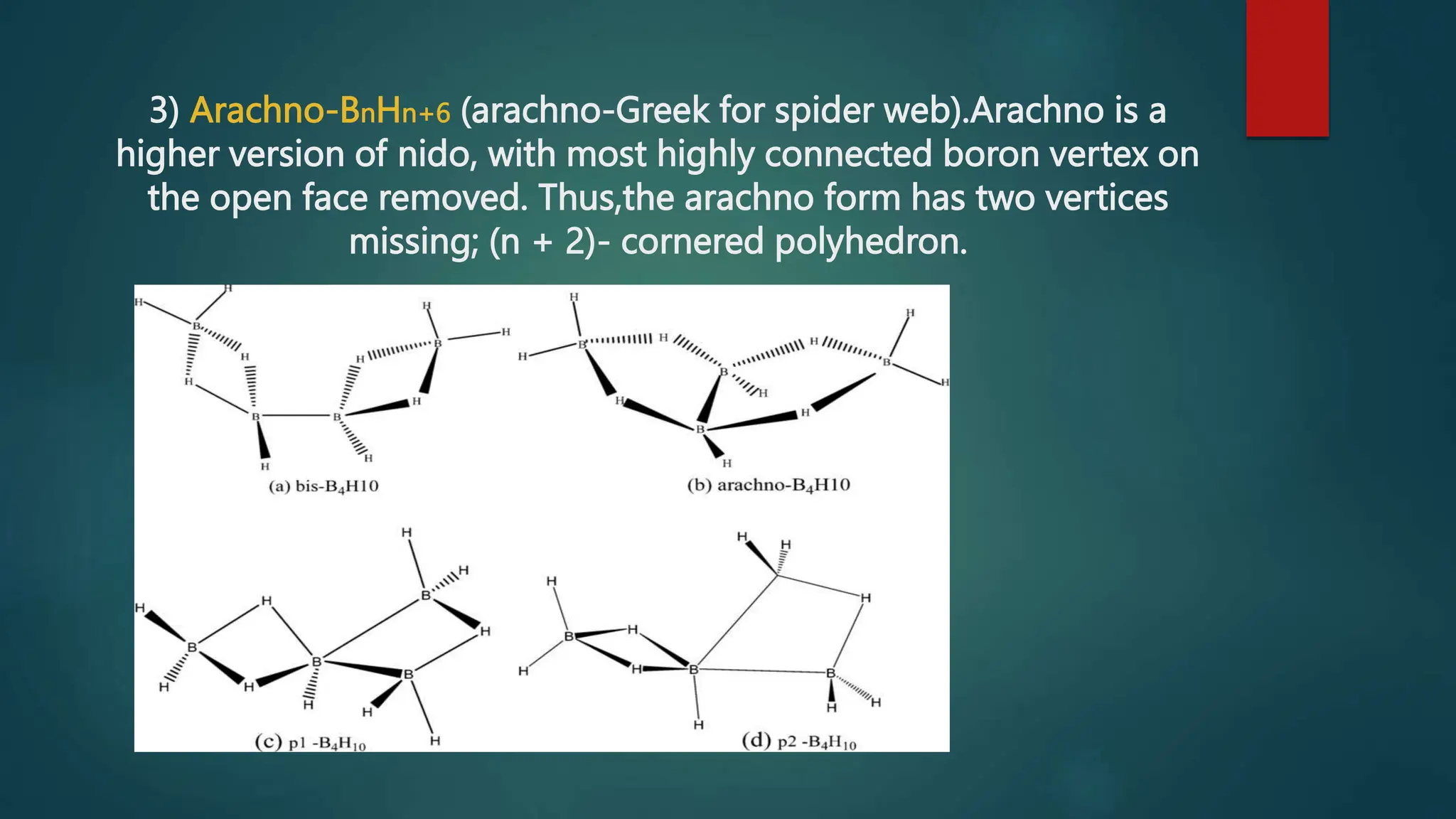
3) Arachno-BnHn+6 (arachno-Greek for spider web).Arachno is a
higher version of nido, with most highly connected boron vertex on
the open face removed. Thus,the arachno form has two vertices
missing; (n + 2)- cornered polyhedron.
4) Hypho- BnHn+8(Greek: net like): They have the most open clusters
in which the B atoms occupy n corners on an (n + 3)-cornered
polyhedron.
5) Conjuncto- BnHn+10(Latin: join together): They have structures
formed by linking together of two or more of the above mentioned
type of clusters.
They can also be written as having the general formula BnHn2‒,
BnHn4‾, BnHn6‾, BnHn8‾, BnHn10‾ for closo, nido, arachno, hypho
and conjuncto respectively. That is formally subtracting the number
of H+ ions from the formula to make the number of boron and
hydrogen atoms equal.
Synthesis:
Synthesis of diborane:
 Diborane(6), B2H6 is a gas and like most boranes it is air-sensitive and catches
fire.
 It is spontaneously hydrolyzed by water into hydrogen and boric acid. One of the
simplest method is hydride abstraction from BH4-.
 One of the simplest method is hydride abstraction from BH4-.
BH4- + BX3 ---------------½ B2H6 + HBX3- (X = Cl, Br)
 At industrial scale diborane is prepared by reduction of BF3 with sodium hydride.
2BF3 + 6 NaH------------- B2H6 + 6 NaF
Diborane acts as a very versatile reagent in synthesis of organoboranes. It also
acts as a reducing agent for certain functionnal groups such as nitriles and
aldehydes.

Higher borane Msc 2nd semester By: Khushboo Matriya

  • 1.
    Gov. HOLKAR SCIENCECOLLEGE INDORE (M.P.) CHEMISTRY SEMINAR SESSION 2024-25 TOPIC: HIGHER BORANE SUBMITTED TO: DR. NILIMA PRADHAN SUBMITTED BY: KHUSHBOO MATRIYA MSC.2ND SEMESTER
  • 2.
    Higher Borane: Table ofcontent:  Introduction  Types of bonds in higher borane  Structure and bonding in higher borane  Classification of Higher borane  Synthesis
  • 3.
    Introduction:  The hydridesof boron are known as Borane.  Boranes are colourless and diamagnetic.  Boranes are generally represented by two general formula: o Bn Hn+4 : These borane are quite stable and have high melting point, where n= 2,5,6,8,10 o Bn Hn+6 : These borane are less stable and have low melting point, where n= 4,5,6,9,10 Ex: B6H10 (Hexaborane-10)
  • 4.
    Types of bondsin Higher borane:  Higher borane have majorly four types of bond:  Terminal B-H bond ( 2centre– 2 electron):This is normal covalent bond formed by overlapping of singly filled sp3 hybrid orbital of boron atom and singly filled 1s- orbital of hydrogen atom.  Direct B-B bond (2centre- 2electron):This is a normal covalent bond formed by overlapping of singly filled sp3 hybrid of two boron atoms.  Bridging or open B-H bond (3 centre- 2electron): This type of bond formed by overlapping of two sp3 hybrid orbitals of two boron atoms (one singly filled and other empty) and 1s- orbital of hydrogen atom.  Triply bridge or closed B-B-B Bond (3centre- 2electron): This type of bond formed by overlapping os 3-sp3 hybrid orbital of 3-boron atoms. Out of these 1-sp3 hybrid orbitals empty.
  • 5.
    Structure and bondingin higher borane:  Structure of Diborane: (B2H6- Diborane-6),The diborane is an electron deficient compound i.e. there are not enough valence electorns to form the expected number of covalent bonds.  In the structure of hydrogen atom form a bridge between two boron atoms while the terminal hydrogen atom form normal covalent bonds with boron atoms.
  • 6.
     In thisfigure we have: 4 terminal hydrogen atom are known as terminal hydrogens (Ht). And two other hydrogen atoms are known as bridging hygrogen (Hb). The two boron atoms and 4 terminal hydrogen atom lie on the same plane while two bridging hydrogen atom lie on a perpendicular to this plane. Types of bond in Diborane structure: 1) Terminal bond (B-H) : 4 2) Bridging bond (B-H-B): 2
  • 8.
    CLASSIFICATION OF BORANES: Theboranes are mainly classified as: 1) Closo-BnHn+2 :(closo-Greek for cage), Closo pertains to the symmetrical symmetrical form that is a closed polyhedral. 2) Nido-BnHn+4 (nido-Greek for nest), nido has one of the vertex removed from a regular polyhedral; (n + 1)-cornered FIG: NIDO
  • 9.
    3) Arachno-BnHn+6 (arachno-Greekfor spider web).Arachno is a higher version of nido, with most highly connected boron vertex on the open face removed. Thus,the arachno form has two vertices missing; (n + 2)- cornered polyhedron.
  • 10.
    4) Hypho- BnHn+8(Greek:net like): They have the most open clusters in which the B atoms occupy n corners on an (n + 3)-cornered polyhedron. 5) Conjuncto- BnHn+10(Latin: join together): They have structures formed by linking together of two or more of the above mentioned type of clusters. They can also be written as having the general formula BnHn2‒, BnHn4‾, BnHn6‾, BnHn8‾, BnHn10‾ for closo, nido, arachno, hypho and conjuncto respectively. That is formally subtracting the number of H+ ions from the formula to make the number of boron and hydrogen atoms equal.
  • 11.
    Synthesis: Synthesis of diborane: Diborane(6), B2H6 is a gas and like most boranes it is air-sensitive and catches fire.  It is spontaneously hydrolyzed by water into hydrogen and boric acid. One of the simplest method is hydride abstraction from BH4-.  One of the simplest method is hydride abstraction from BH4-. BH4- + BX3 ---------------½ B2H6 + HBX3- (X = Cl, Br)  At industrial scale diborane is prepared by reduction of BF3 with sodium hydride. 2BF3 + 6 NaH------------- B2H6 + 6 NaF
  • 12.
    Diborane acts asa very versatile reagent in synthesis of organoboranes. It also acts as a reducing agent for certain functionnal groups such as nitriles and aldehydes.