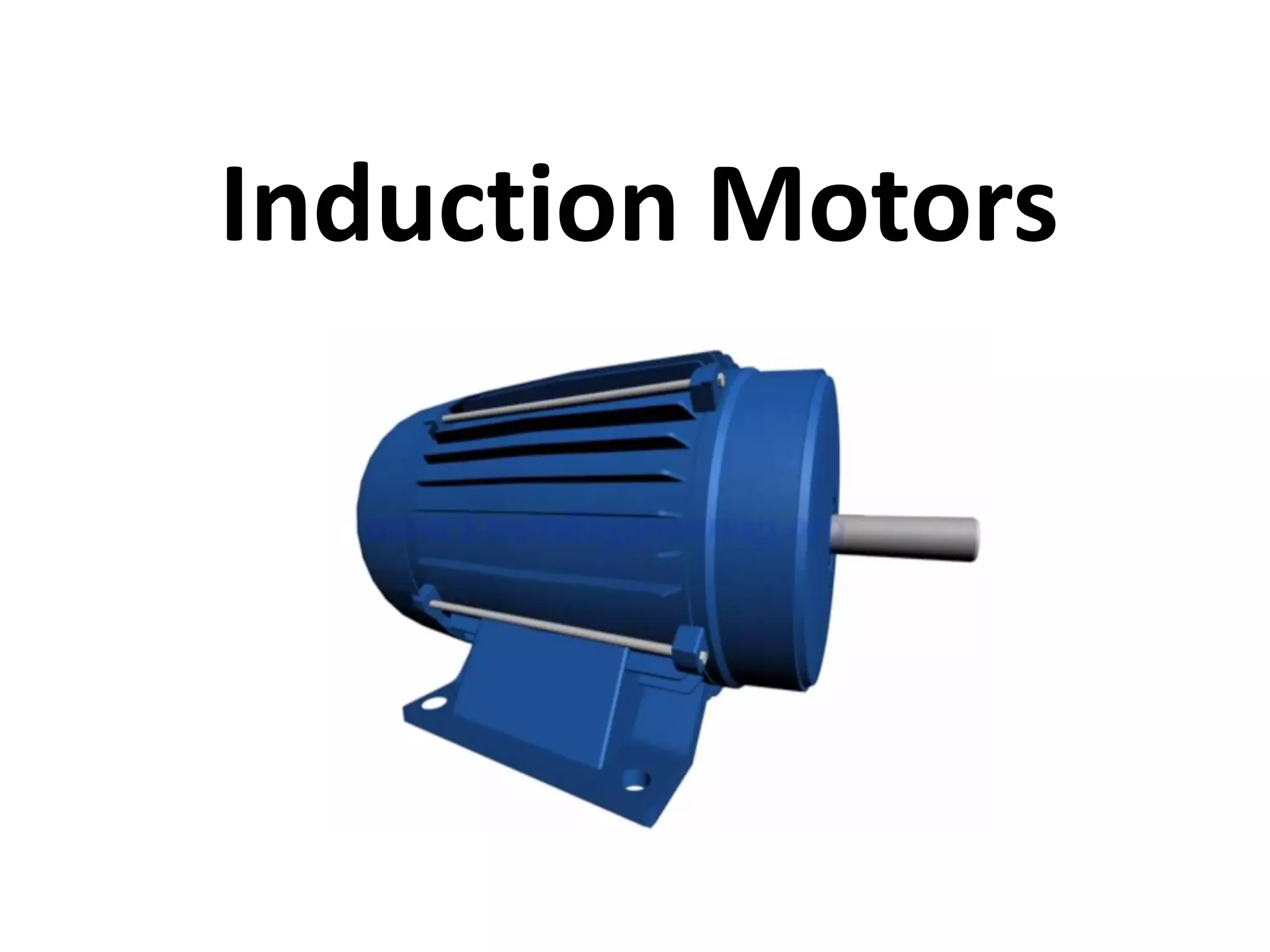
Induction Motors
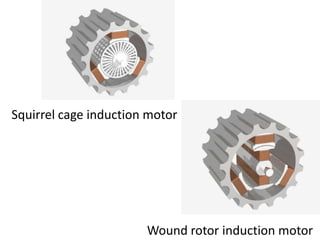
Squirrel cage induction motor
Wound rotor induction motor
• Induction motors are the most commonly used electrical
machines, they are cheaper, rugged and easier to
maintain compare to other alternatives.
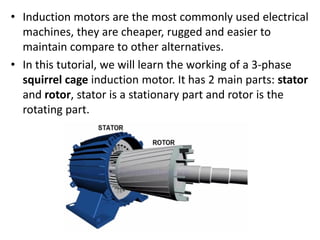
• In this tutorial, we will learn the working of a 3-phase
squirrel cage induction motor. It has 2 main parts: stator
and rotor, stator is a stationary part and rotor is the
rotating part.
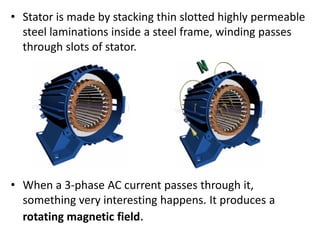
• Stator is made by stacking thin slotted highly permeable
steel laminations inside a steel frame, winding passes
through slots of stator.
• When a 3-phase AC current passes through it,
something very interesting happens. It produces a
rotating magnetic field.
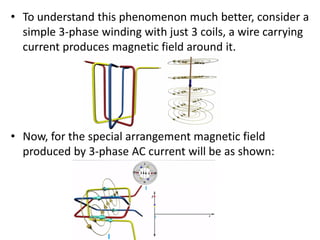
• To understand this phenomenon much better, consider a
simple 3-phase winding with just 3 coils, a wire carrying
current produces magnetic field around it.
• Now, for the special arrangement magnetic field
produced by 3-phase AC current will be as shown:
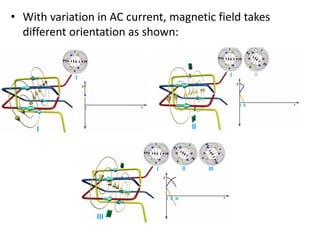
• With variation in AC current, magnetic field takes
different orientation as shown:
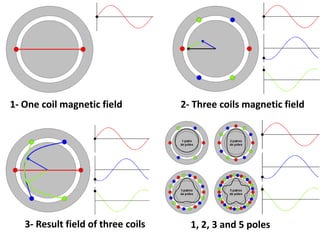
1- One coil magnetic field
1, 2, 3 and 5 poles3- Result field of three coils
2- Three coils magnetic field
• From these 3 positions, it’s clear that it’s like a magnetic
field of uniform strength is rotating. The speed of
rotation of a magnetic field is known as synchronous
speed (Ns).
• Assume you’re putting a close conductor inside it, since
the magnetic field is fluctuating, an e.m.f will be induced
in the loop according to Lenz-Faraday’s law.
• In physics, Lenz-Faraday’s law, or Faraday’s law, can
account macroscopic phenomena of electromagnetic
induction. Based on Michael Faraday's work in 1831, and
the Heinrich Lenz 1834 Statement, today it is deducted
from the local Maxwell-Faraday equation.
• This is a moderation law, meaning it describes effects
that oppose to their causes.
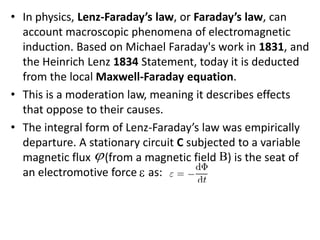
• The integral form of Lenz-Faraday’s law was empirically
departure. A stationary circuit C subjected to a variable
magnetic flux (from a magnetic field ) is the seat of
an electromotive force as:
 

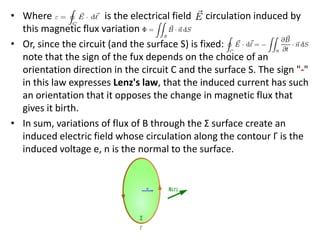
• Where is the electrical field circulation induced by
this magnetic flux variation
• Or, since the circuit (and the surface S) is fixed:
note that the sign of the fux depends on the choice of an
orientation direction in the circuit C and the surface S. The sign "-"
in this law expresses Lenz's law, that the induced current has such
an orientation that it opposes the change in magnetic flux that
gives it birth.
• In sum, variations of flux of B through the Σ surface create an
induced electric field whose circulation along the contour Γ is the
induced voltage e, n is the normal to the surface.
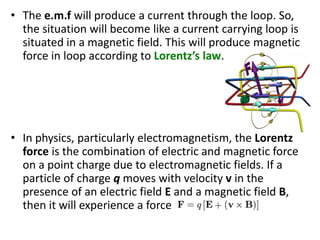
• The e.m.f will produce a current through the loop. So,
the situation will become like a current carrying loop is
situated in a magnetic field. This will produce magnetic
force in loop according to Lorentz’s law.
• In physics, particularly electromagnetism, the Lorentz
force is the combination of electric and magnetic force
on a point charge due to electromagnetic fields. If a
particle of charge q moves with velocity v in the
presence of an electric field E and a magnetic field B,
then it will experience a force
• Variations on this basic formula describe the magnetic force on
a current-carrying wire (sometimes called Laplace force).
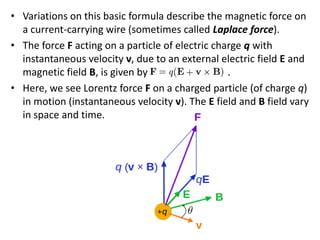
• The force F acting on a particle of electric charge q with
instantaneous velocity v, due to an external electric field E and
magnetic field B, is given by .
• Here, we see Lorentz force F on a charged particle (of charge q)
in motion (instantaneous velocity v). The E field and B field vary
in space and time.
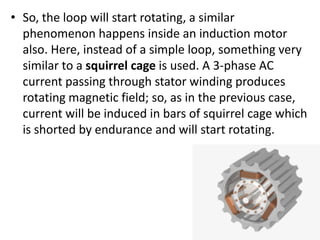
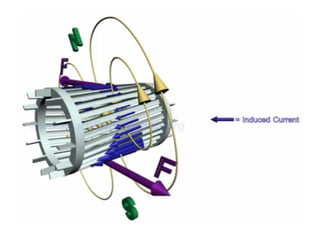
• So, the loop will start rotating, a similar
phenomenon happens inside an induction motor
also. Here, instead of a simple loop, something very
similar to a squirrel cage is used. A 3-phase AC
current passing through stator winding produces
rotating magnetic field; so, as in the previous case,
current will be induced in bars of squirrel cage which
is shorted by endurance and will start rotating.
• That’s why it’s called an induction motor, electicity is
inducted in rotor by magnetic induction rather than
direct electric connection. To collapse such electric
magnetic induction, insulated iron core laminar are
packed inside the rotor, such small slices of iron make
sure that Eddy current losses are minimum. This is
another big advantage of a 3-phase induction motor.
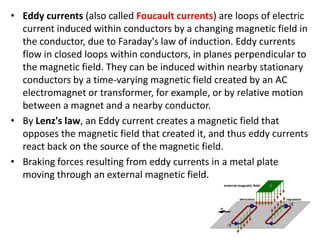
• Eddy currents (also called Foucault currents) are loops of electric
current induced within conductors by a changing magnetic field in
the conductor, due to Faraday's law of induction. Eddy currents
flow in closed loops within conductors, in planes perpendicular to
the magnetic field. They can be induced within nearby stationary
conductors by a time-varying magnetic field created by an AC
electromagnet or transformer, for example, or by relative motion
between a magnet and a nearby conductor.
• By Lenz's law, an Eddy current creates a magnetic field that
opposes the magnetic field that created it, and thus eddy currents
react back on the source of the magnetic field.
• Braking forces resulting from eddy currents in a metal plate
moving through an external magnetic field.
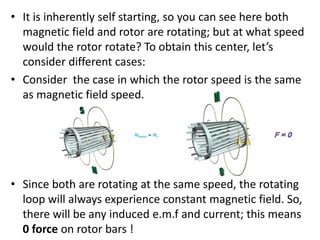
• It is inherently self starting, so you can see here both
magnetic field and rotor are rotating; but at what speed
would the rotor rotate? To obtain this center, let’s
consider different cases:
• Consider the case in which the rotor speed is the same
as magnetic field speed.
• Since both are rotating at the same speed, the rotating
loop will always experience constant magnetic field. So,
there will be any induced e.m.f and current; this means
0 force on rotor bars !
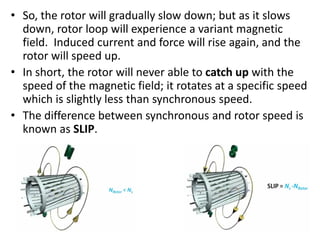
• So, the rotor will gradually slow down; but as it slows
down, rotor loop will experience a variant magnetic
field. Induced current and force will rise again, and the
rotor will speed up.
• In short, the rotor will never able to catch up with the
speed of the magnetic field; it rotates at a specific speed
which is slightly less than synchronous speed.
• The difference between synchronous and rotor speed is
known as SLIP.
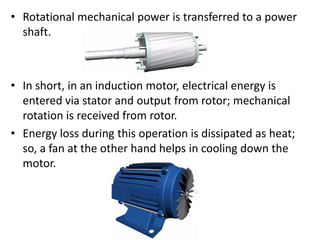
• Rotational mechanical power is transferred to a power
shaft.
• In short, in an induction motor, electrical energy is
entered via stator and output from rotor; mechanical
rotation is received from rotor.
• Energy loss during this operation is dissipated as heat;
so, a fan at the other hand helps in cooling down the
motor.
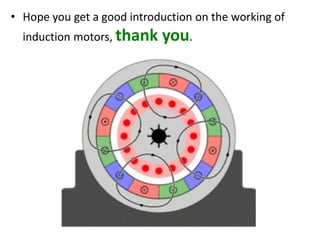
• Hope you get a good introduction on the working of
induction motors, thank you.

Induction Motors

  • 1.
  • 2.
    Squirrel cage inductionmotor Wound rotor induction motor
  • 3.
    • Induction motorsare the most commonly used electrical machines, they are cheaper, rugged and easier to maintain compare to other alternatives. • In this tutorial, we will learn the working of a 3-phase squirrel cage induction motor. It has 2 main parts: stator and rotor, stator is a stationary part and rotor is the rotating part.
  • 4.
    • Stator ismade by stacking thin slotted highly permeable steel laminations inside a steel frame, winding passes through slots of stator. • When a 3-phase AC current passes through it, something very interesting happens. It produces a rotating magnetic field.
  • 5.
    • To understandthis phenomenon much better, consider a simple 3-phase winding with just 3 coils, a wire carrying current produces magnetic field around it. • Now, for the special arrangement magnetic field produced by 3-phase AC current will be as shown:
  • 6.
    • With variationin AC current, magnetic field takes different orientation as shown:
  • 7.
    1- One coilmagnetic field 1, 2, 3 and 5 poles3- Result field of three coils 2- Three coils magnetic field
  • 8.
    • From these3 positions, it’s clear that it’s like a magnetic field of uniform strength is rotating. The speed of rotation of a magnetic field is known as synchronous speed (Ns). • Assume you’re putting a close conductor inside it, since the magnetic field is fluctuating, an e.m.f will be induced in the loop according to Lenz-Faraday’s law.
  • 9.
    • In physics,Lenz-Faraday’s law, or Faraday’s law, can account macroscopic phenomena of electromagnetic induction. Based on Michael Faraday's work in 1831, and the Heinrich Lenz 1834 Statement, today it is deducted from the local Maxwell-Faraday equation. • This is a moderation law, meaning it describes effects that oppose to their causes. • The integral form of Lenz-Faraday’s law was empirically departure. A stationary circuit C subjected to a variable magnetic flux (from a magnetic field ) is the seat of an electromotive force as:   
  • 10.
    • Where isthe electrical field circulation induced by this magnetic flux variation • Or, since the circuit (and the surface S) is fixed: note that the sign of the fux depends on the choice of an orientation direction in the circuit C and the surface S. The sign "-" in this law expresses Lenz's law, that the induced current has such an orientation that it opposes the change in magnetic flux that gives it birth. • In sum, variations of flux of B through the Σ surface create an induced electric field whose circulation along the contour Γ is the induced voltage e, n is the normal to the surface.
  • 11.
    • The e.m.fwill produce a current through the loop. So, the situation will become like a current carrying loop is situated in a magnetic field. This will produce magnetic force in loop according to Lorentz’s law. • In physics, particularly electromagnetism, the Lorentz force is the combination of electric and magnetic force on a point charge due to electromagnetic fields. If a particle of charge q moves with velocity v in the presence of an electric field E and a magnetic field B, then it will experience a force
  • 12.
    • Variations onthis basic formula describe the magnetic force on a current-carrying wire (sometimes called Laplace force). • The force F acting on a particle of electric charge q with instantaneous velocity v, due to an external electric field E and magnetic field B, is given by . • Here, we see Lorentz force F on a charged particle (of charge q) in motion (instantaneous velocity v). The E field and B field vary in space and time.
  • 13.
    • So, theloop will start rotating, a similar phenomenon happens inside an induction motor also. Here, instead of a simple loop, something very similar to a squirrel cage is used. A 3-phase AC current passing through stator winding produces rotating magnetic field; so, as in the previous case, current will be induced in bars of squirrel cage which is shorted by endurance and will start rotating.
  • 15.
    • That’s whyit’s called an induction motor, electicity is inducted in rotor by magnetic induction rather than direct electric connection. To collapse such electric magnetic induction, insulated iron core laminar are packed inside the rotor, such small slices of iron make sure that Eddy current losses are minimum. This is another big advantage of a 3-phase induction motor.
  • 16.
    • Eddy currents(also called Foucault currents) are loops of electric current induced within conductors by a changing magnetic field in the conductor, due to Faraday's law of induction. Eddy currents flow in closed loops within conductors, in planes perpendicular to the magnetic field. They can be induced within nearby stationary conductors by a time-varying magnetic field created by an AC electromagnet or transformer, for example, or by relative motion between a magnet and a nearby conductor. • By Lenz's law, an Eddy current creates a magnetic field that opposes the magnetic field that created it, and thus eddy currents react back on the source of the magnetic field. • Braking forces resulting from eddy currents in a metal plate moving through an external magnetic field.
  • 17.
    • It isinherently self starting, so you can see here both magnetic field and rotor are rotating; but at what speed would the rotor rotate? To obtain this center, let’s consider different cases: • Consider the case in which the rotor speed is the same as magnetic field speed. • Since both are rotating at the same speed, the rotating loop will always experience constant magnetic field. So, there will be any induced e.m.f and current; this means 0 force on rotor bars !
  • 18.
    • So, therotor will gradually slow down; but as it slows down, rotor loop will experience a variant magnetic field. Induced current and force will rise again, and the rotor will speed up. • In short, the rotor will never able to catch up with the speed of the magnetic field; it rotates at a specific speed which is slightly less than synchronous speed. • The difference between synchronous and rotor speed is known as SLIP.
  • 19.
    • Rotational mechanicalpower is transferred to a power shaft. • In short, in an induction motor, electrical energy is entered via stator and output from rotor; mechanical rotation is received from rotor. • Energy loss during this operation is dissipated as heat; so, a fan at the other hand helps in cooling down the motor.
  • 20.
    • Hope youget a good introduction on the working of induction motors, thank you.