Lapuz, Sopia Marie P.
BSEd-Science 1A
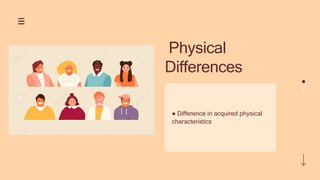
Physical
Differences
● Difference in acquired physical
characteristics
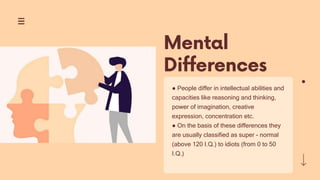
● People differ in intellectual abilities and
capacities like reasoning and thinking,
power of imagination, creative
expression, concentration etc.
● On the basis of these differences they
are usually classified as super - normal
(above 120 I.Q.) to idiots (from 0 to 50
I.Q.)
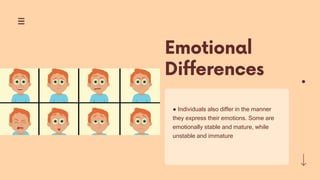
● Individuals also differ in the manner
they express their emotions. Some are
emotionally stable and mature, while
unstable and immature
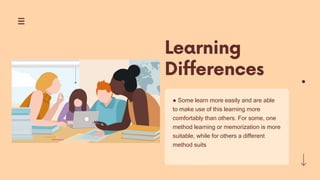
● Some learn more easily and are able
to make use of this learning more
comfortably than others. For some, one
method learning or memorization is more
suitable, while for others a different
method suits
● Individuals are found to differ with
regard to development are acquisition of
one or more types of skills
● Difference in achievement exist in
achievement and in knowledge even
among individuals who have almost the
ssae amount of intelligence and have
been subjected to equal amount of
schooling and experience
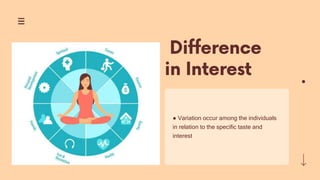
● Variation occur among the individuals
in relation to the specific taste and
interest
1. Limited size of the class
2. Proper division of the class
3. Home task
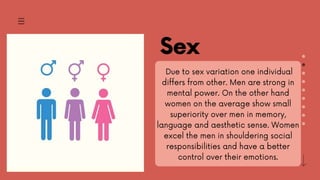
4. Factor of sex
5. Curriculum
6. Methods of Teaching
7. Educational Guidance
8. Vocational Guidance

INDIVIDUAL DIFFERENCES.pptx

  • 1.
    Lapuz, Sopia MarieP. BSEd-Science 1A
  • 5.
    Physical Differences ● Difference inacquired physical characteristics
  • 6.
    ● People differin intellectual abilities and capacities like reasoning and thinking, power of imagination, creative expression, concentration etc. ● On the basis of these differences they are usually classified as super - normal (above 120 I.Q.) to idiots (from 0 to 50 I.Q.)
  • 7.
    ● Individuals alsodiffer in the manner they express their emotions. Some are emotionally stable and mature, while unstable and immature
  • 8.
    ● Some learnmore easily and are able to make use of this learning more comfortably than others. For some, one method learning or memorization is more suitable, while for others a different method suits
  • 9.
    ● Individuals arefound to differ with regard to development are acquisition of one or more types of skills
  • 10.
    ● Difference inachievement exist in achievement and in knowledge even among individuals who have almost the ssae amount of intelligence and have been subjected to equal amount of schooling and experience
  • 11.
    ● Variation occuramong the individuals in relation to the specific taste and interest
  • 20.
    1. Limited sizeof the class 2. Proper division of the class 3. Home task 4. Factor of sex 5. Curriculum 6. Methods of Teaching 7. Educational Guidance 8. Vocational Guidance