GIFTED CHILD
SPECIAL NEEDS
• According to Mauro (2009), children with
special needs may have mild learning
disabilities or profound cognitive
impairment; food allergies or terminal illness;
developmental delays that catch up quickly
or remain entrenched; occasional panic
attacks or serious psychiatric problems.
Some children have needs or disabilities that
affect their ability to learn. For example:
• behavioural/social (eg difficulty making friends)
• reading and writing (eg dyslexia)
• understanding things ( Gifted Child and Late
Development)
• concentrating (eg Attention Deficit
Hyperactivity Disorder)
• physical needs or impairments
GIFTED CHILD
“A gifted student is one whose intelligence - typically
described as an IQ score resulting from one or more
tests - is 130 or above. That is, giftedness is a measure
of innate ability, not performance. The result is a
paradox.”
“'gifted' learners are those with abilities in one or more
academic subjects, such as Math or English.”
(TeacherFirst.com)
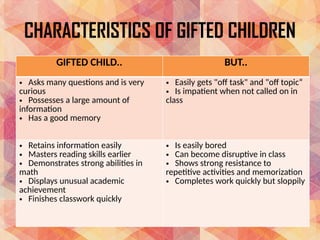
CHARACTERISTICS OF GIFTED CHILDREN
GIFTED CHILD.. BUT..
• Asks many questions and is very
curious
• Possesses a large amount of
information
• Has a good memory
• Easily gets "off task" and "off topic“
• Is impatient when not called on in
class
• Retains information easily
• Masters reading skills earlier
• Demonstrates strong abilities in
math
• Displays unusual academic
achievement
• Finishes classwork quickly
• Is easily bored
• Can become disruptive in class
• Shows strong resistance to
repetitive activities and memorization
• Completes work quickly but sloppily
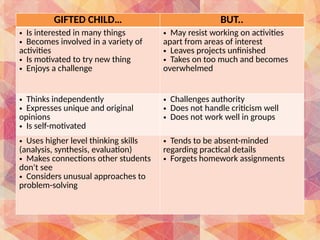
GIFTED CHILD… BUT..
• Is interested in many things
• Becomes involved in a variety of
activities
• Is motivated to try new thing
• Enjoys a challenge
• May resist working on activities
apart from areas of interest
• Leaves projects unfinished
• Takes on too much and becomes
overwhelmed
• Thinks independently
• Expresses unique and original
opinions
• Is self-motivated
• Challenges authority
• Does not handle criticism well
• Does not work well in groups
• Uses higher level thinking skills
(analysis, synthesis, evaluation)
• Makes connections other students
don't see
• Considers unusual approaches to
problem-solving
• Tends to be absent-minded
regarding practical details
• Forgets homework assignments
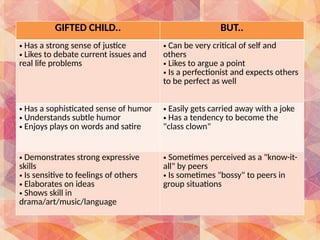
GIFTED CHILD.. BUT..
• Has a strong sense of justice
• Likes to debate current issues and
real life problems
• Can be very critical of self and
others
• Likes to argue a point
• Is a perfectionist and expects others
to be perfect as well
• Has a sophisticated sense of humor
• Understands subtle humor
• Enjoys plays on words and satire
• Easily gets carried away with a joke
• Has a tendency to become the
"class clown"
• Demonstrates strong expressive
skills
• Is sensitive to feelings of others
• Elaborates on ideas
• Shows skill in
drama/art/music/language
• Sometimes perceived as a "know-it-
all" by peers
• Is sometimes "bossy" to peers in
group situations
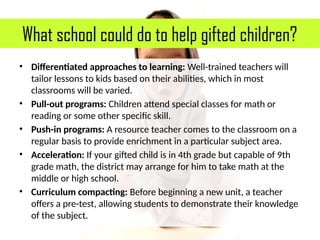
What school could do to help gifted children?
• Differentiated approaches to learning: Well-trained teachers will
tailor lessons to kids based on their abilities, which in most
classrooms will be varied.
• Pull-out programs: Children attend special classes for math or
reading or some other specific skill.
• Push-in programs: A resource teacher comes to the classroom on a
regular basis to provide enrichment in a particular subject area.
• Acceleration: If your gifted child is in 4th grade but capable of 9th
grade math, the district may arrange for him to take math at the
middle or high school.
• Curriculum compacting: Before beginning a new unit, a teacher
offers a pre-test, allowing students to demonstrate their knowledge
of the subject.
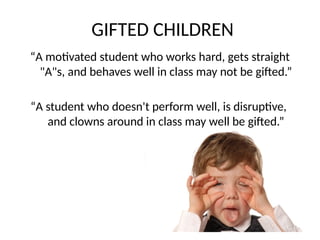
GIFTED CHILDREN
“A motivated student who works hard, gets straight
"A"s, and behaves well in class may not be gifted.”
“A student who doesn't perform well, is disruptive,
and clowns around in class may well be gifted.”
Thank You

GIFTED_CHILD.pptx. Multiple Intelligence

  • 1.
  • 2.
    SPECIAL NEEDS • Accordingto Mauro (2009), children with special needs may have mild learning disabilities or profound cognitive impairment; food allergies or terminal illness; developmental delays that catch up quickly or remain entrenched; occasional panic attacks or serious psychiatric problems.
  • 3.
    Some children haveneeds or disabilities that affect their ability to learn. For example: • behavioural/social (eg difficulty making friends) • reading and writing (eg dyslexia) • understanding things ( Gifted Child and Late Development) • concentrating (eg Attention Deficit Hyperactivity Disorder) • physical needs or impairments
  • 4.
    GIFTED CHILD “A giftedstudent is one whose intelligence - typically described as an IQ score resulting from one or more tests - is 130 or above. That is, giftedness is a measure of innate ability, not performance. The result is a paradox.” “'gifted' learners are those with abilities in one or more academic subjects, such as Math or English.” (TeacherFirst.com)
  • 5.
    CHARACTERISTICS OF GIFTEDCHILDREN GIFTED CHILD.. BUT.. • Asks many questions and is very curious • Possesses a large amount of information • Has a good memory • Easily gets "off task" and "off topic“ • Is impatient when not called on in class • Retains information easily • Masters reading skills earlier • Demonstrates strong abilities in math • Displays unusual academic achievement • Finishes classwork quickly • Is easily bored • Can become disruptive in class • Shows strong resistance to repetitive activities and memorization • Completes work quickly but sloppily
  • 6.
    GIFTED CHILD… BUT.. •Is interested in many things • Becomes involved in a variety of activities • Is motivated to try new thing • Enjoys a challenge • May resist working on activities apart from areas of interest • Leaves projects unfinished • Takes on too much and becomes overwhelmed • Thinks independently • Expresses unique and original opinions • Is self-motivated • Challenges authority • Does not handle criticism well • Does not work well in groups • Uses higher level thinking skills (analysis, synthesis, evaluation) • Makes connections other students don't see • Considers unusual approaches to problem-solving • Tends to be absent-minded regarding practical details • Forgets homework assignments
  • 7.
    GIFTED CHILD.. BUT.. •Has a strong sense of justice • Likes to debate current issues and real life problems • Can be very critical of self and others • Likes to argue a point • Is a perfectionist and expects others to be perfect as well • Has a sophisticated sense of humor • Understands subtle humor • Enjoys plays on words and satire • Easily gets carried away with a joke • Has a tendency to become the "class clown" • Demonstrates strong expressive skills • Is sensitive to feelings of others • Elaborates on ideas • Shows skill in drama/art/music/language • Sometimes perceived as a "know-it- all" by peers • Is sometimes "bossy" to peers in group situations
  • 8.
    What school coulddo to help gifted children? • Differentiated approaches to learning: Well-trained teachers will tailor lessons to kids based on their abilities, which in most classrooms will be varied. • Pull-out programs: Children attend special classes for math or reading or some other specific skill. • Push-in programs: A resource teacher comes to the classroom on a regular basis to provide enrichment in a particular subject area. • Acceleration: If your gifted child is in 4th grade but capable of 9th grade math, the district may arrange for him to take math at the middle or high school. • Curriculum compacting: Before beginning a new unit, a teacher offers a pre-test, allowing students to demonstrate their knowledge of the subject.
  • 9.
    GIFTED CHILDREN “A motivatedstudent who works hard, gets straight "A"s, and behaves well in class may not be gifted.” “A student who doesn't perform well, is disruptive, and clowns around in class may well be gifted.”
  • 10.