Aspect of Growth and
Development
• Physical and Motor
development
Objectives
▪ Learn about the Physical and Motor development of children
▪ Learn about Factors Affecting Growth
▪ How aTeacher Could Help in Physical and Motor Development
| Introduction |
.
Physical and Motor development
▪ Physical development involves the growth and changes in a child's body
size, shape, and physical abilities.
▪ Motor development, on the other hand, refers to the progress children
make in their ability to control their movements and manipulate objects.
– Gross Motor Skill
– Fine Motor Skill
Physical and motor development play a significant role in a child's growth and
overall well-being.
Short Activity
1. find a small object nearby that you can hold in their hand, such
as a small object, pencil, or keychain.
2. Have them hold the object with their dominant hand and
perform a series of actions with it, such as squeezing it,
flipping it, and twirling it around.
3. repeat the same actions with their non-dominant hand.
4. Reflect on their experience.
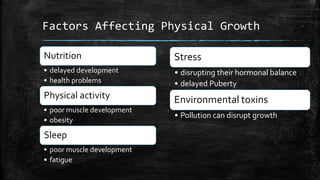
Factors Affecting Physical Growth
Nutrition
• delayed development
• health problems
Physical activity
• poor muscle development
• obesity
Sleep
• poor muscle development
• fatigue
Stress
• disrupting their hormonal balance
• delayed Puberty
Environmental toxins
• Pollution can disrupt growth
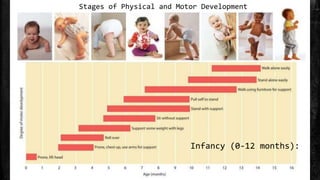
Infancy (0-12 months):
Stages of Physical and Motor Development
Age Range Typical Characteristics Implications for Teachers
Early Childhood
2-6 Years Old
[preschool / kindergarten]
 Loss of babyish appearance,
lengthening of arms and legs,
looking more mature.
 Endless energy for new gross
motor skills, like running, bopping,
tumbling, climbing, and swinging.
 Children acquire many new fine
motor skills, like gripping (pencils,
scissors).
 Boys more physically active than
girls.
 Provide ample opportunities
to play.
 Give children rest and quiet
time. after physical activity.
 Encourage fine motor skills
through puzzles, blocks, arts
and crafts, etc. and choose a
variety to appeal to children
at differing stages of physical
development.
 In what ways can a teacher
get involve to help with the
students well-being ?
Age Range Typical Characteristics Implications for Teachers
Middle Childhood
6-10 Years Old
[elementary school /
primary school]
 increase in height and weight.
 Sophistication of gross motor skills,
and integration of them into
structured play activities.
 Participation in organized sports.
Increase in fine motor skills like
handwriting and drawing.
 Athletic talents and interests begin
to show themselves.
 Preferences for sports and physical
activities start to align with gender.
 Integrate physical movement
into school activities.
 Teach children the basics of
various sports and physical
games.
 Encourage children to partake
in organized sports.
 Encourage children to practice
their fine motor skills.
 In what ways can a teacher
get involve to help with the
students well-being ?
Age Range Typical Characteristics Implications for Teachers
Early Adolescence
10-14 Years Old
[middle school /
junior high school]
 Period of rapid growth.
 Beginning of puberty and therefore
self-consciousness about bodies
and changes.
 Boys tend to increasingly act
aggressively.
 Exercise sometimes aligns with
leisure activities.
 Young teens differ drastically in
terms of strength, endurance and
talent in certain sports.
 Visible gender differences start to
arise; boys become faster, stronger
and more confident about their
physical abilities versus girls.
 Act as a role model with
regards to physical fitness and
healthy eating.
 Allow for privacy in clothes
changing situations after
physical education.
 Explain what sexual
harassment is and do not
tolerate it in a capacity.
 Encourage students to
participate in leisure activities
that allow them to spend their
time wisely and actively.
 In what ways can a teacher
get involve to help with the
students well-being ?
Age Range Typical Characteristics Implications for Teachers
Adolescence
12-18 Years Old
[high school]
 Muscle Development: During
adolescence, muscles become
stronger and more defined
 Sexual Development: Adolescents
experience significant changes in
their reproductive systems
 Growth Spurts: Adolescents
experience rapid growth during this
period
 Physical Activity: Adolescents often
become less active as they enter
high school.
 Support emotional regulation:
teachers can provide
opportunities for mindfulness
or other relaxation techniques
to help students manage their
emotions and make positive
decisions.
 Encourage healthy habits:
Teachers can encourage
healthy habits such as regular
exercise, healthy eating, and
adequate sleep to support
physical and motor
development
 In what ways can a teacher
get involve to help with the
students well-being ?
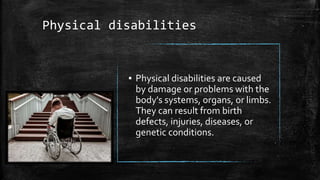
Physical disabilities
▪ Physical disabilities are caused
by damage or problems with the
body's systems, organs, or limbs.
They can result from birth
defects, injuries, diseases, or
genetic conditions.
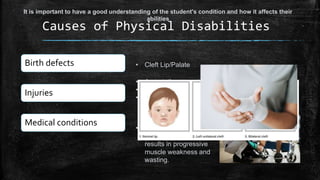
Causes of Physical Disabilities
Birth defects
Injuries
Medical conditions
It is important to have a good understanding of the student's condition and how it affects their
abilities
• Cleft Lip/Palate
• Amputation
• Burn injuries
• Fractures
• Muscular Dystrophy:
A genetic disorder that
results in progressive
muscle weakness and
wasting.
How a Teacher Could Help in Development
Provide a supportive environment
Encourage physical activity
Monitor developmental milestones
Adapt instruction
Thank you for joining me in
this presentation!

Physical and Motor development.pptx

  • 1.
    Aspect of Growthand Development • Physical and Motor development
  • 2.
    Objectives ▪ Learn aboutthe Physical and Motor development of children ▪ Learn about Factors Affecting Growth ▪ How aTeacher Could Help in Physical and Motor Development
  • 3.
    | Introduction | . Physicaland Motor development ▪ Physical development involves the growth and changes in a child's body size, shape, and physical abilities. ▪ Motor development, on the other hand, refers to the progress children make in their ability to control their movements and manipulate objects. – Gross Motor Skill – Fine Motor Skill Physical and motor development play a significant role in a child's growth and overall well-being.
  • 4.
    Short Activity 1. finda small object nearby that you can hold in their hand, such as a small object, pencil, or keychain. 2. Have them hold the object with their dominant hand and perform a series of actions with it, such as squeezing it, flipping it, and twirling it around. 3. repeat the same actions with their non-dominant hand. 4. Reflect on their experience.
  • 5.
    Factors Affecting PhysicalGrowth Nutrition • delayed development • health problems Physical activity • poor muscle development • obesity Sleep • poor muscle development • fatigue Stress • disrupting their hormonal balance • delayed Puberty Environmental toxins • Pollution can disrupt growth
  • 6.
    Infancy (0-12 months): Stagesof Physical and Motor Development
  • 7.
    Age Range TypicalCharacteristics Implications for Teachers Early Childhood 2-6 Years Old [preschool / kindergarten]  Loss of babyish appearance, lengthening of arms and legs, looking more mature.  Endless energy for new gross motor skills, like running, bopping, tumbling, climbing, and swinging.  Children acquire many new fine motor skills, like gripping (pencils, scissors).  Boys more physically active than girls.  Provide ample opportunities to play.  Give children rest and quiet time. after physical activity.  Encourage fine motor skills through puzzles, blocks, arts and crafts, etc. and choose a variety to appeal to children at differing stages of physical development.  In what ways can a teacher get involve to help with the students well-being ?
  • 8.
    Age Range TypicalCharacteristics Implications for Teachers Middle Childhood 6-10 Years Old [elementary school / primary school]  increase in height and weight.  Sophistication of gross motor skills, and integration of them into structured play activities.  Participation in organized sports. Increase in fine motor skills like handwriting and drawing.  Athletic talents and interests begin to show themselves.  Preferences for sports and physical activities start to align with gender.  Integrate physical movement into school activities.  Teach children the basics of various sports and physical games.  Encourage children to partake in organized sports.  Encourage children to practice their fine motor skills.  In what ways can a teacher get involve to help with the students well-being ?
  • 9.
    Age Range TypicalCharacteristics Implications for Teachers Early Adolescence 10-14 Years Old [middle school / junior high school]  Period of rapid growth.  Beginning of puberty and therefore self-consciousness about bodies and changes.  Boys tend to increasingly act aggressively.  Exercise sometimes aligns with leisure activities.  Young teens differ drastically in terms of strength, endurance and talent in certain sports.  Visible gender differences start to arise; boys become faster, stronger and more confident about their physical abilities versus girls.  Act as a role model with regards to physical fitness and healthy eating.  Allow for privacy in clothes changing situations after physical education.  Explain what sexual harassment is and do not tolerate it in a capacity.  Encourage students to participate in leisure activities that allow them to spend their time wisely and actively.  In what ways can a teacher get involve to help with the students well-being ?
  • 10.
    Age Range TypicalCharacteristics Implications for Teachers Adolescence 12-18 Years Old [high school]  Muscle Development: During adolescence, muscles become stronger and more defined  Sexual Development: Adolescents experience significant changes in their reproductive systems  Growth Spurts: Adolescents experience rapid growth during this period  Physical Activity: Adolescents often become less active as they enter high school.  Support emotional regulation: teachers can provide opportunities for mindfulness or other relaxation techniques to help students manage their emotions and make positive decisions.  Encourage healthy habits: Teachers can encourage healthy habits such as regular exercise, healthy eating, and adequate sleep to support physical and motor development  In what ways can a teacher get involve to help with the students well-being ?
  • 11.
    Physical disabilities ▪ Physicaldisabilities are caused by damage or problems with the body's systems, organs, or limbs. They can result from birth defects, injuries, diseases, or genetic conditions.
  • 12.
    Causes of PhysicalDisabilities Birth defects Injuries Medical conditions It is important to have a good understanding of the student's condition and how it affects their abilities • Cleft Lip/Palate • Amputation • Burn injuries • Fractures • Muscular Dystrophy: A genetic disorder that results in progressive muscle weakness and wasting.
  • 13.
    How a TeacherCould Help in Development Provide a supportive environment Encourage physical activity Monitor developmental milestones Adapt instruction
  • 14.
    Thank you forjoining me in this presentation!