Individual Differences Framework
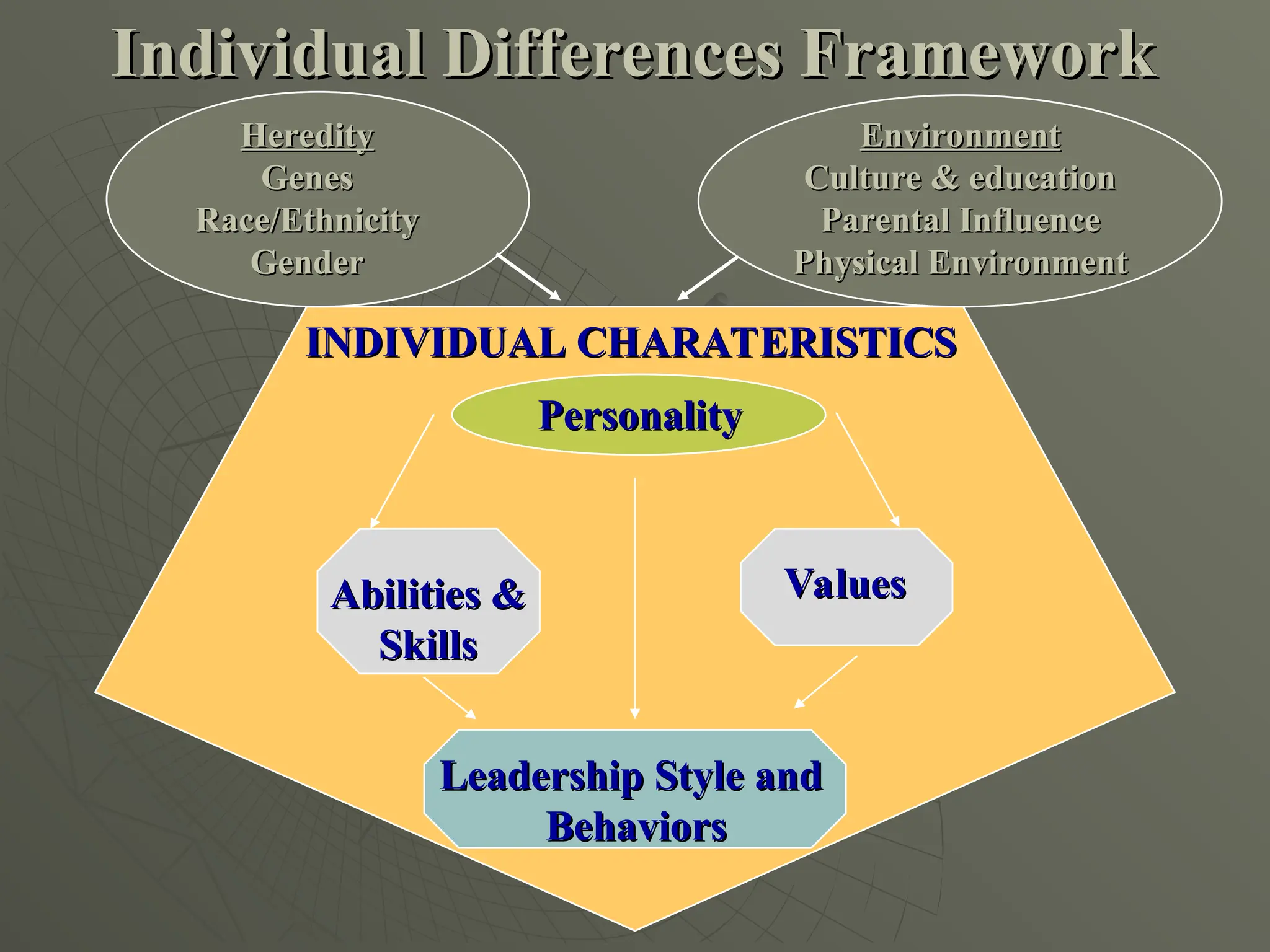
Personality
Personality
Leadership Style and
Behaviors
Behaviors
Abilities &
Abilities &
Skills
Skills
Values
Values
Environment
Environment
Culture & education
Culture & education
Parental Influence
Parental Influence
Physical Environment
Heredity
Heredity
Genes
Genes
Race/Ethnicity
Race/Ethnicity
Gender
Gender
INDIVIDUAL CHARATERISTICS
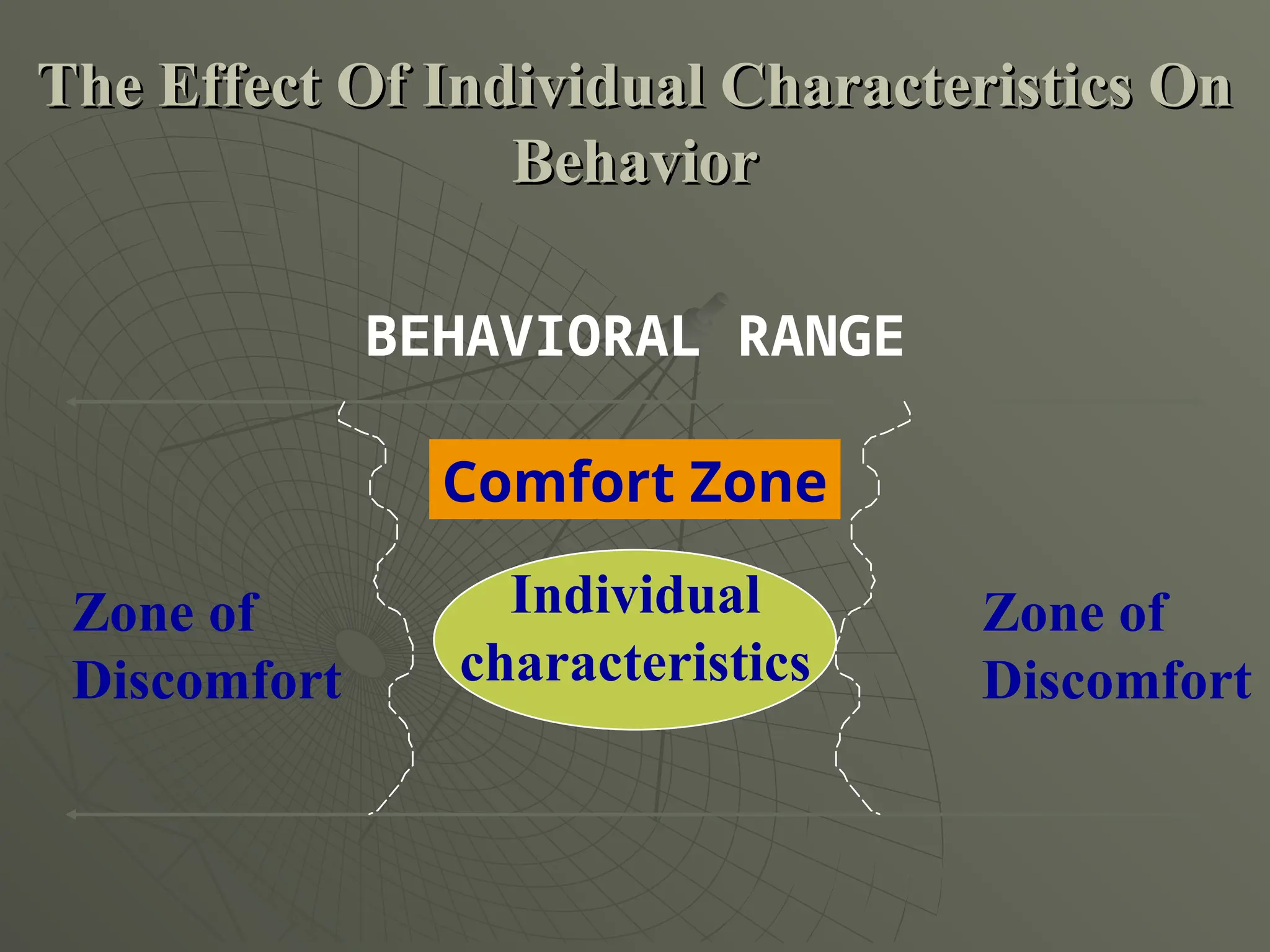
The Effect Of Individual Characteristics On
Behavior
Behavior
Zone of
Discomfort
Zone of
Discomfort
BEHAVIORAL RANGE
Individual
characteristics
Comfort Zone
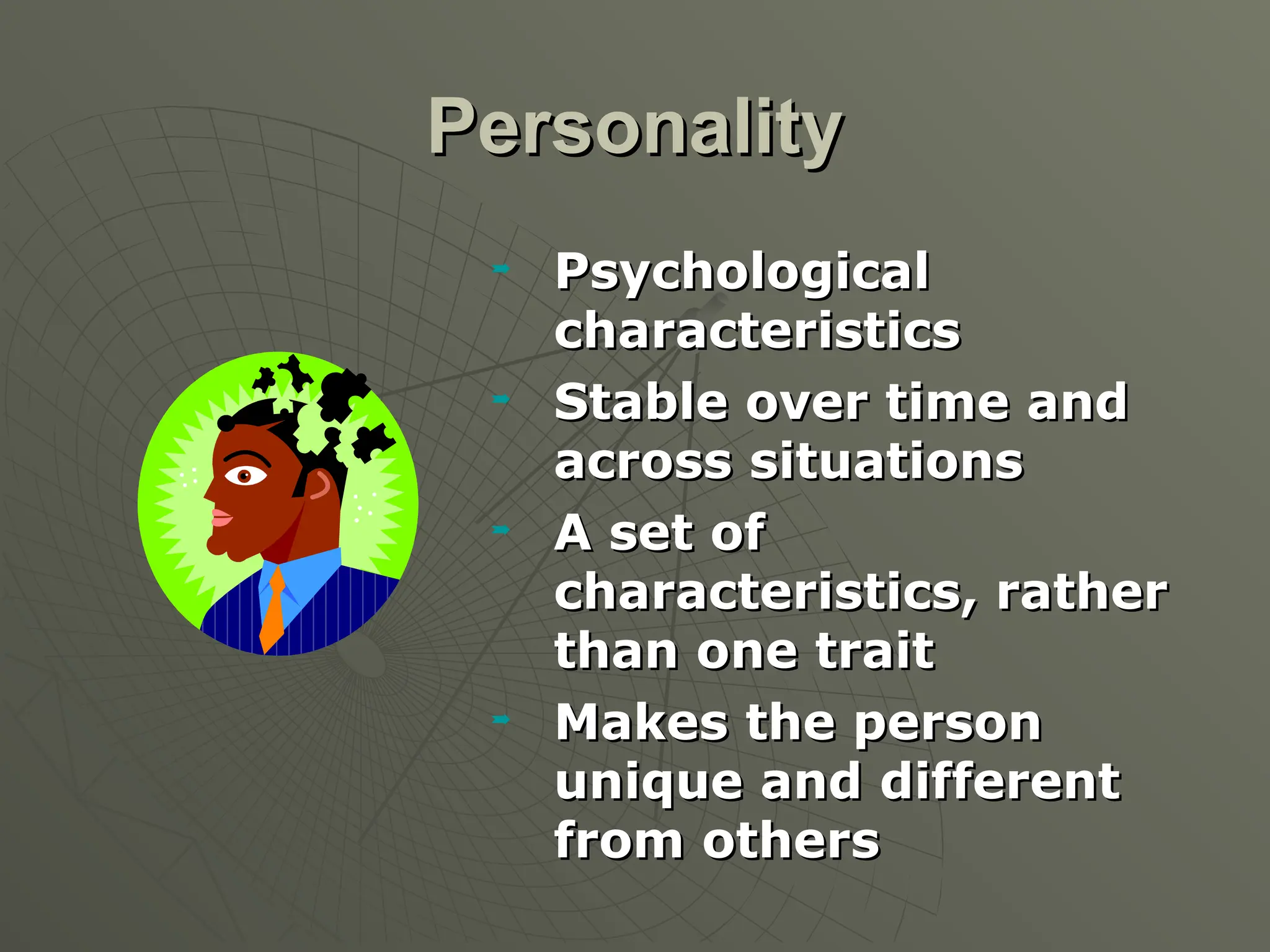
Personality
Personality
 Psychological
Psychological
characteristics
characteristics
 Stable over time and
Stable over time and
across situations
across situations
 A set of
A set of
characteristics, rather
than one trait
than one trait
 Makes the person
Makes the person
unique and different
from others
from others
Abilities and Skills

Ability, or aptitude, is a stable natural
talent for doing something mental or
physical.
physical.

A skill is an acquired talent that a person
develops related to a specific task.
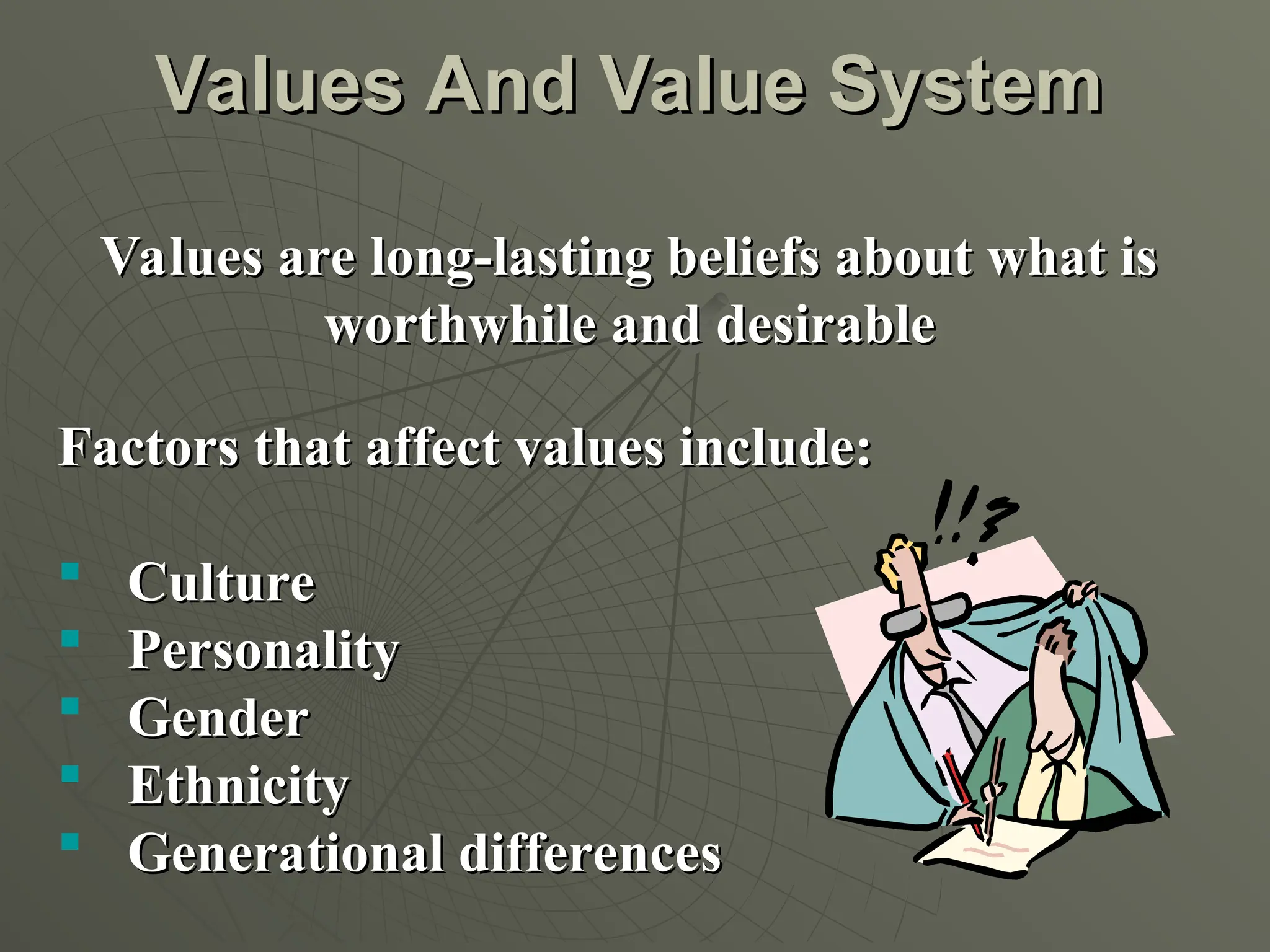
Values And Value System
Values are long-lasting beliefs about what is
worthwhile and desirable
Factors that affect values include:
 Culture
Culture
 Personality
Personality
 Gender
Gender
 Ethnicity
Ethnicity
 Generational differences
Generational differences
Views of Ethics
Views of Ethics
 The relativist view of ethics
The relativist view of ethics
suggests a belief that what is right
or wrong depends on the situation
or the culture.
or the culture.
 The universalist view of ethics
The universalist view of ethics
suggests that all activities should
be judged by the same standards,
regardless of the situation or
culture.
culture.
Components Of Emotional Intelligence

Self-awareness
Self-awareness

Managing emotions
Managing emotions

Self-motivation
Self-motivation

Empathy for others
Empathy for others

Interpersonal skills
Characteristics Of Creative Leaders
 Perseverance when facing obstacles
Perseverance when facing obstacles
 Self-confidence
Self-confidence
 Willingness to take risks
Willingness to take risks
 Willingness to grow and openness to
Willingness to grow and openness to
new experiences
new experiences
 Tolerance for ambiguity
Tolerance for ambiguity
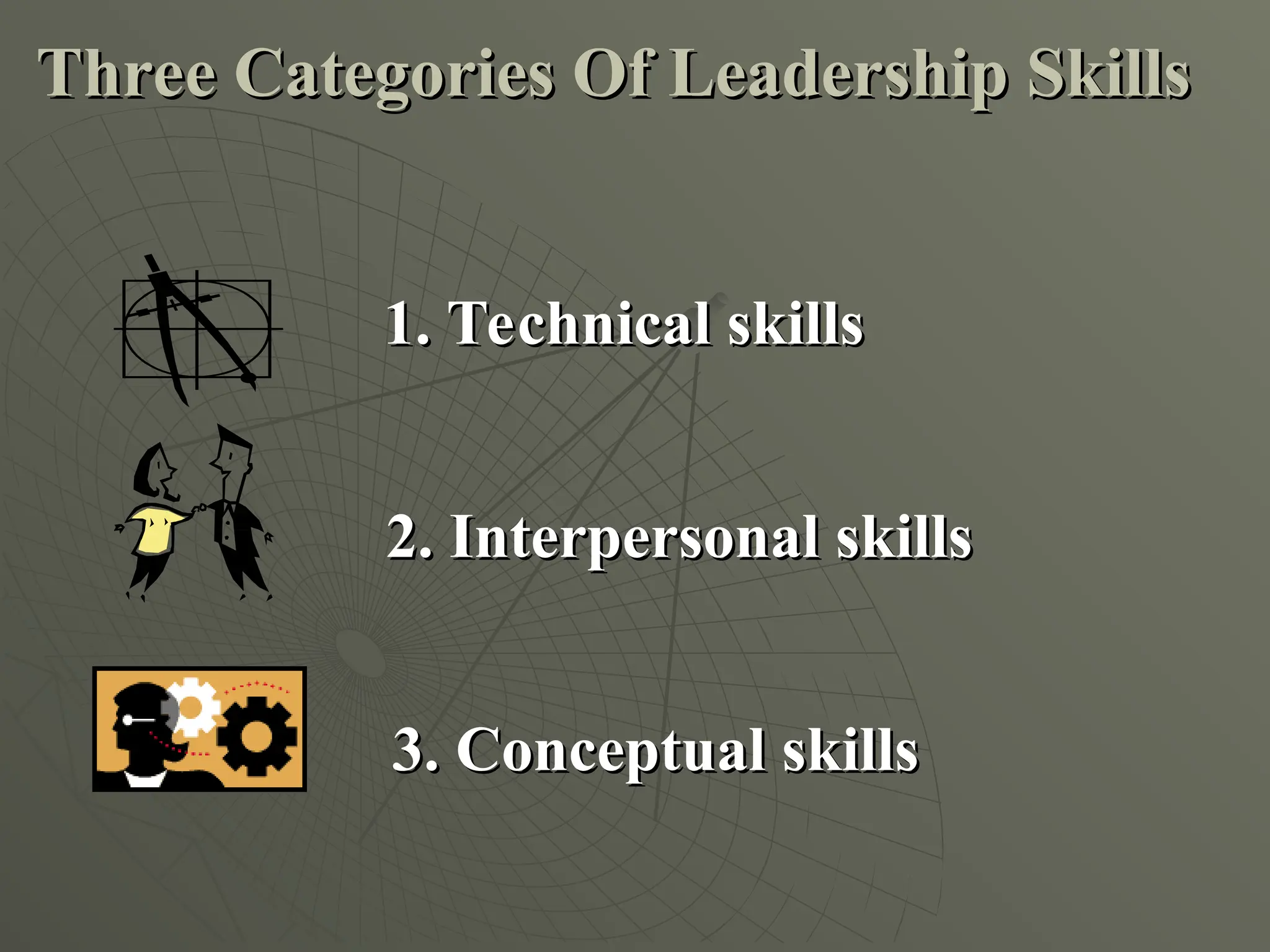
Three Categories Of Leadership Skills
1. Technical skills
1. Technical skills
2. Interpersonal skills
3. Conceptual skills
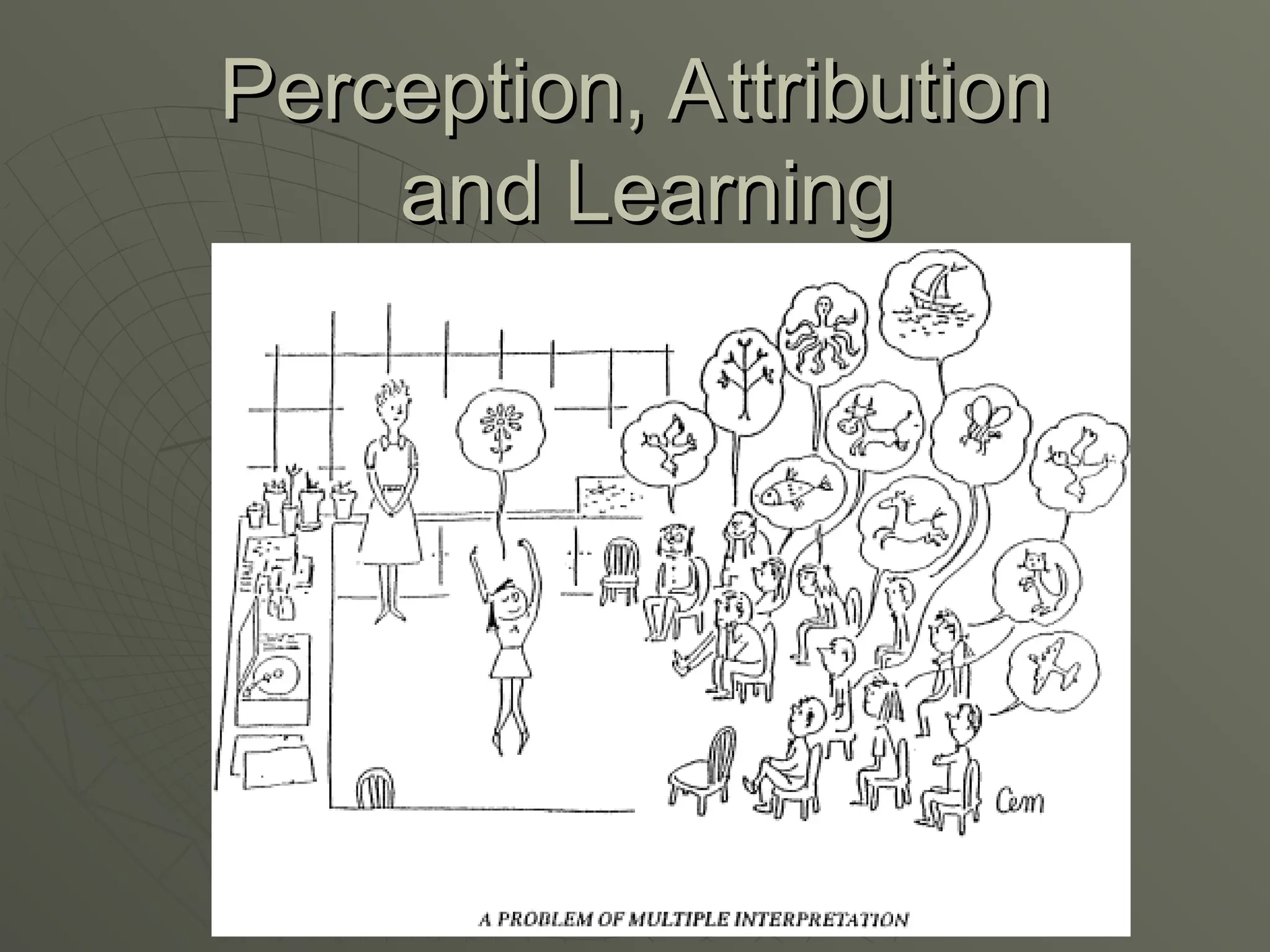
Perception, Attribution
and Learning
and Learning
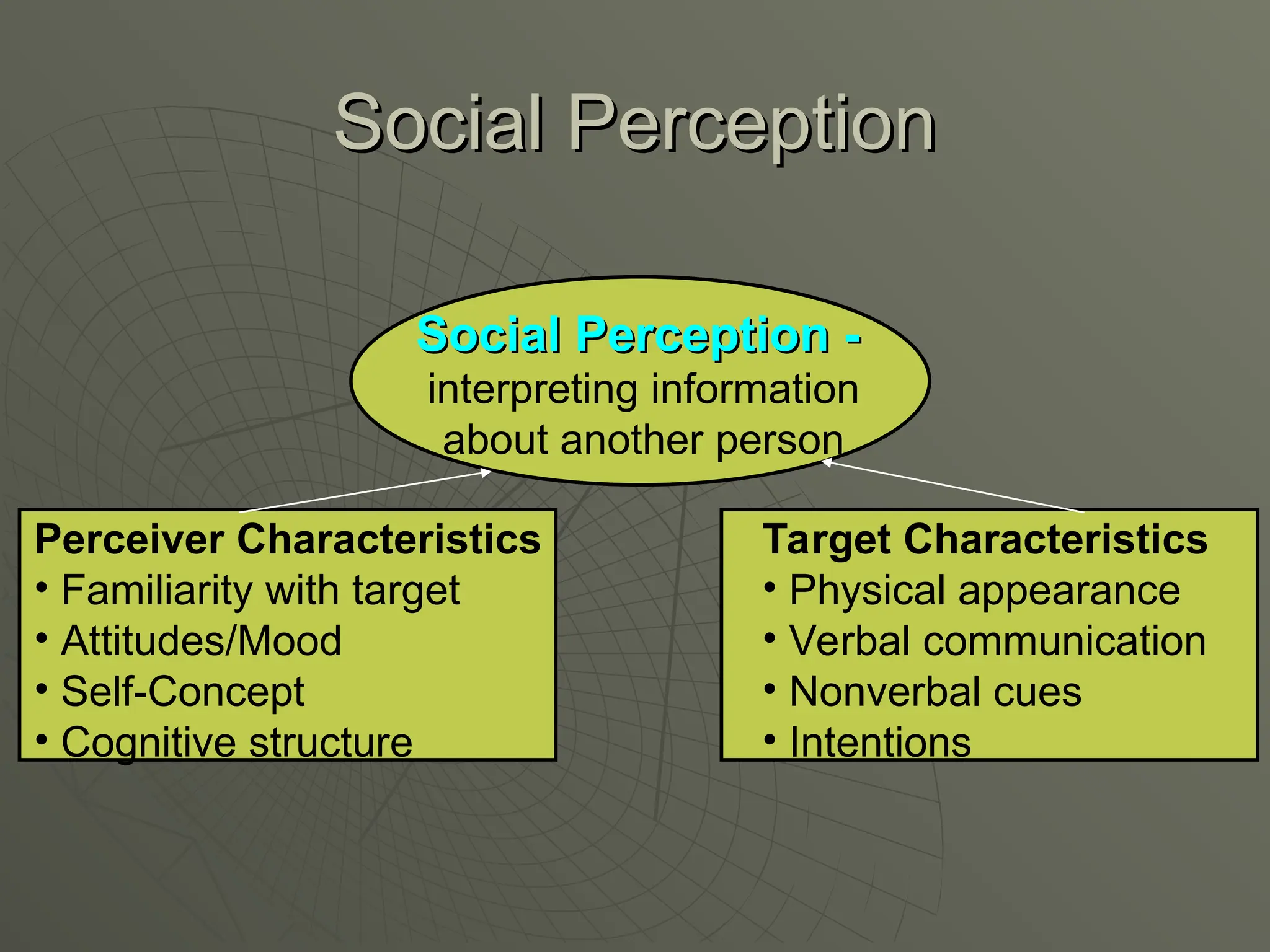
Social Perception
Social Perception
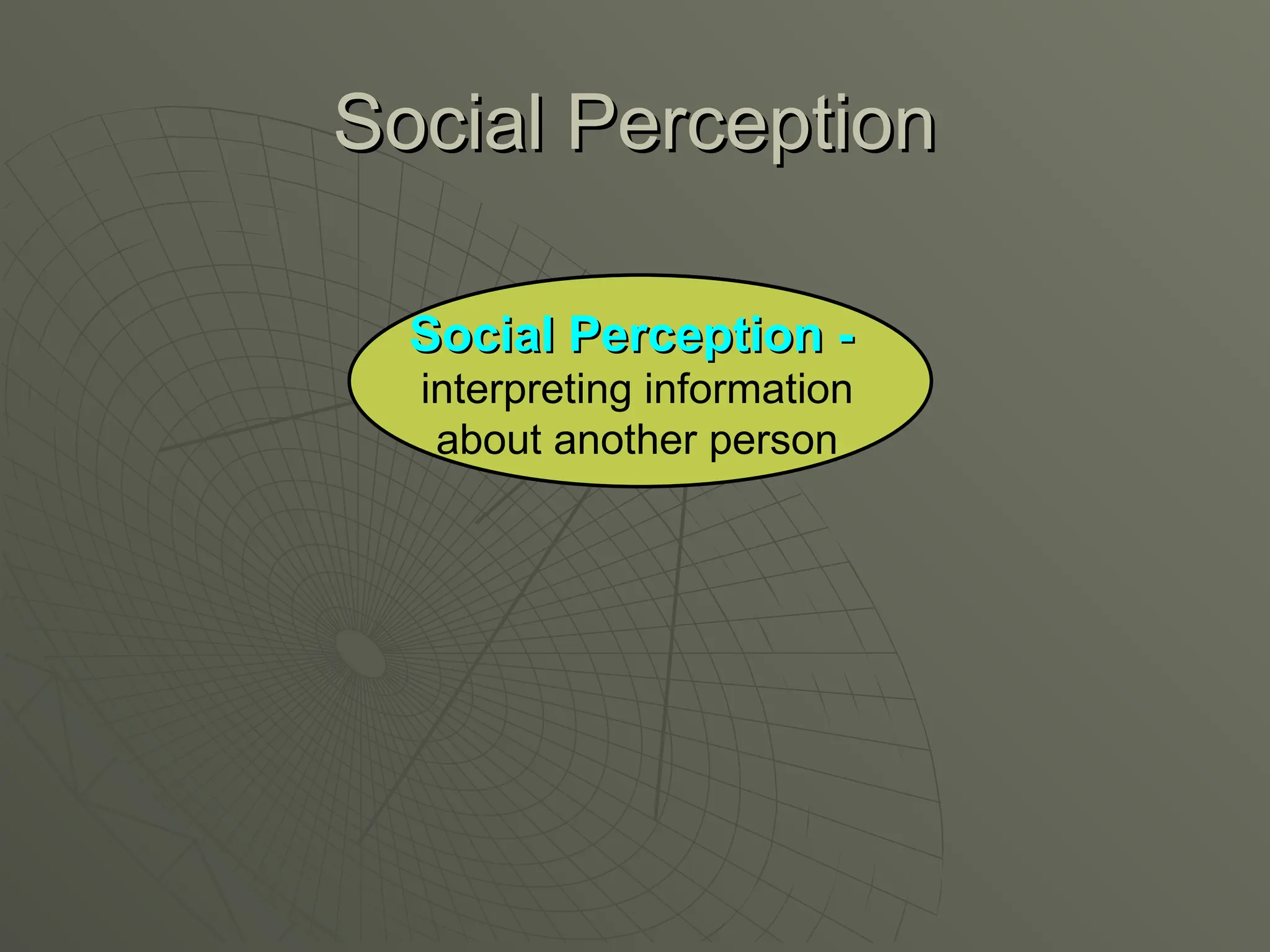
Social Perception -
Social Perception -
interpreting information
about another person
Social Perception
Social Perception
Social Perception -
Social Perception -
interpreting information
about another person
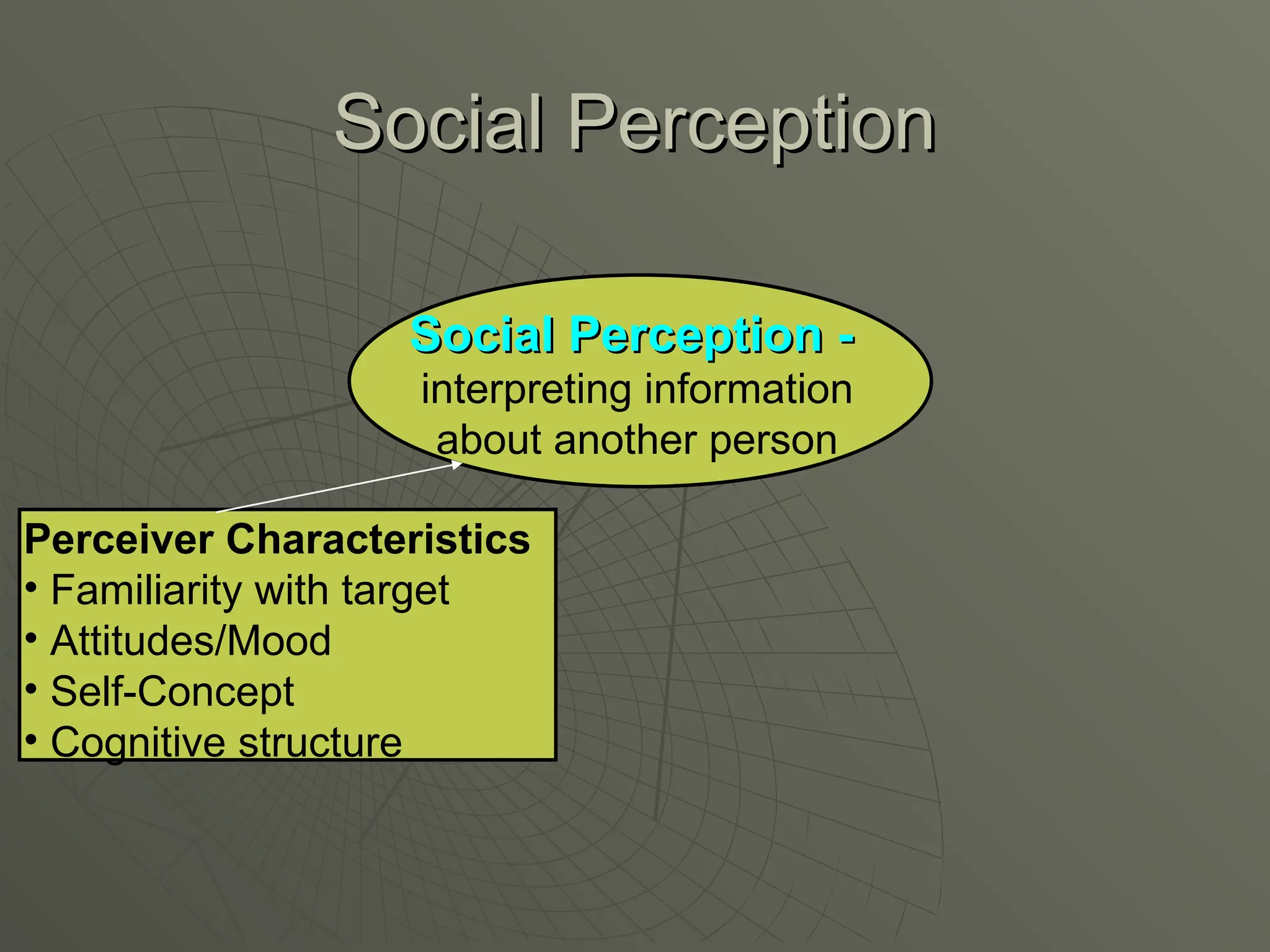
Perceiver Characteristics
• Familiarity with target
• Attitudes/Mood
• Self-Concept
• Cognitive structure
Social Perception
Social Perception
Social Perception -
Social Perception -
interpreting information
about another person
Perceiver Characteristics
• Familiarity with target
• Attitudes/Mood
• Self-Concept
• Cognitive structure
Target Characteristics
• Physical appearance
• Verbal communication
• Nonverbal cues
• Intentions
Social Perception -
Social Perception -
interpreting information
about another person
Social Perception
Social Perception
Perceiver Characteristics
• Familiarity with target
• Attitudes/Mood
• Self-Concept
• Cognitive structure
Target Characteristics
• Physical appearance
• Verbal communication
• Nonverbal cues
• Intentions
Situational Characteristics
• Interaction context
• Strength of situational cues
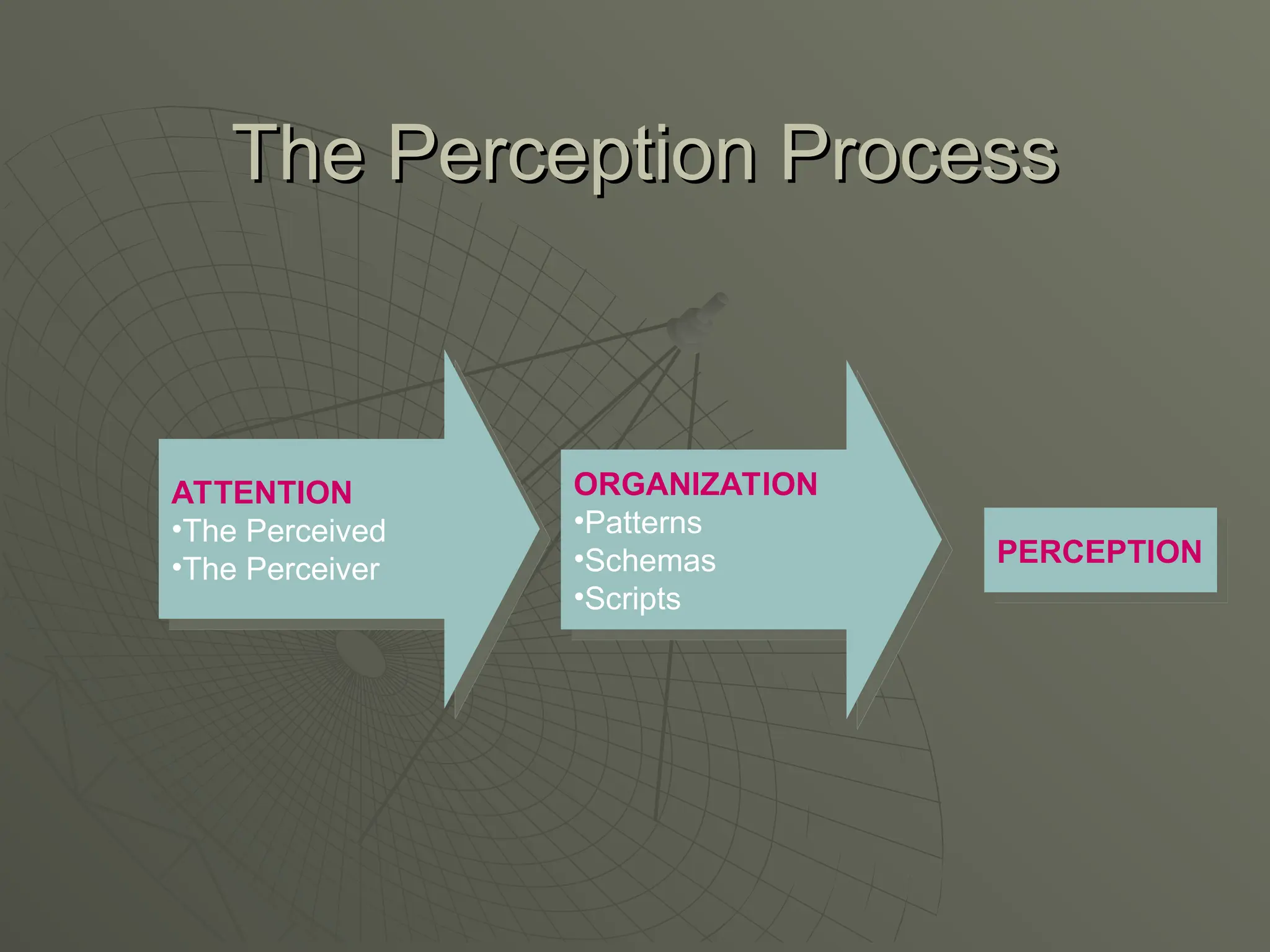
The Perception Process
ATTENTION
•The Perceived
•The Perceiver
ORGANIZATION
•Patterns
•Schemas
•Scripts
PERCEPTION
Comprehending Perception
We all have a different store of knowledge.
We all therefore interpret the world around us
differently.
Understanding relies upon the speaker and his
audience having the same perception of the required
outcome.
Perception is a 'Learned
Experience'
Experience'

It is the “awareness” of the
external world (or some aspect of
it, through one or more of our
senses and, the interpretation of
these by our mind.
these by our mind.
Understanding
Understanding
 Understanding is achieved by interpreting current
Understanding is achieved by interpreting current
experience using past experience as a source of
reference, and establishing a context upon which to
base this new information. In other words:
• We are only able to understand today in terms of,
We are only able to understand today in terms of,
and because of, our past experiences.
• Yet, we also know that 'Today' is unlike 'Yesterday'.
Yet, we also know that 'Today' is unlike 'Yesterday'.
• We inherit Yesterday's patterns and need them to
We inherit Yesterday's patterns and need them to
interpret what our senses are experiencing in the
present.
present.
• These patterns are simultaneously essential and yet
These patterns are simultaneously essential and yet
out of date.
out of date.
How do we perceive?
How do we perceive?
 We store a ‘model’ or memory of objects.
We store a ‘model’ or memory of objects.
 The process of perceiving involves ‘matching’
The process of perceiving involves ‘matching’
what our senses are experiencing to one of
our ‘models.’
our ‘models.’
 Perception is an active pattern-matching
Perception is an active pattern-matching
process.
process.
 We recognize the world because of our
We recognize the world because of our
historical store of information.
 We create our own unique world, our own
We create our own unique world, our own
interpretation of reality.
Barriers to Social Perception

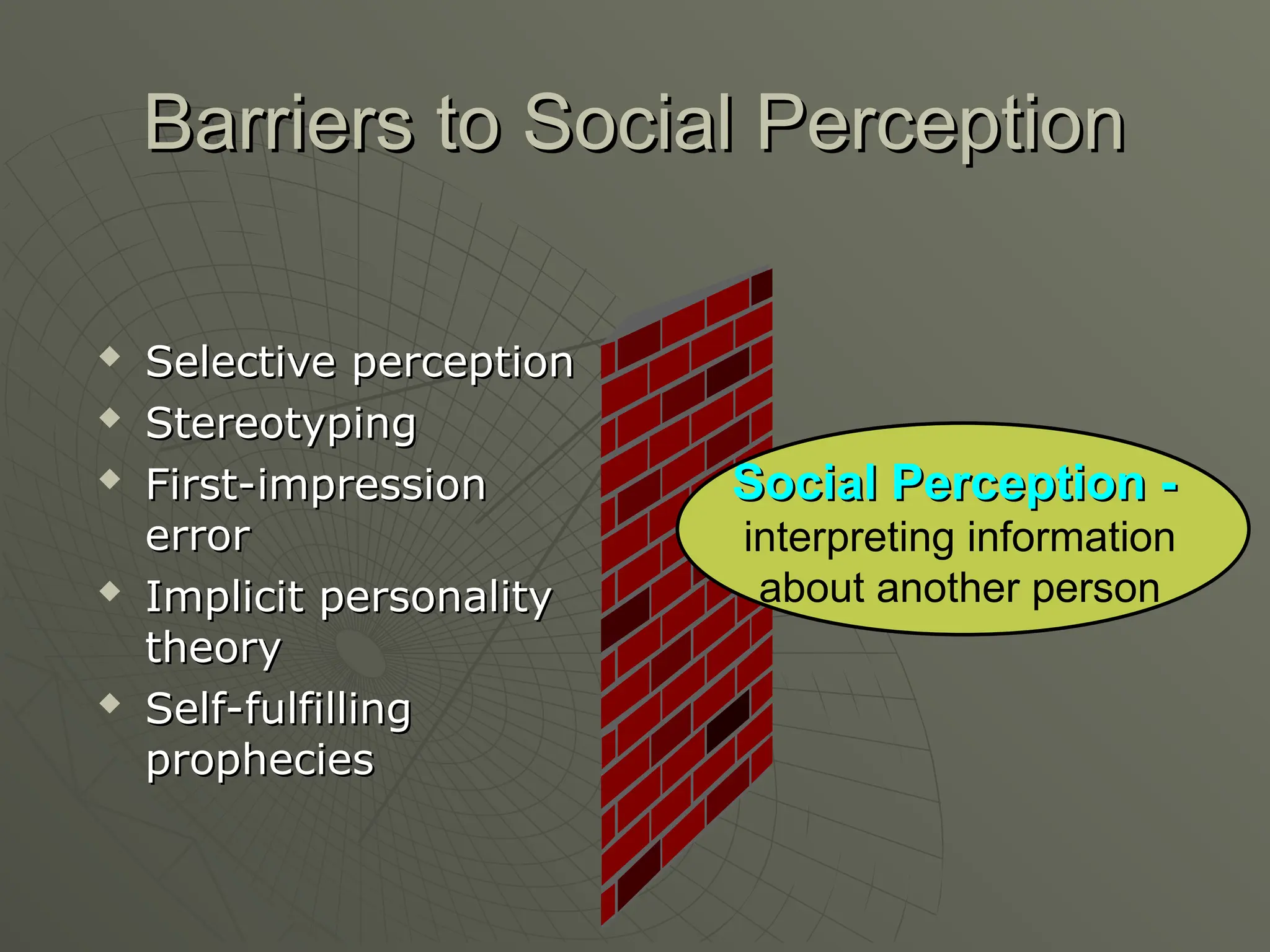
Selective perception

Stereotyping
Stereotyping

First-impression
First-impression
error
error

Implicit personality
theory
theory

Self-fulfilling
Self-fulfilling
prophecies
prophecies
Social Perception -
Social Perception -
interpreting information
about another person
Personality Theories
Trait Theory - understand individuals by breaking
down behavior patterns into observable traits
Psychodynamic Theory - emphasizes the unconscious
determinants of behavior
Humanistic Theory - emphasizes individual growth
and improvement
and improvement
Integrative Approach -
Integrative Approach - describes personality as a
describes personality as a
composite of an individual’s psychological
processes
processes
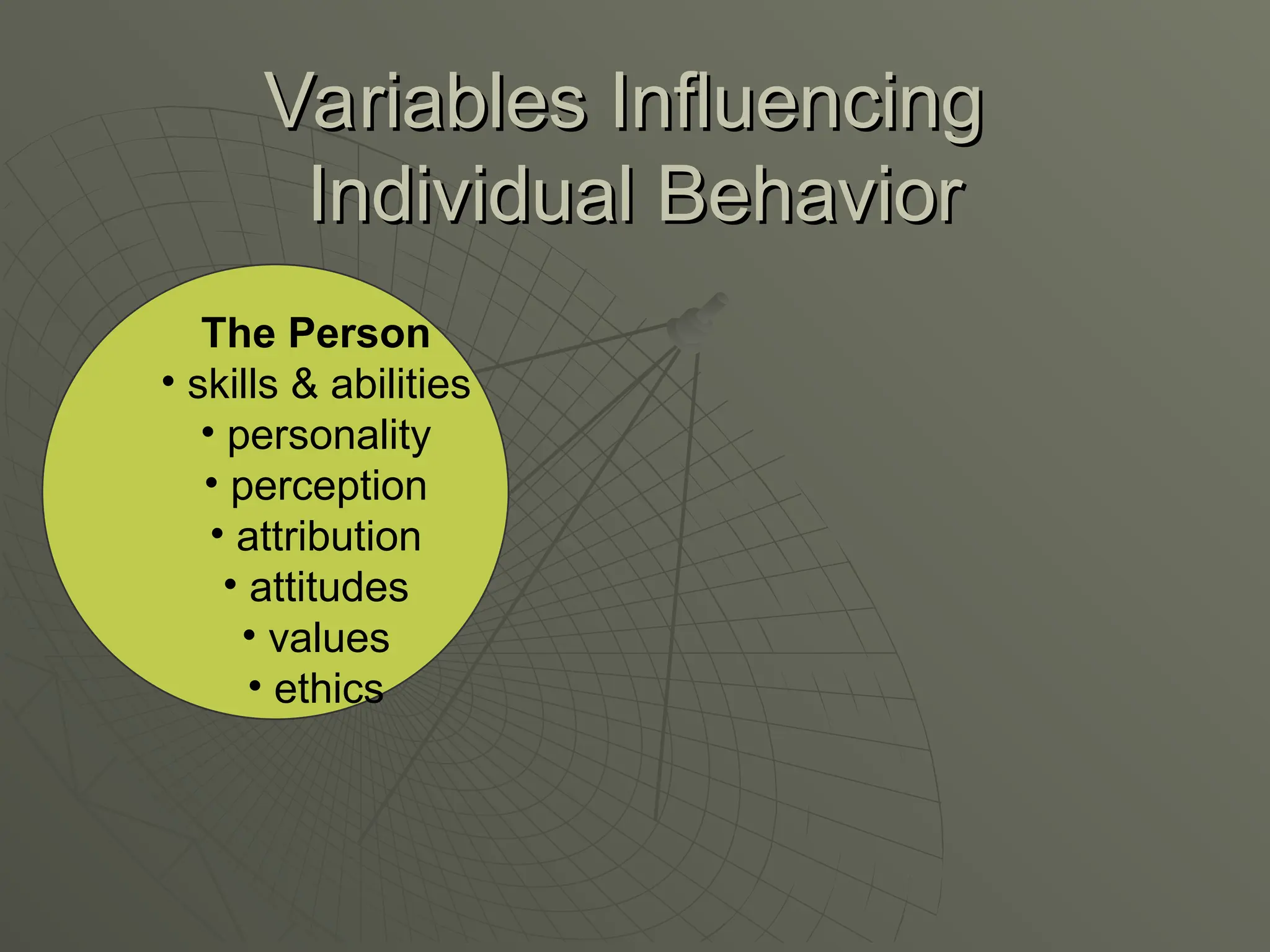
Variables Influencing
Individual Behavior
Individual Behavior
The Person
• skills & abilities
• personality
• perception
• attribution
• attitudes
• values
• ethics
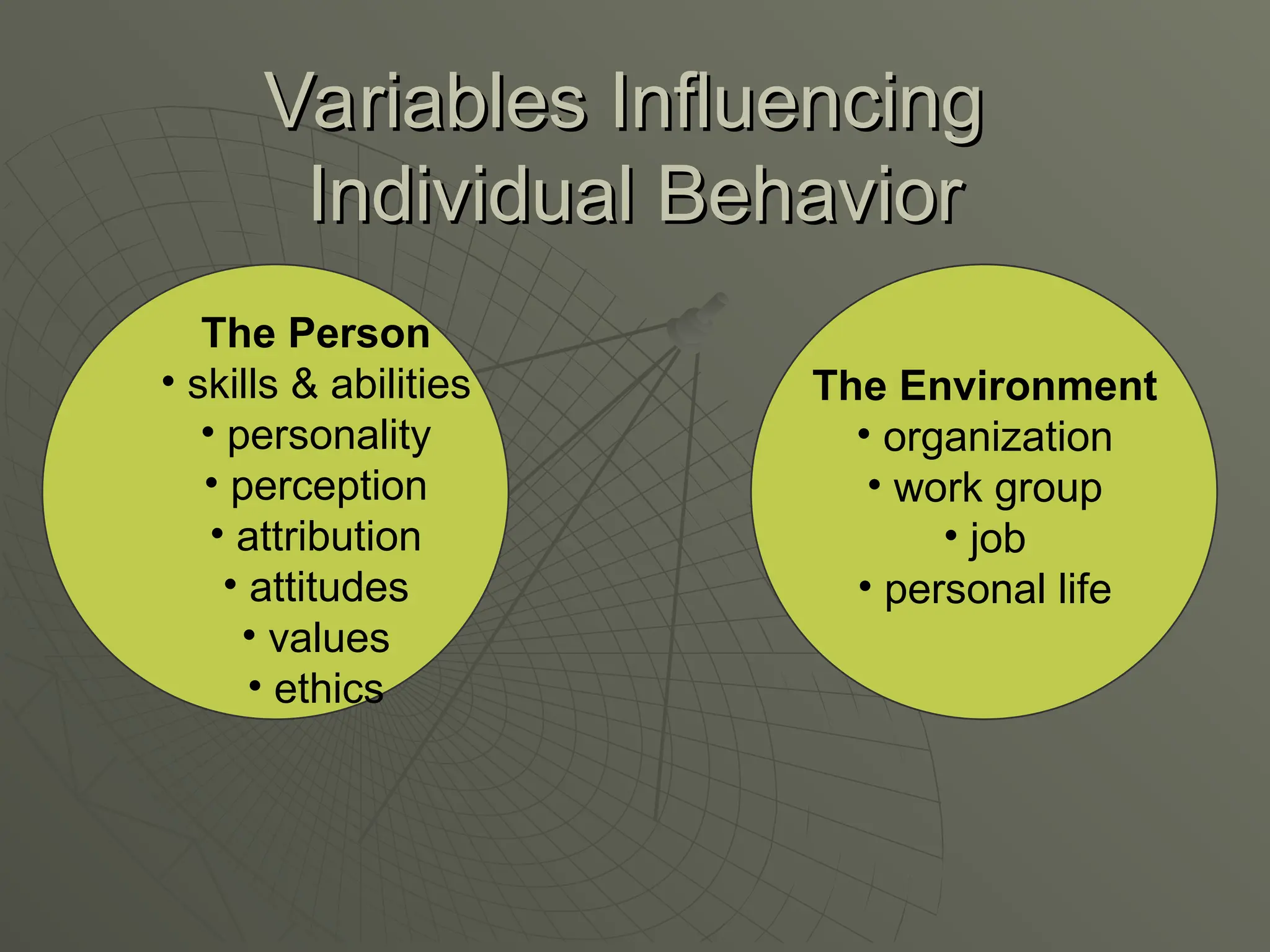
Variables Influencing
Individual Behavior
Individual Behavior
The Person
• skills & abilities
• personality
• perception
• attribution
• attitudes
• values
• ethics
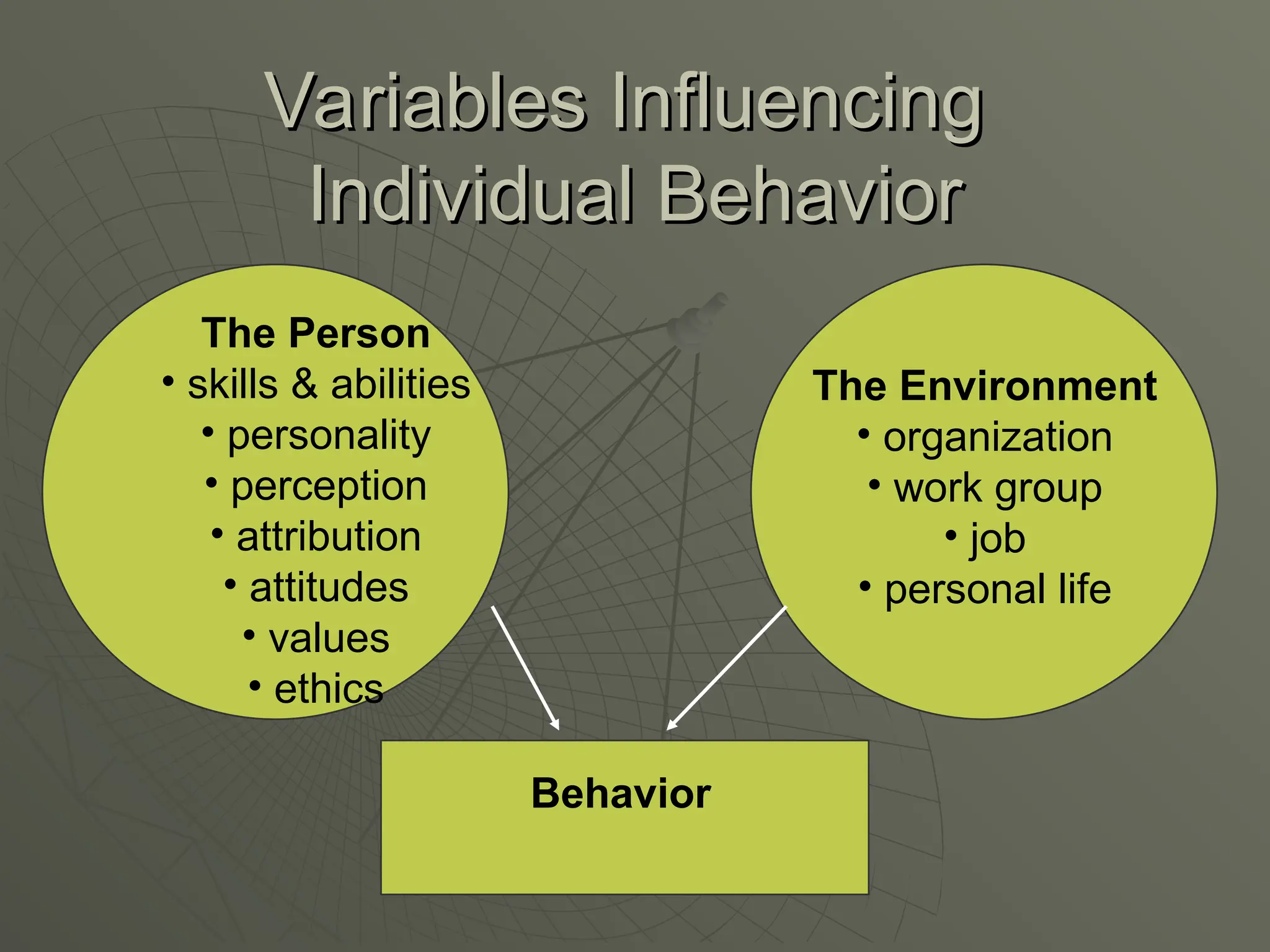
The Environment
• organization
• work group
• job
• personal life
The Environment
• organization
• work group
• job
• personal life
Behavior
Variables Influencing
Individual Behavior
Individual Behavior
The Person
• skills & abilities
• personality
• perception
• attribution
• attitudes
• values
• ethics
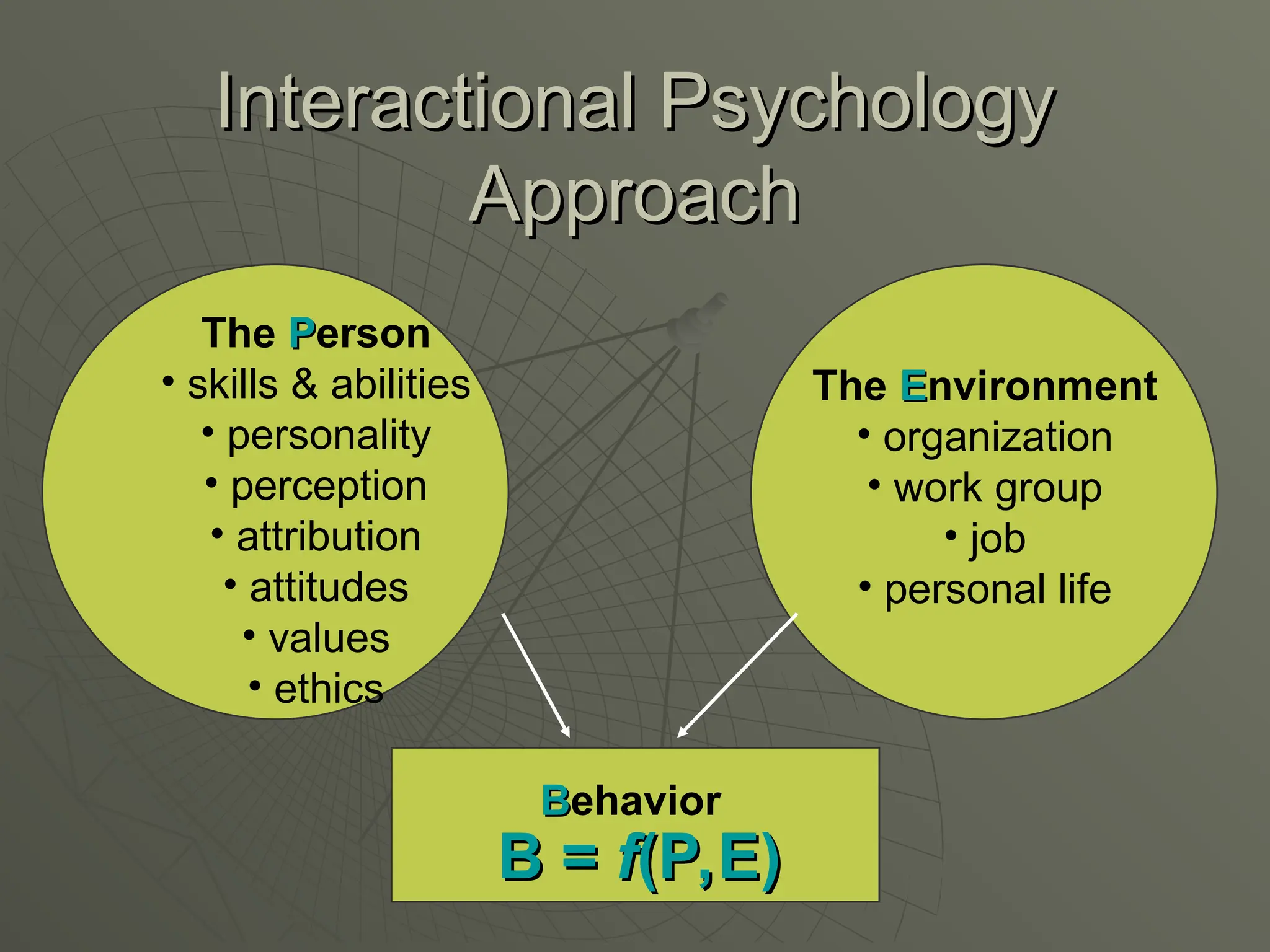
Interactional Psychology
Approach
Approach
The E
Environment
• organization
• work group
• job
• personal life
B =
B = f
f(P,E)
(P,E)
B
Behavior
The P
Person
• skills & abilities
• personality
• perception
• attribution
• attitudes
• values
• ethics
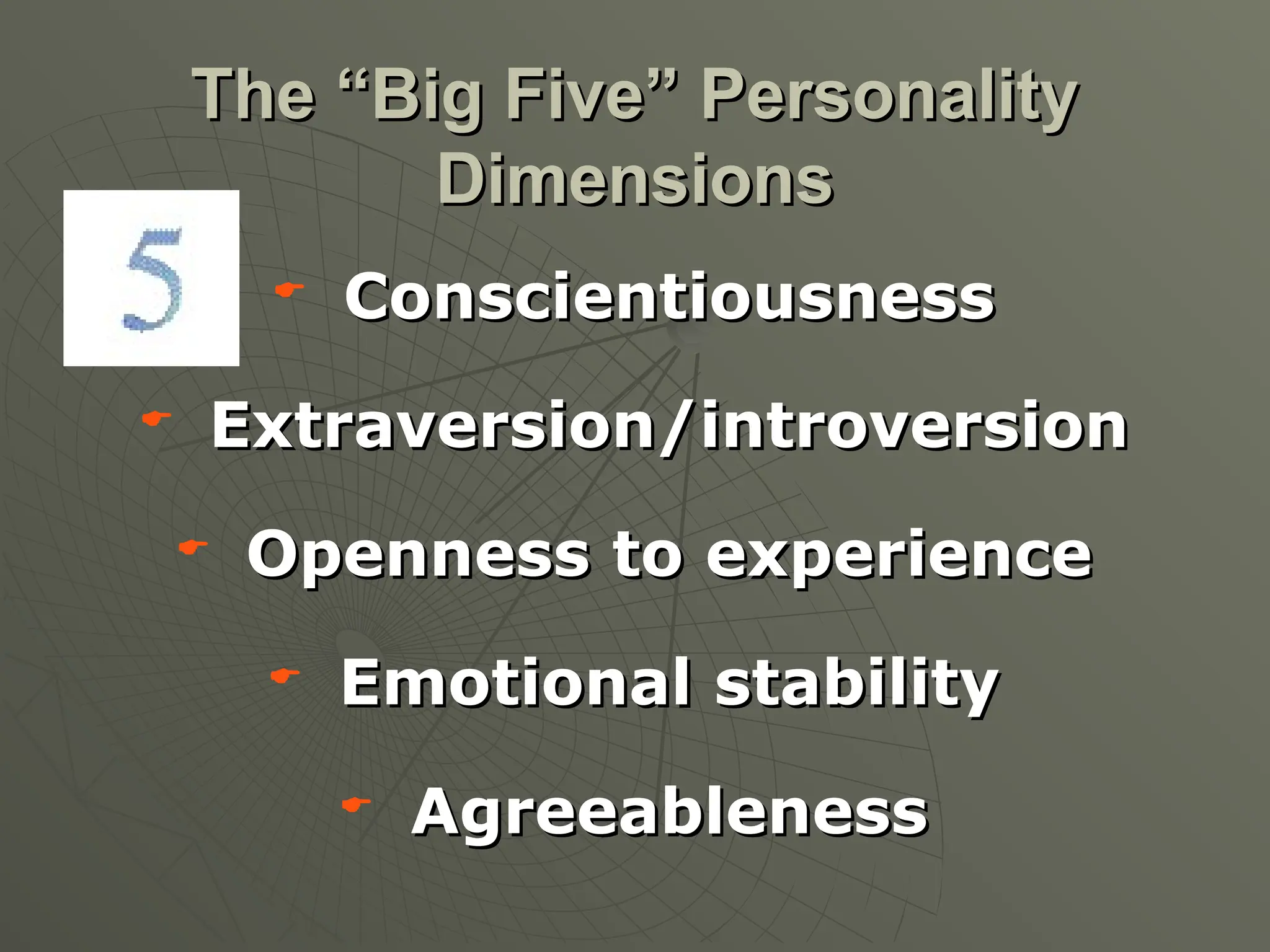
 Conscientiousness
Conscientiousness
 Extraversion/introversion
Extraversion/introversion
 Openness to experience
Openness to experience
 Emotional stability
Emotional stability
 Agreeableness
Agreeableness
The “Big Five” Personality
Dimensions
Dimensions

Less anxious
Less anxious

Set harder goals
Set harder goals

Manage stress well and adapt to
change
change

More considerate of followers and
less likely to use coercive power

Internal CEOs select risky and
innovative strategies
Characteristics Of Individuals
With Internal Locus Of Control
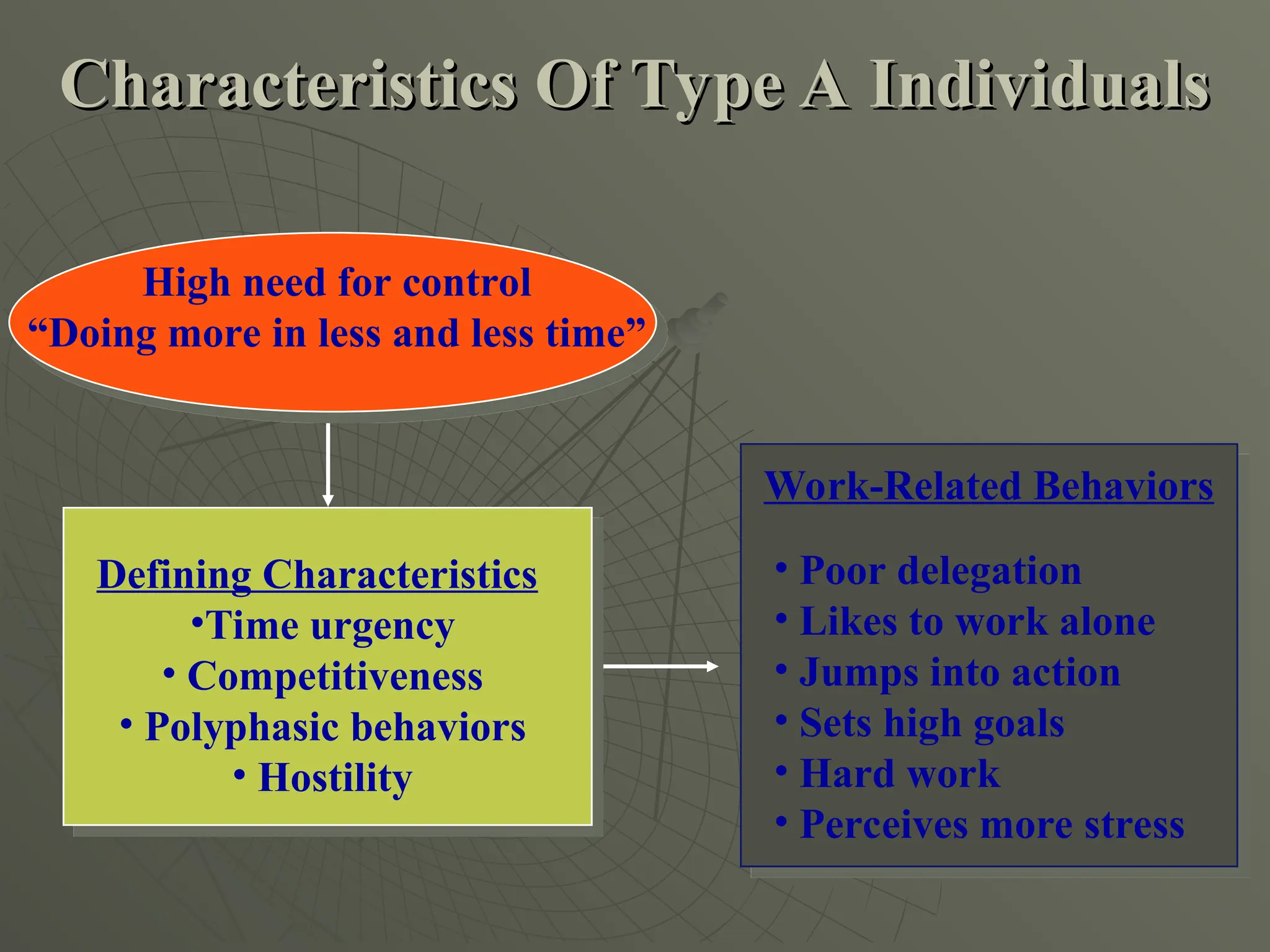
High need for control
“Doing more in less and less time”
Defining Characteristics
•Time urgency
• Competitiveness
• Polyphasic behaviors
• Hostility
Work-Related Behaviors
• Poor delegation
• Likes to work alone
• Jumps into action
• Sets high goals
• Hard work
• Perceives more stress
Characteristics Of Type A Individuals

Able to read cues from the
environment
environment

Able to change behavior to match
situation
situation

Able to cope in cross-cultural
environments
environments

May be a key factor in leadership
effectiveness
effectiveness
Characteristics Of High
Self-monitors
Self-monitors
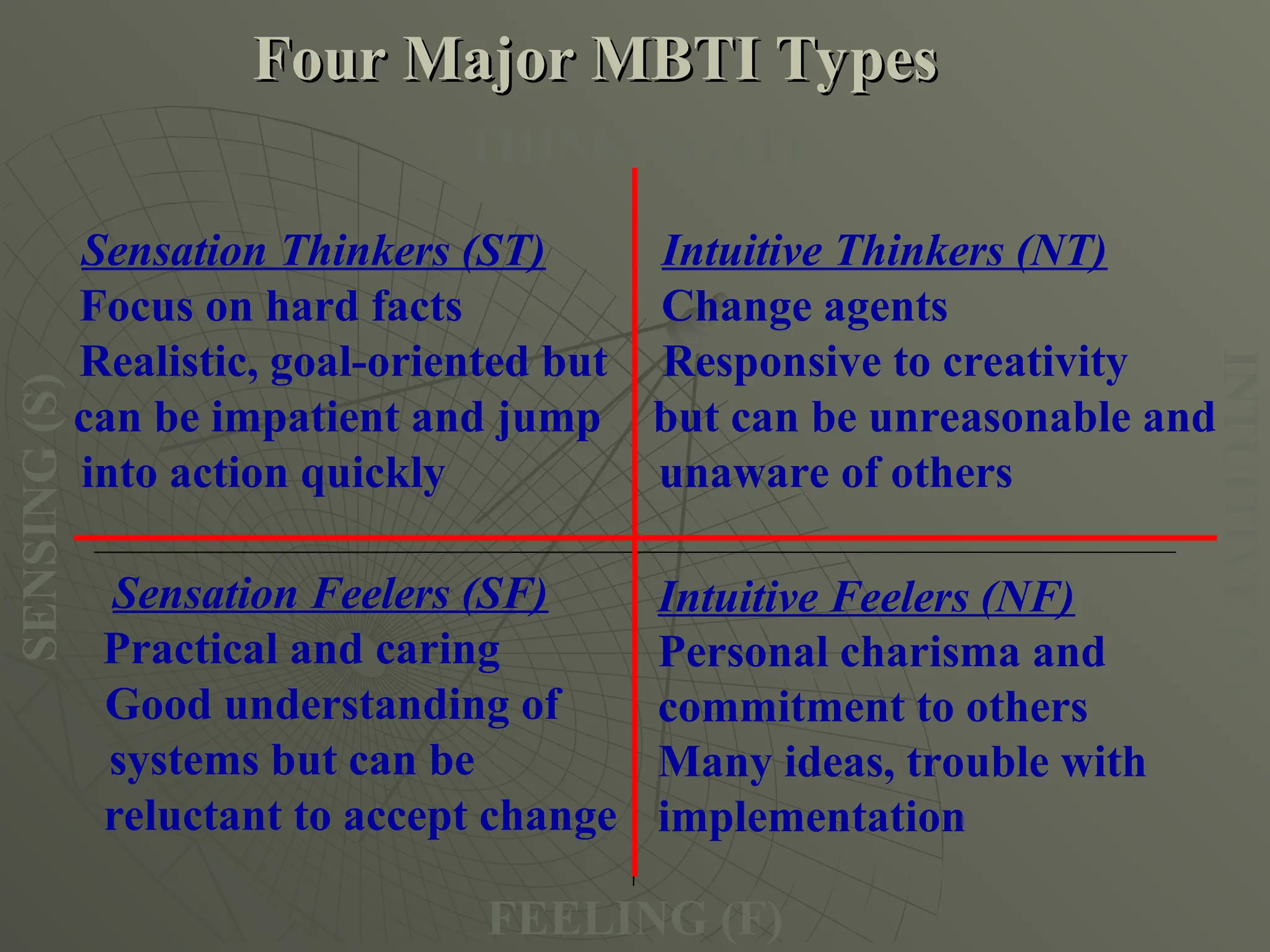
Sensation Thinkers (ST)
Focus on hard facts
Realistic, goal-oriented but
can be impatient and jump
into action quickly
Intuitive Thinkers (NT)
Change agents
Responsive to creativity
but can be unreasonable and
unaware of others
Sensation Feelers (SF)
Practical and caring
Good understanding of
systems but can be
reluctant to accept change
THINKING (T)
FEELING (F)
INTUITIVE
(N)
SENSING
(S)
Four Major MBTI Types
Intuitive Feelers (NF)
Personal charisma and
commitment to others
Many ideas, trouble with
implementation
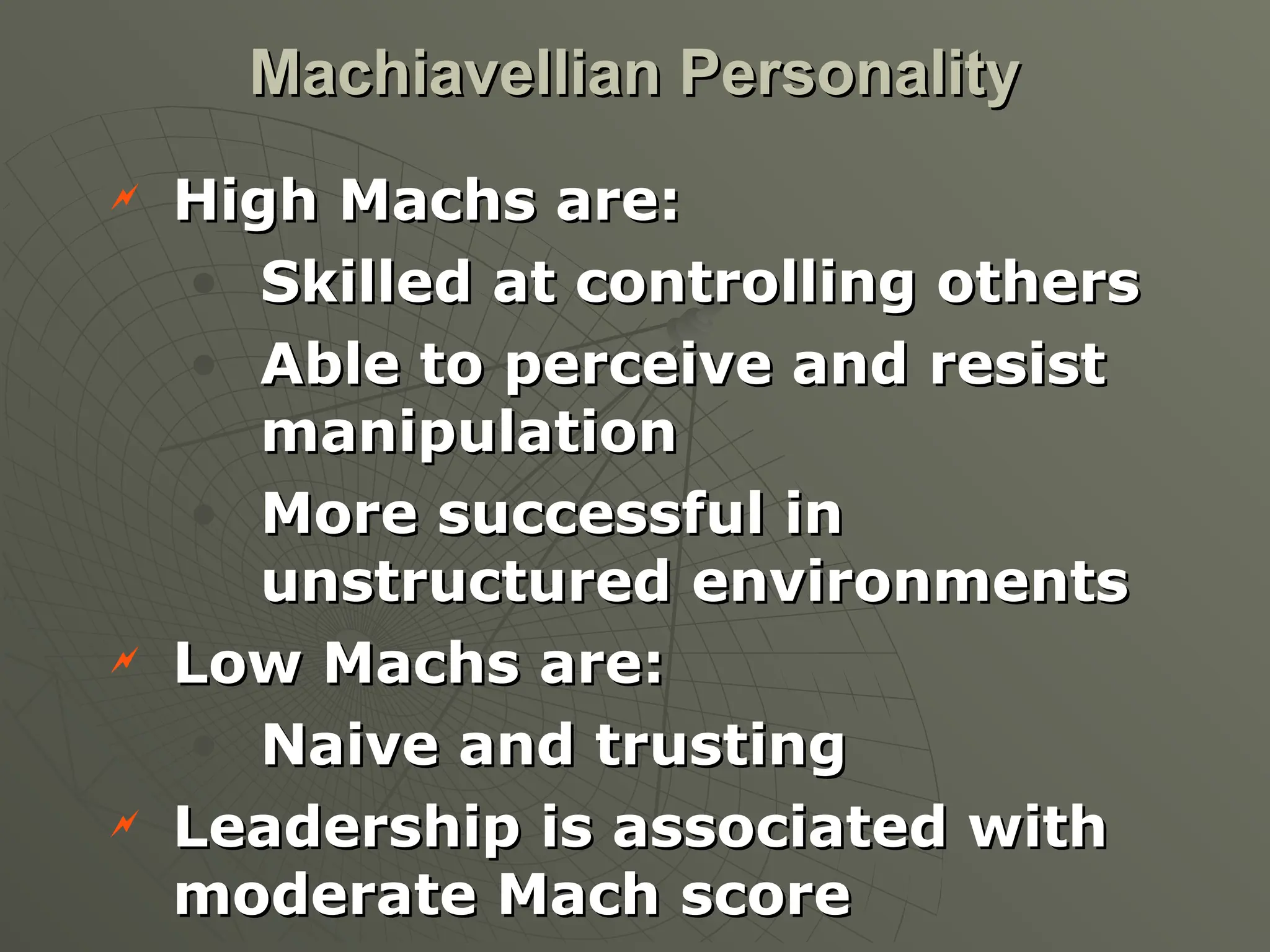
 High Machs are:
High Machs are:
• Skilled at controlling others
Skilled at controlling others
• Able to perceive and resist
Able to perceive and resist
manipulation
manipulation
• More successful in
More successful in
unstructured environments
 Low Machs are:
Low Machs are:
• Naive and trusting
Naive and trusting
 Leadership is associated with
Leadership is associated with
moderate Mach score
moderate Mach score
Machiavellian Personality
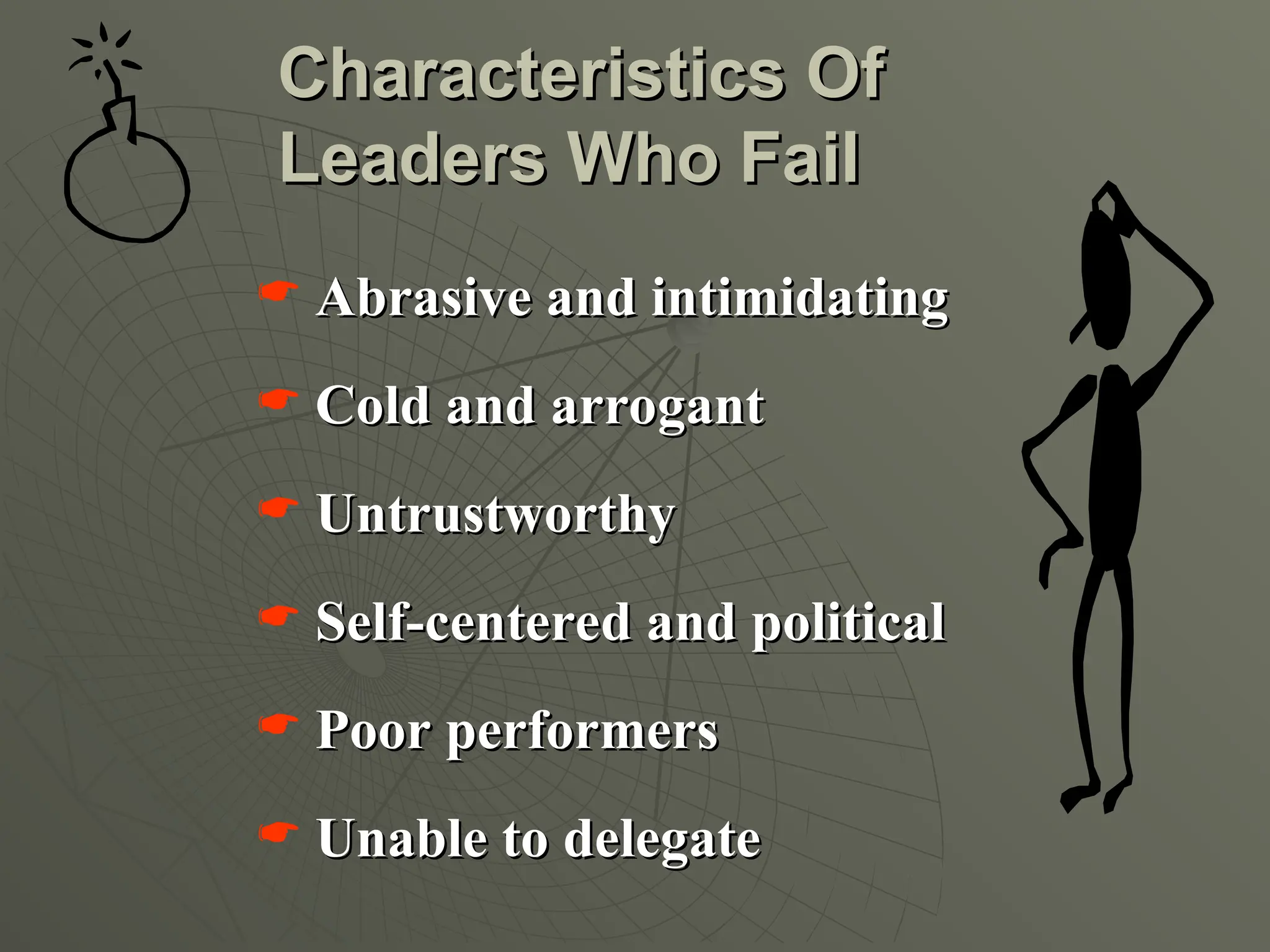
 Abrasive and intimidating
Abrasive and intimidating
 Cold and arrogant
Cold and arrogant
 Untrustworthy
Untrustworthy
 Self-centered and political
Self-centered and political
 Poor performers
Poor performers
 Unable to delegate
Unable to delegate
Characteristics Of
Characteristics Of
Leaders Who Fail
Leaders Who Fail
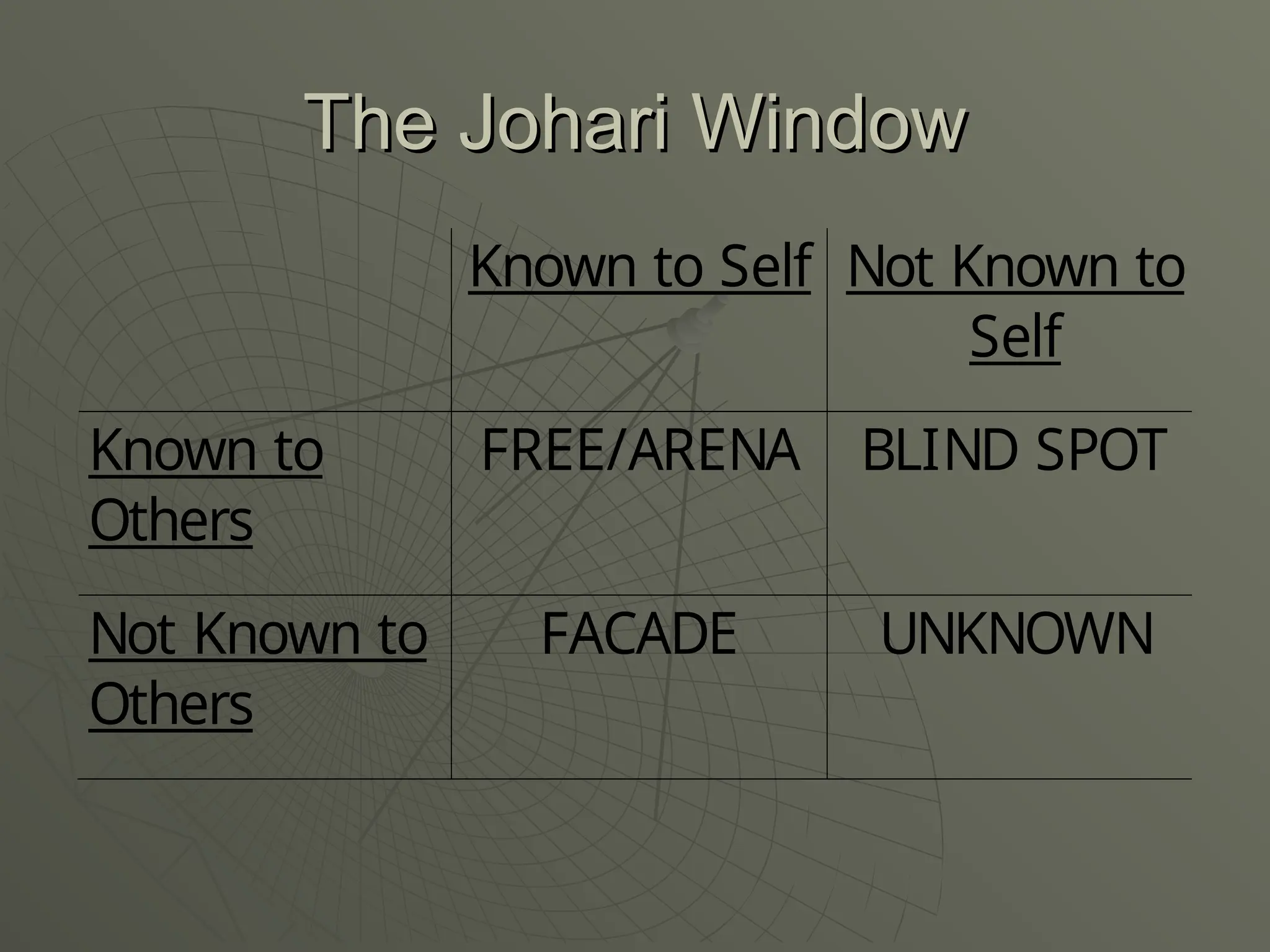
The Johari Window
The Johari Window
Known to Self Not Known to
Self
Known to
Others
FREE/ARENA BLIND SPOT
Not Known to
Others
FACADE UNKNOWN
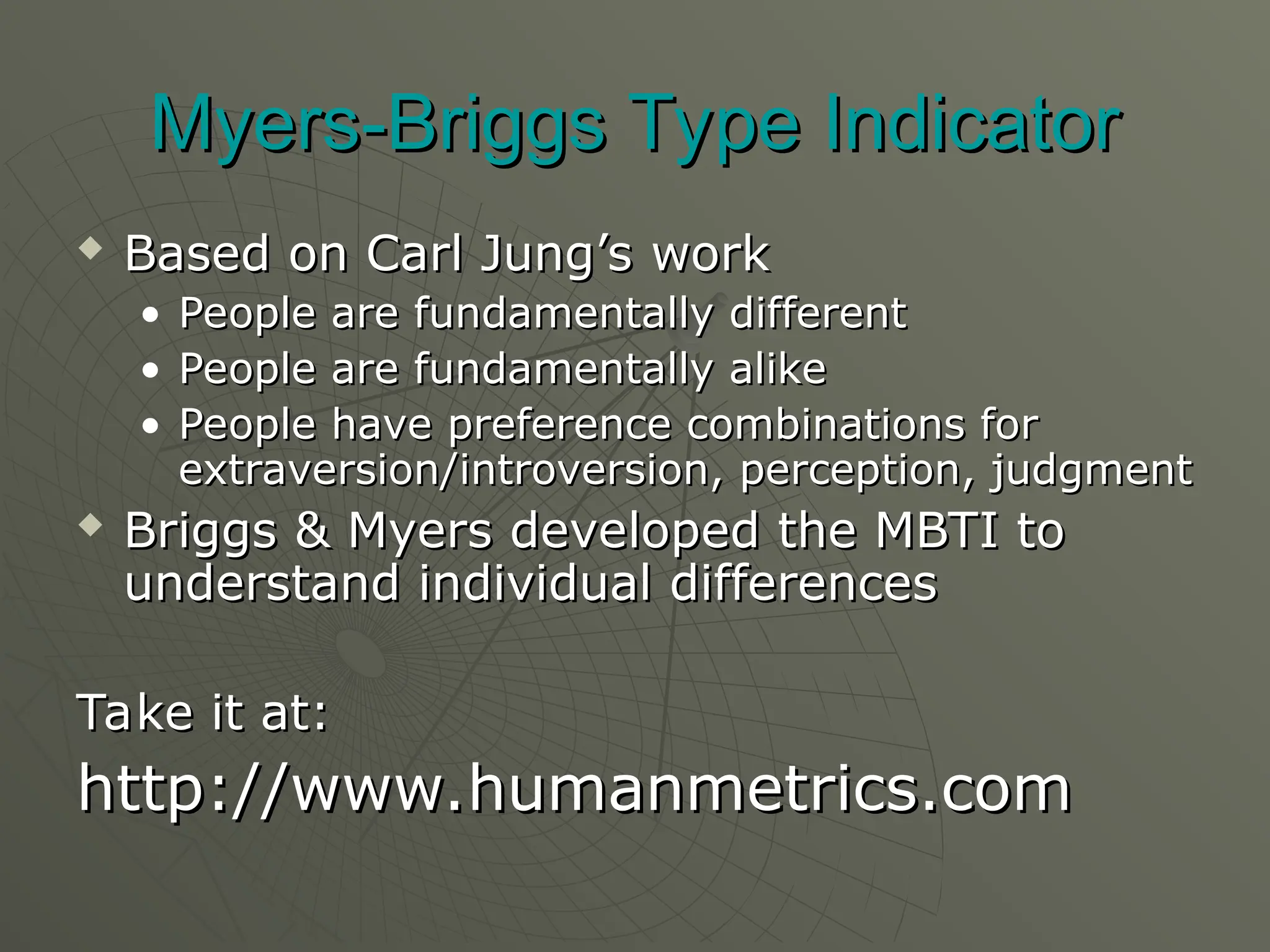
Myers-Briggs Type Indicator
 Based on Carl Jung’s work
Based on Carl Jung’s work
• People are fundamentally different
People are fundamentally different
• People are fundamentally alike
People are fundamentally alike
• People have preference combinations for
People have preference combinations for
extraversion/introversion, perception, judgment
 Briggs & Myers developed the MBTI to
Briggs & Myers developed the MBTI to
understand individual differences
Take it at:
Take it at:
http://www.humanmetrics.com
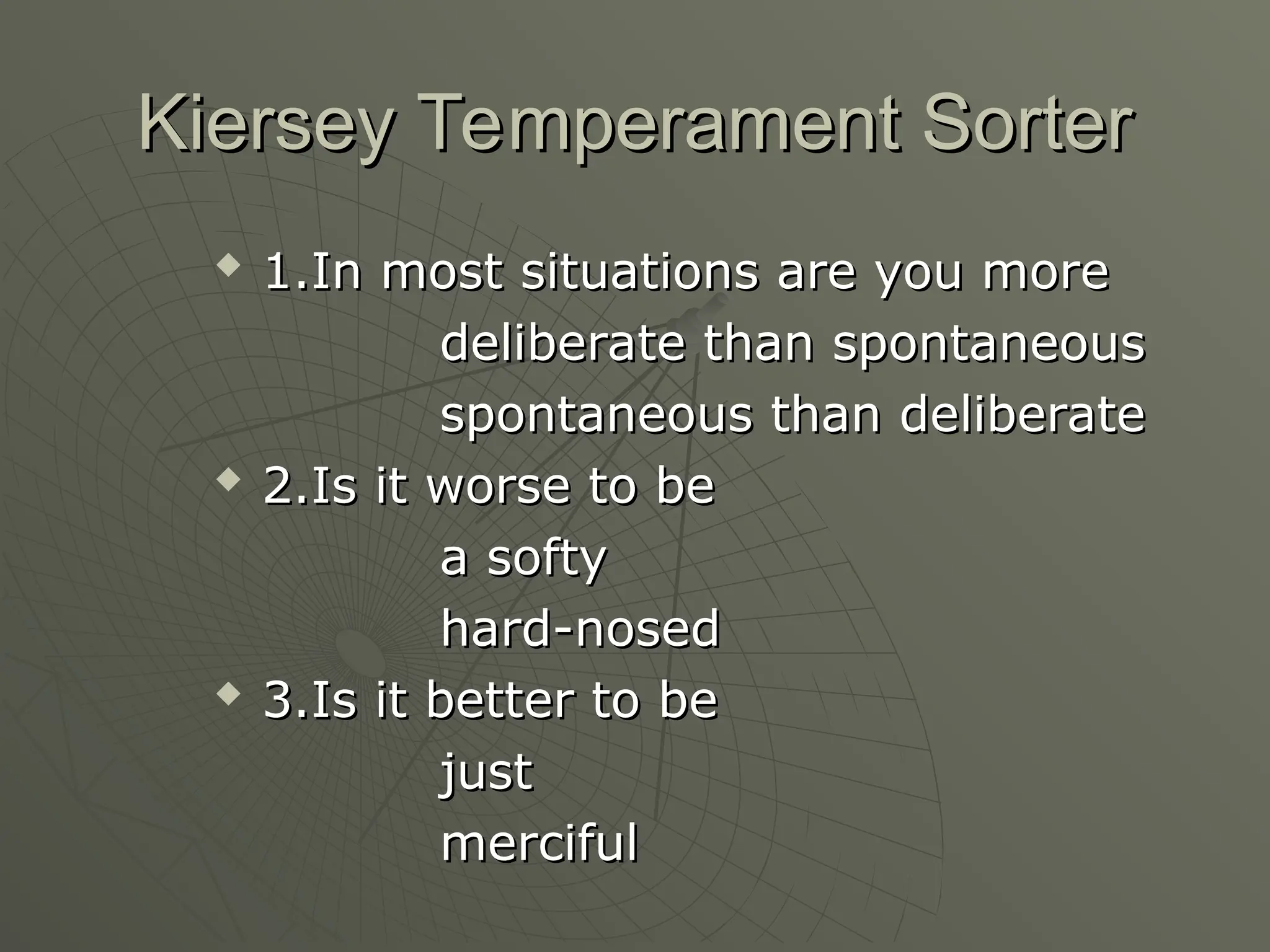
Kiersey Temperament Sorter

1.In most situations are you more
deliberate than spontaneous
spontaneous than deliberate

2.Is it worse to be
2.Is it worse to be
a softy
a softy
hard-nosed
hard-nosed

3.Is it better to be
just
just
merciful
merciful
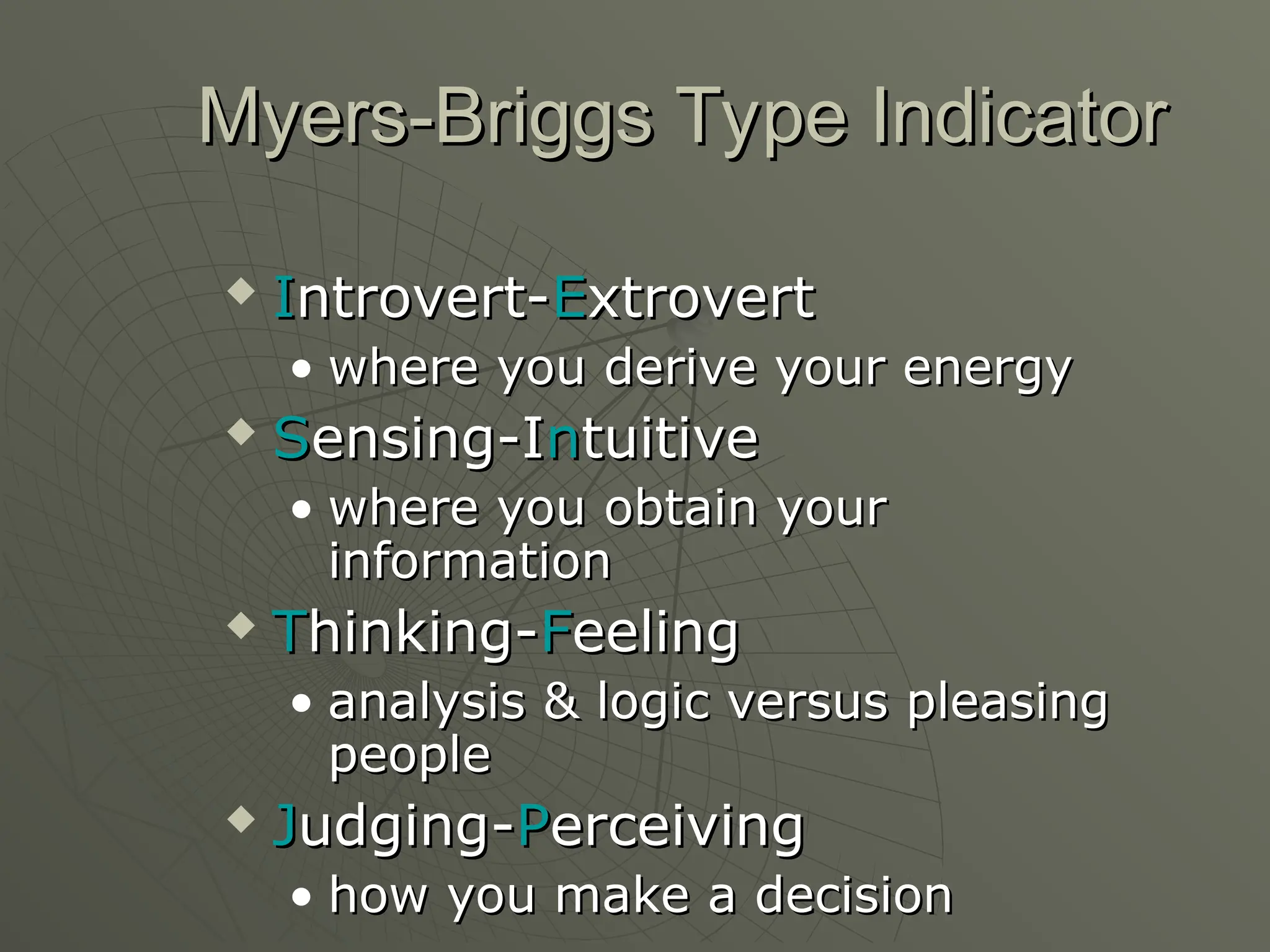
Myers-Briggs Type Indicator
 I
Introvert-
ntrovert-E
Extrovert
xtrovert
• where you derive your energy
where you derive your energy
 S
Sensing-I
ensing-In
ntuitive
tuitive
• where you obtain your
where you obtain your
information
information
 T
Thinking-
hinking-F
Feeling
eeling
• analysis & logic versus pleasing
analysis & logic versus pleasing
people
people
 J
Judging-
udging-P
Perceiving
erceiving
• how you make a decision
how you make a decision
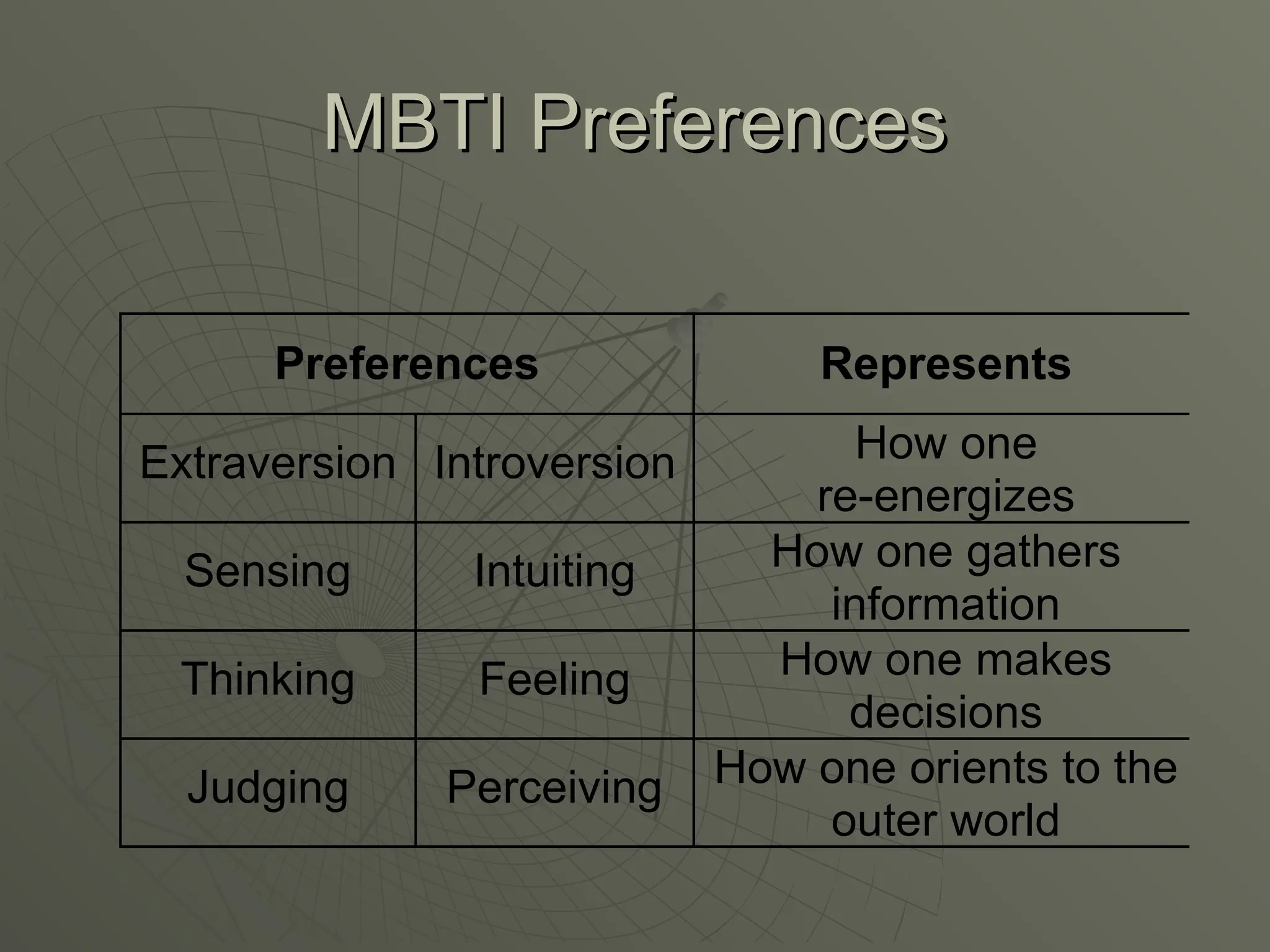
MBTI Preferences
MBTI Preferences
Preferences Represents
Extraversion Introversion How one
re-energizes
Sensing Intuiting How one gathers
information
Thinking Feeling How one makes
decisions
Judging Perceiving How one orients to the
outer world
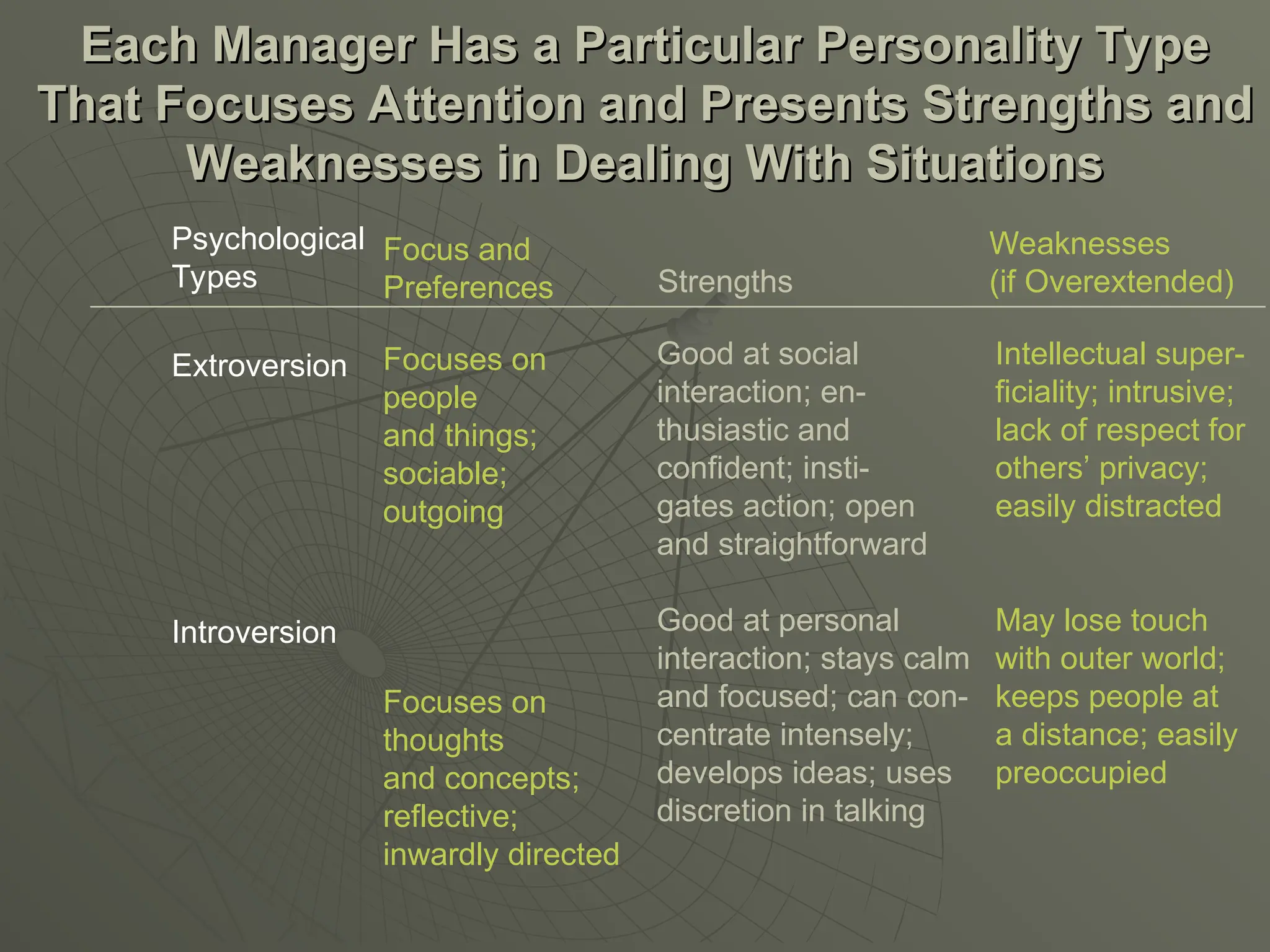
Each Manager Has a Particular Personality Type
That Focuses Attention and Presents Strengths and
Weaknesses in Dealing With Situations
Extroversion
Introversion
Focuses on
people
and things;
sociable;
outgoing
Focuses on
thoughts
and concepts;
reflective;
inwardly directed
Good at social
interaction; en-
thusiastic and
confident; insti-
gates action; open
and straightforward
Good at personal
interaction; stays calm
and focused; can con-
centrate intensely;
develops ideas; uses
discretion in talking
Intellectual super-
ficiality; intrusive;
lack of respect for
others’ privacy;
easily distracted
May lose touch
with outer world;
keeps people at
a distance; easily
preoccupied
Psychological
Types
Focus and
Preferences Strengths
Weaknesses
(if Overextended)
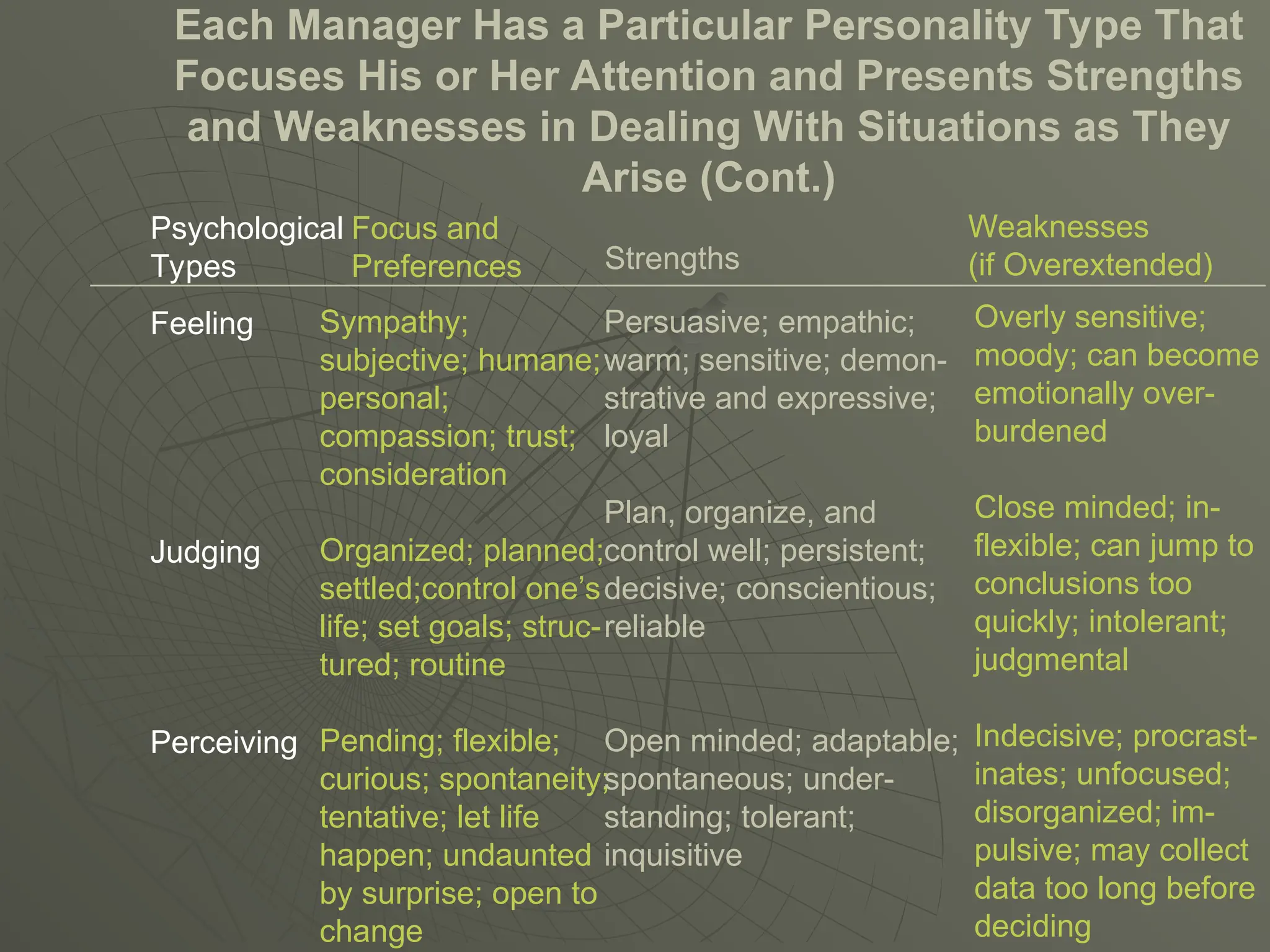
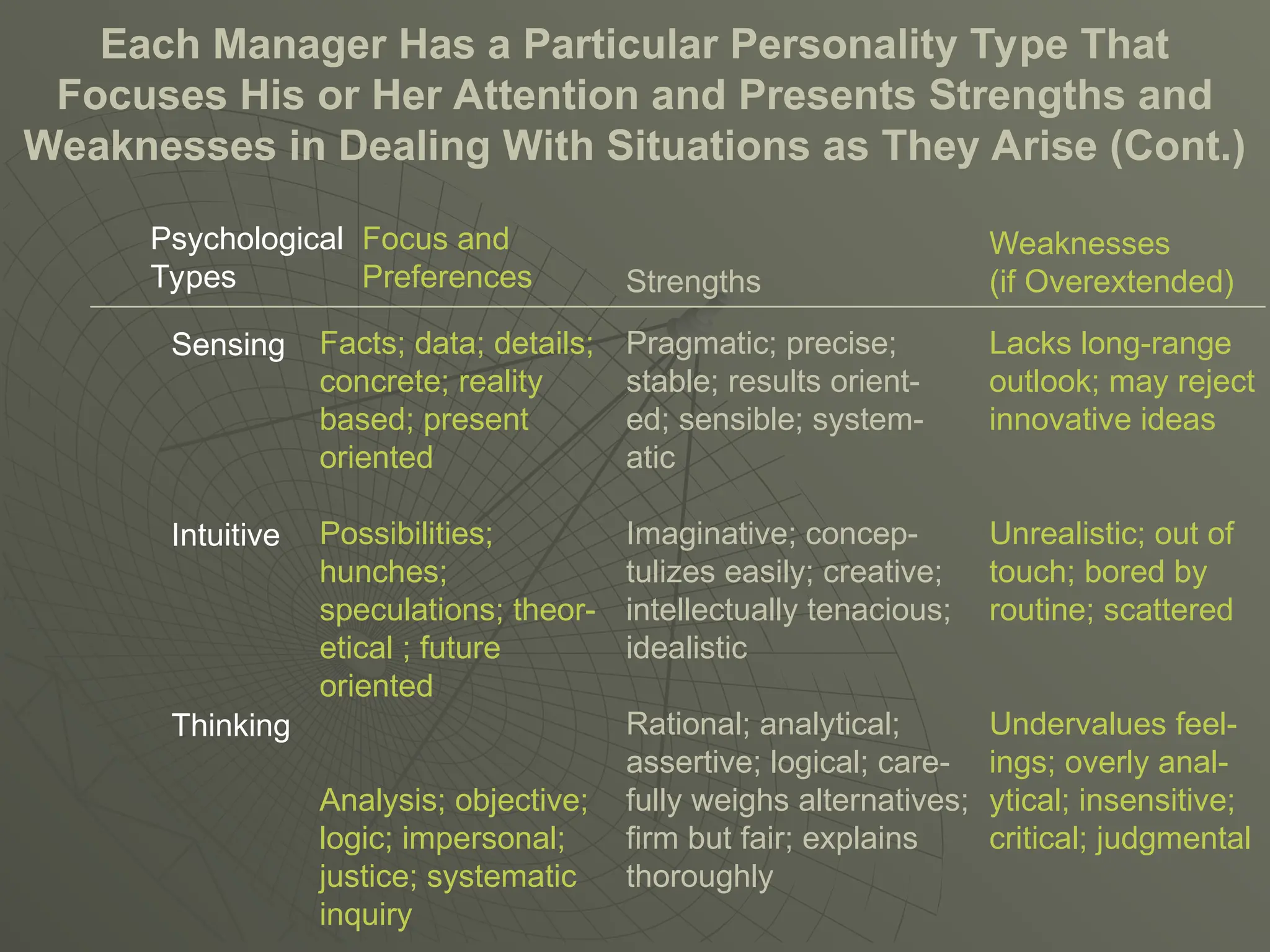
Each Manager Has a Particular Personality Type That
Focuses His or Her Attention and Presents Strengths and
Weaknesses in Dealing With Situations as They Arise (Cont.)
Sensing
Intuitive
Thinking
Facts; data; details;
concrete; reality
based; present
oriented
Possibilities;
hunches;
speculations; theor-
etical ; future
oriented
Analysis; objective;
logic; impersonal;
justice; systematic
inquiry
Pragmatic; precise;
stable; results orient-
ed; sensible; system-
atic
Imaginative; concep-
tulizes easily; creative;
intellectually tenacious;
idealistic
Rational; analytical;
assertive; logical; care-
fully weighs alternatives;
firm but fair; explains
thoroughly
Lacks long-range
outlook; may reject
innovative ideas
Unrealistic; out of
touch; bored by
routine; scattered
Undervalues feel-
ings; overly anal-
ytical; insensitive;
critical; judgmental
Psychological
Types
Focus and
Preferences Strengths
Weaknesses
(if Overextended)
Each Manager Has a Particular Personality Type That
Focuses His or Her Attention and Presents Strengths
and Weaknesses in Dealing With Situations as They
Arise (Cont.)
Feeling
Judging
Perceiving
Sympathy;
subjective; humane;
personal;
compassion; trust;
consideration
Organized; planned;
settled;control one’s
life; set goals; struc-
tured; routine
Pending; flexible;
curious; spontaneity;
tentative; let life
happen; undaunted
by surprise; open to
change
Persuasive; empathic;
warm; sensitive; demon-
strative and expressive;
loyal
Plan, organize, and
control well; persistent;
decisive; conscientious;
reliable
Open minded; adaptable;
spontaneous; under-
standing; tolerant;
inquisitive
Overly sensitive;
moody; can become
emotionally over-
burdened
Close minded; in-
flexible; can jump to
conclusions too
quickly; intolerant;
judgmental
Indecisive; procrast-
inates; unfocused;
disorganized; im-
pulsive; may collect
data too long before
deciding
Psychological
Types
Focus and
Preferences Strengths
Weaknesses
(if Overextended)

Individual Differences Individual Differences & Traits.ppt

  • 1.
    Individual Differences Framework IndividualDifferences Framework Personality Personality Leadership Style and Leadership Style and Behaviors Behaviors Abilities & Abilities & Skills Skills Values Values Environment Environment Culture & education Culture & education Parental Influence Parental Influence Physical Environment Physical Environment Heredity Heredity Genes Genes Race/Ethnicity Race/Ethnicity Gender Gender INDIVIDUAL CHARATERISTICS INDIVIDUAL CHARATERISTICS
  • 2.
    The Effect OfIndividual Characteristics On The Effect Of Individual Characteristics On Behavior Behavior Zone of Discomfort Zone of Discomfort BEHAVIORAL RANGE Individual characteristics Comfort Zone
  • 3.
    Personality Personality  Psychological Psychological characteristics characteristics  Stableover time and Stable over time and across situations across situations  A set of A set of characteristics, rather characteristics, rather than one trait than one trait  Makes the person Makes the person unique and different unique and different from others from others
  • 4.
    Abilities and Skills Abilitiesand Skills  Ability, or aptitude, is a stable natural Ability, or aptitude, is a stable natural talent for doing something mental or talent for doing something mental or physical. physical.  A skill is an acquired talent that a person A skill is an acquired talent that a person develops related to a specific task. develops related to a specific task.
  • 5.
    Values And ValueSystem Values And Value System Values are long-lasting beliefs about what is Values are long-lasting beliefs about what is worthwhile and desirable worthwhile and desirable Factors that affect values include: Factors that affect values include:  Culture Culture  Personality Personality  Gender Gender  Ethnicity Ethnicity  Generational differences Generational differences
  • 6.
    Views of Ethics Viewsof Ethics  The relativist view of ethics The relativist view of ethics suggests a belief that what is right suggests a belief that what is right or wrong depends on the situation or wrong depends on the situation or the culture. or the culture.  The universalist view of ethics The universalist view of ethics suggests that all activities should suggests that all activities should be judged by the same standards, be judged by the same standards, regardless of the situation or regardless of the situation or culture. culture.
  • 7.
    Components Of EmotionalIntelligence Components Of Emotional Intelligence  Self-awareness Self-awareness  Managing emotions Managing emotions  Self-motivation Self-motivation  Empathy for others Empathy for others  Interpersonal skills Interpersonal skills
  • 8.
    Characteristics Of CreativeLeaders Characteristics Of Creative Leaders  Perseverance when facing obstacles Perseverance when facing obstacles  Self-confidence Self-confidence  Willingness to take risks Willingness to take risks  Willingness to grow and openness to Willingness to grow and openness to new experiences new experiences  Tolerance for ambiguity Tolerance for ambiguity
  • 9.
    Three Categories OfLeadership Skills Three Categories Of Leadership Skills 1. Technical skills 1. Technical skills 2. Interpersonal skills 2. Interpersonal skills 3. Conceptual skills 3. Conceptual skills
  • 10.
  • 11.
    Social Perception Social Perception SocialPerception - Social Perception - interpreting information about another person
  • 12.
    Social Perception Social Perception SocialPerception - Social Perception - interpreting information about another person Perceiver Characteristics • Familiarity with target • Attitudes/Mood • Self-Concept • Cognitive structure
  • 13.
    Social Perception Social Perception SocialPerception - Social Perception - interpreting information about another person Perceiver Characteristics • Familiarity with target • Attitudes/Mood • Self-Concept • Cognitive structure Target Characteristics • Physical appearance • Verbal communication • Nonverbal cues • Intentions
  • 14.
    Social Perception - SocialPerception - interpreting information about another person Social Perception Social Perception Perceiver Characteristics • Familiarity with target • Attitudes/Mood • Self-Concept • Cognitive structure Target Characteristics • Physical appearance • Verbal communication • Nonverbal cues • Intentions Situational Characteristics • Interaction context • Strength of situational cues
  • 15.
    The Perception Process ThePerception Process ATTENTION •The Perceived •The Perceiver ORGANIZATION •Patterns •Schemas •Scripts PERCEPTION
  • 16.
    Comprehending Perception We allhave a different store of knowledge. We all therefore interpret the world around us differently. Understanding relies upon the speaker and his audience having the same perception of the required outcome.
  • 17.
    Perception is a'Learned Perception is a 'Learned Experience' Experience'  It is the “awareness” of the It is the “awareness” of the external world (or some aspect of external world (or some aspect of it, through one or more of our it, through one or more of our senses and, the interpretation of senses and, the interpretation of these by our mind. these by our mind.
  • 18.
    Understanding Understanding  Understanding isachieved by interpreting current Understanding is achieved by interpreting current experience using past experience as a source of experience using past experience as a source of reference, and establishing a context upon which to reference, and establishing a context upon which to base this new information. In other words: base this new information. In other words: • We are only able to understand today in terms of, We are only able to understand today in terms of, and because of, our past experiences. and because of, our past experiences. • Yet, we also know that 'Today' is unlike 'Yesterday'. Yet, we also know that 'Today' is unlike 'Yesterday'. • We inherit Yesterday's patterns and need them to We inherit Yesterday's patterns and need them to interpret what our senses are experiencing in the interpret what our senses are experiencing in the present. present. • These patterns are simultaneously essential and yet These patterns are simultaneously essential and yet out of date. out of date.
  • 19.
    How do weperceive? How do we perceive?  We store a ‘model’ or memory of objects. We store a ‘model’ or memory of objects.  The process of perceiving involves ‘matching’ The process of perceiving involves ‘matching’ what our senses are experiencing to one of what our senses are experiencing to one of our ‘models.’ our ‘models.’  Perception is an active pattern-matching Perception is an active pattern-matching process. process.  We recognize the world because of our We recognize the world because of our historical store of information. historical store of information.  We create our own unique world, our own We create our own unique world, our own interpretation of reality. interpretation of reality.
  • 20.
    Barriers to SocialPerception Barriers to Social Perception  Selective perception Selective perception  Stereotyping Stereotyping  First-impression First-impression error error  Implicit personality Implicit personality theory theory  Self-fulfilling Self-fulfilling prophecies prophecies Social Perception - Social Perception - interpreting information about another person
  • 21.
    Personality Theories Personality Theories TraitTheory - understand individuals by breaking Trait Theory - understand individuals by breaking down behavior patterns into observable traits down behavior patterns into observable traits Psychodynamic Theory - emphasizes the unconscious Psychodynamic Theory - emphasizes the unconscious determinants of behavior determinants of behavior Humanistic Theory - emphasizes individual growth Humanistic Theory - emphasizes individual growth and improvement and improvement Integrative Approach - Integrative Approach - describes personality as a describes personality as a composite of an individual’s psychological composite of an individual’s psychological processes processes
  • 22.
    Variables Influencing Variables Influencing IndividualBehavior Individual Behavior The Person • skills & abilities • personality • perception • attribution • attitudes • values • ethics
  • 23.
    Variables Influencing Variables Influencing IndividualBehavior Individual Behavior The Person • skills & abilities • personality • perception • attribution • attitudes • values • ethics The Environment • organization • work group • job • personal life
  • 24.
    The Environment • organization •work group • job • personal life Behavior Variables Influencing Variables Influencing Individual Behavior Individual Behavior The Person • skills & abilities • personality • perception • attribution • attitudes • values • ethics
  • 25.
    Interactional Psychology Interactional Psychology Approach Approach TheE Environment • organization • work group • job • personal life B = B = f f(P,E) (P,E) B Behavior The P Person • skills & abilities • personality • perception • attribution • attitudes • values • ethics
  • 26.
     Conscientiousness Conscientiousness  Extraversion/introversion Extraversion/introversion Openness to experience Openness to experience  Emotional stability Emotional stability  Agreeableness Agreeableness The “Big Five” Personality The “Big Five” Personality Dimensions Dimensions
  • 27.
     Less anxious Less anxious  Setharder goals Set harder goals  Manage stress well and adapt to Manage stress well and adapt to change change  More considerate of followers and More considerate of followers and less likely to use coercive power less likely to use coercive power  Internal CEOs select risky and Internal CEOs select risky and innovative strategies innovative strategies Characteristics Of Individuals Characteristics Of Individuals With Internal Locus Of Control With Internal Locus Of Control
  • 28.
    High need forcontrol “Doing more in less and less time” Defining Characteristics •Time urgency • Competitiveness • Polyphasic behaviors • Hostility Work-Related Behaviors • Poor delegation • Likes to work alone • Jumps into action • Sets high goals • Hard work • Perceives more stress Characteristics Of Type A Individuals Characteristics Of Type A Individuals
  • 29.
     Able to readcues from the Able to read cues from the environment environment  Able to change behavior to match Able to change behavior to match situation situation  Able to cope in cross-cultural Able to cope in cross-cultural environments environments  May be a key factor in leadership May be a key factor in leadership effectiveness effectiveness Characteristics Of High Characteristics Of High Self-monitors Self-monitors
  • 30.
    Sensation Thinkers (ST) Focuson hard facts Realistic, goal-oriented but can be impatient and jump into action quickly Intuitive Thinkers (NT) Change agents Responsive to creativity but can be unreasonable and unaware of others Sensation Feelers (SF) Practical and caring Good understanding of systems but can be reluctant to accept change THINKING (T) FEELING (F) INTUITIVE (N) SENSING (S) Four Major MBTI Types Four Major MBTI Types Intuitive Feelers (NF) Personal charisma and commitment to others Many ideas, trouble with implementation
  • 31.
     High Machsare: High Machs are: • Skilled at controlling others Skilled at controlling others • Able to perceive and resist Able to perceive and resist manipulation manipulation • More successful in More successful in unstructured environments unstructured environments  Low Machs are: Low Machs are: • Naive and trusting Naive and trusting  Leadership is associated with Leadership is associated with moderate Mach score moderate Mach score Machiavellian Personality Machiavellian Personality
  • 32.
     Abrasive andintimidating Abrasive and intimidating  Cold and arrogant Cold and arrogant  Untrustworthy Untrustworthy  Self-centered and political Self-centered and political  Poor performers Poor performers  Unable to delegate Unable to delegate Characteristics Of Characteristics Of Leaders Who Fail Leaders Who Fail
  • 33.
    The Johari Window TheJohari Window Known to Self Not Known to Self Known to Others FREE/ARENA BLIND SPOT Not Known to Others FACADE UNKNOWN
  • 34.
    Myers-Briggs Type Indicator Myers-BriggsType Indicator  Based on Carl Jung’s work Based on Carl Jung’s work • People are fundamentally different People are fundamentally different • People are fundamentally alike People are fundamentally alike • People have preference combinations for People have preference combinations for extraversion/introversion, perception, judgment extraversion/introversion, perception, judgment  Briggs & Myers developed the MBTI to Briggs & Myers developed the MBTI to understand individual differences understand individual differences Take it at: Take it at: http://www.humanmetrics.com http://www.humanmetrics.com
  • 35.
    Kiersey Temperament Sorter KierseyTemperament Sorter  1.In most situations are you more 1.In most situations are you more deliberate than spontaneous deliberate than spontaneous spontaneous than deliberate spontaneous than deliberate  2.Is it worse to be 2.Is it worse to be a softy a softy hard-nosed hard-nosed  3.Is it better to be 3.Is it better to be just just merciful merciful
  • 36.
    Myers-Briggs Type Indicator Myers-BriggsType Indicator  I Introvert- ntrovert-E Extrovert xtrovert • where you derive your energy where you derive your energy  S Sensing-I ensing-In ntuitive tuitive • where you obtain your where you obtain your information information  T Thinking- hinking-F Feeling eeling • analysis & logic versus pleasing analysis & logic versus pleasing people people  J Judging- udging-P Perceiving erceiving • how you make a decision how you make a decision
  • 37.
    MBTI Preferences MBTI Preferences PreferencesRepresents Extraversion Introversion How one re-energizes Sensing Intuiting How one gathers information Thinking Feeling How one makes decisions Judging Perceiving How one orients to the outer world
  • 38.
    Each Manager Hasa Particular Personality Type Each Manager Has a Particular Personality Type That Focuses Attention and Presents Strengths and That Focuses Attention and Presents Strengths and Weaknesses in Dealing With Situations Weaknesses in Dealing With Situations Extroversion Introversion Focuses on people and things; sociable; outgoing Focuses on thoughts and concepts; reflective; inwardly directed Good at social interaction; en- thusiastic and confident; insti- gates action; open and straightforward Good at personal interaction; stays calm and focused; can con- centrate intensely; develops ideas; uses discretion in talking Intellectual super- ficiality; intrusive; lack of respect for others’ privacy; easily distracted May lose touch with outer world; keeps people at a distance; easily preoccupied Psychological Types Focus and Preferences Strengths Weaknesses (if Overextended)
  • 39.
    Each Manager Hasa Particular Personality Type That Focuses His or Her Attention and Presents Strengths and Weaknesses in Dealing With Situations as They Arise (Cont.) Sensing Intuitive Thinking Facts; data; details; concrete; reality based; present oriented Possibilities; hunches; speculations; theor- etical ; future oriented Analysis; objective; logic; impersonal; justice; systematic inquiry Pragmatic; precise; stable; results orient- ed; sensible; system- atic Imaginative; concep- tulizes easily; creative; intellectually tenacious; idealistic Rational; analytical; assertive; logical; care- fully weighs alternatives; firm but fair; explains thoroughly Lacks long-range outlook; may reject innovative ideas Unrealistic; out of touch; bored by routine; scattered Undervalues feel- ings; overly anal- ytical; insensitive; critical; judgmental Psychological Types Focus and Preferences Strengths Weaknesses (if Overextended)
  • 40.
    Each Manager Hasa Particular Personality Type That Focuses His or Her Attention and Presents Strengths and Weaknesses in Dealing With Situations as They Arise (Cont.) Feeling Judging Perceiving Sympathy; subjective; humane; personal; compassion; trust; consideration Organized; planned; settled;control one’s life; set goals; struc- tured; routine Pending; flexible; curious; spontaneity; tentative; let life happen; undaunted by surprise; open to change Persuasive; empathic; warm; sensitive; demon- strative and expressive; loyal Plan, organize, and control well; persistent; decisive; conscientious; reliable Open minded; adaptable; spontaneous; under- standing; tolerant; inquisitive Overly sensitive; moody; can become emotionally over- burdened Close minded; in- flexible; can jump to conclusions too quickly; intolerant; judgmental Indecisive; procrast- inates; unfocused; disorganized; im- pulsive; may collect data too long before deciding Psychological Types Focus and Preferences Strengths Weaknesses (if Overextended)