1) Introduction
2) Problem statement
3) Definitions
4) Epidemiological determinants
5) Agent
6) Host
7) Environment
8) Mode of transmission
9) Measurement indices
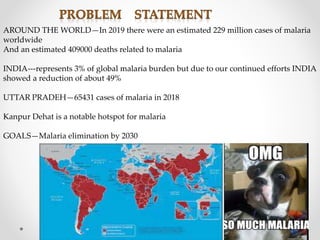
AROUND THE WORLD—In 2019 there were an estimated 229 million cases of malaria
worldwide
And an estimated 409000 deaths related to malaria
INDIA---represents 3% of global malaria burden but due to our continued efforts INDIA
showed a reduction of about 49%
UTTAR PRADEH—65431 cases of malaria in 2018
Kanpur Dehat is a notable hotspot for malaria
GOALS—Malaria elimination by 2030
 Causative Agent – Plasmodium species
 Definitive Host-Female Anopheles Mosquito (Sexual
development/Sporogony)
Anopheles stephensi-URBAN
Anopheles culicifacies-RURAL
 Intermediate Host-Human (Asexual
development/Schizogony)
 Three distinct stages of an attack- cold , hot ,sweating
1. Malaria Control-Reduction of malaria burden to a level at
which it is no longer a public health burden
2. Malaria elimination-Interruption of local mosquito borne
malaria transmission
3. Eradication- Reduction to zero of worldwide incidence of
infection
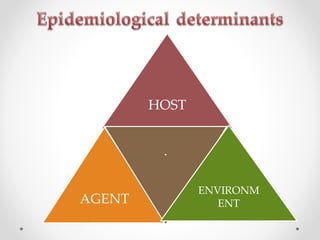
HOST
AGENT
.
ENVIRONM
ENT
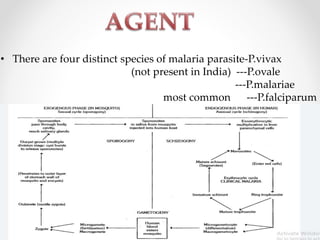
• There are four distinct species of malaria parasite-P.vivax
(not present in India) ---P.ovale
---P.malariae
most common ---P.falciparum
• Human reservoir is one who harbor's the sexual forms or gametocytes of the parasite
Characteristics of eligible reservoir are as follows
• Must harbor both the sexes of gametocyte in his blood
• Gametocytes must be mature and viable
• Gametocytes must be in least 12 per cubic mm of blood
Period of communicability
• Malaria is communicable as long as gametocytes(mature and viable) persist in
circulating blood in sufficient density to infect vector mosquitoes
• P.Vivax persist for 3 years and cause relapse
• P.malariae persist for 20-40 years and cause relapse
• P.falciparum persist for 1 year and cause recrudescence
 WHO IS SUSCEPTIBLE?
 AGE—All ages but children and young adults especially
Newborn/Infants due to increased level of fetal hemoglobin which
suppresses parasitic development are almost resistant to malaria
 Sickle cell trait individuals are also almost resistant to malaria
 Duffy negative RBC (a genetic trait) are also resistant to P.vivax
 Pregnancy increases the risk
 Poor socioeconomic factors and poor housing places people at risk for
infection
 Low immune status of population also is a risk factor
 SEASONAL-Maximum prevalence from July to November
 TEMPERATURE-optimum for malaria parasite:20-30 deg C.
-unfavorable :less than 16 deg C. and greater than 30 deg C.
 Humidity-60-70%
 Rainfall-Provides opportunities for mosquito breeding
But Heavy rainfall is a protective factor as it washes off larva
 Altitude-Maximum altitude reached by mosquito is 2000-2500 mts
1) Indirect –vector borne malaria
2) Direct --via blood and blood products
• incase of blood transfusion: blood collected from diseased(especially endemics)
remains infective for 14 days
• Incase of previous history of known malaria avoid blood transfusion for 3 years
3)Congenital malaria
INCUBATION PERIOD-
• Always greater than 10 days
• For P.falciparum—12 days
• P.Vivax—14 days
• P.Ovale—16-18 days
• P.Malariae-28 days
•SPLEEN RATE
•AVERAGE ENLARGED SPLEEN
•PARASITE RATE
•PARASITE DENSITY INDEX
•INFANT PARASITE RATE
•PROPORTIONAL CASE RATE
PRE-ERADICATION ERA
•Annual parasitic incidence
•Annual falciparum incidence
•Slide positivity rate
•Slide falciparum rate
ERADICATION
ERA
1. Spleen rate: percentage children 2-10 years age showing enlargement of spleen
Used to measure endemicity of malaria in a community
2. Average enlarged spleen- takes average size of enlarged spleen into account
3. Parasite rate- percentage children 2-10 years showing parasite sin blood films
4. Parasite density index
5. Infant parasite rate-percentage infants showing parasites in blood film
• most sensitive index of recent malaria transmission in a locality
• if 0 for 3 consecutive years, regarded as absence of malaria transmission even
though anophelene may remain
6.Proportional case rate-No. of clinical malaria cases diagnosed per 100 patients
attending hospitals and dispensaries
 API(Annual parasitic incidence)=Total number of confirmed cases
either by slide + or RDT+ in a year *1000
Total population under survey
 Should ideally be less than 1
 Best indicator of the impact of program
 Epidemiological indicator and Most important indicator of malaria control in a
community
 Gives us incidence of malaria in an area
• Annual blood examination rate=Total number of slides examined *100
total population under survey
• It is an operational indicator
• Proxy or indirect indicator for prevalence of fever in the country
1. Slide positivity rate =total number of slides positive
total number of slides examined
• Sensitive indicator for –Outbreak potential and Impending outbreak
2. Slide falciparum rate=percentage of slides positive for falciparum
• Park’s “ Textbook of preventive and
social medicine”
• Vivek jain ‘s “Review of preventive and
social medicine”
• Data on malaria worldwide taken from CDC and WHO websites
Malaria epidemiology and malariometric measures

Malaria epidemiology and malariometric measures

  • 2.
    1) Introduction 2) Problemstatement 3) Definitions 4) Epidemiological determinants 5) Agent 6) Host 7) Environment 8) Mode of transmission 9) Measurement indices
  • 3.
    AROUND THE WORLD—In2019 there were an estimated 229 million cases of malaria worldwide And an estimated 409000 deaths related to malaria INDIA---represents 3% of global malaria burden but due to our continued efforts INDIA showed a reduction of about 49% UTTAR PRADEH—65431 cases of malaria in 2018 Kanpur Dehat is a notable hotspot for malaria GOALS—Malaria elimination by 2030
  • 4.
     Causative Agent– Plasmodium species  Definitive Host-Female Anopheles Mosquito (Sexual development/Sporogony) Anopheles stephensi-URBAN Anopheles culicifacies-RURAL  Intermediate Host-Human (Asexual development/Schizogony)  Three distinct stages of an attack- cold , hot ,sweating
  • 5.
    1. Malaria Control-Reductionof malaria burden to a level at which it is no longer a public health burden 2. Malaria elimination-Interruption of local mosquito borne malaria transmission 3. Eradication- Reduction to zero of worldwide incidence of infection
  • 6.
  • 7.
    • There arefour distinct species of malaria parasite-P.vivax (not present in India) ---P.ovale ---P.malariae most common ---P.falciparum
  • 8.
    • Human reservoiris one who harbor's the sexual forms or gametocytes of the parasite Characteristics of eligible reservoir are as follows • Must harbor both the sexes of gametocyte in his blood • Gametocytes must be mature and viable • Gametocytes must be in least 12 per cubic mm of blood Period of communicability • Malaria is communicable as long as gametocytes(mature and viable) persist in circulating blood in sufficient density to infect vector mosquitoes • P.Vivax persist for 3 years and cause relapse • P.malariae persist for 20-40 years and cause relapse • P.falciparum persist for 1 year and cause recrudescence
  • 9.
     WHO ISSUSCEPTIBLE?  AGE—All ages but children and young adults especially Newborn/Infants due to increased level of fetal hemoglobin which suppresses parasitic development are almost resistant to malaria  Sickle cell trait individuals are also almost resistant to malaria  Duffy negative RBC (a genetic trait) are also resistant to P.vivax  Pregnancy increases the risk  Poor socioeconomic factors and poor housing places people at risk for infection  Low immune status of population also is a risk factor
  • 10.
     SEASONAL-Maximum prevalencefrom July to November  TEMPERATURE-optimum for malaria parasite:20-30 deg C. -unfavorable :less than 16 deg C. and greater than 30 deg C.  Humidity-60-70%  Rainfall-Provides opportunities for mosquito breeding But Heavy rainfall is a protective factor as it washes off larva  Altitude-Maximum altitude reached by mosquito is 2000-2500 mts
  • 11.
    1) Indirect –vectorborne malaria 2) Direct --via blood and blood products • incase of blood transfusion: blood collected from diseased(especially endemics) remains infective for 14 days • Incase of previous history of known malaria avoid blood transfusion for 3 years 3)Congenital malaria INCUBATION PERIOD- • Always greater than 10 days • For P.falciparum—12 days • P.Vivax—14 days • P.Ovale—16-18 days • P.Malariae-28 days
  • 12.
    •SPLEEN RATE •AVERAGE ENLARGEDSPLEEN •PARASITE RATE •PARASITE DENSITY INDEX •INFANT PARASITE RATE •PROPORTIONAL CASE RATE PRE-ERADICATION ERA •Annual parasitic incidence •Annual falciparum incidence •Slide positivity rate •Slide falciparum rate ERADICATION ERA
  • 13.
    1. Spleen rate:percentage children 2-10 years age showing enlargement of spleen Used to measure endemicity of malaria in a community 2. Average enlarged spleen- takes average size of enlarged spleen into account 3. Parasite rate- percentage children 2-10 years showing parasite sin blood films 4. Parasite density index 5. Infant parasite rate-percentage infants showing parasites in blood film • most sensitive index of recent malaria transmission in a locality • if 0 for 3 consecutive years, regarded as absence of malaria transmission even though anophelene may remain 6.Proportional case rate-No. of clinical malaria cases diagnosed per 100 patients attending hospitals and dispensaries
  • 14.
     API(Annual parasiticincidence)=Total number of confirmed cases either by slide + or RDT+ in a year *1000 Total population under survey  Should ideally be less than 1  Best indicator of the impact of program  Epidemiological indicator and Most important indicator of malaria control in a community  Gives us incidence of malaria in an area
  • 15.
    • Annual bloodexamination rate=Total number of slides examined *100 total population under survey • It is an operational indicator • Proxy or indirect indicator for prevalence of fever in the country
  • 16.
    1. Slide positivityrate =total number of slides positive total number of slides examined • Sensitive indicator for –Outbreak potential and Impending outbreak 2. Slide falciparum rate=percentage of slides positive for falciparum
  • 17.
    • Park’s “Textbook of preventive and social medicine” • Vivek jain ‘s “Review of preventive and social medicine” • Data on malaria worldwide taken from CDC and WHO websites