National Vector Borne
Disease Control Program
DR SUMIT SABLE
MD COMMUNITY MEDICINE
Index
 Introduction NVBDCP
 Maleria
Agent Host Environment ,Treatment , National Framework ,
Stratergies
 Elemination of lymphaic filariasis
 Kala azar / leishmania
 Japanese encephlalitis
 Dengue
 Chikengunya
National Vector Borne Disease Control
Programe
 National Vector Borne Disease Control Program (NVBDCP) is
implemented in the States/UTs for prevention and control of vector
borne diseases (VBDs) namely Malaria, Dengue, Chikungunya,
Filariasis, Japanese Encephalitis (JE) and Kala-azar
 The Directorate of NVBDCP is the nodal agency for planning, policy
making, technical guidance and monitoring and evaluation of
program implementation in respect of prevention and control of
these vector borne diseases under the overall umbrella of NHM.
 Dengue, Chikungunya and JE are known as outbreak prone VBDs
Anopheles: clean water
Culex: dirty water
Aedes: artificial collection
Mansonia: water with aquatic
vegetations
 SANDFLY IS VECTOR FOR KALA AZAR/ LEISHMANIA
Maleria
 Malaria has been a major public health problem in
India. Intermittent fever, with high incidence during the
rainy season, coinciding with agriculture, sowing and
harvesting .
 Malaria is a public health problem in several parts of the
country. About 95% population in the country resides in
malaria endemic areas and 80% of malaria reported in
the country is confined to areas consisting 20% of
population residing in tribal, hilly, difficult and
inaccessible areas.
 Malaria is caused by the Plasmodium protozoa, which
are transmitted to humans by Anopheles mosquitoes.
Epidemiology of malaria
AGENT
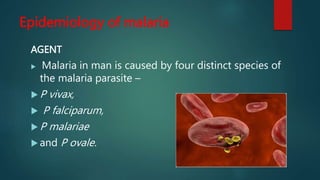
 Malaria in man is caused by four distinct species of
the malaria parasite –
 P vivax,
 P falciparum,
 P malariae
 and P ovale.
Life cycle of malaria
(b) RESERVOIR OF INFECTION
 A human reservoir is one
who harbours the sexual
forms (gametocytes) of the
parasite.
 Children are more likely to be
gametocyte carriers than
adults.
Host factors
 (a) AGE: Malaria affects all ages. Newborn infants have considerable
resistance to infection with P falciparum.
 This has been attributed to the high concentration of foetal
haemoglobin during the first few months of life, which suppresses the
development of P falciparum
 (b) SEX: Males are more frequently exposed to the risk of acquiring
malaria than females because of the outdoor life they lead.
 (c) RACE: Individuals with AS haemoglobin (sickle-cell trait) have a
milder illness with falciparum infection than do those with normal (AA)
haemoglobin.
 Persons whose red blood cells are "Duffy negative" (a genetic trait) are
resistant to P vivax infection.
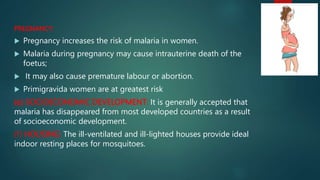
PREGNANCY:
 Pregnancy increases the risk of malaria in women.
 Malaria during pregnancy may cause intrauterine death of the
foetus;
 It may also cause premature labour or abortion.
 Primigravida women are at greatest risk
(e) SOCIOECONOMIC DEVELOPMENT: It is generally accepted that
malaria has disappeared from most developed countries as a result
of socioeconomic development.
(f) HOUSING: The ill-ventilated and ill-lighted houses provide ideal
indoor resting places for mosquitoes.
Environmental factors
 (a) SEASON: The maximum prevalence is
from July to November.
 (b) TEMPERATURE:
 The optimum temperature for the development of the
malaria parasite in the insect vector is between 20 deg. to
30 deg.C
 (d) RAINFAll: Rain in general provides opportunities for
the breeding of mosquitoes
 A relative humidity of 60 per cent is considered necessary
for mosquitoes to live their normal span of life.
 (e) ALTITUDE: As a rule, Anophelines are not found at
altitudes above 2000-2500 metres, due to unfavourable
climatic conditions.
Mode of transmission
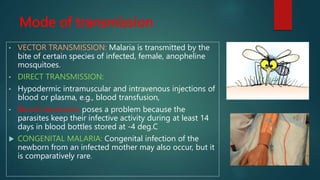
• VECTOR TRANSMISSION: Malaria is transmitted by the
bite of certain species of infected, female, anopheline
mosquitoes.
• DIRECT TRANSMISSION:
• Hypodermic intramuscular and intravenous injections of
blood or plasma, e.g., blood transfusion,
• Blood transfusion poses a problem because the
parasites keep their infective activity during at least 14
days in blood bottles stored at -4 deg.C
 CONGENITAL MALARIA: Congenital infection of the
newborn from an infected mother may also occur, but it
is comparatively rare.
Incubation period:
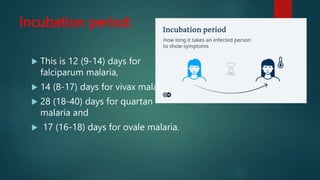
 This is 12 (9-14) days for
falciparum malaria,
 14 (8-17) days for vivax malaria,
 28 (18-40) days for quartan
malaria and
 17 (16-18) days for ovale malaria.
Clinical features
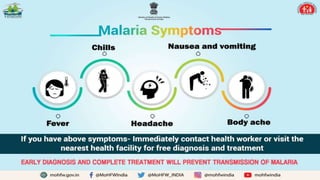
 COLD STAGE " The onset is with
headache, nausea and chilly sensation
followed in an hour or so by rigors.
 The temperature rises rapidly to 39-
41°C.
 HOT STAGE - " The patient feels burning
hot and casts off his clothes.
 The skin is hot and dry to touch.
 Headache is intense but nausea
commonly diminishes.
 The pulse is full and respiration rapid.
This stage lasts for 2 to 6 hours.
 SWEATING STAGE - " Fever comes down with
profuse sweating.“
 The temperature drops rapidly to normal and
skin is cool and moist.
Diagnosis
 Two types of blood films are useful in
searching for and identification of malaria
parasite. The "thin film“ and the "thick film".
 The thick film is more reliable in searching for
parasite.
 The thin slide is more valuable for identifying
the species of the parasite present.
 Rapid diagnostics kits are also available now .
Annual Blood Examination Rate And
Annual Parasite Index
• ABER = No of slides examined X 100
Population under surveillance
Min. 10% of slides of population to be examined.
Should be equal to fever rate
• API = Confirmed cases in 1 year X 100
Population under surveillance
• SPR slide positivity rate = No of slides +ve for MP X 100
Total No of smears examined
Malaria Elimination Frame Work At
Glance
 VISION
Eliminate malaria nationally and contribute to improved health, quality of life
and alleviation of poverty.
GOALS
• Eliminate malaria (zero indigenous cases) throughout the entire country by
2030; and
• Maintain malaria–free status in areas where malaria transmission has been
interrupted and prevent re-introduction of malaria.
objectives
The Framework has four objectives:
 • Eliminate malaria from all 26 low (Category 1) and moderate (Category
2) transmission states/union territories (UTs) by 2022;
 • Reduce the incidence of malaria to less than 1 case per 1000
population per year in all states and UTs and their districts by 2024;
 • Interrupt indigenous transmission of malaria throughout the entire
country, including all high transmission states and union territories (UTs)
(Category 3) by 2027; and
 • Prevent the re-establishment of local transmission of malaria in areas
where it has been eliminated and maintain national malaria-free status
by 2030 and beyond.
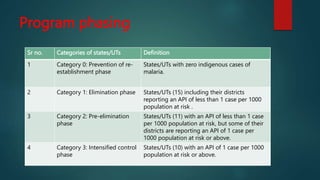
Program phasing
Sr no. Categories of states/UTs Definition
1 Category 0: Prevention of re-
establishment phase
States/UTs with zero indigenous cases of
malaria.
2 Category 1: Elimination phase States/UTs (15) including their districts
reporting an API of less than 1 case per 1000
population at risk .
3 Category 2: Pre-elimination
phase
States/UTs (11) with an API of less than 1 case
per 1000 population at risk, but some of their
districts are reporting an API of 1 case per
1000 population at risk or above.
4 Category 3: Intensified control
phase
States/UTs (10) with an API of 1 case per 1000
population at risk or above.
Category 0 (prevention of re-establishment phase)
 1. Detect any re-introduced case of malaria;
 2 Notify immediately all detected cases of malaria;
 3. Determine all underlying causes of resumed local
transmission;
 4 Apply rapid curative and preventive measures;
 5. Prevent re introduction and possible re-establishment of
malaria transmission; and
 6. Maintain malaria-free status in these areas.
Category 1 (Elimination phase: States/UTs with
API<1, and all their districts reporting API < 1)
 1. All efforts will be directed at interrupting local
transmission in all active foci of malaria.
 2. Mandatory notification of each case of malaria from the
private sector, other organized government sectors or any
other health facility.
 3. Adequate case-based surveillance and complete case
management established and fully functional across the
entire country to handle each case of malaria.
 4.Investigation and classification of all foci of malaria.
 5. A strict total coverage of all active foci by effective vector control
measures.
 6. Early detection and treatment of all cases of malaria by means of ACD
and/or PCD to prevent onward transmission.
 7. State and national level malaria elimination database established and
made operational.
 8. Implementation of interventions for effective screening, management
and prevention of malaria among mobile and migrant populations.
 9. Establishment of an effective epidemic forecasting and response system.
 10. Ensuring rigorous quality assurance of all medicines and diagnostics.
 11. Setting up a national-level reference laboratory
 12. During investigation of foci, all suspected cases of
malaria are to be screened for malaria. These could
include household members, neighbours, schoolchildren,
workplace colleagues and relatives.
 13. Surveillance of special groups, migrant populations or
populations residing in the vicinity of industrial areas are
also to be covered under surveillance operations.
Category 2 (Pre-elimination phase : States/UTs with API<1,
but some of elimination districts API >1)
 The states/UTs in pre-elimination phase are those close to
elimination Therefore, entering elimination interventions will be
introduced with particular focus on setting up an elimination
surveillance system and initiating elimination phase activities in
those districts where the API has been reduced to less than 1
case per 1000 population at risk per year.
 The planning of elimination measures will be based on
epidemiological and classification of each malaria case and
focus.
Category 3 (Intensified control phase:
States/UTs with API ≥ 1)
 Massive scaling up of existing disease management and
preventive approaches and tools
 Screening of all fever cases suspected for malaria.
 Classification of areas as per local malaria epidemiology
and grading of areas as per risk of malaria transmission
followed by implementation of tailored interventions.
 Strengthening of intersectoral collaboration.
 One- stop centres or mobile clinics on fixed days in tribal
or conflict affected areas
 Timely referral and treatment of severe malaria cases to
reduce malaria-related mortality.
 Establishment of a robust supply chain management
system.
 Maintenance of an optimum level of surveillance
 Equipment
Broad Strategies For Malaria
Elimination
 • Early diagnosis and radical treatment
 • Case-based surveillance and rapid response
 • Integrated vector management (IVM)
- indoor residual spray (IRS)
- Long-lasting insecticidal nets (LLINs) / Insecticide treated bed nets
- Larval source management (LSM)
 Epidemic preparedness and early response
 • Monitoring and evaluation
 • Advocacy, coordination and partnerships
 • Behaviour change communication
 • Programme planning and management .
Mosquito control measures
 Anti-larval:
 Environmental control: source reduction
 Chemical control: mineral oil, paris green, synthetic
 Biological control: Gamusia affinis, Lebister reticularis
 Anti-adult:
 Residual spray: DDT, Lindane, Malathion
 Space spray: Pyrethrum, Fenitrothion
 Genetic control: sterile male, cytoplasmic incompatibility, chromosomal translocations
 Personal protective measures:
 Mosquito net: size of pore < 0.0475 inch
 Screening: windows
 Repellents: Diethyltoluamide (DEET), Indalone
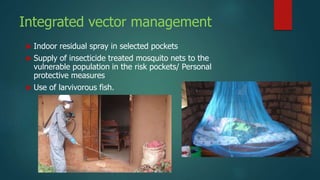
Integrated vector management
 Indoor residual spray in selected pockets
 Supply of insecticide treated mosquito nets to the
vulnerable population in the risk pockets/ Personal
protective measures
 Use of larvivorous fish.
LYMPHATIC FILARIASIS
 Lymphatic filariasis, commonly known as elephantiasis, is a painful
and profoundly disfiguring disease. It is caused by infection with
parasites classified as nematodes (roundworms) that are
transmitted through the bites of infected MANSONIA, culex
mosquitos.
 Lymphoedema and its more advanced form, elephantiasis, occur
primarily in the lower limbs and are commoner in women due to
microfilaria .
 Lymphatic filariasis may also evolve towards a genital disease
(hydrocoele) that is characterized by a swelling of the scrotum and
penis.
STRATERGIES
 The strategy of lymphatic filariasis elimination is through :
(a) Annual Mass Drug Administration (MDA) of single dose of antifilarial
drug for 5 years or more to the eligible population (except pregnant
women, children below 2 years of age and seriously ill persons to interrupt
transmission of the disease.
(b) Home based management of lymphoedema cases and up-scaling of
hydrocele operations in identified CHCs/ district hospitals/medical
colleges.
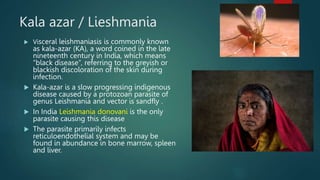
Kala azar / Lieshmania
 Visceral leishmaniasis is commonly known
as kala-azar (KA), a word coined in the late
nineteenth century in India, which means
“black disease”, referring to the greyish or
blackish discoloration of the skin during
infection.
 Kala-azar is a slow progressing indigenous
disease caused by a protozoan parasite of
genus Leishmania and vector is sandfly .
 In India Leishmania donovani is the only
parasite causing this disease
 The parasite primarily infects
reticuloendothelial system and may be
found in abundance in bone marrow, spleen
and liver.
STRATERGIES
Strategies for Kala-azar elmination are :
 (a) Enhanced case detection and complete treatmentincludingintroduction
of K39 rapid diagnostic kits and oral drug Miltefosine for treatment of Kala-
azar cases;
 (b) Interruption of transmission through vector control. It has been decided
to replace DDT with synthetic pyrethroid for the purpose of fogging to
eliminate sandfly, as the insect is becoming resistant to DDT;
 (c) Communication for behavioural impact and intersectoral convergence;
 (d) Capacity building;
 (e) Monitoring, supervision and evaluation; and
 (f) Research guidelines on prevention and control of Kala-azar have been
developed and circulated to the states.
Japanese Encephalitis
 Japanese encephalitis virus JEV is the most
important cause of viral encephalitis in
Asia. It is a mosquito-borne flavivirus, and
belongs to the same genus as dengue,
yellow fever and West Nile viruses.
 JEV is transmitted to humans through bites
from infected mosquitoes of
the Culex species
 Severe disease is characterized by rapid
onset of high fever, headache, neck
stiffness, disorientation, coma, seizures,
spastic paralysis and ultimately death.
STRATERGIES
The strategies for prevention and control of Japanese
encephalitis include -
 strengthening of the surveillance activities through sentinel
sites in tertiary health care institutions,
 early diagnosis and proper case management, integrated
vector control, particularly personal protection and use of
larvivorous fishes, capacity building and behaviour change
communication.
 As the JE vectors are outdoor resters, indoor residual spray is
not effective. The government of India provides need-based
assistance to the states, including support for training
programme and social mobilization.
Dengue
 Dengue (break-bone fever) is a viral infection that
spreads from mosquitoes to people. It is more common
in tropical and subtropical climates.
 Most people who get dengue won’t have symptoms. But
for those that do, the most common symptoms are high
fever, headache, body aches, nausea and rash. Most will
also get better in 1–2 weeks. Some people develop
severe dengue and need care in a hospital.
 In severe cases, dengue can be fatal.
 You can lower your risk of dengue by avoiding mosquito
bites especially during the day.
STRATERGIES
The GOI has taken the following steps for prevention and control of dengue
 (a) Surveillance: Disease and entomological surveillance.
 (b) Case management : Laboratory diagnosis and clinical management.
 (c) Vector management: Environmental management for source reduction, chemical
control, personal protection and legislation.
 (d) Outbreak response: Epidemic preparedness and media management.
 (e) Capacity building : Training, strengthening human resource and operational
research.
 (f) Behavioural change communication: Social mobilization, and information,
education and communication (IEC).
 (g) Inter-sectoral coordination : with ministries of urban development, rural
development, panchayati raj, surface transport and education sector.
 (h) Monitoring and supervision: Analysis of reports, review, field visit and feed-back.
Chiken gunya
 Chikungunya fever is a debilitating non-fatal viral
illness, re-emerging in the country after a gap of
three decades.
 Govt. of India is continuously monitoring the
situation.
 Guidelines for prevention and control of the
disease have been prepared. Since same vector is
involved in the transmission of dengue and
chikungunya, strategies for transmission risk
reduction by vector control are also the same.
 Support in the form of logistics and funds are
provided to the states.For carrying out proactive
surveillance and enhancing diagnostic facilities
for chikungunya.
Thank you …

National Vector Borne Disease Control Program.pptx

  • 1.
    National Vector Borne DiseaseControl Program DR SUMIT SABLE MD COMMUNITY MEDICINE
  • 2.
    Index  Introduction NVBDCP Maleria Agent Host Environment ,Treatment , National Framework , Stratergies  Elemination of lymphaic filariasis  Kala azar / leishmania  Japanese encephlalitis  Dengue  Chikengunya
  • 3.
    National Vector BorneDisease Control Programe  National Vector Borne Disease Control Program (NVBDCP) is implemented in the States/UTs for prevention and control of vector borne diseases (VBDs) namely Malaria, Dengue, Chikungunya, Filariasis, Japanese Encephalitis (JE) and Kala-azar  The Directorate of NVBDCP is the nodal agency for planning, policy making, technical guidance and monitoring and evaluation of program implementation in respect of prevention and control of these vector borne diseases under the overall umbrella of NHM.  Dengue, Chikungunya and JE are known as outbreak prone VBDs
  • 4.
    Anopheles: clean water Culex:dirty water Aedes: artificial collection Mansonia: water with aquatic vegetations  SANDFLY IS VECTOR FOR KALA AZAR/ LEISHMANIA
  • 5.
    Maleria  Malaria hasbeen a major public health problem in India. Intermittent fever, with high incidence during the rainy season, coinciding with agriculture, sowing and harvesting .  Malaria is a public health problem in several parts of the country. About 95% population in the country resides in malaria endemic areas and 80% of malaria reported in the country is confined to areas consisting 20% of population residing in tribal, hilly, difficult and inaccessible areas.  Malaria is caused by the Plasmodium protozoa, which are transmitted to humans by Anopheles mosquitoes.
  • 6.
    Epidemiology of malaria AGENT Malaria in man is caused by four distinct species of the malaria parasite –  P vivax,  P falciparum,  P malariae  and P ovale.
  • 7.
  • 8.
    (b) RESERVOIR OFINFECTION  A human reservoir is one who harbours the sexual forms (gametocytes) of the parasite.  Children are more likely to be gametocyte carriers than adults.
  • 9.
    Host factors  (a)AGE: Malaria affects all ages. Newborn infants have considerable resistance to infection with P falciparum.  This has been attributed to the high concentration of foetal haemoglobin during the first few months of life, which suppresses the development of P falciparum  (b) SEX: Males are more frequently exposed to the risk of acquiring malaria than females because of the outdoor life they lead.  (c) RACE: Individuals with AS haemoglobin (sickle-cell trait) have a milder illness with falciparum infection than do those with normal (AA) haemoglobin.  Persons whose red blood cells are "Duffy negative" (a genetic trait) are resistant to P vivax infection.
  • 10.
    PREGNANCY:  Pregnancy increasesthe risk of malaria in women.  Malaria during pregnancy may cause intrauterine death of the foetus;  It may also cause premature labour or abortion.  Primigravida women are at greatest risk (e) SOCIOECONOMIC DEVELOPMENT: It is generally accepted that malaria has disappeared from most developed countries as a result of socioeconomic development. (f) HOUSING: The ill-ventilated and ill-lighted houses provide ideal indoor resting places for mosquitoes.
  • 11.
    Environmental factors  (a)SEASON: The maximum prevalence is from July to November.  (b) TEMPERATURE:  The optimum temperature for the development of the malaria parasite in the insect vector is between 20 deg. to 30 deg.C  (d) RAINFAll: Rain in general provides opportunities for the breeding of mosquitoes  A relative humidity of 60 per cent is considered necessary for mosquitoes to live their normal span of life.  (e) ALTITUDE: As a rule, Anophelines are not found at altitudes above 2000-2500 metres, due to unfavourable climatic conditions.
  • 12.
    Mode of transmission •VECTOR TRANSMISSION: Malaria is transmitted by the bite of certain species of infected, female, anopheline mosquitoes. • DIRECT TRANSMISSION: • Hypodermic intramuscular and intravenous injections of blood or plasma, e.g., blood transfusion, • Blood transfusion poses a problem because the parasites keep their infective activity during at least 14 days in blood bottles stored at -4 deg.C  CONGENITAL MALARIA: Congenital infection of the newborn from an infected mother may also occur, but it is comparatively rare.
  • 13.
    Incubation period:  Thisis 12 (9-14) days for falciparum malaria,  14 (8-17) days for vivax malaria,  28 (18-40) days for quartan malaria and  17 (16-18) days for ovale malaria.
  • 14.
    Clinical features  COLDSTAGE " The onset is with headache, nausea and chilly sensation followed in an hour or so by rigors.  The temperature rises rapidly to 39- 41°C.  HOT STAGE - " The patient feels burning hot and casts off his clothes.  The skin is hot and dry to touch.  Headache is intense but nausea commonly diminishes.  The pulse is full and respiration rapid. This stage lasts for 2 to 6 hours.
  • 15.
     SWEATING STAGE- " Fever comes down with profuse sweating.“  The temperature drops rapidly to normal and skin is cool and moist.
  • 17.
    Diagnosis  Two typesof blood films are useful in searching for and identification of malaria parasite. The "thin film“ and the "thick film".  The thick film is more reliable in searching for parasite.  The thin slide is more valuable for identifying the species of the parasite present.  Rapid diagnostics kits are also available now .
  • 18.
    Annual Blood ExaminationRate And Annual Parasite Index • ABER = No of slides examined X 100 Population under surveillance Min. 10% of slides of population to be examined. Should be equal to fever rate • API = Confirmed cases in 1 year X 100 Population under surveillance • SPR slide positivity rate = No of slides +ve for MP X 100 Total No of smears examined
  • 20.
    Malaria Elimination FrameWork At Glance  VISION Eliminate malaria nationally and contribute to improved health, quality of life and alleviation of poverty. GOALS • Eliminate malaria (zero indigenous cases) throughout the entire country by 2030; and • Maintain malaria–free status in areas where malaria transmission has been interrupted and prevent re-introduction of malaria.
  • 21.
    objectives The Framework hasfour objectives:  • Eliminate malaria from all 26 low (Category 1) and moderate (Category 2) transmission states/union territories (UTs) by 2022;  • Reduce the incidence of malaria to less than 1 case per 1000 population per year in all states and UTs and their districts by 2024;  • Interrupt indigenous transmission of malaria throughout the entire country, including all high transmission states and union territories (UTs) (Category 3) by 2027; and  • Prevent the re-establishment of local transmission of malaria in areas where it has been eliminated and maintain national malaria-free status by 2030 and beyond.
  • 22.
    Program phasing Sr no.Categories of states/UTs Definition 1 Category 0: Prevention of re- establishment phase States/UTs with zero indigenous cases of malaria. 2 Category 1: Elimination phase States/UTs (15) including their districts reporting an API of less than 1 case per 1000 population at risk . 3 Category 2: Pre-elimination phase States/UTs (11) with an API of less than 1 case per 1000 population at risk, but some of their districts are reporting an API of 1 case per 1000 population at risk or above. 4 Category 3: Intensified control phase States/UTs (10) with an API of 1 case per 1000 population at risk or above.
  • 23.
    Category 0 (preventionof re-establishment phase)  1. Detect any re-introduced case of malaria;  2 Notify immediately all detected cases of malaria;  3. Determine all underlying causes of resumed local transmission;  4 Apply rapid curative and preventive measures;  5. Prevent re introduction and possible re-establishment of malaria transmission; and  6. Maintain malaria-free status in these areas.
  • 24.
    Category 1 (Eliminationphase: States/UTs with API<1, and all their districts reporting API < 1)  1. All efforts will be directed at interrupting local transmission in all active foci of malaria.  2. Mandatory notification of each case of malaria from the private sector, other organized government sectors or any other health facility.  3. Adequate case-based surveillance and complete case management established and fully functional across the entire country to handle each case of malaria.  4.Investigation and classification of all foci of malaria.
  • 25.
     5. Astrict total coverage of all active foci by effective vector control measures.  6. Early detection and treatment of all cases of malaria by means of ACD and/or PCD to prevent onward transmission.  7. State and national level malaria elimination database established and made operational.  8. Implementation of interventions for effective screening, management and prevention of malaria among mobile and migrant populations.  9. Establishment of an effective epidemic forecasting and response system.  10. Ensuring rigorous quality assurance of all medicines and diagnostics.
  • 26.
     11. Settingup a national-level reference laboratory  12. During investigation of foci, all suspected cases of malaria are to be screened for malaria. These could include household members, neighbours, schoolchildren, workplace colleagues and relatives.  13. Surveillance of special groups, migrant populations or populations residing in the vicinity of industrial areas are also to be covered under surveillance operations.
  • 27.
    Category 2 (Pre-eliminationphase : States/UTs with API<1, but some of elimination districts API >1)  The states/UTs in pre-elimination phase are those close to elimination Therefore, entering elimination interventions will be introduced with particular focus on setting up an elimination surveillance system and initiating elimination phase activities in those districts where the API has been reduced to less than 1 case per 1000 population at risk per year.  The planning of elimination measures will be based on epidemiological and classification of each malaria case and focus.
  • 28.
    Category 3 (Intensifiedcontrol phase: States/UTs with API ≥ 1)  Massive scaling up of existing disease management and preventive approaches and tools  Screening of all fever cases suspected for malaria.  Classification of areas as per local malaria epidemiology and grading of areas as per risk of malaria transmission followed by implementation of tailored interventions.  Strengthening of intersectoral collaboration.
  • 29.
     One- stopcentres or mobile clinics on fixed days in tribal or conflict affected areas  Timely referral and treatment of severe malaria cases to reduce malaria-related mortality.  Establishment of a robust supply chain management system.  Maintenance of an optimum level of surveillance  Equipment
  • 30.
    Broad Strategies ForMalaria Elimination  • Early diagnosis and radical treatment  • Case-based surveillance and rapid response  • Integrated vector management (IVM) - indoor residual spray (IRS) - Long-lasting insecticidal nets (LLINs) / Insecticide treated bed nets - Larval source management (LSM)  Epidemic preparedness and early response  • Monitoring and evaluation  • Advocacy, coordination and partnerships  • Behaviour change communication  • Programme planning and management .
  • 31.
    Mosquito control measures Anti-larval:  Environmental control: source reduction  Chemical control: mineral oil, paris green, synthetic  Biological control: Gamusia affinis, Lebister reticularis  Anti-adult:  Residual spray: DDT, Lindane, Malathion  Space spray: Pyrethrum, Fenitrothion  Genetic control: sterile male, cytoplasmic incompatibility, chromosomal translocations  Personal protective measures:  Mosquito net: size of pore < 0.0475 inch  Screening: windows  Repellents: Diethyltoluamide (DEET), Indalone
  • 32.
    Integrated vector management Indoor residual spray in selected pockets  Supply of insecticide treated mosquito nets to the vulnerable population in the risk pockets/ Personal protective measures  Use of larvivorous fish.
  • 33.
    LYMPHATIC FILARIASIS  Lymphaticfilariasis, commonly known as elephantiasis, is a painful and profoundly disfiguring disease. It is caused by infection with parasites classified as nematodes (roundworms) that are transmitted through the bites of infected MANSONIA, culex mosquitos.  Lymphoedema and its more advanced form, elephantiasis, occur primarily in the lower limbs and are commoner in women due to microfilaria .  Lymphatic filariasis may also evolve towards a genital disease (hydrocoele) that is characterized by a swelling of the scrotum and penis.
  • 34.
    STRATERGIES  The strategyof lymphatic filariasis elimination is through : (a) Annual Mass Drug Administration (MDA) of single dose of antifilarial drug for 5 years or more to the eligible population (except pregnant women, children below 2 years of age and seriously ill persons to interrupt transmission of the disease. (b) Home based management of lymphoedema cases and up-scaling of hydrocele operations in identified CHCs/ district hospitals/medical colleges.
  • 35.
    Kala azar /Lieshmania  Visceral leishmaniasis is commonly known as kala-azar (KA), a word coined in the late nineteenth century in India, which means “black disease”, referring to the greyish or blackish discoloration of the skin during infection.  Kala-azar is a slow progressing indigenous disease caused by a protozoan parasite of genus Leishmania and vector is sandfly .  In India Leishmania donovani is the only parasite causing this disease  The parasite primarily infects reticuloendothelial system and may be found in abundance in bone marrow, spleen and liver.
  • 36.
    STRATERGIES Strategies for Kala-azarelmination are :  (a) Enhanced case detection and complete treatmentincludingintroduction of K39 rapid diagnostic kits and oral drug Miltefosine for treatment of Kala- azar cases;  (b) Interruption of transmission through vector control. It has been decided to replace DDT with synthetic pyrethroid for the purpose of fogging to eliminate sandfly, as the insect is becoming resistant to DDT;  (c) Communication for behavioural impact and intersectoral convergence;  (d) Capacity building;  (e) Monitoring, supervision and evaluation; and  (f) Research guidelines on prevention and control of Kala-azar have been developed and circulated to the states.
  • 37.
    Japanese Encephalitis  Japaneseencephalitis virus JEV is the most important cause of viral encephalitis in Asia. It is a mosquito-borne flavivirus, and belongs to the same genus as dengue, yellow fever and West Nile viruses.  JEV is transmitted to humans through bites from infected mosquitoes of the Culex species  Severe disease is characterized by rapid onset of high fever, headache, neck stiffness, disorientation, coma, seizures, spastic paralysis and ultimately death.
  • 38.
    STRATERGIES The strategies forprevention and control of Japanese encephalitis include -  strengthening of the surveillance activities through sentinel sites in tertiary health care institutions,  early diagnosis and proper case management, integrated vector control, particularly personal protection and use of larvivorous fishes, capacity building and behaviour change communication.  As the JE vectors are outdoor resters, indoor residual spray is not effective. The government of India provides need-based assistance to the states, including support for training programme and social mobilization.
  • 39.
    Dengue  Dengue (break-bonefever) is a viral infection that spreads from mosquitoes to people. It is more common in tropical and subtropical climates.  Most people who get dengue won’t have symptoms. But for those that do, the most common symptoms are high fever, headache, body aches, nausea and rash. Most will also get better in 1–2 weeks. Some people develop severe dengue and need care in a hospital.  In severe cases, dengue can be fatal.  You can lower your risk of dengue by avoiding mosquito bites especially during the day.
  • 40.
    STRATERGIES The GOI hastaken the following steps for prevention and control of dengue  (a) Surveillance: Disease and entomological surveillance.  (b) Case management : Laboratory diagnosis and clinical management.  (c) Vector management: Environmental management for source reduction, chemical control, personal protection and legislation.  (d) Outbreak response: Epidemic preparedness and media management.  (e) Capacity building : Training, strengthening human resource and operational research.  (f) Behavioural change communication: Social mobilization, and information, education and communication (IEC).  (g) Inter-sectoral coordination : with ministries of urban development, rural development, panchayati raj, surface transport and education sector.  (h) Monitoring and supervision: Analysis of reports, review, field visit and feed-back.
  • 41.
    Chiken gunya  Chikungunyafever is a debilitating non-fatal viral illness, re-emerging in the country after a gap of three decades.  Govt. of India is continuously monitoring the situation.  Guidelines for prevention and control of the disease have been prepared. Since same vector is involved in the transmission of dengue and chikungunya, strategies for transmission risk reduction by vector control are also the same.  Support in the form of logistics and funds are provided to the states.For carrying out proactive surveillance and enhancing diagnostic facilities for chikungunya.
  • 42.