





Bachelor Of Management Studies
Subject: INDIAN MANAGEMENT THOUGHTS AND
PRACTICES
Topic: The Concept of Dharma & Karma
Shrinivas S Avulu
BMS MBA
Presentation Scope & Flow
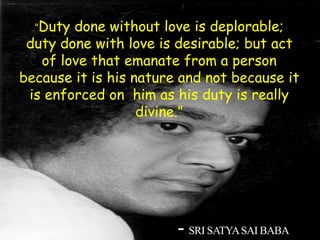
- SRI SATYASAI BABA
“Duty done without love is deplorable;
duty done with love is desirable; but act
of love that emanate from a person
because it is his nature and not because it
is enforced on him as his duty is really
divine.”
Dharmaisthepathofrighteousnessandlivingone'slifeaccordingtothecodesof
conductasdescribebytheHinduscriptures.Ofthefourgrandobjectsofhuman
aspirations(purusharthas),viz.,Dharma,Artha,Kama,andMoksha.Dharmais
giventheforemostrankinthescriptures..Dharmaaloneisthegatewayto
Moksha,toimmortality,infinitebliss,supremepeaceandhighestknowledge.
Hinduismdescribesdharmaasthenaturaluniversallawswhoseobservance
enableshumanstobecontentedandhappyandtoratethemfromdegradation
andsuffering.Dharmaisthemorallawcombinedwithspiritualdisciplinethat
guidesone'slife.Hindusconsiderdharmatheveryfoundationoflife.Theword
dharmaisderivedfromtheroot"dhr"toholdanditsetymologicalmeaningisthat
whichholdsthisworldofthepeopleoftheworldnsthewholecreationfromthe
microcosmtothemacrocosm.Itistheexternaldivinelawofthelord.Theentire
creationisheldtogetherandsustainedbytheall-powerfullawofgod.Dharmais
thelawofbeingwithoutwhichthingscannotexist.
Introduction
Dharma:
“Dharma means
(a) the state of nature as it is,
(b) the laws of nature,
(c) the duties that must be performed in
accordance with the laws of nature, and
(d) the results that are derived from the
fulfillment of such duties.”
-Buddhadasa
Dharmareferstothereligiousethicsaspropoundedbyhindu
gurusinancientindianscriptures.Tulsidas,avigorof
ramcharitmanashasdefinedtherootofdharmaascompassion.
Thisprinciplewastakenupbylordbuddhainhisimmortalbook
ofgreatwisdom,dhammapada.Theatharvavedadescribes
dharmasymbolically:"prithivimdharmadhritam"thatis"this
worldisupheldbydharma".Intheepicpoemmahabharatathe
pandavasrepresentinlifeandthekauravasrepresentadharma
According to scriptures
Dharma in other religious
All other religions also law stress an dharma. Buddhism,
Jainism, christianity,sikhism,zoroastrianism and Islam are all
remarkably alive to its value. Plato, Socrates, Aristotle, Kant,
Swedenborg and Spinoza are all striking examples in the
interesting history of western philosophy for the high pedestal
on which they have placed morality.
Duty and righteousness, and adored them all as the only
means to the attainment of the goal of life. Each religion laws
great on certain aspects of dharma.
Universal rules of dharma
There are four fundamental virtues that all Hindus are asked
to adhere to regularly
1. Non-violence
2. Truth
3. Purity
4. Self-control
Good dharma = Good karma 
Good dharma = Good karma
Hinduism accepts the concept of reincarnation and what
determines the state of an individual in the new existence is
karma which refers to the action undertaken by the body and
the mind. In order to achieve good karma it is important to live
life according to dharma, what is right this involves doing what
is right for the individual, the family, the class or caste and also
for the universe itself. Dharma is like a Bosnia norm and id one
goes against the norm it can Persulu in bad karma so dharma
affects the future according to the karma accumulated.
Therefore one's Dharmic path in the next life it the one
necessary to bring to fruition all the results of part karma.
DHARMA DUTIES
 Patience (dhriti)
 Forgiveness (kshama)
 Piety or self control (dama)
 Honesty (asteya)
 Sanctity (shauch)
 Control of senses (indraiya-nigrah)
 Reason (dhi)
 Knowledge or learning (vidya)
 Truthfulness (satya)
 Absence of anger (krodha).
Dharmic laws govern not only the individual but all in
society.
Dharma disciplines
1. Satya (Truth)
2. Ahimsa (Non-violence)
3. Brahmacharya (Celibacy, non-adultery)
4. Asteya (No desire to possess or steal)
5. Aparighara (Non-corrupt)
6. Shaucha (Cleanliness)
7. Santosh (Contentment)
8. Swadhyaya (Reading of scriptures)
9. Tapas (Austerity, perseverance, penance)
10. Ishwarpranidhan (Regular prayers)
Changingdharma
•“Just as a doctor prescribes different medicines for
different people according to their constitution and the
nature of their disease, so also Hinduism prescribes
different duties for different people.”
•“Rules for women are different from the rules for men. The
rules for different Varnas (castes) and Ashramas (the four
stages of life) vary.”
(“Understanding Hinduism”)
How does literature impact
dharma?
“In the matter of Dharma, the Vedas
are the ultimate authority. You cannot
know the truth about Dharma through
any source of knowledge other than
the Vedas.” (“Understanding
Hinduism”)
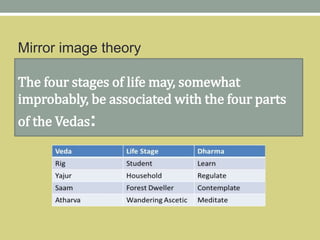
Mirror image theory
The four stages of life may, somewhat
improbably, be associated with the four parts
of the Vedas:
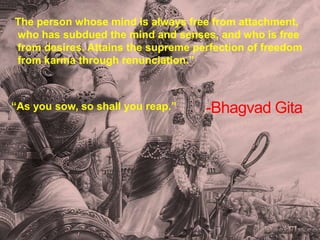
-Bhagvad Gita
“The person whose mind is always free from attachment,
who has subdued the mind and senses, and who is free
from desires. Attains the supreme perfection of freedom
from karma through renunciation.”
“As you sow, so shall you reap.”
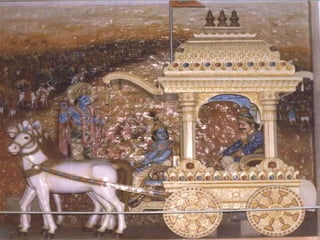
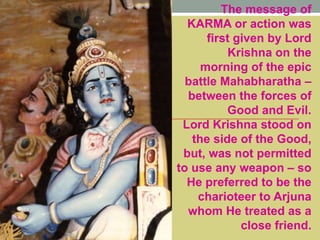
The message of
KARMA or action was
first given by Lord
Krishna on the
morning of the epic
battle Mahabharatha –
between the forces of
Good and Evil.
Lord Krishna stood on
the side of the Good,
but, was not permitted
to use any weapon – so
He preferred to be the
charioteer to Arjuna
whom He treated as a
close friend.
WHAT IS KARMA?
• All our THOUGHTS, WORDS and ACTS or in
one word ALL OUR ACTIONS that collectively
effect and result in our birth – rebirth and joy
and sorrow.
KARMA IS INEVITABLE, ONE HAS TO DO
SOME KARMA OR OTHER. NOT FOR A
SINGLE MOMENT CAN ONE FREE ONESELF
FROM KARMA.
KARMA FACTS
Man is born out of Karma
Man grows in Karma
Man dies in Karma
Karma is the guiding force for human beings
Karma is the cause for pleasure and pain
Swami Says – “Do not take Karma lightly – you entire
life depends on Karma.”
EGO
• Criticizing other or finding faults with others and self-
praise is the EGO game.
• EGO is untruth.
• EGO is what prevents us from getting close to GOD.
• CAUSES YOU TO CONSIDER YOUR BODY AS THE
REAL SELF.
• EGO develops as a result of attachment and desires
– I and Mine.
EGO
WAYS TO REMOVE EGO:
1. SELF ENQUIRY
2. WHAT IS BODY IN RELATION TO
THE CREATION OF GOD
3. WHAT IS THIS BODY THAT WE
REFER TO AS “MY BODY”.
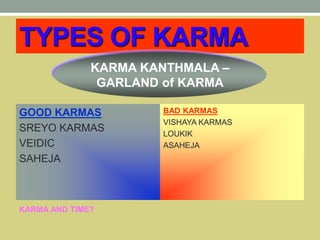
TYPES OF KARMA
GOOD KARMAS
SREYO KARMAS
VEIDIC
SAHEJA
BAD KARMAS
VISHAYA KARMAS
LOUKIK
ASAHEJA
KARMA KANTHMALA –
GARLAND of KARMA
KARMA AND TIME?
KARMA TENSE
• SANCHITA – Past – also Karma Kantha Mala –
The invisible Karma Garland around everybody’s
neck or the Seed Karma
• PRABADHA – The Immediate Present –
THIS IS MOST IMPORTANT
• AGAMI – Future – Suspense, unsure
VISHAYA KARMAS
•VISHAYA KARMAS – Sensory or
Binding Type of Karmas.
• Related to Exterior Objects
• Resorted to with a desire for the
result
• Lead to I & Mine – Cause of EGO
• And the morass of Greed and Lust
SREYO KARMAS
• SREYO KARMAS – Yield Progressive
Joy and auspiciousness, which gives
BLISS to the Soul.
• PURE, FAULTLESS, UNSELFISH &
UNSWERING
• ACTION WITHOUT ANY THOUGHT FOR THE
FRUITS THEREOF OR DESIRELESS
• ACHIEVE TRUTH, JUSTICE, PEACE, LOVE &
NON-VIOLENCE
KARMA VS SCIENCE
• Newtons third law of motion:
TO EVERY ACTION THERE IS EQUAL AND OPPOSITE
REACTION.
• SPITITUALITY’S BASIC LAW OF KARMA:
EVERY ACTION HAS A FRUIT WHICH IS SIMILAR TO
THE ACTION, BUT, TO WHICH THE ‘DOER’ HAVE NO
RIGHT.
WHERE IS THE PROBLEM?
REACTION
NO NO NOT THE FRUIT, BUT, HOW
WE REACT TO THE FRUIT?
Attitude towards the fruit of
action
IF GOOD – WE FEEL HAPPY AND ELATED
IF BAD – WE FEEL SAD AND DEJECTED
These emotional responses set off further desires and
impulses which result in more action with the inherent
consequential fruit – this is a chain reaction
Desires and impulses remain with us even after we
depart from the body – and unfulfilled desires can lead
us to repeated births and re-births.
AVOID RE-BIRTH
• By giving-up desires and doing karma
desirelessly
• To give-up desires – have similar feeling for
good and bad
• How to develop similar feeling?
• You are not this body, so you are not the doer or enjoyer
• Then who are you – an instrument in the hands of the
divine – on the body level
• And a part of the divine soul at the spirit level.
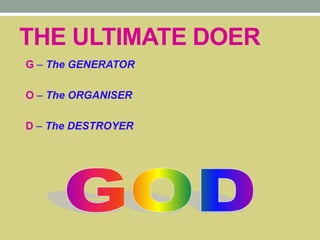
THE ULTIMATE DOER
G – The GENERATOR
O – The ORGANISER
D – The DESTROYER
OUR BIRTH IS A WASTE
• IF THE DOERSHIP IS GODS, THEN MY BIRTH IS A
WASTE.
• THERE IS NOTHING IN MY HANDS
• MY HANDS ARE EMPTY
• I CAN’T EVEN ENJOY THE FRUITS OF ACTIONS
IS IT SO………………..
“ACTION” IS IN OUR HAND
• The action is in our hand fully till we discharge it.
• We have the choice to exercise and choose the path –
that is where we use discrimination.
• While actions are predetermined, the path to execute
the action has to be chosen by man
MEASURE OF ACTION
WATCH THE SECOND, MIN & HR HANDS
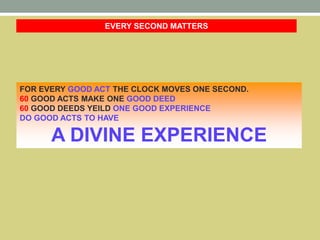
FOR EVERY GOOD ACT THE CLOCK MOVES ONE SECOND.
60 GOOD ACTS MAKE ONE GOOD DEED
60 GOOD DEEDS YEILD ONE GOOD EXPERIENCE
DO GOOD ACTS TO HAVE
A DIVINE EXPERIENCE
EVERY SECOND MATTERS
ITS IMPORTANT
The past – sanchit or seed karma cannot be changed. The
future or agami karma are a mystere.
The present karma are most important – on
one hand you enjoy the fruit of past karma
and on the other hand you are sowing the
seed to fruit in future.
Sow good seeds – baba assures
Good fruits
GOD IS THE ULTIMATE DOER
WHAT ABOUT EVIL DEEDS
• NO NO NO – GOD IS NOT THE DOER HERE.
• GOD PROMPTS US TO DO GOOD ONLY WE DISOBEY
AND DO BAD.
• WE FOLLOW THE MIND WHICH CAN MISLEAD – FOR
CORRECT ACTION FOLLOW THE INTELLECT /
CONSCIENCE
THE PROMISE
In the GITA our beloved Baba promised mankind
through Arjuna – that never will HE ever forsake a
person who has remembered HIM in all his actions.
Baba has advised – there are two paths to reach HIM –
the path of LOVE or the path of KNOWLEDGE. Of
these the path of LOVE is better and surer.
THE PROMISE … contd.
1. Let your MIND focus on Baba.
2. If your mind wavers – do meditation.
3. If you can’t do meditation – do seva to all
around you.
4. If you can’t even do this – SURRENDER
yourself to Baba and receive joy or sorrow –
success or failure as His Blessings.
Only Merciful Baba can
give so many options
What is most important?
Most important is to immediately
start sowing good seeds with
HIS name on our lips and His
Form in our eyes and
HE ~ RESIDING IN OUR
LOTUS HEART.
Indian Management thoughts and practices

Indian Management thoughts and practices

  • 1.
    Bachelor Of ManagementStudies Subject: INDIAN MANAGEMENT THOUGHTS AND PRACTICES Topic: The Concept of Dharma & Karma Shrinivas S Avulu BMS MBA
  • 2.
  • 3.
    - SRI SATYASAIBABA “Duty done without love is deplorable; duty done with love is desirable; but act of love that emanate from a person because it is his nature and not because it is enforced on him as his duty is really divine.”
  • 4.
    Dharmaisthepathofrighteousnessandlivingone'slifeaccordingtothecodesof conductasdescribebytheHinduscriptures.Ofthefourgrandobjectsofhuman aspirations(purusharthas),viz.,Dharma,Artha,Kama,andMoksha.Dharmais giventheforemostrankinthescriptures..Dharmaaloneisthegatewayto Moksha,toimmortality,infinitebliss,supremepeaceandhighestknowledge. Hinduismdescribesdharmaasthenaturaluniversallawswhoseobservance enableshumanstobecontentedandhappyandtoratethemfromdegradation andsuffering.Dharmaisthemorallawcombinedwithspiritualdisciplinethat guidesone'slife.Hindusconsiderdharmatheveryfoundationoflife.Theword dharmaisderivedfromtheroot"dhr"toholdanditsetymologicalmeaningisthat whichholdsthisworldofthepeopleoftheworldnsthewholecreationfromthe microcosmtothemacrocosm.Itistheexternaldivinelawofthelord.Theentire creationisheldtogetherandsustainedbytheall-powerfullawofgod.Dharmais thelawofbeingwithoutwhichthingscannotexist. Introduction
  • 5.
    Dharma: “Dharma means (a) thestate of nature as it is, (b) the laws of nature, (c) the duties that must be performed in accordance with the laws of nature, and (d) the results that are derived from the fulfillment of such duties.” -Buddhadasa
  • 6.
  • 7.
    Dharma in otherreligious All other religions also law stress an dharma. Buddhism, Jainism, christianity,sikhism,zoroastrianism and Islam are all remarkably alive to its value. Plato, Socrates, Aristotle, Kant, Swedenborg and Spinoza are all striking examples in the interesting history of western philosophy for the high pedestal on which they have placed morality. Duty and righteousness, and adored them all as the only means to the attainment of the goal of life. Each religion laws great on certain aspects of dharma.
  • 8.
    Universal rules ofdharma There are four fundamental virtues that all Hindus are asked to adhere to regularly 1. Non-violence 2. Truth 3. Purity 4. Self-control Good dharma = Good karma 
  • 9.
    Good dharma =Good karma Hinduism accepts the concept of reincarnation and what determines the state of an individual in the new existence is karma which refers to the action undertaken by the body and the mind. In order to achieve good karma it is important to live life according to dharma, what is right this involves doing what is right for the individual, the family, the class or caste and also for the universe itself. Dharma is like a Bosnia norm and id one goes against the norm it can Persulu in bad karma so dharma affects the future according to the karma accumulated. Therefore one's Dharmic path in the next life it the one necessary to bring to fruition all the results of part karma.
  • 10.
    DHARMA DUTIES  Patience(dhriti)  Forgiveness (kshama)  Piety or self control (dama)  Honesty (asteya)  Sanctity (shauch)  Control of senses (indraiya-nigrah)  Reason (dhi)  Knowledge or learning (vidya)  Truthfulness (satya)  Absence of anger (krodha). Dharmic laws govern not only the individual but all in society.
  • 11.
    Dharma disciplines 1. Satya(Truth) 2. Ahimsa (Non-violence) 3. Brahmacharya (Celibacy, non-adultery) 4. Asteya (No desire to possess or steal) 5. Aparighara (Non-corrupt) 6. Shaucha (Cleanliness) 7. Santosh (Contentment) 8. Swadhyaya (Reading of scriptures) 9. Tapas (Austerity, perseverance, penance) 10. Ishwarpranidhan (Regular prayers)
  • 12.
    Changingdharma •“Just as adoctor prescribes different medicines for different people according to their constitution and the nature of their disease, so also Hinduism prescribes different duties for different people.” •“Rules for women are different from the rules for men. The rules for different Varnas (castes) and Ashramas (the four stages of life) vary.” (“Understanding Hinduism”)
  • 13.
    How does literatureimpact dharma? “In the matter of Dharma, the Vedas are the ultimate authority. You cannot know the truth about Dharma through any source of knowledge other than the Vedas.” (“Understanding Hinduism”)
  • 14.
    Mirror image theory Thefour stages of life may, somewhat improbably, be associated with the four parts of the Vedas:
  • 16.
    -Bhagvad Gita “The personwhose mind is always free from attachment, who has subdued the mind and senses, and who is free from desires. Attains the supreme perfection of freedom from karma through renunciation.” “As you sow, so shall you reap.”
  • 18.
    The message of KARMAor action was first given by Lord Krishna on the morning of the epic battle Mahabharatha – between the forces of Good and Evil. Lord Krishna stood on the side of the Good, but, was not permitted to use any weapon – so He preferred to be the charioteer to Arjuna whom He treated as a close friend.
  • 19.
    WHAT IS KARMA? •All our THOUGHTS, WORDS and ACTS or in one word ALL OUR ACTIONS that collectively effect and result in our birth – rebirth and joy and sorrow. KARMA IS INEVITABLE, ONE HAS TO DO SOME KARMA OR OTHER. NOT FOR A SINGLE MOMENT CAN ONE FREE ONESELF FROM KARMA.
  • 20.
    KARMA FACTS Man isborn out of Karma Man grows in Karma Man dies in Karma Karma is the guiding force for human beings Karma is the cause for pleasure and pain Swami Says – “Do not take Karma lightly – you entire life depends on Karma.”
  • 21.
    EGO • Criticizing otheror finding faults with others and self- praise is the EGO game. • EGO is untruth. • EGO is what prevents us from getting close to GOD. • CAUSES YOU TO CONSIDER YOUR BODY AS THE REAL SELF. • EGO develops as a result of attachment and desires – I and Mine.
  • 22.
    EGO WAYS TO REMOVEEGO: 1. SELF ENQUIRY 2. WHAT IS BODY IN RELATION TO THE CREATION OF GOD 3. WHAT IS THIS BODY THAT WE REFER TO AS “MY BODY”.
  • 23.
    TYPES OF KARMA GOODKARMAS SREYO KARMAS VEIDIC SAHEJA BAD KARMAS VISHAYA KARMAS LOUKIK ASAHEJA KARMA KANTHMALA – GARLAND of KARMA KARMA AND TIME?
  • 24.
    KARMA TENSE • SANCHITA– Past – also Karma Kantha Mala – The invisible Karma Garland around everybody’s neck or the Seed Karma • PRABADHA – The Immediate Present – THIS IS MOST IMPORTANT • AGAMI – Future – Suspense, unsure
  • 25.
    VISHAYA KARMAS •VISHAYA KARMAS– Sensory or Binding Type of Karmas. • Related to Exterior Objects • Resorted to with a desire for the result • Lead to I & Mine – Cause of EGO • And the morass of Greed and Lust
  • 26.
    SREYO KARMAS • SREYOKARMAS – Yield Progressive Joy and auspiciousness, which gives BLISS to the Soul. • PURE, FAULTLESS, UNSELFISH & UNSWERING • ACTION WITHOUT ANY THOUGHT FOR THE FRUITS THEREOF OR DESIRELESS • ACHIEVE TRUTH, JUSTICE, PEACE, LOVE & NON-VIOLENCE
  • 27.
    KARMA VS SCIENCE •Newtons third law of motion: TO EVERY ACTION THERE IS EQUAL AND OPPOSITE REACTION. • SPITITUALITY’S BASIC LAW OF KARMA: EVERY ACTION HAS A FRUIT WHICH IS SIMILAR TO THE ACTION, BUT, TO WHICH THE ‘DOER’ HAVE NO RIGHT.
  • 28.
    WHERE IS THEPROBLEM? REACTION NO NO NOT THE FRUIT, BUT, HOW WE REACT TO THE FRUIT?
  • 29.
    Attitude towards thefruit of action IF GOOD – WE FEEL HAPPY AND ELATED IF BAD – WE FEEL SAD AND DEJECTED These emotional responses set off further desires and impulses which result in more action with the inherent consequential fruit – this is a chain reaction Desires and impulses remain with us even after we depart from the body – and unfulfilled desires can lead us to repeated births and re-births.
  • 30.
    AVOID RE-BIRTH • Bygiving-up desires and doing karma desirelessly • To give-up desires – have similar feeling for good and bad • How to develop similar feeling? • You are not this body, so you are not the doer or enjoyer • Then who are you – an instrument in the hands of the divine – on the body level • And a part of the divine soul at the spirit level.
  • 31.
    THE ULTIMATE DOER G– The GENERATOR O – The ORGANISER D – The DESTROYER
  • 32.
    OUR BIRTH ISA WASTE • IF THE DOERSHIP IS GODS, THEN MY BIRTH IS A WASTE. • THERE IS NOTHING IN MY HANDS • MY HANDS ARE EMPTY • I CAN’T EVEN ENJOY THE FRUITS OF ACTIONS IS IT SO………………..
  • 33.
    “ACTION” IS INOUR HAND • The action is in our hand fully till we discharge it. • We have the choice to exercise and choose the path – that is where we use discrimination. • While actions are predetermined, the path to execute the action has to be chosen by man
  • 34.
    MEASURE OF ACTION WATCHTHE SECOND, MIN & HR HANDS
  • 35.
    FOR EVERY GOODACT THE CLOCK MOVES ONE SECOND. 60 GOOD ACTS MAKE ONE GOOD DEED 60 GOOD DEEDS YEILD ONE GOOD EXPERIENCE DO GOOD ACTS TO HAVE A DIVINE EXPERIENCE EVERY SECOND MATTERS
  • 36.
    ITS IMPORTANT The past– sanchit or seed karma cannot be changed. The future or agami karma are a mystere. The present karma are most important – on one hand you enjoy the fruit of past karma and on the other hand you are sowing the seed to fruit in future. Sow good seeds – baba assures Good fruits
  • 37.
    GOD IS THEULTIMATE DOER WHAT ABOUT EVIL DEEDS • NO NO NO – GOD IS NOT THE DOER HERE. • GOD PROMPTS US TO DO GOOD ONLY WE DISOBEY AND DO BAD. • WE FOLLOW THE MIND WHICH CAN MISLEAD – FOR CORRECT ACTION FOLLOW THE INTELLECT / CONSCIENCE
  • 38.
    THE PROMISE In theGITA our beloved Baba promised mankind through Arjuna – that never will HE ever forsake a person who has remembered HIM in all his actions. Baba has advised – there are two paths to reach HIM – the path of LOVE or the path of KNOWLEDGE. Of these the path of LOVE is better and surer.
  • 39.
    THE PROMISE …contd. 1. Let your MIND focus on Baba. 2. If your mind wavers – do meditation. 3. If you can’t do meditation – do seva to all around you. 4. If you can’t even do this – SURRENDER yourself to Baba and receive joy or sorrow – success or failure as His Blessings. Only Merciful Baba can give so many options
  • 40.
    What is mostimportant? Most important is to immediately start sowing good seeds with HIS name on our lips and His Form in our eyes and HE ~ RESIDING IN OUR LOTUS HEART.