B.A III Sem
Unit: III
Teachings of Bhagavad Gita
By
Prachi Virag Sontakke
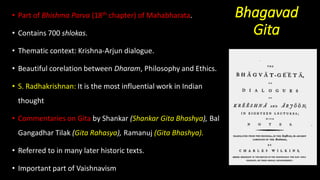
Bhagavad
Gita
• Part of Bhishma Parva (18th chapter) of Mahabharata.
• Contains 700 shlokas.
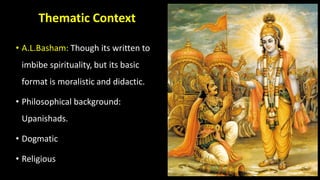
• Thematic context: Krishna-Arjun dialogue.
• Beautiful corelation between Dharam, Philosophy and Ethics.
• S. Radhakrishnan: It is the most influential work in Indian
thought
• Commentaries on Gita by Shankar (Shankar Gita Bhashya), Bal
Gangadhar Tilak (Gita Rahasya), Ramanuj (Gita Bhashya).
• Referred to in many later historic texts.
• Important part of Vaishnavism
Probable date of composition
• D.C.Sirkar: 1/2nd cent CE
• Garbe: 1st cent BCE
• R.G. Bhandarkar: 4th cent BCE
• S.Radhakrishnana: 5th cent BCE
• Referred to in works of Kalidasa, Bhasa, Banabhatta etc.
• Commentary on Gita by Shankar: 9th cent CE.
Thematic Context
• A.L.Basham: Though its written to
imbibe spirituality, but its basic
format is moralistic and didactic.
• Philosophical background:
Upanishads.
• Dogmatic
• Religious
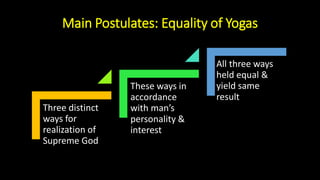
Main Postulates: Equality of Yogas
Three distinct
ways for
realization of
Supreme God
These ways in
accordance
with man’s
personality &
interest
All three ways
held equal &
yield same
result
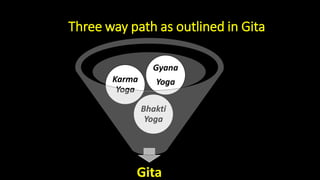
Three way path as outlined in Gita
Gita
Bhakti
Yoga
Karma
Yoga
Gyana
Yoga
Karma Yoga
• Bal Gangadhar Tilak: It’s the
principal Yoga and subject in
Gita.
• God first revealed this Yoga to
Surya, then he to Manu and
Manu taught this to others.
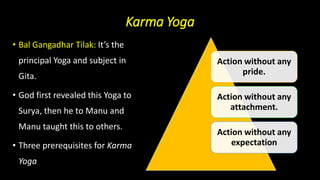
• Three prerequisites for Karma
Yoga
Action without any
pride.
Action without any
attachment.
Action without any
expectation
Action without any pride is Karma Yoga
• We think ourselves to be the doer (Kartaa) of actions
• We take pride in being a doer.
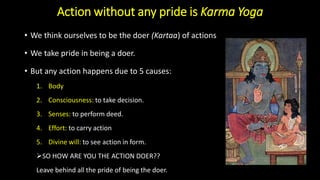
• But any action happens due to 5 causes:
1. Body
2. Consciousness: to take decision.
3. Senses: to perform deed.
4. Effort: to carry action
5. Divine will: to see action in form.
➢SO HOW ARE YOU THE ACTION DOER??
Leave behind all the pride of being the doer.
Action without any attachment is Karma Yoga
• Motive for any action is vested interest: Ending sorrows, bringing joy.
• Karma Yogi should transcend this barrier of motive behind actions.
• Is it possible to do action without any motive?
• Solution: One’s dharam is one’s Karam.
• Each varna has pre defined tasks= His dharam
• Performing the duties attributed to your varna is counted as motive
less action.
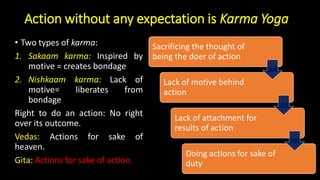
Action without any expectation is Karma Yoga
• Two types of karma:
1. Sakaam karma: Inspired by
motive = creates bondage
2. Nishkaam karma: Lack of
motive= liberates from
bondage
Right to do an action: No right
over its outcome.
Vedas: Actions for sake of
heaven.
Gita: Actions for sake of action.
Sacrificing the thought of
being the doer of action
Lack of motive behind
action
Lack of attachment for
results of action
Doing actions for sake of
duty
Gyana Yoga
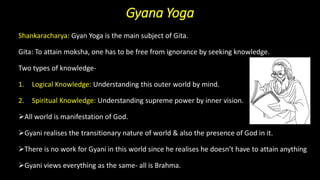
Shankaracharya: Gyan Yoga is the main subject of Gita.
Gita: To attain moksha, one has to be free from ignorance by seeking knowledge.
Two types of knowledge-
1. Logical Knowledge: Understanding this outer world by mind.
2. Spiritual Knowledge: Understanding supreme power by inner vision.
➢All world is manifestation of God.
➢Gyani realises the transitionary nature of world & also the presence of God in it.
➢There is no work for Gyani in this world since he realises he doesn’t have to attain anything
➢Gyani views everything as the same- all is Brahma.
Pursuit of Gyana Yoga
By cleansing body & mind
By staying clear from desires.
By understanding the unity of Atma & Brahma.
By Samatva Yoga:
1. Equality of soul (Atmagat samatva)
2. Equality of things(Vastugat samatva)
3. Equality of qualities (Gunateet samatva).
➢Sthit pragya-free from desire, satisfied with God, free from bondage.
Bhakti Yoga
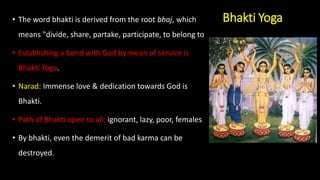
• The word bhakti is derived from the root bhaj, which
means "divide, share, partake, participate, to belong to
• Establishing a bond with God by mean of service is
Bhakti Yoga.
• Narad: Immense love & dedication towards God is
Bhakti.
• Path of Bhakti open to all: ignorant, lazy, poor, females
• By bhakti, even the demerit of bad karma can be
destroyed.
Types of Devotees
1. Aarta: Suffering from diseases. Bhakti to ward of disease.
2. Jigyaasu: Bhakti for knowledge.
3. Ayaarthi: Bhakti for receiving worldly joys & commodities.
4. Gyani: Bhakti for knowledge of God.
The Bhagavad Gita states that all four types of Bhakti yogi are noble
because their pursuit of Bhakti yoga sooner or later starts the journey
on the path of spirituality
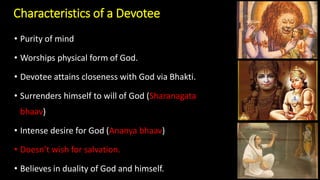
Characteristics of a Devotee
• Purity of mind
• Worships physical form of God.
• Devotee attains closeness with God via Bhakti.
• Surrenders himself to will of God (Sharanagata
bhaav)
• Intense desire for God (Ananya bhaav)
• Doesn’t wish for salvation.
• Believes in duality of God and himself.
Types of Bhakti
1) śravaṇa : listening to the scriptural stories of Krishna and his
companions)
2) kīrtana : praising usually refers to ecstatic group singing
3) smaraṇa : remembering" or fixing the mind on Vishnu
4) pāda-sevana : rendering service
5) arcana : worshiping an image
6) vandana : paying homage
7) dāsya : servitude
8) sākhya : friendship
9) ātma-nivedana : complete surrender of the self.
• Bhakti Yoga grew with the Bhakti Movement, starting about the mid-
1st millennium CE, from Tamil Nadu in South India.
• The movement was led by the Saiva Nayanars and the Vaisnava
Alvars.
• Their ideas and practices inspired bhakti poetry and devotion
throughout India over the 12th-18th century CE
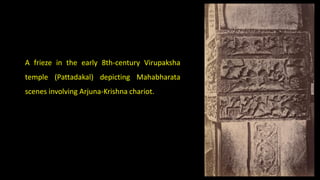
A frieze in the early 8th-century Virupaksha
temple (Pattadakal) depicting Mahabharata
scenes involving Arjuna-Krishna chariot.
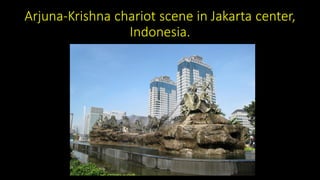
Arjuna-Krishna chariot scene in Jakarta center,
Indonesia.
The Trinity test of the Manhattan Project was the first detonation of a nuclear weapon,
which led Oppenheimer to recall verses from the Bhagavad Gita, notably being: "Now I am
become Death, the destroyer of worlds"
Conclusion
• Well thought of, well analysed philosophical concept
• Karma yoga is path of virtuous action
• jnana yoga is the path of wisdom where the individual pursues knowledge and
introspective self-understanding as spiritual practice.
• Bhakti yoga is a devotee's loving devotion to a personal god as the path for spirituality.
• Offers a practical and pragmatic solution
• Takes into consideration the inherent diversity of human mind.
• Validity unquestioned

gita.pdf

  • 1.
    B.A III Sem Unit:III Teachings of Bhagavad Gita By Prachi Virag Sontakke
  • 2.
    Bhagavad Gita • Part ofBhishma Parva (18th chapter) of Mahabharata. • Contains 700 shlokas. • Thematic context: Krishna-Arjun dialogue. • Beautiful corelation between Dharam, Philosophy and Ethics. • S. Radhakrishnan: It is the most influential work in Indian thought • Commentaries on Gita by Shankar (Shankar Gita Bhashya), Bal Gangadhar Tilak (Gita Rahasya), Ramanuj (Gita Bhashya). • Referred to in many later historic texts. • Important part of Vaishnavism
  • 3.
    Probable date ofcomposition • D.C.Sirkar: 1/2nd cent CE • Garbe: 1st cent BCE • R.G. Bhandarkar: 4th cent BCE • S.Radhakrishnana: 5th cent BCE • Referred to in works of Kalidasa, Bhasa, Banabhatta etc. • Commentary on Gita by Shankar: 9th cent CE.
  • 4.
    Thematic Context • A.L.Basham:Though its written to imbibe spirituality, but its basic format is moralistic and didactic. • Philosophical background: Upanishads. • Dogmatic • Religious
  • 5.
    Main Postulates: Equalityof Yogas Three distinct ways for realization of Supreme God These ways in accordance with man’s personality & interest All three ways held equal & yield same result
  • 6.
    Three way pathas outlined in Gita Gita Bhakti Yoga Karma Yoga Gyana Yoga
  • 7.
    Karma Yoga • BalGangadhar Tilak: It’s the principal Yoga and subject in Gita. • God first revealed this Yoga to Surya, then he to Manu and Manu taught this to others. • Three prerequisites for Karma Yoga Action without any pride. Action without any attachment. Action without any expectation
  • 8.
    Action without anypride is Karma Yoga • We think ourselves to be the doer (Kartaa) of actions • We take pride in being a doer. • But any action happens due to 5 causes: 1. Body 2. Consciousness: to take decision. 3. Senses: to perform deed. 4. Effort: to carry action 5. Divine will: to see action in form. ➢SO HOW ARE YOU THE ACTION DOER?? Leave behind all the pride of being the doer.
  • 9.
    Action without anyattachment is Karma Yoga • Motive for any action is vested interest: Ending sorrows, bringing joy. • Karma Yogi should transcend this barrier of motive behind actions. • Is it possible to do action without any motive? • Solution: One’s dharam is one’s Karam. • Each varna has pre defined tasks= His dharam • Performing the duties attributed to your varna is counted as motive less action.
  • 10.
    Action without anyexpectation is Karma Yoga • Two types of karma: 1. Sakaam karma: Inspired by motive = creates bondage 2. Nishkaam karma: Lack of motive= liberates from bondage Right to do an action: No right over its outcome. Vedas: Actions for sake of heaven. Gita: Actions for sake of action. Sacrificing the thought of being the doer of action Lack of motive behind action Lack of attachment for results of action Doing actions for sake of duty
  • 11.
    Gyana Yoga Shankaracharya: GyanYoga is the main subject of Gita. Gita: To attain moksha, one has to be free from ignorance by seeking knowledge. Two types of knowledge- 1. Logical Knowledge: Understanding this outer world by mind. 2. Spiritual Knowledge: Understanding supreme power by inner vision. ➢All world is manifestation of God. ➢Gyani realises the transitionary nature of world & also the presence of God in it. ➢There is no work for Gyani in this world since he realises he doesn’t have to attain anything ➢Gyani views everything as the same- all is Brahma.
  • 12.
    Pursuit of GyanaYoga By cleansing body & mind By staying clear from desires. By understanding the unity of Atma & Brahma. By Samatva Yoga: 1. Equality of soul (Atmagat samatva) 2. Equality of things(Vastugat samatva) 3. Equality of qualities (Gunateet samatva). ➢Sthit pragya-free from desire, satisfied with God, free from bondage.
  • 13.
    Bhakti Yoga • Theword bhakti is derived from the root bhaj, which means "divide, share, partake, participate, to belong to • Establishing a bond with God by mean of service is Bhakti Yoga. • Narad: Immense love & dedication towards God is Bhakti. • Path of Bhakti open to all: ignorant, lazy, poor, females • By bhakti, even the demerit of bad karma can be destroyed.
  • 14.
    Types of Devotees 1.Aarta: Suffering from diseases. Bhakti to ward of disease. 2. Jigyaasu: Bhakti for knowledge. 3. Ayaarthi: Bhakti for receiving worldly joys & commodities. 4. Gyani: Bhakti for knowledge of God. The Bhagavad Gita states that all four types of Bhakti yogi are noble because their pursuit of Bhakti yoga sooner or later starts the journey on the path of spirituality
  • 15.
    Characteristics of aDevotee • Purity of mind • Worships physical form of God. • Devotee attains closeness with God via Bhakti. • Surrenders himself to will of God (Sharanagata bhaav) • Intense desire for God (Ananya bhaav) • Doesn’t wish for salvation. • Believes in duality of God and himself.
  • 16.
    Types of Bhakti 1)śravaṇa : listening to the scriptural stories of Krishna and his companions) 2) kīrtana : praising usually refers to ecstatic group singing 3) smaraṇa : remembering" or fixing the mind on Vishnu 4) pāda-sevana : rendering service 5) arcana : worshiping an image 6) vandana : paying homage 7) dāsya : servitude 8) sākhya : friendship 9) ātma-nivedana : complete surrender of the self.
  • 17.
    • Bhakti Yogagrew with the Bhakti Movement, starting about the mid- 1st millennium CE, from Tamil Nadu in South India. • The movement was led by the Saiva Nayanars and the Vaisnava Alvars. • Their ideas and practices inspired bhakti poetry and devotion throughout India over the 12th-18th century CE
  • 18.
    A frieze inthe early 8th-century Virupaksha temple (Pattadakal) depicting Mahabharata scenes involving Arjuna-Krishna chariot.
  • 20.
    Arjuna-Krishna chariot scenein Jakarta center, Indonesia.
  • 21.
    The Trinity testof the Manhattan Project was the first detonation of a nuclear weapon, which led Oppenheimer to recall verses from the Bhagavad Gita, notably being: "Now I am become Death, the destroyer of worlds"
  • 22.
    Conclusion • Well thoughtof, well analysed philosophical concept • Karma yoga is path of virtuous action • jnana yoga is the path of wisdom where the individual pursues knowledge and introspective self-understanding as spiritual practice. • Bhakti yoga is a devotee's loving devotion to a personal god as the path for spirituality. • Offers a practical and pragmatic solution • Takes into consideration the inherent diversity of human mind. • Validity unquestioned