UNIT-4
INDIAN ETHOS IN
MANAGEMENT
CULTURE & ETHOS
Culture encompasses the collective beliefs, values, behaviors, and
customs shared by a group of people, shaping their way of life and
interactions with one another.
Ethos refers to the characteristic spirit, guiding principles, and moral
values that define a particular individual, organization, or society.
Culture and ethos are intricately intertwined, as culture provides the
foundation for the development of ethos, while ethos helps uphold
and perpetuate cultural norms and values.
They both play a vital role in shaping identities, influencing decision-
making, fostering social cohesion, and facilitating the transmission of
knowledge and traditions across generations.
Understanding and appreciating diverse cultures and ethoses can
promote empathy, inclusivity, and mutual respect, fostering a more
harmonious and interconnected global society.
Role And Significance Of Ethos In
Managerial Practices
Ethos establishes a moral and ethical framework for managerial
practices.
It guides decision-making processes and sets priorities based
on core values.
Ethos promotes responsible leadership and encourages ethical
behavior.
It fosters a positive work culture, enhancing employee
engagement and productivity.
Ethos attracts and retains talented employees, contributing to
organizational success.
Management Is Culture Bound
 Management practices are influenced by the cultural context in
which they operate.
 Cultural values and beliefs shape managerial styles and
approaches.
 Cultural norms impact how managers structure work, motivate
employees, and establish relationships.
 Organizational structures may vary across cultures based on
cultural preferences.
 Cross-cultural understanding is important for effective
management in diverse settings.
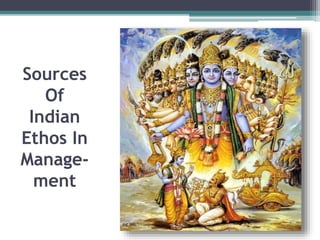
Sources
Of
Indian
Ethos In
Manage-
ment
VEDAS
• Dharma (righteousness): The Vedas emphasize the importance of
adhering to moral and ethical principles in managerial practices.
• Yajna (sacrifice): The concept of yajna highlights the idea of selfless
service and giving back to society, encouraging managers to contribute to
the well-being of their employees and the community.
• Rta (cosmic order): The Vedas promote the understanding of cosmic
order and harmony, which influences managers to establish balanced and
harmonious relationships within the organization.
• Knowledge and learning: The Vedas emphasize the pursuit of knowledge
and continuous learning, encouraging managers to seek wisdom, foster
innovation, and adapt to changing circumstances.
• Hierarchy and cooperation: The Vedas acknowledge the importance of
hierarchy and cooperation within a social structure, guiding managers to
effectively manage teams, delegate responsibilities, and promote
collaboration.
SHASTRAS
• Arthashastra: Offers guidance on governance, leadership, and strategic
management.
• Nitishastra: Emphasizes ethical conduct and moral principles in
managerial practices.
• Yoga Sutras: Promote discipline, self-control, and mindfulness for better
management.
• Manusmriti: Provides guidelines on social behavior, fairness, and equity.
• Dharmashastras: Guide managers on ethical behavior, social
responsibility, and individual well-being.
SMRITIS
• Manusmriti: Provides guidelines on social behavior, fairness, and equity.
• Yajnavalkya Smriti: Focuses on legal principles and social
responsibilities.
• Narada Smriti: Emphasizes moral values, justice, and ethical conduct.
• Brihaspati Smriti: Offers insights into legal and ethical aspects of
governance.
• Parashara Smriti: Provides guidance on ethics, governance, and social
order.
PURANAS
• Vishnu Purana: Ethical leadership and righteous governance.
• Shiva Purana: Balance and transformation in management practices.
• Bhagavata Purana: Leadership, devotion, and ethical decision-making.
• Devi Bhagavata Purana: Women's empowerment and inclusivity in
leadership.
• Matsya Purana: Resource management, sustainability, and environmental
responsibility.
UPANISHADS
• Self-realization: Pursue self-knowledge for effective leadership.
• Ethical conduct: Make decisions based on moral and ethical principles.
• Interconnectedness: Foster holistic and inclusive management.
• Wisdom and knowledge: Continuously learn and apply wisdom.
• Balance and harmony: Manage relationships and conflicts with balance.
RAMAYANA
• Leadership: Exemplifies ideal leadership qualities through the character of
Lord Rama.
• Ethics and morality: Highlights the importance of upholding moral
values and righteousness in decision-making.
• Teamwork and collaboration: Demonstrates the power of teamwork
and collaborative efforts through the diverse characters working together.
• Duty and responsibility: Emphasizes fulfilling one's duties and
responsibilities as a leader and team member.
• Personal growth and self-discipline: Portrays the journey of personal
growth, self-discipline, and resilience in managing challenges.
MAHABHARAT
• Leadership: Portrays various leadership styles and qualities through
characters like Krishna and Arjuna, offering lessons in effective leadership.
• Ethical dilemmas: Explores complex ethical situations faced by the
characters, highlighting the importance of making principled decisions in
management.
• Conflict management: Provides insights into strategies for conflict
resolution, negotiation, and managing diverse viewpoints within a team or
organization.
• Team dynamics: Illustrates the dynamics of teamwork, collaboration,
loyalty, and the role of each team member in achieving common goals.
• Strategic thinking: Showcases strategic planning, decision-making, and
resource management in navigating challenges and achieving long-term
objectives.
ARTHASHASHTRA
• Governance guidance: Offers insights
into effective governance and administration
practices.
• Leadership principles: Provides guidance
on leadership qualities and strategies.
• Strategic management: Discusses
principles of strategic planning, resource
management, and decision-making.
• Ethical governance: Emphasizes the
importance of ethical conduct and moral
values in management.
• Economic policies: Covers economic
principles and policies for sustainable
growth and prosperity.
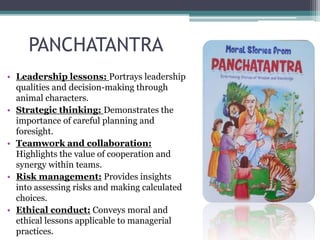
PANCHATANTRA
• Leadership lessons: Portrays leadership
qualities and decision-making through
animal characters.
• Strategic thinking: Demonstrates the
importance of careful planning and
foresight.
• Teamwork and collaboration:
Highlights the value of cooperation and
synergy within teams.
• Risk management: Provides insights
into assessing risks and making calculated
choices.
• Ethical conduct: Conveys moral and
ethical lessons applicable to managerial
practices.
HITOUPDESH
• Leadership lessons: Illustrates effective leadership qualities and
strategies.
• Ethical decision-making: Emphasizes the importance of moral values
and ethical conduct in decision-making.
• Interpersonal relationships: Provides insights into building positive
relationships and managing conflicts.
• Practical wisdom: Offers practical advice and wisdom for managing
various situations.
• Learning from experiences: Encourages learning from past experiences
and applying them to present management practices.
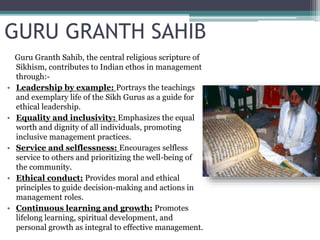
GURU GRANTH SAHIB
Guru Granth Sahib, the central religious scripture of
Sikhism, contributes to Indian ethos in management
through:-
• Leadership by example: Portrays the teachings
and exemplary life of the Sikh Gurus as a guide for
ethical leadership.
• Equality and inclusivity: Emphasizes the equal
worth and dignity of all individuals, promoting
inclusive management practices.
• Service and selflessness: Encourages selfless
service to others and prioritizing the well-being of
the community.
• Ethical conduct: Provides moral and ethical
principles to guide decision-making and actions in
management roles.
• Continuous learning and growth: Promotes
lifelong learning, spiritual development, and
personal growth as integral to effective management.
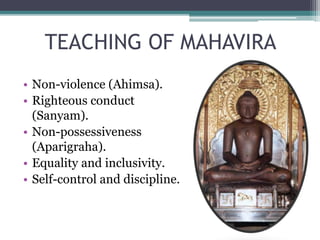
TEACHING OF MAHAVIRA
• Non-violence (Ahimsa).
• Righteous conduct
(Sanyam).
• Non-possessiveness
(Aparigraha).
• Equality and inclusivity.
• Self-control and discipline.
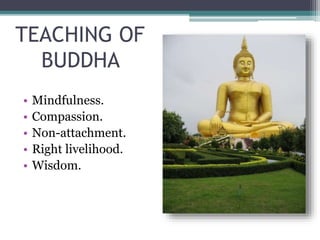
TEACHING OF
BUDDHA
• Mindfulness.
• Compassion.
• Non-attachment.
• Right livelihood.
• Wisdom.
BIBLE
• Servant leadership: Encourages leaders
to serve and prioritize the needs of others.
• Ethical values: Provides moral and
ethical principles for decision-making and
conduct in management roles.
• Integrity and honesty: Emphasizes the
importance of truthfulness, transparency,
and trustworthiness in managerial
practices.
• Humility and humility: Encourages
humility and the recognition of one's
limitations and the value of others'
contributions.
• Stewardship: Promotes responsible and
ethical management of resources and a
sense of accountability towards
stakeholders.
QURAN
• Justice and fairness: Emphasizes the
principles of justice, equity, and treating
others fairly in managerial practices.
• Integrity and honesty: Promotes honesty,
transparency, and trustworthiness in dealings
and decision-making.
• Cooperation and teamwork: Encourages
collaboration, cooperation, and mutual
support in achieving common goals.
• Responsibility and accountability:
Highlights the importance of taking
responsibility for one's actions and being
accountable as a manager.
• Ethical conduct: Provides guidelines for
ethical behavior, including respect for others,
fulfilling commitments, and maintaining
ethical standards.
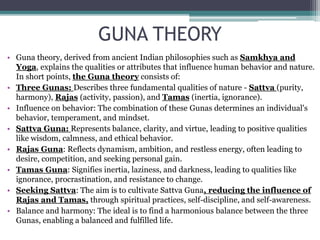
GUNA THEORY
• Guna theory, derived from ancient Indian philosophies such as Samkhya and
Yoga, explains the qualities or attributes that influence human behavior and nature.
In short points, the Guna theory consists of:
• Three Gunas: Describes three fundamental qualities of nature - Sattva (purity,
harmony), Rajas (activity, passion), and Tamas (inertia, ignorance).
• Influence on behavior: The combination of these Gunas determines an individual's
behavior, temperament, and mindset.
• Sattva Guna: Represents balance, clarity, and virtue, leading to positive qualities
like wisdom, calmness, and ethical behavior.
• Rajas Guna: Reflects dynamism, ambition, and restless energy, often leading to
desire, competition, and seeking personal gain.
• Tamas Guna: Signifies inertia, laziness, and darkness, leading to qualities like
ignorance, procrastination, and resistance to change.
• Seeking Sattva: The aim is to cultivate Sattva Guna, reducing the influence of
Rajas and Tamas, through spiritual practices, self-discipline, and self-awareness.
• Balance and harmony: The ideal is to find a harmonious balance between the three
Gunas, enabling a balanced and fulfilled life.
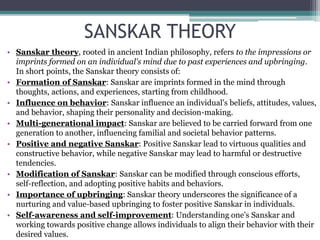
SANSKAR THEORY
• Sanskar theory, rooted in ancient Indian philosophy, refers to the impressions or
imprints formed on an individual's mind due to past experiences and upbringing.
In short points, the Sanskar theory consists of:
• Formation of Sanskar: Sanskar are imprints formed in the mind through
thoughts, actions, and experiences, starting from childhood.
• Influence on behavior: Sanskar influence an individual's beliefs, attitudes, values,
and behavior, shaping their personality and decision-making.
• Multi-generational impact: Sanskar are believed to be carried forward from one
generation to another, influencing familial and societal behavior patterns.
• Positive and negative Sanskar: Positive Sanskar lead to virtuous qualities and
constructive behavior, while negative Sanskar may lead to harmful or destructive
tendencies.
• Modification of Sanskar: Sanskar can be modified through conscious efforts,
self-reflection, and adopting positive habits and behaviors.
• Importance of upbringing: Sanskar theory underscores the significance of a
nurturing and value-based upbringing to foster positive Sanskar in individuals.
• Self-awareness and self-improvement: Understanding one's Sanskar and
working towards positive change allows individuals to align their behavior with their
desired values.

Indian Ethos in Management.pptx

  • 1.
  • 2.
    CULTURE & ETHOS Cultureencompasses the collective beliefs, values, behaviors, and customs shared by a group of people, shaping their way of life and interactions with one another. Ethos refers to the characteristic spirit, guiding principles, and moral values that define a particular individual, organization, or society. Culture and ethos are intricately intertwined, as culture provides the foundation for the development of ethos, while ethos helps uphold and perpetuate cultural norms and values. They both play a vital role in shaping identities, influencing decision- making, fostering social cohesion, and facilitating the transmission of knowledge and traditions across generations. Understanding and appreciating diverse cultures and ethoses can promote empathy, inclusivity, and mutual respect, fostering a more harmonious and interconnected global society.
  • 3.
    Role And SignificanceOf Ethos In Managerial Practices Ethos establishes a moral and ethical framework for managerial practices. It guides decision-making processes and sets priorities based on core values. Ethos promotes responsible leadership and encourages ethical behavior. It fosters a positive work culture, enhancing employee engagement and productivity. Ethos attracts and retains talented employees, contributing to organizational success.
  • 4.
    Management Is CultureBound  Management practices are influenced by the cultural context in which they operate.  Cultural values and beliefs shape managerial styles and approaches.  Cultural norms impact how managers structure work, motivate employees, and establish relationships.  Organizational structures may vary across cultures based on cultural preferences.  Cross-cultural understanding is important for effective management in diverse settings.
  • 5.
  • 6.
    VEDAS • Dharma (righteousness):The Vedas emphasize the importance of adhering to moral and ethical principles in managerial practices. • Yajna (sacrifice): The concept of yajna highlights the idea of selfless service and giving back to society, encouraging managers to contribute to the well-being of their employees and the community. • Rta (cosmic order): The Vedas promote the understanding of cosmic order and harmony, which influences managers to establish balanced and harmonious relationships within the organization. • Knowledge and learning: The Vedas emphasize the pursuit of knowledge and continuous learning, encouraging managers to seek wisdom, foster innovation, and adapt to changing circumstances. • Hierarchy and cooperation: The Vedas acknowledge the importance of hierarchy and cooperation within a social structure, guiding managers to effectively manage teams, delegate responsibilities, and promote collaboration.
  • 7.
    SHASTRAS • Arthashastra: Offersguidance on governance, leadership, and strategic management. • Nitishastra: Emphasizes ethical conduct and moral principles in managerial practices. • Yoga Sutras: Promote discipline, self-control, and mindfulness for better management. • Manusmriti: Provides guidelines on social behavior, fairness, and equity. • Dharmashastras: Guide managers on ethical behavior, social responsibility, and individual well-being.
  • 8.
    SMRITIS • Manusmriti: Providesguidelines on social behavior, fairness, and equity. • Yajnavalkya Smriti: Focuses on legal principles and social responsibilities. • Narada Smriti: Emphasizes moral values, justice, and ethical conduct. • Brihaspati Smriti: Offers insights into legal and ethical aspects of governance. • Parashara Smriti: Provides guidance on ethics, governance, and social order.
  • 9.
    PURANAS • Vishnu Purana:Ethical leadership and righteous governance. • Shiva Purana: Balance and transformation in management practices. • Bhagavata Purana: Leadership, devotion, and ethical decision-making. • Devi Bhagavata Purana: Women's empowerment and inclusivity in leadership. • Matsya Purana: Resource management, sustainability, and environmental responsibility.
  • 10.
    UPANISHADS • Self-realization: Pursueself-knowledge for effective leadership. • Ethical conduct: Make decisions based on moral and ethical principles. • Interconnectedness: Foster holistic and inclusive management. • Wisdom and knowledge: Continuously learn and apply wisdom. • Balance and harmony: Manage relationships and conflicts with balance.
  • 11.
    RAMAYANA • Leadership: Exemplifiesideal leadership qualities through the character of Lord Rama. • Ethics and morality: Highlights the importance of upholding moral values and righteousness in decision-making. • Teamwork and collaboration: Demonstrates the power of teamwork and collaborative efforts through the diverse characters working together. • Duty and responsibility: Emphasizes fulfilling one's duties and responsibilities as a leader and team member. • Personal growth and self-discipline: Portrays the journey of personal growth, self-discipline, and resilience in managing challenges.
  • 12.
    MAHABHARAT • Leadership: Portraysvarious leadership styles and qualities through characters like Krishna and Arjuna, offering lessons in effective leadership. • Ethical dilemmas: Explores complex ethical situations faced by the characters, highlighting the importance of making principled decisions in management. • Conflict management: Provides insights into strategies for conflict resolution, negotiation, and managing diverse viewpoints within a team or organization. • Team dynamics: Illustrates the dynamics of teamwork, collaboration, loyalty, and the role of each team member in achieving common goals. • Strategic thinking: Showcases strategic planning, decision-making, and resource management in navigating challenges and achieving long-term objectives.
  • 13.
    ARTHASHASHTRA • Governance guidance:Offers insights into effective governance and administration practices. • Leadership principles: Provides guidance on leadership qualities and strategies. • Strategic management: Discusses principles of strategic planning, resource management, and decision-making. • Ethical governance: Emphasizes the importance of ethical conduct and moral values in management. • Economic policies: Covers economic principles and policies for sustainable growth and prosperity.
  • 14.
    PANCHATANTRA • Leadership lessons:Portrays leadership qualities and decision-making through animal characters. • Strategic thinking: Demonstrates the importance of careful planning and foresight. • Teamwork and collaboration: Highlights the value of cooperation and synergy within teams. • Risk management: Provides insights into assessing risks and making calculated choices. • Ethical conduct: Conveys moral and ethical lessons applicable to managerial practices.
  • 15.
    HITOUPDESH • Leadership lessons:Illustrates effective leadership qualities and strategies. • Ethical decision-making: Emphasizes the importance of moral values and ethical conduct in decision-making. • Interpersonal relationships: Provides insights into building positive relationships and managing conflicts. • Practical wisdom: Offers practical advice and wisdom for managing various situations. • Learning from experiences: Encourages learning from past experiences and applying them to present management practices.
  • 16.
    GURU GRANTH SAHIB GuruGranth Sahib, the central religious scripture of Sikhism, contributes to Indian ethos in management through:- • Leadership by example: Portrays the teachings and exemplary life of the Sikh Gurus as a guide for ethical leadership. • Equality and inclusivity: Emphasizes the equal worth and dignity of all individuals, promoting inclusive management practices. • Service and selflessness: Encourages selfless service to others and prioritizing the well-being of the community. • Ethical conduct: Provides moral and ethical principles to guide decision-making and actions in management roles. • Continuous learning and growth: Promotes lifelong learning, spiritual development, and personal growth as integral to effective management.
  • 17.
    TEACHING OF MAHAVIRA •Non-violence (Ahimsa). • Righteous conduct (Sanyam). • Non-possessiveness (Aparigraha). • Equality and inclusivity. • Self-control and discipline.
  • 18.
    TEACHING OF BUDDHA • Mindfulness. •Compassion. • Non-attachment. • Right livelihood. • Wisdom.
  • 19.
    BIBLE • Servant leadership:Encourages leaders to serve and prioritize the needs of others. • Ethical values: Provides moral and ethical principles for decision-making and conduct in management roles. • Integrity and honesty: Emphasizes the importance of truthfulness, transparency, and trustworthiness in managerial practices. • Humility and humility: Encourages humility and the recognition of one's limitations and the value of others' contributions. • Stewardship: Promotes responsible and ethical management of resources and a sense of accountability towards stakeholders.
  • 20.
    QURAN • Justice andfairness: Emphasizes the principles of justice, equity, and treating others fairly in managerial practices. • Integrity and honesty: Promotes honesty, transparency, and trustworthiness in dealings and decision-making. • Cooperation and teamwork: Encourages collaboration, cooperation, and mutual support in achieving common goals. • Responsibility and accountability: Highlights the importance of taking responsibility for one's actions and being accountable as a manager. • Ethical conduct: Provides guidelines for ethical behavior, including respect for others, fulfilling commitments, and maintaining ethical standards.
  • 21.
    GUNA THEORY • Gunatheory, derived from ancient Indian philosophies such as Samkhya and Yoga, explains the qualities or attributes that influence human behavior and nature. In short points, the Guna theory consists of: • Three Gunas: Describes three fundamental qualities of nature - Sattva (purity, harmony), Rajas (activity, passion), and Tamas (inertia, ignorance). • Influence on behavior: The combination of these Gunas determines an individual's behavior, temperament, and mindset. • Sattva Guna: Represents balance, clarity, and virtue, leading to positive qualities like wisdom, calmness, and ethical behavior. • Rajas Guna: Reflects dynamism, ambition, and restless energy, often leading to desire, competition, and seeking personal gain. • Tamas Guna: Signifies inertia, laziness, and darkness, leading to qualities like ignorance, procrastination, and resistance to change. • Seeking Sattva: The aim is to cultivate Sattva Guna, reducing the influence of Rajas and Tamas, through spiritual practices, self-discipline, and self-awareness. • Balance and harmony: The ideal is to find a harmonious balance between the three Gunas, enabling a balanced and fulfilled life.
  • 22.
    SANSKAR THEORY • Sanskartheory, rooted in ancient Indian philosophy, refers to the impressions or imprints formed on an individual's mind due to past experiences and upbringing. In short points, the Sanskar theory consists of: • Formation of Sanskar: Sanskar are imprints formed in the mind through thoughts, actions, and experiences, starting from childhood. • Influence on behavior: Sanskar influence an individual's beliefs, attitudes, values, and behavior, shaping their personality and decision-making. • Multi-generational impact: Sanskar are believed to be carried forward from one generation to another, influencing familial and societal behavior patterns. • Positive and negative Sanskar: Positive Sanskar lead to virtuous qualities and constructive behavior, while negative Sanskar may lead to harmful or destructive tendencies. • Modification of Sanskar: Sanskar can be modified through conscious efforts, self-reflection, and adopting positive habits and behaviors. • Importance of upbringing: Sanskar theory underscores the significance of a nurturing and value-based upbringing to foster positive Sanskar in individuals. • Self-awareness and self-improvement: Understanding one's Sanskar and working towards positive change allows individuals to align their behavior with their desired values.