

Dr. Anupma kumari(BNYS)
anupmavaidya123@gmail.com
KARMA YOGA
Dr.Anupma kumari(BNYS)
anupmavaidya123@gmail.com
INTRODUCTION
• Karma yoga is the yoga of action. It is based on the teaching of
Bhagvat geeta.
• Non attachment to result is the key to karma yoga .It doesn’t mean not
setting up goals for attaining result ,it simply means that after all
efforts have been put in for a certain result one has to accept the result
that actually happens with complete equanimity of mind.
• Karma yoga is a school of yoga which teaches us how to turn our
action and deeds into spiritual evolution leading to enlightment.It is a
path of union with god consciousness through the medium of action &
deed .
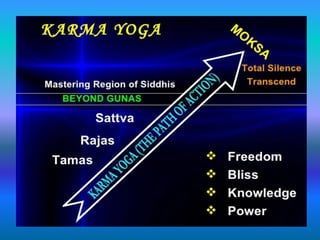
• According to samkhya philosophy nature is composed of 3 forces
called in sanskrit sattva ,rajas ,tamas .These are manifested in the
physical world as eqilibrium activity and inertness .karma yoga has
specially to deal with these three factors
Dr.Anupma kumari(BNYS)
anupmavaidya123@gmail.com
KARMA
• The word karma comes from the sanskrit root “kri” which denotes a
deed ,doing or action.karma includes all actions of body and mind.
• Karma includes thoughts spoken words and physical action .karma can
be manasaa,vaacha or karmanaa i.e, by mind ,word and by doing
,which are mental ,verbal and physical action respectively.
• Karma in it effect is the most tremendous power that man has to deal
with.Man is,as it were a centre and is attracting all the power of
universe towards himself ,and in this centre is fusing them all and
sending them off in a big current .such a centre is the real man –the
almighty ,the omniscient and he draws the whole universe towards
him.
Dr.Anupma kumari(BNYS)
anupmavaidya123@gmail.com
CONCEPT OF KARMA YOGA
• Karma yoga is described as a way of acting ,thinking and willing by
which one orients oneself towards realization by acting in
accordance with one’s duty or dharma without consideration of
personal self centred desires, likes or dislikes .one acts without
being attached to the fruit of one’s deed
• Bhagvat Geeta also talks about meta karma yoga i.e not getting
irritated ,annoyed or unhappy when one gets attached to the result
even after trying to practice karma yoga.
• Lord Krishna explains that work done without selfish action purifies
one’s mind and gradually makes an individual fit to see the value of
reason .he states that it is not necessary to remain in external
solitude ,or remain action-less in order to practice spiritual life
,since the state of action or inaction is primarily determined in the
mind.
Dr.Anupma kumari(BNYS)
anupmavaidya123@gmail.com
TYPES OF ACTION
• Action or deeds can be classified into four types :-
1. Prati-karma or reaction
2. Karma or action
3. Vikarma or proaction
4. Akarma or inaction
therefore a person in supreme conciousness can do just anything
,which may be baffling to the spirituality unawakened ones.
The Goal of karma yoga is to lead one from reaction (pratikara) to
no action (akarma ).when the doer ceases to exist (in the state of
akarma ) an action (karma) becomes karma yogajourney from
reaction to no action is a great tool for enlightment.
Dr.Anupma kumari(BNYS)
anupmavaidya123@gmail.com
COMPONENTS OF KARMA
• Generally an action has three components :-
1. Udesya (goal)
2. Karmanya (the action to be done to attain the goal )
3. Phala (reward of an action)
Dr.Anupma kumari(BNYS)
anupmavaidya123@gmail.com
REWARD OR CONSEQUENCES
Phala or reward can be manifested in 3 ways:-
1. Kriyaman - a course of action happening to the present
2. Prarabdha- a reward good or bad that has become your destiny.
3. Sanchita – a reward that you has accumulated and will manifest sooner or
later.
Karma yoga says –set a goal (udesya),work for that (karmanya) but do not
insist that a result will necessarily of your choice .The phala could be as
expected by you or could be something totally unexpected by you.
Lord krishna says to his disciple arjuna:-
कर्मणयेवाधिकारस्ते र्ा फलेषु कदाचन।
र्ा कर्मफलहेतुर्भमर्ाम ते सङ्गोऽस््वकर्मणण।
i.e. You have a right to perform your prescribed duty, but you are not entitled
to the fruits of actions, Never consider yourself the cause of the results of
your activities, and never be attached to not doing your duty.
Thus non attachment to result is a key to karma yoga.
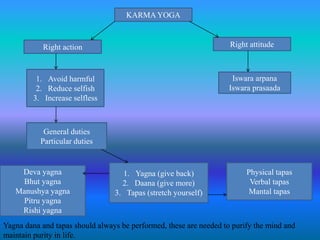
KARMA YOGA
Right action Right attitude
1. Avoid harmful
2. Reduce selfish
3. Increase selfless
Iswara arpana
Iswara prasaada
General duties
Particular duties
1. Yagna (give back)
2. Daana (give more)
3. Tapas (stretch yourself)
Physical tapas
Verbal tapas
Mantal tapas
Deva yagna
Bhut yagna
Manushya yagna
Pitru yagna
Rishi yagna
Yagna dana and tapas should always be performed, these are needed to purify the mind and
maintain purity in life.
Dr.Anupma kumari(BNYS)
anupmavaidya123@gmail.com
YAGNA (PAYING BACK)
• We have already taken a lot from the environment , parent ,society
etc. So we are under a huge debit.give willingly instead of being
robbed forcefully.
FIVE KINDS OF DEBITS:-
1.DEVA RUNA:-debit to inanimate object (nature).we are made of the
gross and subtle elements .earth gives food,sun gives heat & light
,we need air to breath ,water to drink etc.
2. BHUTA RUNA:- debit to other plants & animals.
3. PITRU RUNA:-debit to parents and ancestor .
4. MANUSHYA RUNA:-debit to the society .
5. RISHI RUNA :- debit to the teachers .
So paying back against the pancha runa brings our account back to
balance. It is okay to overpay. It will be credited back.
Dr.Anupma kumari(BNYS)
anupmavaidya123@gmail.com
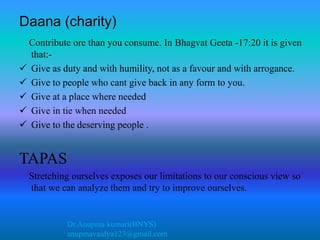
Daana (charity)
Contribute ore than you consume. In Bhagvat Geeta -17:20 it is given
that:-
 Give as duty and with humility, not as a favour and with arrogance.
 Give to people who cant give back in any form to you.
 Give at a place where needed
 Give in tie when needed
 Give to the deserving people .
TAPAS
Stretching ourselves exposes our limitations to our conscious view so
that we can analyze them and try to improve ourselves.
Dr.Anupma kumari(BNYS)
anupmavaidya123@gmail.com
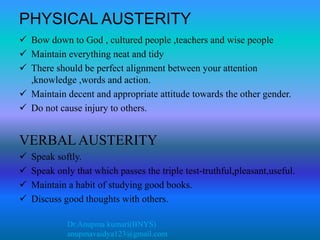
PHYSICAL AUSTERITY
 Bow down to God , cultured people ,teachers and wise people
 Maintain everything neat and tidy
 There should be perfect alignment between your attention
,knowledge ,words and action.
 Maintain decent and appropriate attitude towards the other gender.
 Do not cause injury to others.
VERBAL AUSTERITY
 Speak softly.
 Speak only that which passes the triple test-truthful,pleasant,useful.
 Maintain a habit of studying good books.
 Discuss good thoughts with others.
Dr.Anupma kumari(BNYS)
anupmavaidya123@gmail.com
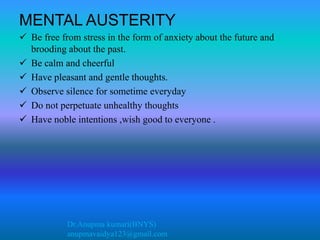
MENTAL AUSTERITY
 Be free from stress in the form of anxiety about the future and
brooding about the past.
 Be calm and cheerful
 Have pleasant and gentle thoughts.
 Observe silence for sometime everyday
 Do not perpetuate unhealthy thoughts
 Have noble intentions ,wish good to everyone .
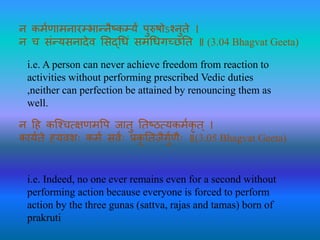
न कर्मणार्नारम्र्ान्नैष्कम्यं पुरुषोऽश्नुते ।
न च संन्यसनादेव ससदधिं सर्धिगच्छतत ॥ (3.04 Bhagvat Geeta)
i.e. A person can never achieve freedom from reaction to
activities without performing prescribed Vedic duties
,neither can perfection be attained by renouncing them as
well.
न हह कश्श्च्षणर्पप जातु ततष्ठ्यकर्मकृ त् ।
कायमते ह्यवशः कर्म सवमः प्रकृ ततजैगुमणैः ॥(3.05 Bhagvat Geeta)
i.e. Indeed, no one ever remains even for a second without
performing action because everyone is forced to perform
action by the three gunas (sattva, rajas and tamas) born of
prakruti
Karma yoga

Karma yoga

  • 1.
  • 2.
    Dr.Anupma kumari(BNYS) anupmavaidya123@gmail.com INTRODUCTION • Karmayoga is the yoga of action. It is based on the teaching of Bhagvat geeta. • Non attachment to result is the key to karma yoga .It doesn’t mean not setting up goals for attaining result ,it simply means that after all efforts have been put in for a certain result one has to accept the result that actually happens with complete equanimity of mind. • Karma yoga is a school of yoga which teaches us how to turn our action and deeds into spiritual evolution leading to enlightment.It is a path of union with god consciousness through the medium of action & deed . • According to samkhya philosophy nature is composed of 3 forces called in sanskrit sattva ,rajas ,tamas .These are manifested in the physical world as eqilibrium activity and inertness .karma yoga has specially to deal with these three factors
  • 3.
    Dr.Anupma kumari(BNYS) anupmavaidya123@gmail.com KARMA • Theword karma comes from the sanskrit root “kri” which denotes a deed ,doing or action.karma includes all actions of body and mind. • Karma includes thoughts spoken words and physical action .karma can be manasaa,vaacha or karmanaa i.e, by mind ,word and by doing ,which are mental ,verbal and physical action respectively. • Karma in it effect is the most tremendous power that man has to deal with.Man is,as it were a centre and is attracting all the power of universe towards himself ,and in this centre is fusing them all and sending them off in a big current .such a centre is the real man –the almighty ,the omniscient and he draws the whole universe towards him.
  • 4.
    Dr.Anupma kumari(BNYS) anupmavaidya123@gmail.com CONCEPT OFKARMA YOGA • Karma yoga is described as a way of acting ,thinking and willing by which one orients oneself towards realization by acting in accordance with one’s duty or dharma without consideration of personal self centred desires, likes or dislikes .one acts without being attached to the fruit of one’s deed • Bhagvat Geeta also talks about meta karma yoga i.e not getting irritated ,annoyed or unhappy when one gets attached to the result even after trying to practice karma yoga. • Lord Krishna explains that work done without selfish action purifies one’s mind and gradually makes an individual fit to see the value of reason .he states that it is not necessary to remain in external solitude ,or remain action-less in order to practice spiritual life ,since the state of action or inaction is primarily determined in the mind.
  • 5.
    Dr.Anupma kumari(BNYS) anupmavaidya123@gmail.com TYPES OFACTION • Action or deeds can be classified into four types :- 1. Prati-karma or reaction 2. Karma or action 3. Vikarma or proaction 4. Akarma or inaction therefore a person in supreme conciousness can do just anything ,which may be baffling to the spirituality unawakened ones. The Goal of karma yoga is to lead one from reaction (pratikara) to no action (akarma ).when the doer ceases to exist (in the state of akarma ) an action (karma) becomes karma yogajourney from reaction to no action is a great tool for enlightment.
  • 6.
    Dr.Anupma kumari(BNYS) anupmavaidya123@gmail.com COMPONENTS OFKARMA • Generally an action has three components :- 1. Udesya (goal) 2. Karmanya (the action to be done to attain the goal ) 3. Phala (reward of an action)
  • 7.
    Dr.Anupma kumari(BNYS) anupmavaidya123@gmail.com REWARD ORCONSEQUENCES Phala or reward can be manifested in 3 ways:- 1. Kriyaman - a course of action happening to the present 2. Prarabdha- a reward good or bad that has become your destiny. 3. Sanchita – a reward that you has accumulated and will manifest sooner or later. Karma yoga says –set a goal (udesya),work for that (karmanya) but do not insist that a result will necessarily of your choice .The phala could be as expected by you or could be something totally unexpected by you. Lord krishna says to his disciple arjuna:- कर्मणयेवाधिकारस्ते र्ा फलेषु कदाचन। र्ा कर्मफलहेतुर्भमर्ाम ते सङ्गोऽस््वकर्मणण। i.e. You have a right to perform your prescribed duty, but you are not entitled to the fruits of actions, Never consider yourself the cause of the results of your activities, and never be attached to not doing your duty. Thus non attachment to result is a key to karma yoga.
  • 8.
    KARMA YOGA Right actionRight attitude 1. Avoid harmful 2. Reduce selfish 3. Increase selfless Iswara arpana Iswara prasaada General duties Particular duties 1. Yagna (give back) 2. Daana (give more) 3. Tapas (stretch yourself) Physical tapas Verbal tapas Mantal tapas Deva yagna Bhut yagna Manushya yagna Pitru yagna Rishi yagna Yagna dana and tapas should always be performed, these are needed to purify the mind and maintain purity in life.
  • 9.
    Dr.Anupma kumari(BNYS) anupmavaidya123@gmail.com YAGNA (PAYINGBACK) • We have already taken a lot from the environment , parent ,society etc. So we are under a huge debit.give willingly instead of being robbed forcefully. FIVE KINDS OF DEBITS:- 1.DEVA RUNA:-debit to inanimate object (nature).we are made of the gross and subtle elements .earth gives food,sun gives heat & light ,we need air to breath ,water to drink etc. 2. BHUTA RUNA:- debit to other plants & animals. 3. PITRU RUNA:-debit to parents and ancestor . 4. MANUSHYA RUNA:-debit to the society . 5. RISHI RUNA :- debit to the teachers . So paying back against the pancha runa brings our account back to balance. It is okay to overpay. It will be credited back.
  • 10.
    Dr.Anupma kumari(BNYS) anupmavaidya123@gmail.com Daana (charity) Contributeore than you consume. In Bhagvat Geeta -17:20 it is given that:-  Give as duty and with humility, not as a favour and with arrogance.  Give to people who cant give back in any form to you.  Give at a place where needed  Give in tie when needed  Give to the deserving people . TAPAS Stretching ourselves exposes our limitations to our conscious view so that we can analyze them and try to improve ourselves.
  • 11.
    Dr.Anupma kumari(BNYS) anupmavaidya123@gmail.com PHYSICAL AUSTERITY Bow down to God , cultured people ,teachers and wise people  Maintain everything neat and tidy  There should be perfect alignment between your attention ,knowledge ,words and action.  Maintain decent and appropriate attitude towards the other gender.  Do not cause injury to others. VERBAL AUSTERITY  Speak softly.  Speak only that which passes the triple test-truthful,pleasant,useful.  Maintain a habit of studying good books.  Discuss good thoughts with others.
  • 12.
    Dr.Anupma kumari(BNYS) anupmavaidya123@gmail.com MENTAL AUSTERITY Be free from stress in the form of anxiety about the future and brooding about the past.  Be calm and cheerful  Have pleasant and gentle thoughts.  Observe silence for sometime everyday  Do not perpetuate unhealthy thoughts  Have noble intentions ,wish good to everyone .
  • 14.
    न कर्मणार्नारम्र्ान्नैष्कम्यं पुरुषोऽश्नुते। न च संन्यसनादेव ससदधिं सर्धिगच्छतत ॥ (3.04 Bhagvat Geeta) i.e. A person can never achieve freedom from reaction to activities without performing prescribed Vedic duties ,neither can perfection be attained by renouncing them as well. न हह कश्श्च्षणर्पप जातु ततष्ठ्यकर्मकृ त् । कायमते ह्यवशः कर्म सवमः प्रकृ ततजैगुमणैः ॥(3.05 Bhagvat Geeta) i.e. Indeed, no one ever remains even for a second without performing action because everyone is forced to perform action by the three gunas (sattva, rajas and tamas) born of prakruti