Presented by:
Ankit Deora
Gargy Sharma
Rudrakshi Singh
Sakshi Somani
ShivanshikaShekhawat
Supriya Somani
Surbhi Mathur
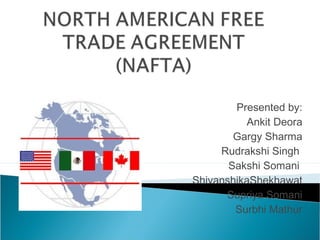
 The North American Free Trade Agreement (NAFTA) is a
comprehensive trade agreement that sets the rules of trade
and investment between Canada, the United States, and
Mexico
 NAFTA has systematically eliminated most tariff and non-
tariff barriers to free trade and investment between the
three NAFTA countries.
 Establishment: 1 January 1994
 Members: Canada, Mexico & United States
 Official languages: English, French and Spanish
 Secretariats: Mexico city, Ottawa, Washington D.C.
 NAFTA supplements: NAAEC & NAALC
 NAFTA is a formal agreement that establishes clear
rules for commercial activity between Canada, the
United States, and Mexico.
 It is overseen by a number of institutions that ensure
the proper interpretation and smooth implementation
of the Agreement’s provisions. 
• Free Trade Commission
• NAFTA Coordinators
• NAFTA working groups & committees
• NAFTA Secretariat
• Commission for labor Cooperation
• Commission for Environmental Cooperation
 To eliminate trade barriers & facilitate the cross-border
movements of goods and services between the parties
 To promote conditions of fair competition
 To substantially increase investment opportunities
 To provide adequate and effective protection & enforcement
of intellectual property rights in each territory
 To create effective procedures for the implementation and
application of this agreement ,for its joint administration &
for resolution of disputes
 To establish a framework for further trilateral, regional and
multilateral co-operation to expand and enhance benefits of
this agreement
 The North American Agreement on Environmental
Cooperation (NAAEC) is an environmental agreement 
between the United States of America, Canada and 
Mexico as a side-treaty of the North American Free Trade 
Agreement. 
 The agreement came into effect January 1, 1994.
 The agreement consists of a declaration of principles and 
objectives concerning conservation and the protection of 
the environment as well as concrete measures to further 
cooperation on these matters between the three countries. 
 The  North  American  Agreement  on  Labor  Cooperation 
(NAALC)  was  signed  on  September  14,  1993,  by  the 
Presidents of Mexico and the United States, and the Prime 
Minister of Canada, as one of the supplementary accords 
to the North America Free Trade Agreement (NAFTA). 
 It entered into force on January 1, 1994.
 The NAALC was the first international agreement on labor 
to be linked to an international trade agreement.
  It provides a mechanism for member countries to ensure 
the effective enforcement of existing and future domestic 
labor  standards  and  laws  without  interfering  in  the 
sovereign  functioning  of  the  different  national  labor 
systems, an approach that made it novel and unique. 
NAFTA also seeks to eliminate non-tariff trade barriers and to 
protect the intellectual property right of the products.
 Intellectual Property:
    NAFTA  made some changes to the Copyright law of the 
United States foreshadowing the Uruguay Round Agreements 
Act of 1994 by restoring copyright (within NAFTA) on 
certain motion pictures which had entered the public domain.
 Environment:
    A side agreement was negotiated on the environment with 
Canada and Mexico, the North American Agreement on 
Environmental Cooperation (NAAEC), which led to the 
creation of the Commission for Environmental 
Cooperation(CEC) in 1994. 
Transportation infrastructure:
NAFTA established the CANAMEX Corridor for road transport 
between Canada and Mexico, also proposed for use by rail, 
pipeline, and fiber optic telecommunications infrastructure. This 
became a High Priority Corridor under the U.S. Intermodal Surface 
Transportation Efficiency Act of 1991.
Agriculture:
three separate agreements were signed between each pair of parties. 
The Canada–U.S. agreement contains significant restrictions and 
tariff quotas on agricultural products (mainly sugar, dairy, and 
poultry products), whereas the Mexico–U.S. pact allows for a 
wider liberalization within a framework of phase-out periods (it 
was the first North–South FTA on agriculture to be signed).
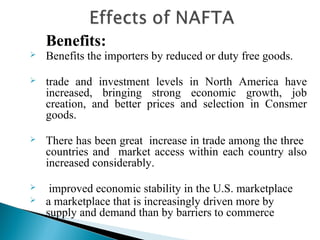
Benefits:
 Benefits the importers by reduced or duty free goods.
 trade and investment levels in North America have
increased, bringing strong economic growth, job
creation, and better prices and selection in Consmer
goods.
 There has been great increase in trade among the three
countries and market access within each country also
increased considerably.
 improved economic stability in the U.S. marketplace
 a marketplace that is increasingly driven more by
supply and demand than by barriers to commerce
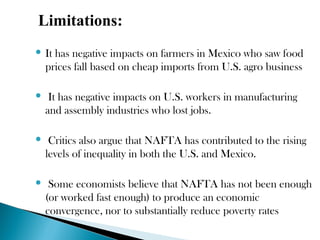
Limitations:
 It has negative impacts on farmers in Mexico who saw food
prices fall based on cheap imports from U.S. agro business
 It has negative impacts on U.S. workers in manufacturing
and assembly industries who lost jobs.
 Critics also argue that NAFTA has contributed to the rising
levels of inequality in both the U.S. and Mexico.
 Some economists believe that NAFTA has not been enough
(or worked fast enough) to produce an economic
convergence, nor to substantially reduce poverty rates
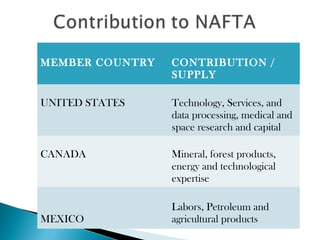
MEMBER COUNTRY CONTRIBUTION /
SUPPLY
UNITED STATES Technology, Services, and
data processing, medical and
space research and capital
CANADA Mineral, forest products,
energy and technological
expertise
MEXICO
Labors, Petroleum and
agricultural products
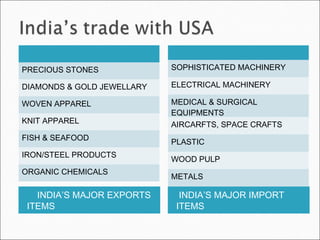
INDIA’S MAJOR EXPORTS
ITEMS
INDIA’S MAJOR IMPORT
ITEMS
PRECIOUS STONES
DIAMONDS & GOLD JEWELLARY
WOVEN APPAREL
KNIT APPAREL
FISH & SEAFOOD
IRON/STEEL PRODUCTS
ORGANIC CHEMICALS
SOPHISTICATED MACHINERY
ELECTRICAL MACHINERY
MEDICAL & SURGICAL
EQUIPMENTS
AIRCARFTS, SPACE CRAFTS
PLASTIC
WOOD PULP
METALS
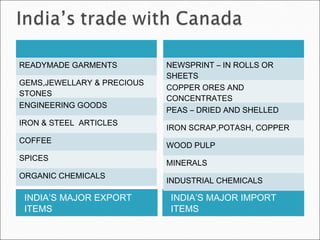
INDIA’S MAJOR EXPORT
ITEMS
INDIA’S MAJOR IMPORT
ITEMS
READYMADE GARMENTS
GEMS,JEWELLARY & PRECIOUS
STONES
ENGINEERING GOODS
IRON & STEEL ARTICLES
COFFEE
SPICES
ORGANIC CHEMICALS
NEWSPRINT – IN ROLLS OR
SHEETS
COPPER ORES AND
CONCENTRATES
PEAS – DRIED AND SHELLED
IRON SCRAP,POTASH, COPPER
WOOD PULP
MINERALS
INDUSTRIAL CHEMICALS
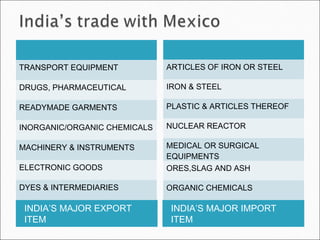
INDIA’S MAJOR EXPORT
ITEM
INDIA’S MAJOR IMPORT
ITEM
TRANSPORT EQUIPMENT
DRUGS, PHARMACEUTICAL
READYMADE GARMENTS
INORGANIC/ORGANIC CHEMICALS
MACHINERY & INSTRUMENTS
ELECTRONIC GOODS
DYES & INTERMEDIARIES
ARTICLES OF IRON OR STEEL
IRON & STEEL
PLASTIC & ARTICLES THEREOF
NUCLEAR REACTOR
MEDICAL OR SURGICAL
EQUIPMENTS
ORES,SLAG AND ASH
ORGANIC CHEMICALS
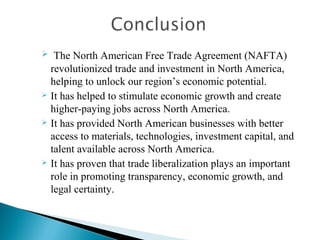
 The North American Free Trade Agreement (NAFTA)
revolutionized trade and investment in North America,
helping to unlock our region’s economic potential.
 It has helped to stimulate economic growth and create
higher-paying jobs across North America.
 It has provided North American businesses with better
access to materials, technologies, investment capital, and
talent available across North America.
 It has proven that trade liberalization plays an important
role in promoting transparency, economic growth, and
legal certainty.

Nafta ppt