
Class :- T.Y.B.M.S
Division:- A
Semester:-6
Subject:-Indian management
thoughts & practices.
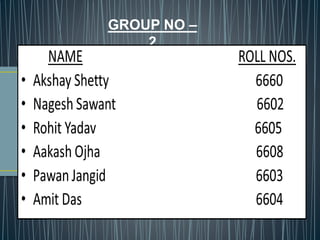
GROUP NO –
2
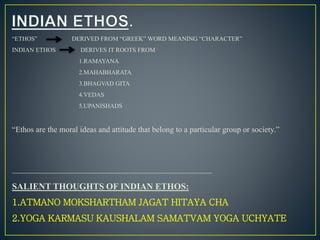
“ETHOS” DERIVED FROM “GREEK” WORD MEANING “CHARACTER”
INDIAN ETHOS DERIVES IT ROOTS FROM
1.RAMAYANA
2.MAHABHARATA
3.BHAGVAD GITA
4.VEDAS
5.UPANISHADS
“Ethos are the moral ideas and attitude that belong to a particular group or society.”
-------------------------------------------------------------------------------------------------------
SALIENT THOUGHTS OF INDIAN ETHOS:
1.ATMANO MOKSHARTHAM JAGAT HITAYA CHA
2.YOGA KARMASU KAUSHALAM SAMATVAM YOGA UCHYATE
• Development of value based management
system
• Self development & self management
• Stress management
• Social sensitivity
• Humanizing the organization
• Self introspection
• Brain stilling/Meditation
• Maintain holistic universe
• Welfare
• Unique work culture
• Self development
• Provides concentration
• Establish value system
Indian culture:- Indian culture is an ‘Inward-looking’
Culture characteristics by Simple living and High
Thinking.
Decision making
Respect
‘Atithi Devo Bhava’
Tolerance
Humility and respect
Individualism
Progress & Change
Control of Nature and the Environment
Beliefs in social Darwinism
• Group oriented
• Importance to others opinion
• Group mentality
• Social dimension
• Secular society
• Harmony , order & self development
• More importance to law
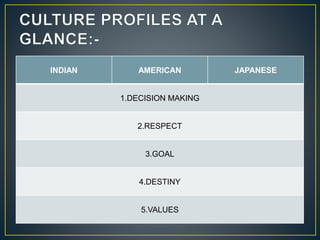
INDIAN AMERICAN JAPANESE
1.DECISION MAKING
2.RESPECT
3.GOAL
4.DESTINY
5.VALUES
It means application of principles of management
revealed in our ancient wisdom described in
Upanishads and Gita.
The following basic principles of management are
as per ancient Indian Wisdom and Insight.
• EACH SOUL IS A POTENTIAL
GOD.
• HOLISTIC APPROACH.
• EQUAL IMPORTANCE
SUBJECTIVITY/OBJECTIVITY.
• KARMA YOGA.
• YOGAH KARMASU
KAUSHALAM.
• CO-OPERATUION.
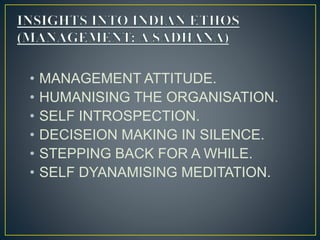
• MANAGEMENT ATTITUDE.
• HUMANISING THE ORGANISATION.
• SELF INTROSPECTION.
• DECISEION MAKING IN SILENCE.
• STEPPING BACK FOR A WHILE.
• SELF DYANAMISING MEDITATION.
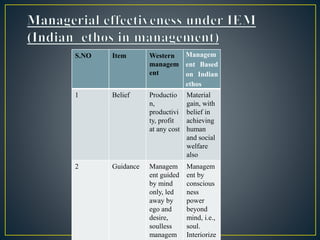
S.NO Item Western
managem
ent
Managem
ent Based
on Indian
ethos
1 Belief Productio
n,
productivi
ty, profit
at any cost
Material
gain, with
belief in
achieving
human
and social
welfare
also
2 Guidance Managem
ent guided
by mind
only, led
away by
ego and
desire,
soulless
managem
Managem
ent by
conscious
ness
power
beyond
mind, i.e.,
soul.
Interiorize
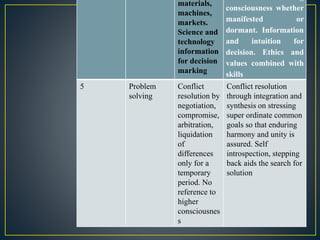
materials,
machines,
markets.
Science and
technology
information
for decision
marking
consciousness whether
manifested or
dormant. Information
and intuition for
decision. Ethics and
values combined with
skills
5 Problem
solving
Conflict
resolution by
negotiation,
compromise,
arbitration,
liquidation
of
differences
only for a
temporary
period. No
reference to
higher
consciousnes
s
Conflict resolution
through integration and
synthesis on stressing
super ordinate common
goals so that enduring
harmony and unity is
assured. Self
introspection, stepping
back aids the search for
solution
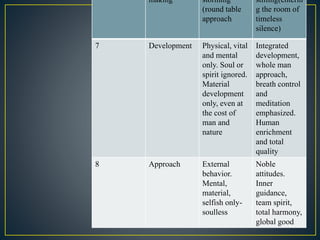
making storming
(round table
approach
stilling(enterin
g the room of
timeless
silence)
7 Development Physical, vital
and mental
only. Soul or
spirit ignored.
Material
development
only, even at
the cost of
man and
nature
Integrated
development,
whole man
approach,
breath control
and
meditation
emphasized.
Human
enrichment
and total
quality
8 Approach External
behavior.
Mental,
material,
selfish only-
soulless
Noble
attitudes.
Inner
guidance,
team spirit,
total harmony,
global good
THANK YOU

Indian management thoughts and practices ppt 1

  • 1.
    Class :- T.Y.B.M.S Division:-A Semester:-6 Subject:-Indian management thoughts & practices.
  • 2.
  • 3.
    “ETHOS” DERIVED FROM“GREEK” WORD MEANING “CHARACTER” INDIAN ETHOS DERIVES IT ROOTS FROM 1.RAMAYANA 2.MAHABHARATA 3.BHAGVAD GITA 4.VEDAS 5.UPANISHADS “Ethos are the moral ideas and attitude that belong to a particular group or society.” ------------------------------------------------------------------------------------------------------- SALIENT THOUGHTS OF INDIAN ETHOS: 1.ATMANO MOKSHARTHAM JAGAT HITAYA CHA 2.YOGA KARMASU KAUSHALAM SAMATVAM YOGA UCHYATE
  • 4.
    • Development ofvalue based management system • Self development & self management • Stress management • Social sensitivity • Humanizing the organization • Self introspection • Brain stilling/Meditation
  • 5.
    • Maintain holisticuniverse • Welfare • Unique work culture • Self development • Provides concentration • Establish value system
  • 6.
    Indian culture:- Indianculture is an ‘Inward-looking’ Culture characteristics by Simple living and High Thinking. Decision making Respect ‘Atithi Devo Bhava’ Tolerance Humility and respect
  • 7.
    Individualism Progress & Change Controlof Nature and the Environment Beliefs in social Darwinism
  • 8.
    • Group oriented •Importance to others opinion • Group mentality • Social dimension • Secular society • Harmony , order & self development • More importance to law
  • 9.
    INDIAN AMERICAN JAPANESE 1.DECISIONMAKING 2.RESPECT 3.GOAL 4.DESTINY 5.VALUES
  • 10.
    It means applicationof principles of management revealed in our ancient wisdom described in Upanishads and Gita. The following basic principles of management are as per ancient Indian Wisdom and Insight.
  • 11.
    • EACH SOULIS A POTENTIAL GOD. • HOLISTIC APPROACH. • EQUAL IMPORTANCE SUBJECTIVITY/OBJECTIVITY. • KARMA YOGA. • YOGAH KARMASU KAUSHALAM. • CO-OPERATUION.
  • 12.
    • MANAGEMENT ATTITUDE. •HUMANISING THE ORGANISATION. • SELF INTROSPECTION. • DECISEION MAKING IN SILENCE. • STEPPING BACK FOR A WHILE. • SELF DYANAMISING MEDITATION.
  • 13.
    S.NO Item Western managem ent Managem entBased on Indian ethos 1 Belief Productio n, productivi ty, profit at any cost Material gain, with belief in achieving human and social welfare also 2 Guidance Managem ent guided by mind only, led away by ego and desire, soulless managem Managem ent by conscious ness power beyond mind, i.e., soul. Interiorize
  • 14.
    materials, machines, markets. Science and technology information for decision marking consciousnesswhether manifested or dormant. Information and intuition for decision. Ethics and values combined with skills 5 Problem solving Conflict resolution by negotiation, compromise, arbitration, liquidation of differences only for a temporary period. No reference to higher consciousnes s Conflict resolution through integration and synthesis on stressing super ordinate common goals so that enduring harmony and unity is assured. Self introspection, stepping back aids the search for solution
  • 15.
    making storming (round table approach stilling(enterin gthe room of timeless silence) 7 Development Physical, vital and mental only. Soul or spirit ignored. Material development only, even at the cost of man and nature Integrated development, whole man approach, breath control and meditation emphasized. Human enrichment and total quality 8 Approach External behavior. Mental, material, selfish only- soulless Noble attitudes. Inner guidance, team spirit, total harmony, global good
  • 16.