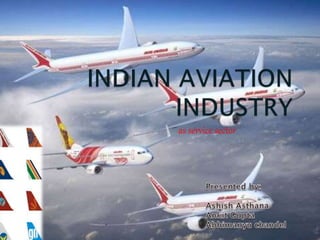
as service sector
1953: Nationalization of Aircraft Industry
Consequently, assets of 9 existing companies transferred
to two entities in the aviation sector controlled by the
Government in
a) Indian Airlines, primarily serving domestic sectors
b) Air India, primarily serving the international
sectors
Implication
Aviation became a preferred mode of transport for elite
class
Restricted Growth of Aviation Industry
High Cost structure
Underdevelopment of infrastructure
1986: Private Sector Players permitted as Air
taxi operators
Players including Jet, Air Sahara, NEPC,
East West, Modiluft,etc started service
1994: Private Carriers permitted to operate
scheduled services
Six operators granted license however
only Jet and Air Sahara able to service
2003: Entry of low cost carriers
Air Deccan, Spice Jet, Go Air, Indigo
Implication
Aviation has become affordable with check fares and
discount schemes
Various Operators with different business model
Huge growth foreseen in the Aviation Industry
HUGE POTENTIAL
Under penetrated Market
- Total Passenger Traffic only 50 mn as on 31st Dec 2005 amounting
to only 0.05 trips per annum as compared to
developed Nations like United States have 2.02 trips per annum
- High Level of potential demand with growth in Indian economy
Untapped Air Cargo Market
- Air Cargo has not yet been fully taped in the Indian markets and is
expected that in the coming years
large no of players would have dedicated fleets
What this means…
- Build up of capacity by existing players and entry of new players
CONSTRAINTS
Infrastructure Constraints
-Shortage of airport facilities, parking
bays,air traffic control facilities and
takeoff and landing slots
- Continued growth might be hampered
Relatively Limited Reach
-Only 454 airports with less than 100
airports having more than one daily
service
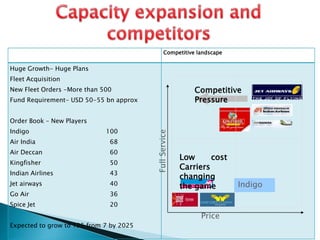
Competitive landscape
Huge Growth- Huge Plans
Fleet Acquisition
New Fleet Orders -More than 500
Fund Requirement- USD 50-55 bn approx
Order Book – New Players
Indigo 100
Air India 68
Air Deccan 60
Kingfisher 50
Indian Airlines 43
Jet airways 40
Go Air 36
Spice Jet 20
Expected to grow to 125 from 7 by 2025
Competitive
Pressure
FullService
Price
Low cost
Carriers
changing
the game Indigo
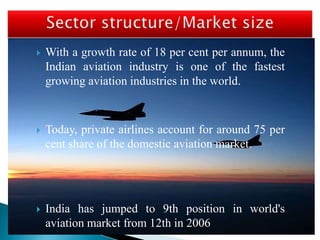
 With a growth rate of 18 per cent per annum, the
Indian aviation industry is one of the fastest
growing aviation industries in the world.
 Today, private airlines account for around 75 per
cent share of the domestic aviation market.
 India has jumped to 9th position in world's
aviation market from 12th in 2006
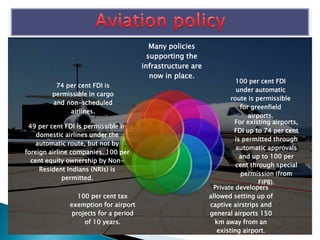
Many policies
supporting the
infrastructure are
now in place.
100 per cent FDI
under automatic
route is permissible
for greenfield
airports.
For existing airports,
FDI up to 74 per cent
is permitted through
automatic approvals
and up to 100 per
cent through special
permission (from
FIPB).
Private developers
allowed setting up of
captive airstrips and
general airports 150
km away from an
existing airport.
100 per cent tax
exemption for airport
projects for a period
of 10 years.
49 per cent FDI is permissible in
domestic airlines under the
automatic route, but not by
foreign airline companies. 100 per
cent equity ownership by Non-
Resident Indians (NRIs) is
permitted.
74 per cent FDI is
permissible in cargo
and non-scheduled
airlines.
DEMAND DRIVERS
GDP Growth has been more than 7%
in the last 4 years
The rising middle class of more
than 300 mn is fuelling the
growth
The Increase in Consumerism and
Affordability of Air travel
Government Liberal Policy to allow
private carriers and entry of Low
Cost Carriers has lead to a
increase in demand in passenger
traffic
Domestic Tourism and International
Business Travel and Tourism has
also greatly fuelled the rise of
Indian aviation sector
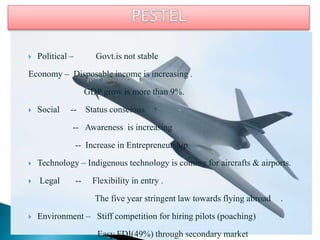
 Political – Govt.is not stable
Economy – Disposable income is increasing .
GDP grow is more than 9%.
 Social -- Status conscious
-- Awareness is increasing
-- Increase in Entrepreneurship
 Technology – Indigenous technology is coming for aircrafts & airports.
 Legal -- Flexibility in entry .
The five year stringent law towards flying abroad .
 Environment – Stiff competition for hiring pilots (poaching)
Easy FDI(49%) through secondary market
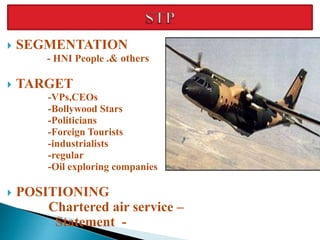
 SEGMENTATION
- HNI People .& others
 TARGET
-VPs,CEOs
-Bollywood Stars
-Politicians
-Foreign Tourists
-industrialists
-regular
-Oil exploring companies
 POSITIONING
Chartered air service –
Statement -
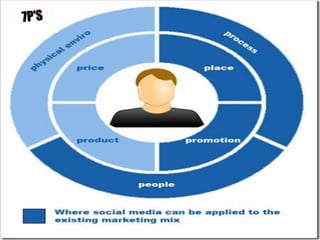
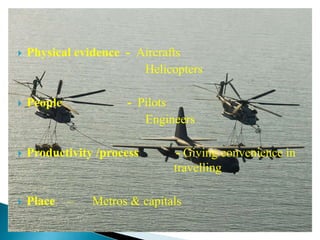
 Physical evidence - Aircrafts
Helicopters
 People - Pilots
Engineers
 Productivity /process - Giving convenience in
travelling
 Place – Metros & capitals
 Declining yields
 Building on cost efficiencies
 High input costs
 Gaps in infrastructure
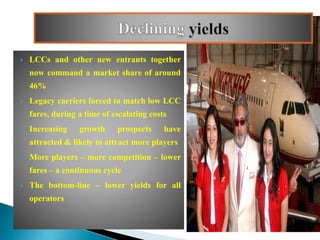
 LCCs and other new entrants together
now command a market share of around
46%
 Legacy carriers forced to match low LCC
fares, during a time of escalating costs
 Increasing growth prospects have
attracted & likely to attract more players
 More players – more competition – lower
fares – a continuous cycle
 The bottom-line – lower yields for all
operators
 Low yield regime to continue
 Airlines have to build on their cost efficiencies & drive down costs
below the yield that their product will fetch, to return to profits
 For an industry that is estimating losses of US$ 500-550 million by
end of current fiscal, this is a daunting challenge
 Yet, airlines have no control on external input costs
High input costs
 ATF prices in India continue to be far higher than global rates, making ATF account
for 35-40% of operating cost, as against global average of 20-25%
 High basic rates aggravated by high taxes imposed by State Govt.’s
 ATF cost / kilolitre :
◦ US$ 755 in Delhi
◦ US$ 780 in Mumbai
◦ US$ 455 in Singapore
◦ US$ 497 in Dubai
High input costs
 Witholding tax on interest repayments on foreign currency loans for aircraft
acquisition
 Witholding tax proposed on aircraft lease rentals for leases concluded after 1st
April’07.
 Increasing manpower costs due to shortage of technical personnel
 A large & growing potential market
 Developing alternative revenue streams
◦ Air cargo operations
◦ Airframe, engine & component overhaul
◦ Ground handling
◦ Training
◦ Leveraging the internet
 Access to new markets
 Freight carriage in India currently around 4200 tons per day
 CAGR of 15% over the past 2 years
 Fuelled by a fast growing economy, supported by a strong
industrial base
 Forecast to grow at 11.4% p.a. till 2011-12
 Ground handling business in India estimated at Rs. 1074 crores
 Expected to grow at 15% CAGR till 2011-12
 Opportunity lies in 3rd party handling as well as entering into service
contracts with private airports / AAI to offer comprehensive ground handling
solutions, e.g. AI – CIAL at Cochin
◦ Airlines in India will need training for pilots, engineers,
cabin crew, load & trim, etc.
 Projected requirement for 3600 additional pilots in the short to
medium term
 Cabin crew, engineers, technicians will also be required to
support aircraft being inducted
◦ Opportunity for simulator training establishments
◦ IA already has a Central Training Establishment at
Hyderabad, with facilities for most categories / types of
trainings on A320
◦ Increasing numbers are booking directly from the airlines’ websites
 Traditional sales channels with paper tickets cost airlines ~10% of ticket
price
 Comparatively, e-ticket sales from own website cost an airline only ~3% of
ticket price
 For every direct booking from their website, airlines save an estimated US$
4 plus 5% agency commission
◦ Airlines can also turn their websites into one stop shops for all travel
related services, generating additional revenue
 As airlines complete 5 years of domestic operations, those with 20+
aircraft will get international access
◦ Access to new revenue streams
◦ Help even out the seasonality factor of domestic operations
◦ Spread the risk of downturn in a single market
 The opportunity for some will be a challenge for the existing
international players
 The risk – cycle of increased competition, low yields, and growth
transferred to the international arena
 The Indian aviation industry Is one of the fastest growing aviation industries in the % share
of the world.
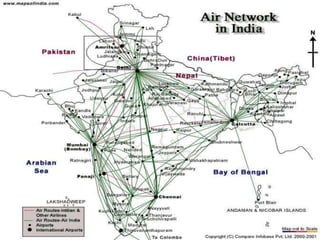
 India has 454 airports and airstrips; of these,16 are designated international airports.
 With the liberalization of the Indian aviation sector, aviation industry in India has
undergone a rapid transforamtion.priavate airline account for around 75% share of the
domestic aviation market
 Being primarily a govt-ownwed industry ,the Indian aviation industry is now dominanated by
privately owned full service airlines and low cost carriers.
 Domestic and international traffic is up 45% and 15.1
%,respectively.
 Over 135 aircraft have been added in the past two year alone.
 Center for Asia pacific aviation (CAPA) estimates domestic
traffic to grow 25-30 % annually and international traffic
15%untill 2010.
 Indian Aviation has seen high growth on account of sustained Indian socio economic growth and
liberalized Government initiatives
 Airport Infrastructure needs to improve significantly to meet the current and future demand of
the Indian Aviation Sector
 Authorities have initiated various steps to implement modernization, reconstruction and
development of airport infrastructure to implement infrastructure development plan
 Provides a huge opportunity for private players operating in Aerospace and allied industries
 Significant opportunity for foreign companies as Indian companies not technologically equipped
to cater to requirements
 Despite a growing market, airlines in India are fighting for
survival in a highly competitive environment
 A host of initiatives are required to be taken by all concerned, to
tide over the current situation
◦ Control Costs
◦ Improve quality of service
◦ Develop a large pool of skilled / technical manpower
◦ Attract more professionals to manage the aviation industry
◦ Develop infrastructure to match growth plans
◦ Liberalise rules & regulations governing civil aviation, without
compromising on safety & security
◦ Reduction in ATF prices and taxation on ATF and lease rentals
Indian aviation industry

Indian aviation industry

  • 1.
  • 3.
    1953: Nationalization ofAircraft Industry Consequently, assets of 9 existing companies transferred to two entities in the aviation sector controlled by the Government in a) Indian Airlines, primarily serving domestic sectors b) Air India, primarily serving the international sectors Implication Aviation became a preferred mode of transport for elite class Restricted Growth of Aviation Industry High Cost structure Underdevelopment of infrastructure 1986: Private Sector Players permitted as Air taxi operators Players including Jet, Air Sahara, NEPC, East West, Modiluft,etc started service 1994: Private Carriers permitted to operate scheduled services Six operators granted license however only Jet and Air Sahara able to service 2003: Entry of low cost carriers Air Deccan, Spice Jet, Go Air, Indigo Implication Aviation has become affordable with check fares and discount schemes Various Operators with different business model Huge growth foreseen in the Aviation Industry
  • 4.
    HUGE POTENTIAL Under penetratedMarket - Total Passenger Traffic only 50 mn as on 31st Dec 2005 amounting to only 0.05 trips per annum as compared to developed Nations like United States have 2.02 trips per annum - High Level of potential demand with growth in Indian economy Untapped Air Cargo Market - Air Cargo has not yet been fully taped in the Indian markets and is expected that in the coming years large no of players would have dedicated fleets What this means… - Build up of capacity by existing players and entry of new players CONSTRAINTS Infrastructure Constraints -Shortage of airport facilities, parking bays,air traffic control facilities and takeoff and landing slots - Continued growth might be hampered Relatively Limited Reach -Only 454 airports with less than 100 airports having more than one daily service
  • 5.
    Competitive landscape Huge Growth-Huge Plans Fleet Acquisition New Fleet Orders -More than 500 Fund Requirement- USD 50-55 bn approx Order Book – New Players Indigo 100 Air India 68 Air Deccan 60 Kingfisher 50 Indian Airlines 43 Jet airways 40 Go Air 36 Spice Jet 20 Expected to grow to 125 from 7 by 2025 Competitive Pressure FullService Price Low cost Carriers changing the game Indigo
  • 6.
     With agrowth rate of 18 per cent per annum, the Indian aviation industry is one of the fastest growing aviation industries in the world.  Today, private airlines account for around 75 per cent share of the domestic aviation market.  India has jumped to 9th position in world's aviation market from 12th in 2006
  • 7.
    Many policies supporting the infrastructureare now in place. 100 per cent FDI under automatic route is permissible for greenfield airports. For existing airports, FDI up to 74 per cent is permitted through automatic approvals and up to 100 per cent through special permission (from FIPB). Private developers allowed setting up of captive airstrips and general airports 150 km away from an existing airport. 100 per cent tax exemption for airport projects for a period of 10 years. 49 per cent FDI is permissible in domestic airlines under the automatic route, but not by foreign airline companies. 100 per cent equity ownership by Non- Resident Indians (NRIs) is permitted. 74 per cent FDI is permissible in cargo and non-scheduled airlines.
  • 8.
    DEMAND DRIVERS GDP Growthhas been more than 7% in the last 4 years The rising middle class of more than 300 mn is fuelling the growth The Increase in Consumerism and Affordability of Air travel Government Liberal Policy to allow private carriers and entry of Low Cost Carriers has lead to a increase in demand in passenger traffic Domestic Tourism and International Business Travel and Tourism has also greatly fuelled the rise of Indian aviation sector
  • 9.
     Political –Govt.is not stable Economy – Disposable income is increasing . GDP grow is more than 9%.  Social -- Status conscious -- Awareness is increasing -- Increase in Entrepreneurship  Technology – Indigenous technology is coming for aircrafts & airports.  Legal -- Flexibility in entry . The five year stringent law towards flying abroad .  Environment – Stiff competition for hiring pilots (poaching) Easy FDI(49%) through secondary market
  • 10.
     SEGMENTATION - HNIPeople .& others  TARGET -VPs,CEOs -Bollywood Stars -Politicians -Foreign Tourists -industrialists -regular -Oil exploring companies  POSITIONING Chartered air service – Statement -
  • 13.
     Physical evidence- Aircrafts Helicopters  People - Pilots Engineers  Productivity /process - Giving convenience in travelling  Place – Metros & capitals
  • 15.
     Declining yields Building on cost efficiencies  High input costs  Gaps in infrastructure
  • 16.
     LCCs andother new entrants together now command a market share of around 46%  Legacy carriers forced to match low LCC fares, during a time of escalating costs  Increasing growth prospects have attracted & likely to attract more players  More players – more competition – lower fares – a continuous cycle  The bottom-line – lower yields for all operators
  • 17.
     Low yieldregime to continue  Airlines have to build on their cost efficiencies & drive down costs below the yield that their product will fetch, to return to profits  For an industry that is estimating losses of US$ 500-550 million by end of current fiscal, this is a daunting challenge  Yet, airlines have no control on external input costs
  • 18.
    High input costs ATF prices in India continue to be far higher than global rates, making ATF account for 35-40% of operating cost, as against global average of 20-25%  High basic rates aggravated by high taxes imposed by State Govt.’s  ATF cost / kilolitre : ◦ US$ 755 in Delhi ◦ US$ 780 in Mumbai ◦ US$ 455 in Singapore ◦ US$ 497 in Dubai High input costs  Witholding tax on interest repayments on foreign currency loans for aircraft acquisition  Witholding tax proposed on aircraft lease rentals for leases concluded after 1st April’07.  Increasing manpower costs due to shortage of technical personnel
  • 20.
     A large& growing potential market  Developing alternative revenue streams ◦ Air cargo operations ◦ Airframe, engine & component overhaul ◦ Ground handling ◦ Training ◦ Leveraging the internet  Access to new markets
  • 21.
     Freight carriagein India currently around 4200 tons per day  CAGR of 15% over the past 2 years  Fuelled by a fast growing economy, supported by a strong industrial base  Forecast to grow at 11.4% p.a. till 2011-12
  • 22.
     Ground handlingbusiness in India estimated at Rs. 1074 crores  Expected to grow at 15% CAGR till 2011-12  Opportunity lies in 3rd party handling as well as entering into service contracts with private airports / AAI to offer comprehensive ground handling solutions, e.g. AI – CIAL at Cochin
  • 23.
    ◦ Airlines inIndia will need training for pilots, engineers, cabin crew, load & trim, etc.  Projected requirement for 3600 additional pilots in the short to medium term  Cabin crew, engineers, technicians will also be required to support aircraft being inducted ◦ Opportunity for simulator training establishments ◦ IA already has a Central Training Establishment at Hyderabad, with facilities for most categories / types of trainings on A320
  • 24.
    ◦ Increasing numbersare booking directly from the airlines’ websites  Traditional sales channels with paper tickets cost airlines ~10% of ticket price  Comparatively, e-ticket sales from own website cost an airline only ~3% of ticket price  For every direct booking from their website, airlines save an estimated US$ 4 plus 5% agency commission ◦ Airlines can also turn their websites into one stop shops for all travel related services, generating additional revenue
  • 25.
     As airlinescomplete 5 years of domestic operations, those with 20+ aircraft will get international access ◦ Access to new revenue streams ◦ Help even out the seasonality factor of domestic operations ◦ Spread the risk of downturn in a single market  The opportunity for some will be a challenge for the existing international players  The risk – cycle of increased competition, low yields, and growth transferred to the international arena
  • 26.
     The Indianaviation industry Is one of the fastest growing aviation industries in the % share of the world.  India has 454 airports and airstrips; of these,16 are designated international airports.  With the liberalization of the Indian aviation sector, aviation industry in India has undergone a rapid transforamtion.priavate airline account for around 75% share of the domestic aviation market  Being primarily a govt-ownwed industry ,the Indian aviation industry is now dominanated by privately owned full service airlines and low cost carriers.
  • 27.
     Domestic andinternational traffic is up 45% and 15.1 %,respectively.  Over 135 aircraft have been added in the past two year alone.  Center for Asia pacific aviation (CAPA) estimates domestic traffic to grow 25-30 % annually and international traffic 15%untill 2010.
  • 28.
     Indian Aviationhas seen high growth on account of sustained Indian socio economic growth and liberalized Government initiatives  Airport Infrastructure needs to improve significantly to meet the current and future demand of the Indian Aviation Sector  Authorities have initiated various steps to implement modernization, reconstruction and development of airport infrastructure to implement infrastructure development plan  Provides a huge opportunity for private players operating in Aerospace and allied industries  Significant opportunity for foreign companies as Indian companies not technologically equipped to cater to requirements
  • 29.
     Despite agrowing market, airlines in India are fighting for survival in a highly competitive environment  A host of initiatives are required to be taken by all concerned, to tide over the current situation ◦ Control Costs ◦ Improve quality of service ◦ Develop a large pool of skilled / technical manpower ◦ Attract more professionals to manage the aviation industry ◦ Develop infrastructure to match growth plans ◦ Liberalise rules & regulations governing civil aviation, without compromising on safety & security ◦ Reduction in ATF prices and taxation on ATF and lease rentals