AIRLINE ECONOMICS
Cahit Kutay Uysal
AVM 101
OUTLINE
 The Basic Measures
◦ Available Seat Kilometer (ASK)
◦ Revenue Passenger Kilometer (RPK)
◦ Load Factor (LF)
◦ Yield
◦ Unit Cost
 Revenue
 Basic Airline Profit Equation
 Examples
 Conclusion
 Bibliography
THE BASIC MEASURES
 Available Seat Kilometer (ASK)
 Revenue Passenger Kilometer (RPK)
 Load Factor (LF)
 Yield
 Unit Cost
AVAILABLE SEAT KILOMETER
(ASK)
 The most common measure of airline
output is an available seat kilometer.
 If we have an aircraft with 500 seats
and flown at a distance of 10.000 km,
than we will have 5.000.000 seats
kilometer.
TRAFFİC – REVENUE
PASSENGER KILOMETER
(RPK)
 Althought the airline produced seats,
not all will be sold. The sale of the
products will measured by RPK.
 So in the earlier example, if only 400
out of the 500 seats were sold, than
the RPK will be 4.000.000.
MEASURE OF SALE RATE –
LOAD FACTOR
 Is the rate of passenger to aircraft
capacity.
 In the earlier example, we have an
aircraft with 500 seats but we sold only
400 seats. So, our load factor is 80%
 LF = Revenue Passenger Kilometer /
Available Seat Kilometer
 It changes for all airlines. However an
airline had many types of aircrafts and
different sectors like business and
economy class.
MEASURE OF UNIT REVENUE
- YIELD
 Avarage fare paid by all passengers
per kilometer.
 Yield measures average earnings
made by an airline by transporting
passengers per kilometer.
 Yield = Established Total Revenue /
Available Seat Kilometer
UNIT COST (COST PER
ASK)
 This is the cost of the seat.
 Unit cost calculated same formula with
yield.
 Unit Cost = Total Revenue / Available
Seat Kilometer
 If the unit cost lower than yield,
airlines will make a profit.
REVENUE
 What is the revenue?
◦ Ticket fares, including fuel surcharge
◦ In-flight sales
◦ Extra or oversized baggage
◦ Freight not linked to passanger
 What is the not revenue?
◦ Taxes, fees or other charges
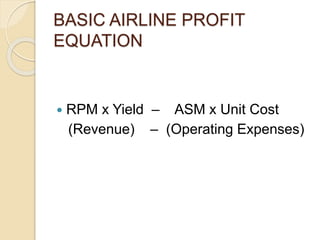
BASIC AIRLINE PROFIT
EQUATION
 RPM x Yield – ASM x Unit Cost
(Revenue) – (Operating Expenses)
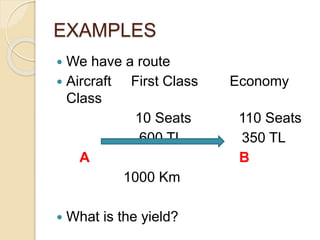
EXAMPLES
 We have a route
 Aircraft First Class Economy
Class
10 Seats 110 Seats
600 TL 350 TL
A B
1000 Km
 What is the yield?
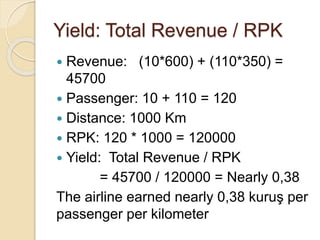
Yield: Total Revenue / RPK
 Revenue: (10*600) + (110*350) =
45700
 Passenger: 10 + 110 = 120
 Distance: 1000 Km
 RPK: 120 * 1000 = 120000
 Yield: Total Revenue / RPK
= 45700 / 120000 = Nearly 0,38
The airline earned nearly 0,38 kuruş per
passenger per kilometer
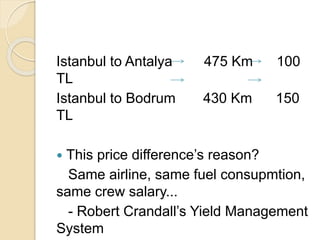
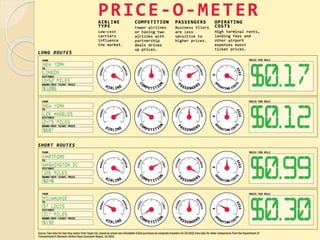
Istanbul to Antalya 475 Km 100
TL
Istanbul to Bodrum 430 Km 150
TL
 This price difference’s reason?
Same airline, same fuel consupmtion,
same crew salary...
- Robert Crandall’s Yield Management
System
CONCLUSION
 The basic measures for the calculate
profit/loss for airline.
◦ Available Seat Kilometer
◦ Revenue Passenger Kilometer
◦ Load Factor
◦ Yield
◦ Unit Cost
 How airlines detect their ticket prices?
BIBLIOGRAPHY
 http://en.wikipedia.org/wiki/Airline#Econo
mic_considerations
 http://catsr.vse.gmu.edu/SYST660/Chap
3_Airline_Economics[2].pdf
 http://www.havayolu101.com/2010/08/31
/ucak-biletinin-fiyati-nasil-
belirleniyor/#content-anchor
 http://www.slideshare.net/pgarodia/reven
ue-passenger-kilometer?related=1
 http://ocw.mit.edu/courses/aeronautics-
and-astronautics/16-75j-airline-
management-spring-2006/lecture-
notes/lect2.pdf